


Everyone in Nigeria talking about forex is lying to you.

Olumide Adeyemi
Pioneiro do Trading na África Ocidental ·  Nigeria
☕ 14 min de leitura
O que você vai aprender:

Everyone in Nigeria talking about forex is lying to you. They show you screenshots of profits, talk about 'financial freedom,' and sell you dreams wrapped in technical analysis. The real forex trading meaning here has nothing to do with Lamborghinis. It's about understanding a global casino where the Naira is just another chip, where your emotions are your biggest enemy, and where most people lose because they never grasp the fundamentals. I've blown accounts, celebrated too early, and learned lessons the hard way. Let me show you what this game really is.
Forget the fancy definitions. At its core, forex trading is betting on the value of one currency against another. You're not buying physical dollars. You're speculating on a price movement. The 'foreign exchange market' is just a giant, decentralized network where banks, governments, corporations, and guys like us in Lagos or Abuja try to guess which way the wind will blow.
It's open 24 hours a day, five days a week, because when we sleep, Asia is awake, and when they sleep, London and New York are trading. This is crucial for us in Nigeria. Major moves often happen during London and New York sessions (afternoon and evening our time), not necessarily when you're free in the middle of the day.
The most important concept? Currency pairs. You'll see EUR/USD, GBP/USD, and USD/JPY all the time. For us, USD/NGN is the home game, but you'll rarely trade it directly on major platforms. Instead, you're trading global pairs, which are influenced by everything from US interest rates to European political drama. When you buy EUR/USD, you're betting the Euro will strengthen against the US Dollar. That's the entire forex trading meaning in one action: a calculated guess on relative strength.

Warning: Don't confuse trading with 'investing.' You're not buying a currency to hold for years like a stock. Most retail trades last hours, days, or weeks. It's a sprint, not a marathon.
I learned this the painful way. Early on, I 'invested' in GBP/USD because I thought the Pound was 'strong.' I held a losing position for three weeks, watching my capital erode, hoping it would 'come back.' It didn't. That trade cost me $420. I was a holder, not a trader. The market doesn't reward hope.

💡 Dica do Winston
Your first ₦100,000 profit is the most dangerous. It convinces you you're smarter than the market. Withdraw half of it. Let your ego cash out, not your discipline.
“The real forex trading meaning here has nothing to do with Lamborghinis. It's about understanding a global casino where the Naira is just another chip.”
Here's where theory meets our chaotic, beautiful reality. Trading in Nigeria isn't like trading in the UK or US. We have unique hurdles that become part of your trading cost.
The Regulatory Gray Zone
Let's be clear: it is legal for you, as a Nigerian, to open an account with an international broker and trade your own money. However, the Central Bank of Nigeria (CBN) doesn't love the idea of speculative forex trading draining reserves. They regulate the official market, not the retail broker you use. The Securities and Exchange Commission (SEC) Nigeria doesn't license forex brokers either. This creates a gap.
What does this mean for you? You have zero local regulatory protection. If you sign up with a shady 'broker' based in Nigeria with no overseas license, and they vanish with your money, you have almost no recourse. This is why I only use brokers with strong international regulation, like FCA-regulated ones or those under other reputable jurisdictions. Your safety is your responsibility.
Costs Beyond the Spread
Yes, you'll pay the spread (the difference between buy and sell price) and maybe a commission. But your real costs as a Nigerian trader are often hidden:
- Internet: Reliable, fast internet is non-negotiable. A dropped connection during a volatile news event can be catastrophic. Budget ₦15,000–₦20,000 monthly for top-tier service.
- Power: You need uninterrupted power. A generator or inverter isn't a luxury; it's a trading tool. A power cut during a London open is a risk you cannot afford.
- Tax: The Federal Inland Revenue Service (FIRS) expects 10% Capital Gains Tax on your trading profits. Keep careful records. I set aside 10% of every profitable withdrawal into a separate account. It's not yours until the taxman gets his share.
The Naira's Role
You might want to trade the Naira, but most global platforms don't offer USD/NGN as a tradable pair for speculation. You'll be trading your Naira for USD or EUR to fund your account, then trading major pairs. Some brokers like Exness or HFM offer NGN-denominated accounts, which simplifies things mentally, but the underlying asset is still a foreign currency pair.
The recent CBN reforms unifying exchange rates and tightening rules on Bureau de Change operators have actually reduced wild arbitrage opportunities for the average trader. The market is becoming more transparent, which is good for long-term stability but means the 'easy money' from rate differences is gone.
“use is a tool, not a strategy. I once used 1:500 use on a gold trade... I was liquidated.”
If you're still reading, you're serious. Here's the exact path I wish someone had given me.
Step 1: Education (Not YouTube Guru Edutainment) Learn the absolute basics on your own. What is a pip? What is a spread? What is use? Use free resources from reputable broker education centers. Do not pay anyone for a 'secret strategy' at this stage. I wasted ₦150,000 on a 'signal group' that just repackaged free news. Understand fundamental drivers: interest rates, inflation, geopolitical events. Then learn one or two technical indicators deeply, like the RSI or MACD, not 10 of them poorly.
Step 2: Choose a Broker (This is Critical) Your broker is your gateway. Don't just pick the one with the flashiest ads. Compare these things:
- Regulation: Must be regulated offshore (CySEC, FCA, ASIC, FSCA). This is non-negotiable.
- Deposit/Withdrawal: Do they support local bank transfers, cards, or e-wallets you use? How long do withdrawals take? I use brokers with a track record of smooth Naira payouts.
- Trading Costs: Look at the typical spread on EUR/USD. Is it 0.9 pips or 2.0 pips? Over hundreds of trades, that difference will eat you alive. A broker like IC Markets offers raw spreads from 0.0 pips with a commission, which is better for high-volume scalping.
- Platform: Most start with MetaTrader 4 or 5. It's the industry standard. Ensure your broker offers it.
Step 3: Open a Demo Account Trade with virtual money for at least 3 months. Not 2 weeks. Three full months. Experience different market conditions: trending markets, ranging markets, high-volatility news events. Your goal isn't to make fake profit; it's to not lose fake money consistently. Track every trade in a journal. Why did you enter? Why did you exit? What was your emotion?
Step 4: Develop a Trading Plan This is your constitution. It must answer:
- What markets/pairs do I trade? (Stick to 1-2 major pairs at first)
- What is my strategy for entering a trade? (e.g., "Buy when RSI is below 30 on the 1-hour chart and price bounces off key support")
- What is my risk per trade? (Never more than 1-2% of your account)
- What is my profit target and stop-loss for every single trade? (These are set BEFORE you click buy)
- When do I stop trading for the day? (e.g., "Stop after 2 losses or a 3% total daily loss")
Without a plan, you're just gambling. My first live account blew up because I had no plan. I'd win ₦50,000, feel like a king, then lose ₦80,000 trying to chase back a loss. It was emotional chaos.
Step 5: Fund a Live Account (Start SMALL) The research says a recommended start is $200-$1000. I'm telling you, start with an amount you are 100% willing to lose completely. For me, that was $100 (about ₦140,000 at the time). That small amount forced me to respect risk management because every loss hurt. Your first goal is not to double your account. Your first goal is to survive 6 months without blowing up.

Pro Tip: Use a position size calculator for every trade. It removes emotion. If your account is $500 and your risk is 1%, you can only lose $5 on that trade. The calculator tells you exactly how many lots or micro-lots to trade to stick to that $5 risk, based on your stop-loss distance.

“use is a tool, not a strategy. I once used 1:500 use on a gold trade... I was liquidated.”
Let me save you some money and heartache by showing you my scars.
1. Overleveraging. This is the killer. A broker offers you 1:1000 use, so you think, "My ₦50,000 can control ₦50 million!" Yes, and a 0.1% move against you will wipe out your entire account. use is a tool, not a strategy. I once used 1:500 use on a gold (XAU/USD) trade. A $10 normal move turned into a $5,000 loss in minutes. I was liquidated. Start with 1:10 or 1:20 max until you truly understand the force you're playing with.
2. Trading Without a Stop-Loss. You think, "The market will come back." It doesn't always. I held a EUR/USD trade that went 50 pips against me, then 100, then 200. I couldn't bring myself to click 'close.' I was waiting for a miracle. It hit my margin call and the broker closed it for me at a loss that wiped out 60% of my account. A stop-loss is not a suggestion; it's an insurance policy. Set it every single time.
3. Chasing Losses. You lose ₦20,000. Your brain screams, "Get it back now!" So you enter a bigger, riskier trade out of anger or fear. This is how a bad day becomes a catastrophic month. My rule now: two consecutive losses, and I'm done for the day. I shut down the platform and walk away.
4. Following 'Signal Sellers' Blindly. No one who is consistently profitable selling signals for ₦5,000 a month. If their strategy was that good, they'd be trading with their own millions, not hustling for your subscription. I learned this after losing more in trades from a 'guru's' signals than I ever paid him.
5. Ignoring Fundamentals. As a technical trader, I used to ignore news. Then, one Thursday during a European Central Bank press conference, I was in a nice technical short on EUR/USD. Within 15 seconds, the ECB president made a surprisingly hawkish comment. The pair ripped 90 pips upwards against my position, blowing through my stop-loss and then some. Now, I always check an economic calendar. I don't trade during major news releases like Non-Farm Payrolls (US jobs data). The technicals don't matter when a fundamental bomb drops.
💡 Dica do Winston
If you can't explain your trade setup in one simple sentence before you enter, you don't have a setup. You have a hope.
“A stop-loss is not a suggestion; it's an insurance policy. Set it every single time.”
You don't need a complicated system. You need a disciplined approach to a simple one. Here are two core styles:
Scalping: This is taking many small profits throughout the day. You're in and out of trades in minutes, aiming for 5-10 pips per trade. It requires intense focus, a fast platform, and very low spreads (which is why brokers like Pepperstone with their Razor account are popular for this). It's stressful and can lead to overtrading. I found it exhausting and not sustainable with Nigeria's occasional internet issues.
Swing Trading: This is my home. You hold trades for days or weeks, aiming to catch larger moves of 50-200 pips. You analyze the 4-hour and daily charts, make a decision, and manage the trade over time. It fits a normal job schedule better. This is a classic swing trading approach. You need more patience, but it's less frantic.
A Simple Strategy to Build On
Here's a basic structure I used to find my footing:
- Identify the Trend: Use the daily chart. Is price mostly making higher highs and higher lows (uptrend)? Or lower highs and lower lows (downtrend)? Only take trades in the direction of the daily trend.
- Find an Entry on a Lower Timeframe: Switch to the 4-hour or 1-hour chart. Wait for price to pull back to a key area of support (in an uptrend) or resistance (in a downtrend).
- Look for Confirmation: Use a simple indicator like the RSI to see if it's coming out of oversold (in an uptrend) or overbought (in a downtrend) territory.
- Execute with Risk Management: Place your buy order with a stop-loss below the recent swing low (for a buy). Your take-profit should be at least 1.5 times the distance of your stop-loss. If your stop is 30 pips away, your target should be 45+ pips away.
This isn't a holy grail. No strategy wins 100% of the time. But it gives you a clear, repeatable process. Your job is to execute the process consistently, not to win every trade.

Example: In an uptrend on EUR/USD, price pulls back to 1.0850 on the 4hr chart, which was previous resistance (now support). RSI dipped to 35. You decide to buy. You place a stop at 1.0820 (30 pips risk). You set a take-profit at 1.0895 (45 pips reward). Your risk-reward ratio is 1:1.5. Even if you only win 50% of your trades with this ratio, you can be profitable.
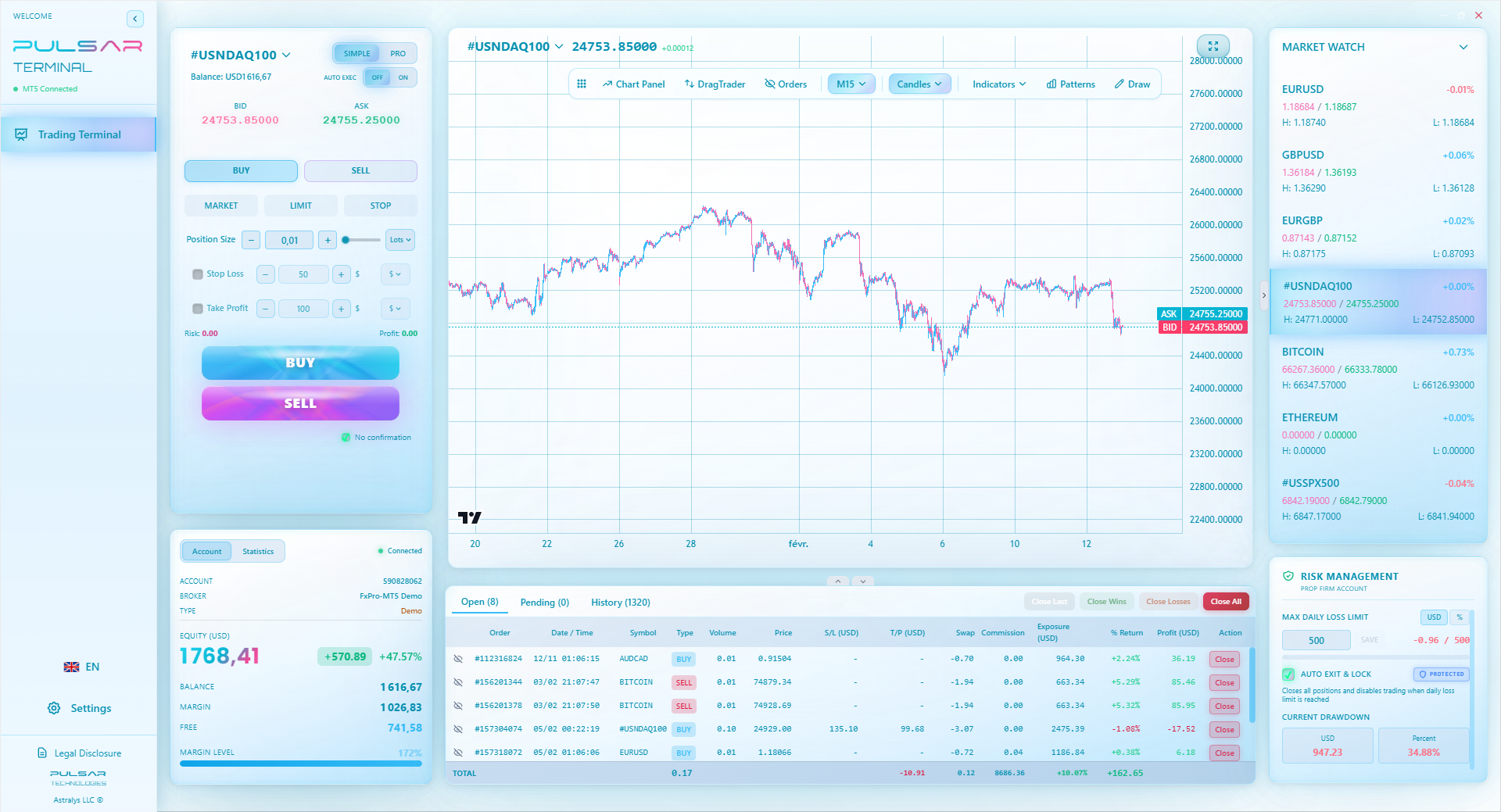
Managing multiple trades and setting precise stop-losses is complex, but tools like Pulsar Terminal automate this directly on your MT5 platform, letting you focus on your strategy instead of order mechanics.
Pulsar Terminal
A ferramenta MT5 tudo-em-um: ordens drag-and-drop, multi-TP/SL, trailing stop, grid trading, Volume Profile e proteção prop firm. Usado diariamente por 1.000+ traders.
“A stop-loss is not a suggestion; it's an insurance policy. Set it every single time.”
This is the true forex trading meaning. The market is a mirror of your psychology. Greed, fear, hope, and ego will destroy you if left unchecked.
Risk Management is Your Survival Kit:
- The 1% Rule: Never risk more than 1% of your trading account capital on a single trade. If you have a $1,000 account, your maximum loss per trade is $10. This ensures a string of losses won't kill you.
- Use Stop-Losses Religiously: Decide where you're wrong before you enter. Place the stop-loss order immediately. Never move it further away because the trade is going against you. That's just delaying a loss and making it bigger.
- Diversify Your Risk: Don't put all your capital into one currency pair or one type of trade. If you have two trades on, make sure they aren't highly correlated (like both long EUR and long GBP).
Emotional Discipline:
- Have a Trading Routine: Start your day reviewing the economic calendar. Analyze charts without any positions on. This puts you in an objective state of mind.
- Accept Losses: Losses are the cost of doing business. They are not failures. A professional trader focuses on executing their plan correctly, not on the profit/loss of an individual trade. Some of my best-executed trades were losses where I followed my rules perfectly.
- Take Breaks: If you feel frustrated, tired, or overly excited, stop. Emotional trading is reckless trading. I schedule mandatory 15-minute breaks after every 90 minutes of screen time.
The hardest lesson I learned was to separate my self-worth from my trading results. A losing trade doesn't make you a loser. It makes you a trader who took a calculated risk that didn't pay off this time. Protect your capital first, and the profits will follow.
💡 Dica do Winston
The market's job is to find the price where the most people will be wrong. Your job is to not be one of them when your stop-loss gets hit.

“Start with the expectation of learning, not earning. Fund your account with 'tuition fee' money, not 'rent money.'”
Honestly? For most people, no. It's a brutal, time-consuming skill that demands continuous learning, emotional fortitude, and capital you can afford to lose. The statistics are grim: a huge majority of retail traders lose money.
But for a specific type of person, it can be worthwhile. Are you disciplined, patient, analytical, and able to handle stress? Are you willing to treat it as a serious business, not a lottery ticket? Can you survive 6-12 months of breaking even or small losses while you learn?
If yes, then the potential is real. You can generate an income stream that isn't tied to a 9-5 job. You can trade from anywhere with an internet connection. You gain a deep understanding of global economics that few have.
For me, it was worth the pain. The losses taught me humility. The gradual consistency built real confidence, not the fake kind from a lucky win. I now have a skill that, while it doesn't make me rich overnight, provides a supplemental income and intellectual challenge I couldn't find elsewhere.
Start with the expectation of learning, not earning. Fund your account with 'tuition fee' money, not 'rent money.' Focus on the process. If you can master yourself, you stand a chance of mastering a small piece of the largest market on earth. That's the real, unglamorous, powerful meaning of forex trading.
FAQ
Q1Is forex trading legal in Nigeria?
Yes, it is legal for individual Nigerian residents to open accounts with internationally regulated forex brokers and trade with their own funds. However, the Central Bank of Nigeria (CBN) does not regulate these retail brokers, and the SEC Nigeria does not currently license them. This means you lack local regulatory protection, so choosing a broker with strong offshore regulation (like FCA, CySEC, ASIC) is critical for your safety.
Q2How much money do I need to start forex trading in Nigeria?
You can technically start with as little as $1 with some brokers, but that's not practical for learning. A more realistic minimum to practice proper risk management is between $200 and $1000. However, I strongly advise you to start with an amount you are completely willing to lose - your 'tuition fee.' Many Nigerians start with the equivalent of ₦50,000 to ₦200,000. The key is that the amount allows you to trade micro-lots so you can apply the 1% risk rule.
Q3What is the best time to trade forex in Nigeria?
The most volatile and liquid sessions overlap with the London and New York markets. This is from about 1:00 PM to 10:00 PM Nigerian time (WAT). The London session opens at 8:00 AM GMT (9:00 AM WAT), and the New York session opens at 1:00 PM GMT (2:00 PM WAT). The overlap between 2:00 PM and 5:00 PM WAT often sees the highest volume and best trading opportunities for major pairs like EUR/USD.
Q4How do I withdraw my forex profits in Nigeria?
Reputable international brokers offer multiple withdrawal methods. The most common for Nigerians are direct bank transfers (in USD or Naira if the broker supports it), bank cards (Visa/Mastercard), and e-wallets like Skrill, Neteller, or Perfect Money. Withdrawal times vary from a few hours to several business days. Always ensure your broker account is verified with your correct details to avoid delays. Remember to set aside 10% for Capital Gains Tax to the FIRS.
Q5Can I trade forex on my phone in Nigeria?
Absolutely. Most brokers offer full-featured mobile apps for MetaTrader 4 (MT4) or MetaTrader 5 (MT5), as well as their own proprietary apps. You can analyze charts, place trades, and manage your account from your smartphone. This is incredibly useful, but be cautious of trading on small screens during high volatility, and always ensure you have a stable data connection to avoid slippage or order errors.
Q6What is use and why is it dangerous?
use is borrowed capital from your broker that allows you to control a larger position with a small amount of your own money. For example, 1:100 use means you can control $10,000 with just $100 of your own capital. While it magnifies potential profits, it magnifies losses even more dramatically. A small move against your position can result in a loss exceeding your initial deposit, leading to a margin call where your broker closes your trades to prevent negative balance. It's the number one reason new traders blow up their accounts.
Q7Do I need to pay tax on forex trading profits in Nigeria?
Yes. The Federal Inland Revenue Service (FIRS) considers forex trading profits as capital gains. The current Capital Gains Tax rate is 10% of your net profit (total profits minus total losses over a period). You are responsible for declaring this income and paying the tax. It is essential to keep detailed records of all your trades, deposits, and withdrawals for tax purposes.
Lição do Prof. Winston
Pontos-chave:
- ✓Risk only 1% of your capital per trade.
- ✓Demo trade for 3 months minimum.
- ✓Choose brokers with strong international regulation.
- ✓Set stop-loss and take-profit before every entry.
- ✓10% of profits go to FIRS tax immediately.
Quão útil foi este artigo?
Clique em uma estrela
Insights de Trading Semanal
Análises e estratégias semanais grátis. Sem spam.
Sobre o autor
Olumide Adeyemi
Pioneiro do Trading na África Ocidental
Um dos educadores de trading forex mais ativos da Nigéria. 8 anos de experiência operando a partir de Lagos. Especialista em estratégias de baixo capital e desafios de prop firms para traders africanos.
Comentários
Aviso de risco
A negociação de instrumentos financeiros envolve riscos significativos e pode não ser adequada para todos os investidores. O desempenho passado não garante resultados futuros. Este conteúdo é apenas para fins educacionais e não deve ser considerado aconselhamento de investimento. Sempre conduza sua própria pesquisa antes de negociar.
Você também pode gostar

Cara Trading Forex Sukses: 7 Prinsip dari Trader Profesional
Cara trading forex sukses dengan 7 prinsip trader pro: manajemen modal, disiplin, journal trading, backtest. Data nyata, bukan janji profit palsu.
Jam Trading Forex Terbaik untuk Trader Indonesia: Panduan Lengkap dengan Tabel Waktu
Panduan jam trading forex untuk trader Indonesia. Tabel 4 sesi dunia, jam emas 20:00-00:00, sesi mana yang harus dihindari. Data akurat + tips dari trader berpengalaman.
Top 5 Sàn Forex Uy Tín Nhất 2026: Review Jujur dari Trader Indonesia
Top 5 sàn forex uy tín 2026 untuk trader Indonesia. Review jujur: spread, deposit, withdraw, dukungan lokal. Exness, XM, IC Markets & lebih.
Obter Pulsar Terminal
Todas essas calculadoras estão integradas ao Pulsar Terminal com dados em tempo real da sua conta MT5.
Obter Pulsar Terminal