


My screen flashed red.

Olumide Adeyemi
Pioneiro do Trading na África Ocidental ·  Nigeria
☕ 12 min de leitura
O que você vai aprender:
My screen flashed red. It was March 2020, and a signal service I'd paid $150 a month for had just called a 'sure' buy on EUR/USD at 1.1050. I entered with 2 lots, my biggest position in weeks. Thirty minutes later, the market had cratered 180 pips. I was staring at a $3,600 loss, my trust shattered along with my stop-loss. That moment, more than any win, taught me everything about forex trading signals. They're not a magic wand. They're a tool, and like any tool in Lagos traffic, you need to know how to use it without causing a major pile-up.
At its core, a forex trading signal is just a suggestion. It tells you what currency pair to trade, when to enter, where to place your stop loss, and where to take profit. It looks like this: "BUY GBP/USD @ 1.2650, SL @ 1.2620, TP @ 1.2710."
Sounds simple, right? The complexity, and the danger, lies in where that suggestion comes from. In Nigeria, you'll bump into three main types.
1. The Human Analyst Signal. This is someone, often calling themselves a 'guru' or 'mentor,' who analyzes charts and sends out calls. I started with these. The problem? Human emotion. In 2018, I followed a popular local analyst who was brilliant in ranging markets but would double down on losing trades during trends, dragging his subscribers down with him. His ego wouldn't let him take a 30-pip loss, so he'd turn it into a 150-pip disaster.
2. The Algorithmic/Machine Signal. These are generated by software scanning for specific conditions. They're emotionless, which is good. But they're also rigid. I tested one in 2021 that was fantastic in high-volatility environments like when the Fed made announcements. In the quiet Asian session, though? It would get chopped up by false breakouts, giving back all its gains. You need to know the market condition the algo was built for.
3. The Copy Trading/Social Trading Signal. This is where you automatically mirror the trades of another trader on a platform. It's passive. I put $1,000 into a copy trade on a popular platform in 2022, mirroring a trader with a 12-month winning streak. It worked, until it didn't. The trader changed his strategy, the market regime shifted, and he blew his account (and 30% of my capital) in two weeks trying to recover. The lesson? Past performance is the most seductive, and most dangerous, lie in finance.

Warning: A signal is just an opinion. The moment you treat it as an order, you've handed over control of your money. I learned that the hard way. Your job isn't to obey. It's to audit.

💡 Dica do Winston
A signal is a hypothesis, not a fact. Your capital is the test. Never risk more on someone else's idea than you would on your own.
“A signal is just an opinion. The moment you treat it as an order, you've handed over control of your money.”
Let's talk plainly. The forex signal space in Nigeria is a wild market - full of opportunity and riddled with landmines. The lack of specific local regulation for retail forex means anyone with a Telegram channel and some fancy chart screenshots can set up shop.
First, the ugly side. I've lost count of the 'signal groups' that promise "90% win rate" and "₦500,000 weekly." They often use fake myfxbook statements or only show you the winning trades. A common trick is the "re-quote." They'll send a signal after the move has already happened, saying "We just took profit at 1.2850!" when the price is currently at 1.2845. If you enter then, you're already 5 pips in the hole.
Now, the legitimate costs. Based on my experience and research, here’s what you’re looking at for real services:
| Provider Type | Cost Range (Monthly) | What You Get | My Experience |
|---|---|---|---|
| Freemium (e.g., Learn2Trade) | $0 | 3-5 signals/day, basic analysis. | Good for beginners to see structure. Execution speed is slow. Not for scalping strategy. |
| Mid-Tier Subscription (e.g., FXPremiere) | ~$24 - $50 | More signals, sometimes SMS alerts, basic education. | Hit-and-miss. I found the analysis shallow. Good for idea generation, not for blind following. |
| Premium/Managed (e.g., Signal Start) | $25 + $30-$100 for providers | Access to multiple vetted signal providers, performance stats. | This is where I found more consistency. The $25 platform fee gets you transparency. You can see a provider's real drawdown, not just their wins. |
| Broker-Tied "Free" Signals | "Free" (Min. deposit $1,000+) | Signals if you fund an account with their partner broker. | Major conflict of interest warning. I tried A2XM's model. The signals were often on exotic pairs with huge spreads. The broker makes money on the spread, the signal provider gets a kickback. Your profit is an afterthought. |
Remember the 10% capital gains tax? If you're profitable with signals, that applies. Keep records. The FIRS isn't joking.

Example: Let's say you subscribe to a service for $50/month. You trade a $5,000 account. You need to make just 1% per month ($50) to break even on the fee. That sounds easy, but it adds pressure. I've seen traders overtrade just to 'get their fee's worth,' which always ends badly.
The good news? Nigeria's market is growing fast - turnover jumped 56.4% to $8.6 billion recently. There are real, serious traders here now. You just have to filter out the noise.
“Past performance is the most seductive, and most dangerous, lie in finance.”
After my 2020 disaster, I made a checklist. I won't consider a service unless it passes all seven points. This saved me from at least three major scams last year alone.
1. Demand a Verifiable Track Record. Not screenshots. A live, verified myfxbook or fxblue link that shows all trades, including the losers. The equity curve should be smooth-ish, not a heart-attack-inducing rollercoaster. If they say "trust me, bro," walk away.
2. Analyze the Risk-Reward Ratio. This is non-negotiable. I look for an average risk-to-reward of at least 1:1.5. If their typical trade risks 50 pips to make 20, they're playing a dangerous game of high-probability, low-reward trades. One loss wipes out five wins. I learned this using a position size calculator to model their strategy. If the math doesn't work, the signal doesn't work.
3. Understand Their Strategy. Are they trend-following? Breakout trading? News scalping? A service that's great at swing trading EUR/USD will be terrible at scalping Gold during London open. Ask them. If they can't explain it simply, they don't understand it.
4. Check the Frequency and Timing. Do they send 10 signals a day or 3 a week? I once subscribed to a "scalping" service that sent 15+ signals daily. The commissions and spreads killed any profit. Also, check the timezone. If signals come at 3 AM WAT for the Tokyo session, are you willing to wake up for that?
5. Look for Transparency in Losses. How do they communicate a losing streak? Do they hide it, or do they send a note explaining the market context? A professional service I now respect sent an email in April 2023 saying: "We've hit our monthly max drawdown of 5%. We are pausing signals for 48 hours to reassess." That's integrity.
6. Test with a Demo Account First. Never, ever go live with a new signal service. Run it on a demo for at least one full market cycle (a month minimum). See how you feel executing the signals. Do you hesitate? That's a data point.
7. Calculate the True Cost. Factor in your broker's spread on the pairs they use. If they trade exotics and your broker charges a 15-pip spread, their 50-pip target just became 35.

Pro Tip: The best signal providers often aren't the loudest on Instagram. They're boring, consistent, and treat trading like a business. Look for the ones who talk more about risk management than Lamborghinis.
“You can have the world's best signal, but if your broker's execution is slow or their spreads are monstrous, you'll lose.”
This is the most important part. Signals should feed your trading plan, not replace it. Here’s how I integrated them after blowing up that account.
Step 1: Use Signals as a Confluence Tool. I never take a signal on its own anymore. It has to align with my own reading of the market. For example, if a signal says BUY GBP/USD, I'll check my own tools. Is price above the daily 200 EMA? Is the MACD indicator bullish on the 4-hour chart? Is there a key support level nearby? I need at least two other pieces of confluence from my own analysis. This turned signals from "commands" into "high-probability alerts."
Step 2: Apply Your Own Risk Management. The signal says risk 2%? No. You decide your risk. I always use my own position size calculator. If their stop loss is 50 pips, I calculate my lot size so that 50 pips equals 0.5% or 1% of my account, my comfort level. I also sometimes tighten the stop loss if I see a clearer level. It's my money, my rules.
Step 3: Journal Every Signal Trade. I have a column in my journal: "Signal Source." I note why I took it, what my confluence was, and the outcome. Over time, this showed me something crucial: I was better at executing signals from Provider A on currency pairs, but terrible with their XAU/USD guide calls. I stopped taking their gold signals. My performance improved instantly.
Step 4: Know When to Ignore. The signal service is having a bad week? Maybe the market is in a tight range and their trend-following system is getting whipsawed. It's okay to pause. You're not paying for every single call, you're paying for access. Use it selectively.
A real example from last quarter: My preferred service sent a SELL signal on EUR/USD guide at 1.0830. My analysis showed strong support at 1.0800. Their SL was at 1.0865 (35 pips risk). I saw a cleaner resistance at 1.0850. I took the signal, but moved my SL to 1.0850 (20 pips risk). Price tapped 1.0849 and reversed. Their original SL would have been hit. Mine wasn't. The trade went on to hit target for a 4R win. I used their idea, but executed with my precision.
💡 Dica do Winston
The best signal service for you is the one whose strategy you understand so well, you could almost predict their next call. If it's a black box, it will eventually blow up.
“You can have the world's best signal, but if your broker's execution is slow or their spreads are monstrous, you'll lose.”
You can have the world's best signal, but if your broker's execution is slow or their spreads are monstrous, you'll lose. This is especially critical for Nigerian traders where internet speeds can vary.
Execution Speed & Slippage: A scalping signal that targets 10 pips is useless if your broker's execution adds 2 pips of slippage on entry. I back-tested this with two brokers in 2023 on the same set of 100 high-frequency signals. On IC Markets review (known for fast execution), the net profit was +8.2%. On a cheaper, less regulated broker popular for its NGN deposits, the profit was -1.5% due to consistent negative slippage.
Spreads: This is the silent killer. If a signal provider trades the USD/NGN pair or other exotics, check your broker's spread. I've seen spreads of 50+ pips on some local pairs. A 30-pip target is impossible. Stick to signals on majors (EUR/USD, GBP/USD) where brokers like Exness review, Pepperstone review, and IC Markets offer raw spreads from 0.0 pips.
Account Types: For signal following, I strongly recommend an ECN or Raw Spread account. Yes, you pay a commission per lot, but the spread is tiny and transparent. It makes calculating your exact entry and exit easier. The standard account with a 1.5-pip markup on EUR/USD will eat your profits over time.
Local Considerations:
- Deposits/Withdrawals: Use brokers that support local bank transfers in Naira, like Exness or HFM. It's faster and cheaper than international wire transfers.
- use: High use (like 1:1000) is tempting, but deadly with signals. The service doesn't know your use. A 50-pip loss on 1:1000 use can wipe you out. I never use more than 1:50 when following signals, regardless of what the broker offers.
- Regulation: Since local regulation is still developing, prioritize brokers with strong international oversight (FCA, ASIC, CySEC). It adds a layer of protection. XM review and others offer this.
Warning: If a signal provider forces you to use a specific, obscure broker, see a huge red flag. It's almost certainly a rebate scheme. You're the product.
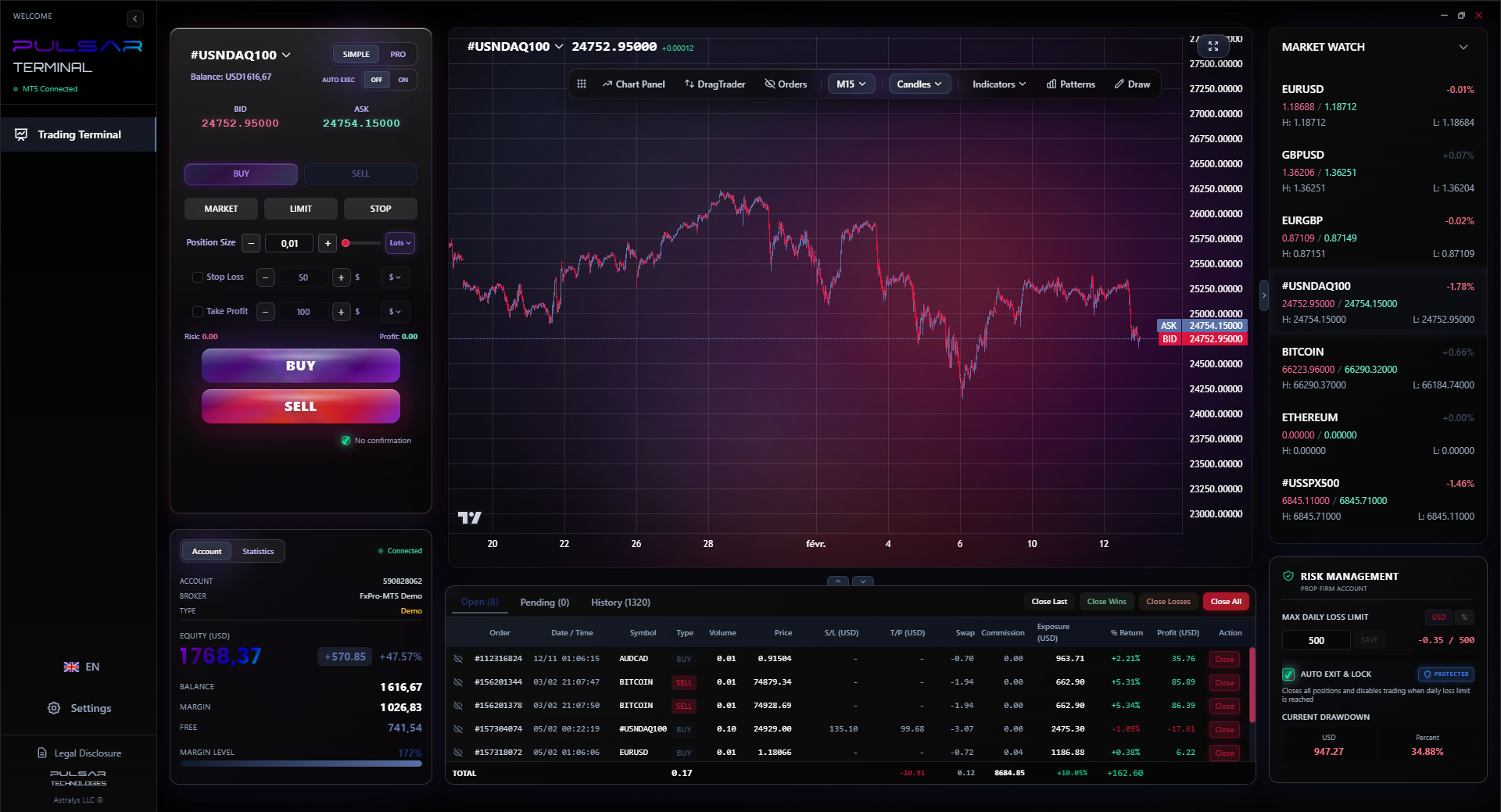
Managing multiple signal-based trades with precise stops and targets is complex, but tools like Pulsar Terminal let you set multi-level take-profits and trailing stops directly on your MT5 charts, automating the execution of any strategy.
Pulsar Terminal
A ferramenta MT5 tudo-em-um: ordens drag-and-drop, multi-TP/SL, trailing stop, grid trading, Volume Profile e proteção prop firm. Usado diariamente por 1.000+ traders.
“The ultimate goal isn't to be a lifelong subscriber. It's to use signals as a training wheel until you can ride on your own.”
The ultimate goal isn't to be a lifelong subscriber. It's to use signals as a training wheel until you can ride on your own. Here's how I transitioned.
Phase 1: The Mirror (Months 1-6). Follow signals blindly on demo, but journal extensively. Note the patterns. What time do winning trades come? What chart patterns precede them? Is there a common RSI indicator level at entry?
Phase 2: The Analyst (Months 6-12). When a signal arrives, don't look at the recommendation. Open the chart yourself. Try to predict what the signal will be. Then compare. This forces you to learn their strategy. I realized my main provider was heavily using order flow and imbalances on the 15-minute chart. I started studying those concepts.
Phase 3: The Hybrid (Year 1+). Use signals purely for idea generation and confirmation. You develop your own watchlist and analysis. If your analysis suggests a buy on USD/CAD, and a trusted signal service independently calls a buy an hour later, that's powerful confluence. That's your edge.
My Mistake & Pivot: I was stuck in Phase 1 for almost two years, afraid to think for myself. The pivot came when I started paper-trading against signals I had low confidence in. If I was right, it boosted my confidence. If I was wrong, I dissected why their analysis was better. This accelerated my learning more than any course.
Now, I don't pay for any service. I'm in several free Telegram groups (like Learn2Trade's free tier) just to see what the crowd is thinking. Sometimes, being contrarian to the popular signal is the best trade of the day. The signal environment becomes a sentiment gauge.
The truth is, no one will care for your money like you will. A signal provider with 1,000 subscribers won't lose sleep over your margin call. You have to.
FAQ
Q1Are free forex trading signals in Nigeria any good?
Some can be useful for learning structure and seeing how professionals frame trades, like the 3-5 daily signals from Learn2Trade's free plan. However, they're often delayed, lack detailed reasoning, and are rarely suitable for fast-moving strategies like scalping. Treat them as educational examples, not a profit engine. The best free resource is often a demo account where you test everything first.
Q2What is a realistic success rate for a legitimate signal service?
Beware of anyone claiming over 80%. It's usually marketing. A realistic, sustainable service might have a win rate between 55% and 70%, but with a strong risk-reward ratio (e.g., risking 1% to make 2%). A service with a 60% win rate and a 1:2 risk-reward is far more profitable and strong than one with an 80% win rate and a 1:0.5 risk-reward. Always ask for the average risk-reward, not just the win rate.
Q3How much should I pay for forex signals?
Don't spend more than you can afford to lose completely. As a guideline, your signal subscription should be a very small fraction of your trading capital - think 1% or less annually. If you have a $5,000 account, paying $500/year ($42/month) is 10% of your capital, which is far too high. Mid-tier services around $25-$50 per month can offer good value if they provide transparency and education. Never choose a service based on cost alone; a cheap scam is more expensive than a legitimate paid service.
Q4Can I get rich quick using forex signals?
No. This is the most dangerous misconception. Signals are a tool for informed trading, not a lottery ticket. Anyone promising quick riches is scamming you. Consistent profitability comes from strict risk management, patience, and a long-term perspective - things no signal can provide for you. I've seen more accounts blown by people over-leveraging 'sure thing' signals than by any other method.
Q5Is it legal to use international forex signal services in Nigeria?
Yes, it is legal for individuals to subscribe to international forex signal services. Forex trading itself is legal. The key legal obligation for you is to declare any profits to the Federal Inland Revenue Service (FIRS) for capital gains tax (currently 10%). The regulatory gap is around the signal providers themselves, so due diligence on your part is critical.
Q6Should I use the same broker my signal provider recommends?
Be extremely cautious. This is a major conflict of interest. Many 'free' signal services are funded by broker kickbacks. They may recommend brokers with wide spreads or poor execution to generate more revenue for themselves, at your expense. Always choose a broker based on your own research into their regulation, spreads, execution speed, and local deposit options, not on a signal provider's recommendation.
Q7What's the single most important thing to check before buying signals?
A verifiable, long-term track record on a third-party platform like myfxbook. It must show all historical trades, the drawdown, and the equity curve. If they only show screenshot wins or a few recent trades, walk away. No track record, no trust. It's that simple.
Lição do Prof. Winston
Pontos-chave:
- ✓Vet track records, not promises. Demand myfxbook links.
- ✓Apply your own risk management. Always use a position size calculator.
- ✓Signals are for confluence, not commands. Add your own analysis.
- ✓Choose your broker for execution, not because a signal provider said so.
Quão útil foi este artigo?
Clique em uma estrela
Insights de Trading Semanal
Análises e estratégias semanais grátis. Sem spam.
Sobre o autor
Olumide Adeyemi
Pioneiro do Trading na África Ocidental
Um dos educadores de trading forex mais ativos da Nigéria. 8 anos de experiência operando a partir de Lagos. Especialista em estratégias de baixo capital e desafios de prop firms para traders africanos.
Comentários
Aviso de risco
A negociação de instrumentos financeiros envolve riscos significativos e pode não ser adequada para todos os investidores. O desempenho passado não garante resultados futuros. Este conteúdo é apenas para fins educacionais e não deve ser considerado aconselhamento de investimento. Sempre conduza sua própria pesquisa antes de negociar.
Você também pode gostar

Cara Trading Forex Sukses: 7 Prinsip dari Trader Profesional
Cara trading forex sukses dengan 7 prinsip trader pro: manajemen modal, disiplin, journal trading, backtest. Data nyata, bukan janji profit palsu.
Jam Trading Forex Terbaik untuk Trader Indonesia: Panduan Lengkap dengan Tabel Waktu
Panduan jam trading forex untuk trader Indonesia. Tabel 4 sesi dunia, jam emas 20:00-00:00, sesi mana yang harus dihindari. Data akurat + tips dari trader berpengalaman.
Top 5 Sàn Forex Uy Tín Nhất 2026: Review Jujur dari Trader Indonesia
Top 5 sàn forex uy tín 2026 untuk trader Indonesia. Review jujur: spread, deposit, withdraw, dukungan lokal. Exness, XM, IC Markets & lebih.
Obter Pulsar Terminal
Todas essas calculadoras estão integradas ao Pulsar Terminal com dados em tempo real da sua conta MT5.
Obter Pulsar Terminal