


I remember downloading a 'Proven Forex Strategy PDF' back in 2018.

Olumide Adeyemi
Pioneiro do Trading na África Ocidental ·  Nigeria
☕ 10 min de leitura
O que você vai aprender:
- 1The PDF Promise vs. Nigerian Reality
- 2What a Good Strategy Guide Should Actually Contain
- 3Building Your Own Edge (The Nigerian Context)
- 4Backtesting: Not Just Believing
- 5From Paper to Live: The Psychology Gap
- 6Red Flags in Strategy Sales
- 7Creating Your Personal Trading Plan Document
- 8Final Word: Your Path Forward
I remember downloading a 'Proven Forex Strategy PDF' back in 2018. It promised 20-pip daily gains with a simple moving average crossover. I funded my account with ₦150,000, followed the rules exactly, and lost ₦45,000 in three weeks. The strategy worked perfectly in the PDF's cherry-picked examples but fell apart in real market noise. That experience taught me more about trading than the PDF ever did. Let's talk about what these documents are really worth and how you can build something that actually works for you.
Everywhere you look online, someone is selling a 'secret' forex trading strategies PDF. The cover usually shows a luxury car, a chart with perfect entries, and promises of financial freedom. For a Nigerian trader dealing with Naira volatility, power outages, and sometimes shaky internet, this fantasy is particularly seductive.
The harsh truth? A static PDF can't adapt. The market I traded in 2020 is not the market of 2026. Central Bank of Nigeria (CBN) policies shift, global risk sentiment changes, and the liquidity during Lagos market hours is different from London's. A strategy that worked during a trending market will get chopped up in a ranging one, and no PDF will tell you when that change is coming.
I learned this the hard way with that moving average system. It was designed for the steady, high-liquidity EUR/USD sessions. When I tried applying it to USD/NGN pairs or even GBP/USD during Asian hours, the results were terrible. The spread alone would eat half the supposed profit target. You need a dynamic understanding, not a static document. For understanding core concepts like what a pip really costs you, a PDF is fine. For a live trading plan, it's insufficient.
Okay, I'm not saying all educational material is trash. A genuinely useful guide - whether a PDF, a course, or a series of articles - should be a framework for thinking, not a set of rigid orders. Here’s what to look for.
The Non-Negotiables: Risk & Money Management
Any strategy that doesn't dedicate at least a third of its content to risk management is dangerous. It must explicitly state the maximum risk per trade (e.g., 1-2% of your capital) and show you how to calculate your position size based on your stop-loss distance. I never risk more than 1.5% on a single idea. This isn't a suggestion; it's what keeps you in the game after a string of losses. Using a position size calculator religiously is the single best habit I ever formed.

Warning: If a PDF says to 'risk 5% to maximize gains' or doesn't discuss position sizing at all, delete it immediately. That's a fast track to a margin call.
Clear, Testable Rules
It should define everything: the chart timeframe, the exact setup conditions, the entry trigger, the initial stop-loss placement, and the profit-taking logic. Ambiguity like 'enter when the trend looks strong' is useless. It should read more like: 'On the H1 chart, enter a buy limit order 5 pips above the previous session's high when the RSI indicator crosses above 30 from oversold territory, with a stop-loss below the recent swing low.'
Context and Market Conditions
This is what separates the pros from the PDF peddlers. A good guide will tell you when the strategy is likely to fail. Does it work best in trending markets? During high volatility? Does it fall apart during major news events like CBN announcements? My early mistake was trading a breakout strategy during consolidation periods because the PDF didn't mention this critical detail.

💡 Dica do Winston
A strategy isn't what you see on a chart. It's the rules you follow when you can't see the next candle. Write those rules down before you trade.
“Your confidence should come from data, not from a sales page.”
Forget finding a holy grail in a forex trading strategies PDF. Your real job is to build an edge that suits your life, your capital, and your local market realities.
First, consider your schedule. Are you a student or a 9-5 worker? You probably can't sit and watch charts all day. Swing trading on daily or H4 charts might be a better fit than a 5-minute scalping strategy. I know traders in Abuja who only trade the London session overlap because that's when their internet is most reliable.
Second, account for the 'Naira Factor'. If you're funding an international broker like Exness or IC Markets, you're dealing with USD. Your profit and loss are in dollars, but your living expenses are in Naira. A 2% gain in USD could be wiped out by a 2% shift in the USD/NGN rate by the time you withdraw. Some traders I know actively hedge this currency risk.
Finally, choose instruments that make sense. Yes, EUR/USD has tight spreads. But maybe you have a better gut feel for commodities like Gold (XAU/USD) because you follow global geopolitics. Specializing in one or two pairs is far better than jumping around with a generic strategy. I had my best runs focusing purely on EUR/USD and XAU/USD because I learned their personalities.
This is where you separate hope from evidence. You must test any strategy concept - from a PDF or your own mind - against historical data. I don't mean glancing at a few charts. I mean rigorous, boring, note-taking backtesting.
Here's my method: I'll take a strategy and run it through at least 100-200 past trades. I use a simple spreadsheet to log every entry, exit, profit, and loss. I note the market condition (trending, ranging, volatile). The goal isn't to find a perfect system. It's to find the strategy's probability and its maximum drawdown - the biggest losing streak you can expect.

Example: I once backtested a support/resistance strategy on GBP/JPY. Over 150 simulated trades, it had a 55% win rate. The average winner was 85 pips, the average loser was 50 pips. That's a positive expectancy. But the key finding? It had a maximum drawdown of 7 consecutive losses. Knowing that mentally prepared me to stick with it during the inevitable bad run.
Most free forex trading strategies PDFs won't include this kind of strong backtesting data. They'll show you the 5 trades that worked. You need to know about the 15 that didn't. Your confidence should come from data, not from a sales page.
💡 Dica do Winston
Your best trade will feel wrong. Your worst trade will feel brilliant. Trust your system, not your gut in the moment.
“A static PDF can't adapt. The market I traded in 2020 is not the market of 2026.”
This is the killer, the single biggest reason downloaded strategies fail. Paper trading feels easy. Live trading, with your real money - money you might have saved for months - is a completely different beast.
When a trade goes 10 pips against you, the PDF doesn't feel the fear. You do. That's when you're tempted to move your stop-loss, breaking the strategy's number one rule. I've done it. In early 2022, I broke my own rules on a USD/CAD trade, moved my stop, and turned a controlled $80 loss into a catastrophic $450 loss. The strategy was sound; my discipline wasn't.
The only bridge across this gap is a trading journal. Not just logging trades, but logging your emotions. 'Felt anxious because I was down for the week, almost closed early.' Reviewing those journals shows you your personal psychological traps. Maybe you cut winners too soon. Maybe you overtrade on Fridays. A PDF gives you a map, but your journal shows you where you are likely to get lost.
This is also where tools that reduce emotional decision-making are priceless. Having a clear, automated plan for moving stops to breakeven or taking partial profits can save you from yourself.
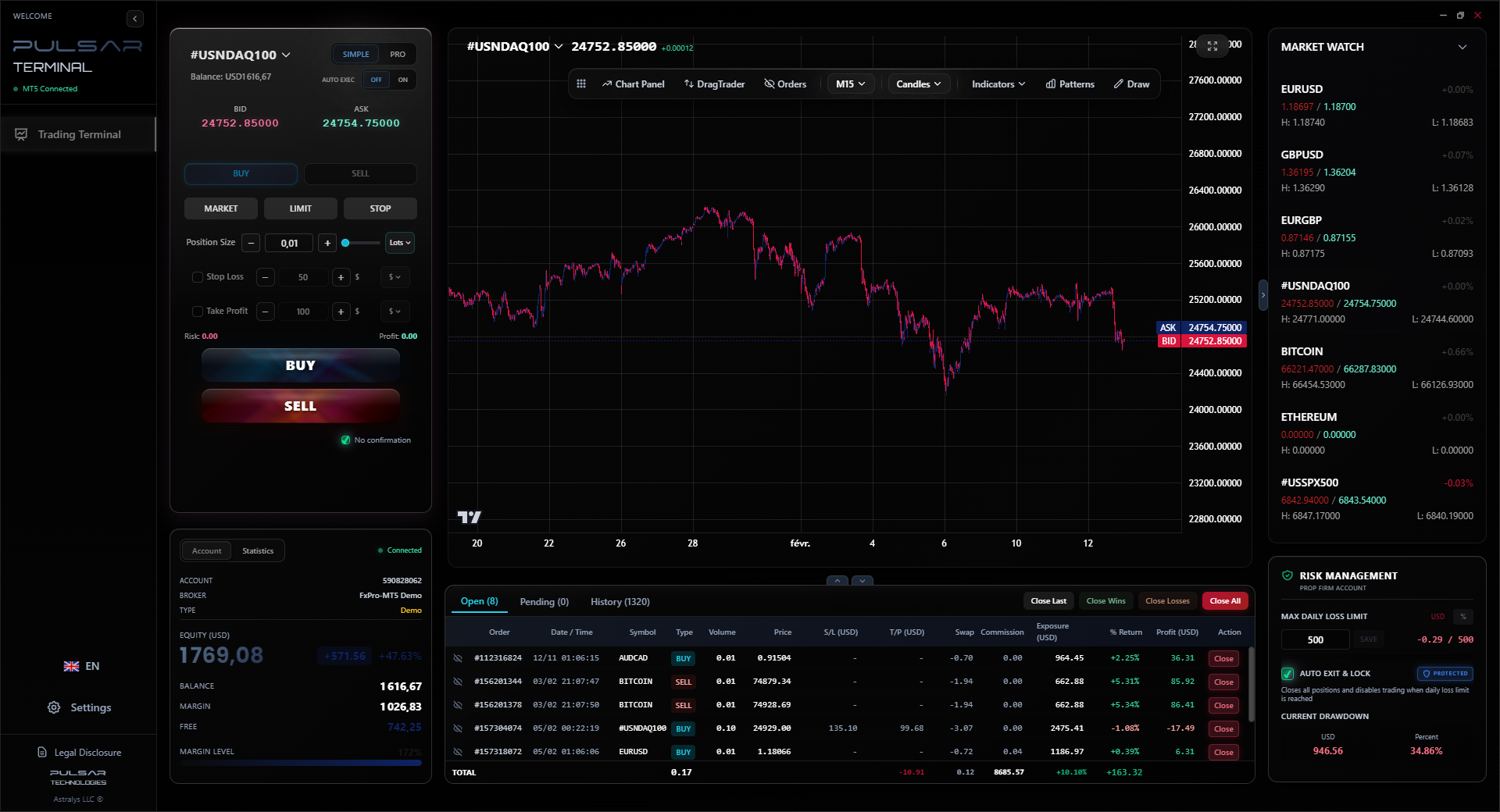
Sticking to your trading plan's rules for stop-losses and take-profits is the hardest part, which is why automating those decisions with a tool like Pulsar Terminal directly on your MT5 platform can be a game-saver.
Pulsar Terminal
A ferramenta MT5 tudo-em-um: ordens drag-and-drop, multi-TP/SL, trailing stop, grid trading, Volume Profile e proteção prop firm. Usado diariamente por 1.000+ traders.
Let's be blunt. The market for 'secret' forex trading strategies PDFs is full of predators. Here’s how to spot them.
- Guaranteed Profits or High Win Rates: Anyone promising 90% wins or guaranteed income is lying. The market is probabilistic, not certain. If they could guarantee it, they'd be trading, not selling PDFs.
- Overly Complex 'Black Box' Systems: If the strategy requires 15 indicators with obscure settings and the seller can't explain the logic in simple terms, it's likely curve-fitted nonsense. It's designed to look sophisticated, not to be understood.
- No Discussion of Losses: A legitimate educator talks openly about losses, drawdowns, and risk. If every chart in the PDF is a perfect winner, it's a fabrication.
- Pressure to Act Now: 'Limited time offer!' 'Price doubles tomorrow!' This is pure marketing manipulation. Real trading knowledge doesn't expire.
Instead of buying a random PDF, invest in your own education through reputable sources. Learn how the MACD indicator actually works. Read broker reviews like our deep dives on XM or Pepperstone to understand trading costs. This foundational knowledge is what you truly own.
💡 Dica do Winston
If you wouldn't risk ₦10,000 on the idea in Lagos, don't risk $100 on it in New York. Fear translates across currencies.
“The only 'forex trading strategies PDF' that matters is the one you write for yourself.”
This is the only 'forex trading strategies PDF' that matters - the one you write for yourself. It's a living document. Mine has evolved over a decade.
Section 1: The Foundation.
- My trading capital (e.g., $500 or ₦500,000).
- My maximum risk per trade (1.5%).
- My monthly profit goal (realistic, like 5-10%).
- My acceptable monthly loss limit (e.g., 8%). Once hit, I stop for the month.
Section 2: The Strategy.
- The specific setup(s) I trade (be brutally precise).
- The chart timeframes I use.
- My entry rules.
- My initial stop-loss rules.
- My take-profit rules (do I use a 1:2 risk-reward? Do I take partial profits at 1R?).
Section 3: The Daily Routine.
- When I analyze charts (e.g., Sunday evening, 30 mins before London open).
- My pre-news event checklist (do I close positions? widen stops?).
- My end-of-day journaling process.
Section 4: The Review Protocol.
- Every Sunday, I review last week's trades against my plan.
- At the end of each month, I analyze my journal for psychological leaks and strategic flaws.
- I allow myself to tweak one small element of the strategy per quarter - no major overhauls based on a bad week.
This document is your anchor. When you're in a drawdown, you go back to it. You trust the process you designed in a calm state, not the fear in a losing moment.
Look, I wasted money on those flashy forex trading strategies PDFs too. I wanted the shortcut. But trading well is a skill, built through study, practice, and brutal self-honesty.
Start small. Open a demo account with a broker known for good execution, like IC Markets or Pepperstone. Don't just trade randomly. Pick one simple concept - like trading pullbacks in a trend using a single indicator. Write your own mini-plan. Backtest it for 50 trades. Then trade it on demo for a month, journaling everything.
Only then, fund a live account with money you can truly afford to lose. Use that position size calculator on every single trade. Your first goal isn't profit. Your first goal is to execute your plan flawlessly for 20 trades in a row, win or lose.
The market will always be here. The goal isn't to get rich next week. The goal is to build a sustainable process that can work for you in Lagos, Port Harcourt, or Kano, through Naira fluctuations and all. That's a document worth writing.
FAQ
Q1Are free forex trading strategies PDFs from online forums any good?
Sometimes, but you have to be a detective. A free PDF shared by a community member showing a simple strategy with clear rules and backtest results can be a great starting point for your own testing. However, many free PDFs are just lead magnets - watered-down versions designed to make you buy a 'full course'. Always test the concept yourself before risking any money.
Q2I'm in Nigeria. Should I focus on USD/NGN pairs or major forex pairs?
Stick to the major pairs (EUR/USD, GBP/USD) or crosses like EUR/GBP. The liquidity and spreads are far better on international brokers. USD/NGN trading for retail traders is often through CFDs with very wide spreads and unpredictable gaps due to CBN interventions. It's a much harder market to trade consistently.
Q3How much money do I need to start testing a strategy from a PDF?
You need $0 to start. Use a demo account. To test it live with minimal risk, look for brokers with very low minimum deposits. For example, you can open a live account with Exness for $10 or XM for $5. This lets you feel the psychology of real money without significant danger. Never start with your full intended capital.
Q4What's the single most important thing missing from most strategy PDFs?
Context about market regimes. They rarely tell you that a trend-following strategy will lose money in a choppy, range-bound market, or that a volatility breakout system will fail during quiet holiday periods. A strategy is a tool for specific conditions, not a hammer for every nail.
Q5Do I need to pay taxes on forex profits in Nigeria?
Yes. According to Nigerian law, you are required to report income from all sources, including trading with international brokers. A capital gains tax of 10% applies to your profits. Keep detailed records of your trades and withdrawals for tax purposes.
Q6Can I automate a strategy from a PDF with an Expert Advisor (EA)?
Technically, yes, if the rules are 100% clear and mechanical. But this is an advanced step. You must first manually trade and backtest the strategy thoroughly to understand its behavior. Most retail EAs built from simple PDF strategies fail because they can't adapt to changing market volatility or conditions the PDF author never mentioned.
Lição do Prof. Winston
Pontos-chave:
- ✓Test any strategy over 100+ historical trades before believing it.
- ✓Never risk more than 2% of your capital on a single trade.
- ✓A 10% capital gains tax applies to your forex profits in Nigeria.
- ✓Focus on 1-2 currency pairs to learn their personality deeply.
Quão útil foi este artigo?
Clique em uma estrela
Insights de Trading Semanal
Análises e estratégias semanais grátis. Sem spam.
Sobre o autor
Olumide Adeyemi
Pioneiro do Trading na África Ocidental
Um dos educadores de trading forex mais ativos da Nigéria. 8 anos de experiência operando a partir de Lagos. Especialista em estratégias de baixo capital e desafios de prop firms para traders africanos.
Comentários
Aviso de risco
A negociação de instrumentos financeiros envolve riscos significativos e pode não ser adequada para todos os investidores. O desempenho passado não garante resultados futuros. Este conteúdo é apenas para fins educacionais e não deve ser considerado aconselhamento de investimento. Sempre conduza sua própria pesquisa antes de negociar.
Você também pode gostar

Cara Trading Forex Sukses: 7 Prinsip dari Trader Profesional
Cara trading forex sukses dengan 7 prinsip trader pro: manajemen modal, disiplin, journal trading, backtest. Data nyata, bukan janji profit palsu.
Jam Trading Forex Terbaik untuk Trader Indonesia: Panduan Lengkap dengan Tabel Waktu
Panduan jam trading forex untuk trader Indonesia. Tabel 4 sesi dunia, jam emas 20:00-00:00, sesi mana yang harus dihindari. Data akurat + tips dari trader berpengalaman.
Top 5 Sàn Forex Uy Tín Nhất 2026: Review Jujur dari Trader Indonesia
Top 5 sàn forex uy tín 2026 untuk trader Indonesia. Review jujur: spread, deposit, withdraw, dukungan lokal. Exness, XM, IC Markets & lebih.
Obter Pulsar Terminal
Todas essas calculadoras estão integradas ao Pulsar Terminal com dados em tempo real da sua conta MT5.
Obter Pulsar Terminal