


I lost ₦450,000 in one afternoon because I didn't understand a single term: 'margin call.' I thought my broker was calling to check on me.

Olumide Adeyemi
Pioneiro do Trading na África Ocidental ·  Nigeria
☕ 11 min de leitura
O que você vai aprender:
I lost ₦450,000 in one afternoon because I didn't understand a single term: 'margin call.' I thought my broker was calling to check on me. I was long GBP/NGN with too much use, the rate moved against me, and I got that notification. I ignored it, thinking I'd just wait for the market to come back. It didn't. My positions were liquidated automatically. Poof. Gone. That painful lesson cost me more than a fancy laptop. It taught me that in forex, the words themselves are risk management tools. If you don't speak the language, you're just gambling with fancy charts.
These aren't just vocabulary words. They're the mechanics of how your money moves, gets protected, or gets vaporized. Getting them wrong is how you blow up an account.
Pip: Your Measuring Stick
A pip is the smallest price move a currency pair can make. For most pairs, it's 0.0001. If EUR/USD moves from 1.1050 to 1.1051, that's one pip. For pairs involving the Japanese Yen (like USD/JPY), it's 0.01. Why does this matter? Because your profit, loss, and risk are all measured in pips first, then converted to your account currency. If your stop loss is 50 pips away, you need to know exactly what that means in Naira before you click 'buy.'

Example: Let's say you trade 1 mini lot (10,000 units) of EUR/USD. One pip on that trade is worth roughly $1. If your account is in Naira and the USD/NGN rate is 1500, that pip is worth about ₦1,500. A 50-pip stop loss? That's a ₦75,000 risk on that single trade.
Spread: The Hidden Entry Fee
The spread is the difference between the buy price (ask) and the sell price (bid). It's how many brokers make their money on commission-free accounts. You're 'down' the amount of the spread the moment you enter a trade. A 'tight' spread (like 0.8 pips on EUR/USD) is good. A 'wide' spread (like 3+ pips on an exotic pair) can eat into your profits before the market even moves. Always check the typical spread for your chosen pair, especially during volatile news events or outside major market hours when they can widen dramatically. You can compare real spreads in our Exness review and IC Markets review.
use & Margin: The Double-Edged Sword
This is where Nigerians get into the most trouble, hands down. use is borrowed capital from your broker that amplifies your trading position. Margin is the amount of your own money you need to put up to open that leveraged position.
Think of it like this: You want to control a ₦10,000,000 position. With 1:100 use, you only need to put up ₦100,000 of your own money as margin. The broker lends you the other ₦9,900,000. The potential? Massive gains on a small move. The reality? Massive losses just as fast. That ₦100,000 is your collateral. If your losses approach that amount, you get a margin call. If you ignore it, your positions get closed automatically. I learned this the hard way. use isn't a tool for making more money; it's a tool for blowing up faster if you don't know how to manage risk. Always use a position size calculator to work out your true risk.

💡 Dica do Winston
If you can't explain what a 'pip' is and calculate its value in your sleep, you have no business placing a live trade. Go back to the demo.
Placing a market order is like shouting 'buy now!' at the current price. But professional traders use other orders to control their entry and exit with precision, removing emotion from the equation.
Stop-Loss (SL): Your Life Raft
Your stop-loss is a pre-set order to close a losing trade at a specific price. It's not an admission of defeat. It's a pre-defined cost of doing business. If you don't set one, you're saying 'I'm willing to lose everything in this account on this one idea.' I never trade without one. Ever. Your SL should be based on where your trade idea is objectively wrong on the chart, not on how much money you're willing to lose.
Take-Profit (TP): Your Exit Strategy
Your take-profit is a pre-set order to close a winning trade. The biggest psychological mistake is moving your TP further away when you're in profit (greed) or closing it early out of fear. Set it based on your strategy's reward-to-risk ratio and stick to it. A common framework is a 1:1.5 or 1:2 risk-to-reward. If you risk 50 pips, aim for 75-100 pips profit.
Limit & Stop Orders
A limit order lets you buy below the current market price or sell above it. You're saying 'I only want to enter if the price comes back to this better level.' A stop order (different from a stop-loss) lets you buy above the current price or sell below it. This is used to enter a breakout trade, confirming the price has moved beyond a key level. Understanding these lets you plan trades while you're away from the screen.

Warning: A 'stop-loss' is for closing a position you already have. A 'stop order' is for opening a new position. Mixing these up can lead to disastrous, unintended trades.
“use isn't a tool for making more money; it's a tool for blowing up faster if you don't know how to manage risk.”
Your trading account isn't just a wallet. Its structure defines your costs and capabilities.
Balance, Equity, Free Margin
Your Balance is your cash after all closed positions. Your Equity is your balance plus/minus the profit/loss of your currently open positions. Free Margin is the money in your account that's not being used as collateral for open trades. It's the cushion that keeps you from a margin call. The formula is: Free Margin = Equity - Used Margin. Watch your Free Margin like a hawk. If it gets too low, you're over-leveraged.
Swap (Overnight Financing)
If you hold a position past the broker's daily rollover time (usually 10 PM or 11 PM GMT), you'll pay or receive a swap fee. It's based on the interest rate differential between the two currencies. For a swing trading strategy where you hold for days or weeks, these small daily charges can add up. Some brokers offer 'swap-free' Islamic accounts that avoid this, but they might incorporate costs elsewhere, like wider spreads.
Lot Size
This is the number of currency units you're trading. A standard lot is 100,000 units. A mini lot is 10,000. A micro lot is 1,000. Most Nigerian starters should be trading micro or mini lots. Trading a standard lot with a small account is a one-way ticket to a margin call. Controlling your lot size is the most direct way to control your risk per trade.
💡 Dica do Winston
The market doesn't care about your 'balance.' It only responds to your 'equity' and will ruthlessly attack your 'free margin.' Watch those two numbers, not the first one.
This is the language of your strategy. Are you a technical trader, a fundamental trader, or a mix?
Technical Analysis Terms
This is about price action and indicators.
- Support & Resistance: Price levels where buying (support) or selling (resistance) has historically been strong. Think of them as floors and ceilings.
- Trend: The general direction. Uptrend (higher highs, higher lows), Downtrend (lower highs, lower lows), Range (sideways movement between clear support and resistance).
- Indicators: Tools like the RSI indicator (measures momentum, overbought/oversold) or the MACD indicator (shows trend direction and strength). These are lagging, not predictive. They help confirm what price is already doing.
Fundamental Analysis Terms
This is about the economic 'why' behind price moves.
- Central Bank Rates: Set by institutions like the US Federal Reserve (Fed) or the Central Bank of Nigeria (CBN). The single biggest driver of currency value over the long term.
- CPI (Inflation): Consumer Price Index. High inflation typically leads a central bank to raise rates, which can strengthen a currency.
- NFP (Non-Farm Payrolls): A key US jobs report that causes massive volatility in USD pairs every month. For a Nigerian, you must also watch local fundamentals: CBN monetary policy decisions, crude oil prices (Nigeria's major export), and Naira liquidity. A surprise CBN rate hike can send GBP/NGN or USD/NGN pairs gapping.
“Your stop-loss is not an admission of defeat. It's a pre-defined cost of doing business.”
Trading from Nigeria comes with its own local lexicon and realities.
NGN-Denominated Accounts
Some brokers now offer accounts where your balance and trades are in Nigerian Naira. This is a game-changer for psychology and simplicity. You see your profit and loss in Naira directly, no mental conversion needed. However, always check if the underlying spreads and commissions are competitive with their USD account equivalents. Sometimes the convenience comes with a slightly higher cost.
CBN & SEC Regulations
Forex trading is legal here. The Central Bank of Nigeria (CBN) oversees the financial system, while the Securities and Exchange Commission (SEC) handles capital markets. The critical point? There's no specific local regulation for international online forex brokers. When you sign up with XM or Pepperstone, you're under their regulator's protection (like the FSCA in South Africa or CySEC in Cyprus). Do your homework on that foreign regulator's reputation.
Capital Gains Tax
This isn't a trading term, but it's a financial result term you must know. Profits from forex trading are subject to a 10% Capital Gains Tax in Nigeria, payable to the Federal Inland Revenue Service (FIRS). You are responsible for declaring this. Keep detailed records of all your trades.
Payment Methods & Fees
You'll see terms like 'local bank transfer,' 'USSD,' or 'PayAttitude.' Deposit/withdrawal fees vary wildly. A broker might offer 'zero deposit fees' but your Nigerian bank might charge ₦500-₦2,000 for an international transfer. E-wallets like Skrill or Neteller can be faster but also have fees. Factor these costs into your overall trading profitability.
💡 Dica do Winston
In Nigeria, your biggest edge isn't a secret indicator. It's understanding local liquidity, CBN policy timing, and how oil price swings hit the Naira before the charts show it.
Let's clear up the confusion I see every day in trading groups.
"A wide stop-loss is safer." False. A wider stop-loss means you have to trade a smaller position size to risk the same amount of money. If you widen your stop but keep the same lot size, you are literally risking more Naira. Safety comes from position sizing, not from where you place the stop.
"use is free money." It's the opposite. It's rented risk. The broker isn't giving you a gift. They're giving you a bigger shovel. You can dig a treasure pit or your own grave faster.
"A swap-free account is always better." Not necessarily. The cost of offering that service is often baked into wider spreads. If you're a scalping strategy trader holding positions for minutes, a swap-free account with a 2-pip spread is worse than a regular account with a 0.8-pip spread, even if you pay a tiny swap.
"My balance is my available money." Your balance is history. Your Equity is your current reality. Your Free Margin is your breathing room. Focusing only on your balance while you have open trades is like driving while only looking in the rearview mirror.
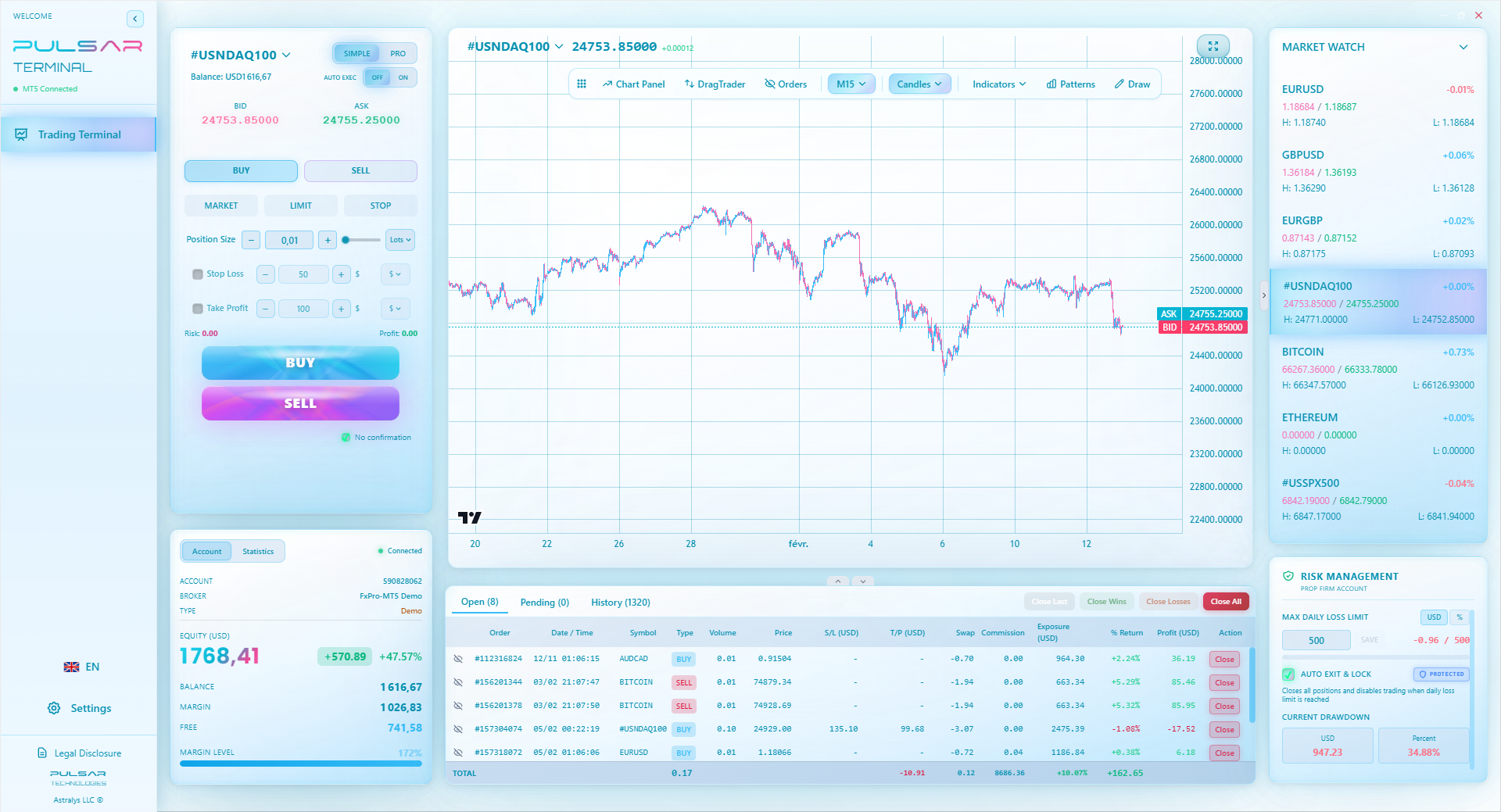
Managing multiple take-profit levels and a trailing stop manually is stressful, but Pulsar Terminal automates it all directly on your MT5 chart, so you can stick to your plan.
Pulsar Terminal
A ferramenta MT5 tudo-em-um: ordens drag-and-drop, multi-TP/SL, trailing stop, grid trading, Volume Profile e proteção prop firm. Usado diariamente por 1.000+ traders.
“Not understanding a 'margin call' cost me ₦450,000 in one afternoon. The words themselves are risk management tools.”
Let's walk through a real scenario with real (old) numbers so you see how the terms interact.
The Setup: I'm looking at XAU/USD (Gold). Price is bouncing off a clear support level on the 4-hour chart. The RSI indicator is showing oversold at 28. I decide to go long.
The Plan:
- Entry: 1815.00 (Market Order)
- Stop-Loss (SL): 1809.00 (6 pips or $60 risk per mini lot)
- Take-Profit (TP): 1827.00 (12 pips or $120 target per mini lot)
- Risk/Reward: 1:2
- Account Size: $2,000 (Let's pretend it's ₦3,000,000 at 1500/$)
- Risk Per Trade: I risk 1% of my account, which is $20.
The Math: If I'm risking $20 total, and my SL is 6 pips ($6 per pip per mini lot), I can trade: $20 / $6 = 3.33 mini lots. So I trade 3 mini lots (30,000 units). My margin requirement (at 1:100 use) is roughly: (30,000 units * 1815.00) / 100 = $544.5. That's my Used Margin. My Free Margin at entry is roughly $2,000 - $544.5 = $1,455.5.
The spread was 0.5 pips. So the moment I entered, I was 'down' 0.5 pips * $3 per pip = $1.50.
The Outcome: Price moved up, hit my TP at 1827.00. The trade closed automatically. Gross Profit: (1827.00 - 1815.00) = 12 pips. 12 pips * $3 per pip = $36. Net Profit: $36 - $1.50 (spread cost) = $34.50. No swap was involved because I closed within the day.
That's how the terms work in concert: Pips, Spread, Lot Size, use, Margin, SL, TP. Every piece was calculated before I clicked buy. The profit was a result of the plan, not luck.
FAQ
Q1What is the most important forex term for a beginner in Nigeria to understand first?
Margin Call. It's the mechanism that protects your broker's money and liquidates your trades when your losses approach your deposited capital. Not understanding this is the number one reason new traders lose everything. It's not a suggestion; it's an automatic process.
Q2Is forex trading legal in Nigeria, and which body regulates it?
Yes, forex trading is legal. The broader financial system is overseen by the Central Bank of Nigeria (CBN), and the Securities and Exchange Commission (SEC) handles capital markets. However, most Nigerian traders use international brokers regulated abroad (e.g., by South Africa's FSCA or Cyprus's CySEC), as there isn't a specific local framework for regulating these offshore entities yet.
Q3What does 'floating the Naira' mean for my trading?
When the CBN floated the Naira in 2016, it stopped pegging its value to the USD and let it be determined by market forces (supply and demand). This means pairs like USD/NGN can be more volatile and trade more like other major forex pairs. It creates both more opportunity and more risk for traders focusing on Naira pairs.
Q4Should I choose a commission-based or a spread-based account?
It depends on your trading style. If you're a high-volume scalper making many trades per day, a raw spread account (0.0 pips) with a small commission per trade (e.g., $3.50 per lot) is often cheaper overall. If you're a swing trader making fewer trades, a commission-free account with a slightly wider spread (e.g., 1.0 pip) might be simpler and cost-effective. Always do the math for your expected trading volume.
Q5What is a 'pip' in Nigerian Naira terms?
A pip's value in Naira depends on three things: the currency pair you're trading, the lot size, and the current USD/NGN exchange rate. For example, 1 pip on a standard lot (100,000 units) of EUR/USD is roughly $10. If $1 = ₦1,500, then that pip is worth about ₦15,000. This is why using a position size calculator is non-negotiable.
Q6Do I pay tax on my forex trading profits in Nigeria?
Yes. According to Nigerian law, profits from forex trading are considered capital gains and are subject to a 10% tax. You are responsible for declaring this income and paying it to the Federal Inland Revenue Service (FIRS). Keep a detailed log of all your trades for tax purposes.
Lição do Prof. Winston
Pontos-chave:
- ✓Master 'Pip,' 'Margin,' and 'Stop-Loss' before you trade a single Naira.
- ✓use above 1:30 is usually a liability, not an advantage.
- ✓Your free margin is your oxygen. Don't let it drop below 50%.
- ✓Always calculate your risk in Naira, not just pips, before entering.
Quão útil foi este artigo?
Clique em uma estrela
Insights de Trading Semanal
Análises e estratégias semanais grátis. Sem spam.
Sobre o autor
Olumide Adeyemi
Pioneiro do Trading na África Ocidental
Um dos educadores de trading forex mais ativos da Nigéria. 8 anos de experiência operando a partir de Lagos. Especialista em estratégias de baixo capital e desafios de prop firms para traders africanos.
Comentários
Aviso de risco
A negociação de instrumentos financeiros envolve riscos significativos e pode não ser adequada para todos os investidores. O desempenho passado não garante resultados futuros. Este conteúdo é apenas para fins educacionais e não deve ser considerado aconselhamento de investimento. Sempre conduza sua própria pesquisa antes de negociar.
Você também pode gostar

Cara Trading Forex Sukses: 7 Prinsip dari Trader Profesional
Cara trading forex sukses dengan 7 prinsip trader pro: manajemen modal, disiplin, journal trading, backtest. Data nyata, bukan janji profit palsu.
Jam Trading Forex Terbaik untuk Trader Indonesia: Panduan Lengkap dengan Tabel Waktu
Panduan jam trading forex untuk trader Indonesia. Tabel 4 sesi dunia, jam emas 20:00-00:00, sesi mana yang harus dihindari. Data akurat + tips dari trader berpengalaman.
Top 5 Sàn Forex Uy Tín Nhất 2026: Review Jujur dari Trader Indonesia
Top 5 sàn forex uy tín 2026 untuk trader Indonesia. Review jujur: spread, deposit, withdraw, dukungan lokal. Exness, XM, IC Markets & lebih.
Obter Pulsar Terminal
Todas essas calculadoras estão integradas ao Pulsar Terminal com dados em tempo real da sua conta MT5.
Obter Pulsar Terminal