


If you think forex volatility is just about big price moves, you're missing the whole point.

Olumide Adeyemi
Pioneiro do Trading na África Ocidental ·  Nigeria
☕ 12 min de leitura
O que você vai aprender:
- 1What Volatility Actually Means (It's Not Just Movement)
- 2How to Measure Volatility (Tools You Can Use Today)
- 3What Causes Naira Volatility? (The Local Drivers)
- 4Trading Strategies for High and Low Volatility
- 5Risk Management: Your Survival Kit in a Volatile Market
- 6Choosing a Broker for a Volatile Nigerian Market
- 7The Psychology of Trading Volatility (Don't Fear the Swing)
If you think forex volatility is just about big price moves, you're missing the whole point. I've seen too many traders in Nigeria get wiped out because they chased a volatile Naira move without understanding what was actually driving it. Volatility isn't just noise, it's information. It tells you about fear, greed, liquidity, and opportunity. Let me set the record straight on the real forex volatility meaning and how you can use it, not just watch it.
Forex volatility meaning boils down to one thing: the rate and magnitude of price changes. It's the market's heartbeat. A slow, steady heartbeat is low volatility (think EUR/CHF on a quiet day). A racing, erratic heartbeat is high volatility (think USD/NGN after a CBN policy announcement).
It's crucial to separate direction from volatility. A pair can trend steadily upward with low volatility, or it can chop sideways violently with high volatility. The latter will stop you out far more often. I learned this the hard way in 2023, trying to swing trade GBP/NGN. The pair was in a clear downtrend, but the daily swings were brutal. I was right on the direction, but my stop-loss was too tight for the volatility. Got stopped out three times in a week before the move finally continued without me.

Warning: High volatility doesn't mean 'high chance of profit.' It means 'high chance of your stop-loss being hit by random noise.' Adjust your strategy accordingly.
For us in Nigeria, understanding volatility is doubly important because we're often trading pairs involving our own currency. The Naira's volatility isn't an abstract concept, it directly impacts the cost of your data, fuel, and even the margin on your trading account if you're funding in Naira. When the CBN introduced its new foreign exchange guidelines in late 2024, the volatility wasn't just a chart pattern, it was a real economic event.
“Volatility isn't noise, it's information. It tells you about fear, greed, liquidity, and opportunity.”
You can't manage what you don't measure. Guessing volatility is a surefire way to blow up your account. Here are the tools I actually use.
Average True Range (ATR): This is my go-to. It doesn't predict direction, it just tells you how much a pair typically moves over a set period. If USD/NGN has an ATR of 150 pips on the daily chart, that means a daily move of ₦1.50 is 'normal.' Setting a stop-loss at 50 pips in that environment is suicide. I use the ATR to set dynamic stop-losses. For a swing trade, I might place my stop at 1.5 times the daily ATR below my entry. You can find this indicator on any platform, including MT5.
Bollinger Bands: These are fantastic for visualizing volatility. The bands widen when volatility increases and contract when it decreases. A classic setup is a 'Bollinger Squeeze,' where the bands tighten significantly. This often precedes a big, volatile breakout. I watched this happen on EUR/NGN in early 2025. The bands squeezed for two weeks, then exploded wider as the Naira began its 7.5% appreciation move for the year.
Economic Calendars: This is the fundamental side of volatility measurement. High-impact news events (like U.S. Non-Farm Payrolls, CBN MPC meetings, or Nigerian inflation data) are guaranteed volatility injectors. The key is knowing the scheduled volatility. I never hold a major position through a high-impact news event unless I'm intentionally trying to trade the news. The spread alone can kill you.
A Practical Nigerian Example
Let's say you're looking at USD/NGN. The official rate is ₦1,450, the parallel market is at ₦1,460. That 10 Naira gap itself is a volatility signal, indicating market stress and potential for a sharp move if the CBN intervenes or new liquidity hits the system. You measure the daily ATR and find it's 80 pips (₦0.80). That's your baseline. If the ATR jumps to 200 pips the next day, the market's character has changed. Your 50-pip scalp strategy is now obsolete.

💡 Dica do Winston
Volatility is a measure of market uncertainty, not opportunity. High uncertainty demands high margin of safety. Cut your position size by half when the ATR doubles.
“In high volatility, I might cut my normal position size by half. It's not about making less, it's about surviving.”
For Nigerian traders, global events matter, but local catalysts are often the fire starters. You need to watch these like a hawk.
Central Bank of Nigeria (CBN) Policy: This is the big one. The shift to a unified, market-driven exchange rate system in 2024/2025 was a volatility bomb. When the CBN announces changes to the Nigerian Foreign Exchange Market guidelines, or intervenes via the EFEMS (Electronic Foreign Exchange Matching System), the market reacts instantly. The 48% and 41% plunges in the official rate in 2023 and 2024 weren't mysterious, they were direct results of policy reforms.
Foreign Reserve Levels: This is our national war chest. When reserves are rising (like hitting over $44 billion in late 2025), it boosts confidence and can stabilize or strengthen the Naira, reducing volatility. When reserves fall, speculation about devaluation spikes, and volatility increases. I pay close attention to the monthly reserve reports.
Liquidity & Market Turnover: The CBN's reforms aimed to boost liquidity. When daily FX turnover climbs - like jumping from $150 million to over $430 million - it can actually reduce wild volatility because there are more buyers and sellers to absorb orders. However, a sudden drop in turnover (like the 32% fall in Dec 2024) can indicate a frozen market, which is its own kind of dangerous volatility.
External Factors: Don't ignore these. The price of oil (our main export), global risk sentiment, and U.S. Federal Reserve interest rate decisions all affect demand for dollars, which directly impacts USD/NGN. In late 2025, foreign investors pulled out ₦99.17 billion from equities ahead of the 2026 capital gains tax. That capital flight creates dollar demand and Naira selling pressure.

Pro Tip: Follow the 'CBN effect.' Often, extreme volatility in the parallel market precedes official action. A widening gap between official and parallel rates is a pressure cooker. Trading the convergence can be a strategy, but it requires serious patience and risk management.
“In high volatility, I might cut my normal position size by half. It's not about making less, it's about surviving.”
You don't trade the same way in a hurricane as you do on a calm day. Your strategy must adapt.
High Volatility Strategies (Naira in the News):
- Breakout Trading: This is my preferred method when volatility spikes. Wait for a consolidation period (like a tight range on USD/NGN after a big move), then enter when price breaks above resistance or below support. The high volatility means the follow-through can be powerful. Use the ATR indicator to set a sensible stop-loss beyond the consolidation range.
- News Trading (For the Brave): This is high-risk, high-reward. You're trading the immediate spike after a data release. The key is having orders placed in advance (buy stops and sell stops) to catch the move, as the spread will be too wide to enter manually. I only allocate tiny, risk capital to this.
- Wider Stops, Fewer Trades: This is the most important adjustment. When the ATR is large, your stop-loss must be wider. This means you must trade a smaller position size to keep your risk in Naira terms the same. Use a position size calculator religiously. In high volatility, I might cut my normal position size by half.
Low Volatility Strategies (The Calm Periods):
- Range Trading: In a low ATR environment, pairs often bounce between clear support and resistance. You can buy near support, sell near resistance. Indicators like the RSI indicator can help identify overbought/oversold conditions within the range.
- Scalping Strategy: Low volatility often means tighter, more predictable spreads. Scalpers can aim for 5-10 pip profits repeatedly. This requires a broker with razor-thin spreads, like some accounts from Pepperstone or IC Markets.
- Preparation: Use low volatility periods to do your research, plan trades, and set alerts. This is when you build your watchlist for the next high-volatility event.
My Mistake: In August 2025, USD/NGN entered a low-volatility phase, trading in a narrow ₦1,530-₦1,550 band. I got bored and started forcing range trades with oversized positions. When geopolitical tensions sparked a breakout, the move against me quickly hit a 2% account loss because my position was too big for the new volatile environment. I broke my own rule.
💡 Dica do Winston
The parallel market rate isn't just a number, it's a volatility gauge. A widening gap between it and the official rate is potential energy waiting to be released, often violently. Trade the convergence, not the gap.
“The Naira's volatility isn't an abstract concept, it directly impacts the cost of your data, fuel, and your trading margin.”
This is where traders live or die. Volatility magnifies both profits and losses. Your risk management must be ironclad.
1. Position Sizing is Everything: This is your primary defense. Your position size should be determined by the distance to your stop-loss and the volatility of the pair, not by how much you want to make. If volatility is high, your stop is wider, so your position size must be smaller to maintain the same monetary risk. Never risk more than 1-2% of your account on a single trade, especially in our Naira market.
2. Use Trailing Stop-Losses: A static stop-loss can protect you, but a trailing stop can lock in profits during a volatile run. If you catch a strong Naira appreciation move, a trailing stop set at a multiple of the ATR will follow the price up, securing profits if the market suddenly reverses.
3. Mind the Gaps: The Naira market can 'gap' over weekends or after major CBN announcements. This means the price opens at a completely different level than it closed. Your stop-loss won't protect you; you'll be filled at the worse price. Avoid holding highly leveraged positions over major event risks.
4. use is a Double-Edged Sword: Brokers like Exness might offer high use (even 1:1000). In a volatile market, high use is a quick path to a margin call. I treat use as a privilege, not a right. For volatile pairs like exotic/NGN crosses, I rarely use more than 1:10 use.
5. Correlation Risk: If you're trading USD/NGN and also trading XAU/USD (Gold), remember they can both be driven by dollar strength. In a 'risk-off' event, the dollar might surge, moving both against you. You could have two losing trades that are the same bet. Diversify your exposures.

Example: You have a ₦500,000 account. Your 1% risk rule means you can lose ₦5,000 per trade. You want to sell USD/NGN at ₦1,540, with a stop-loss at ₦1,560 (200 pip risk). Each pip on a standard lot is roughly ₦100. To risk only ₦5,000, you can trade a maximum position size of 0.25 lots (₦5,000 / (200 pips * ₦100 per pip)). That's your hard limit, no matter how confident you are.
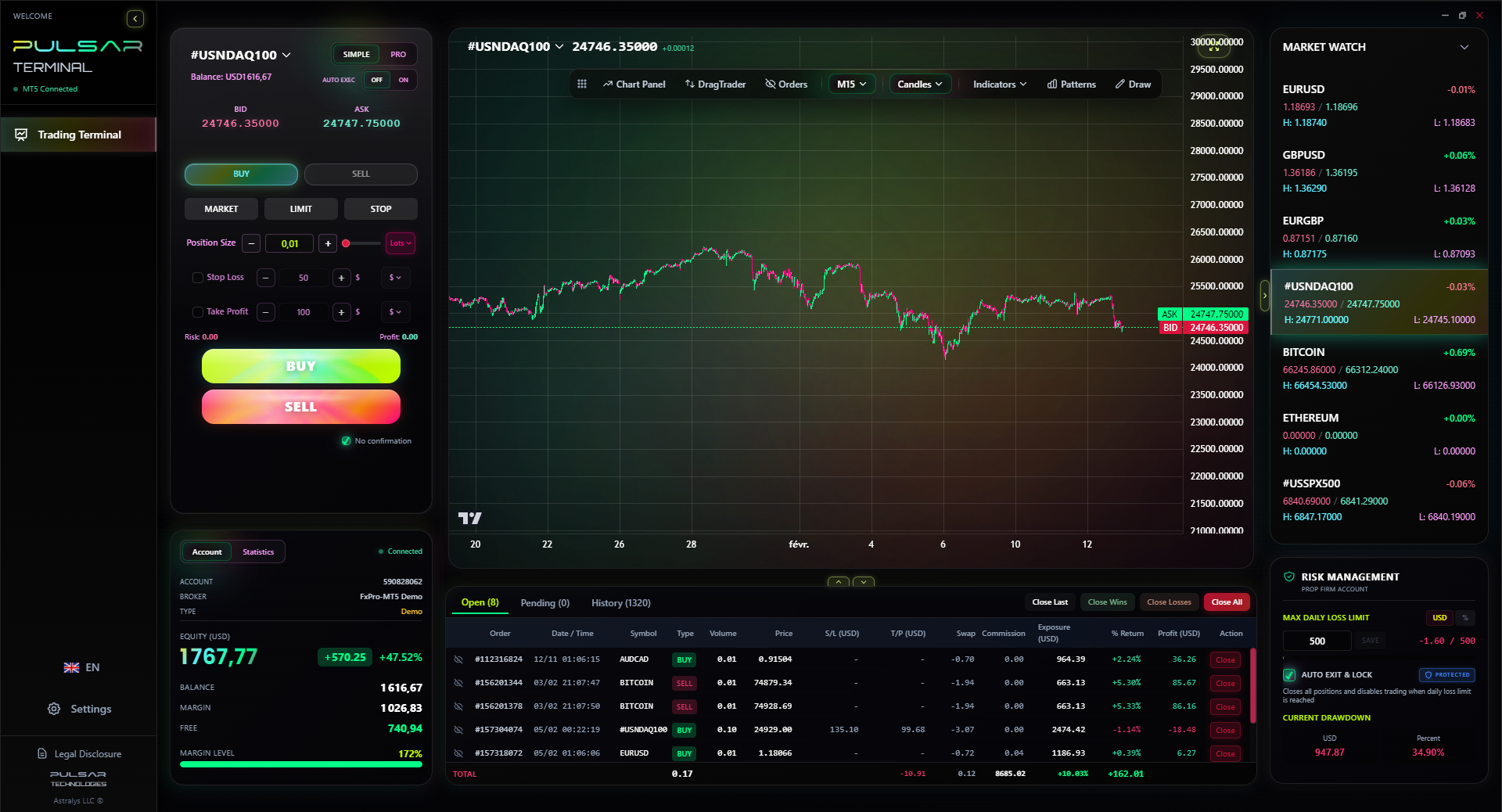
Managing volatile trades requires precision tools; Pulsar Terminal's drag-and-drop orders and multi-TP/SL features let you set complex risk parameters on MT5 in seconds, not minutes.
Pulsar Terminal
A ferramenta MT5 tudo-em-um: ordens drag-and-drop, multi-TP/SL, trailing stop, grid trading, Volume Profile e proteção prop firm. Usado diariamente por 1.000+ traders.
“The Naira's volatility isn't an abstract concept, it directly impacts the cost of your data, fuel, and your trading margin.”
Your broker can be an ally or an obstacle when volatility hits. Here’s what to look for.
Regulation & Safety: Since Nigeria's retail forex regulation is nuanced, prioritize brokers regulated by top-tier international bodies (like the UK's FCA or Australia's ASIC). This offers a layer of protection for your funds. Brokers like XM and AvaTrade are regulated across multiple jurisdictions. This is non-negotiable.
Execution & Spreads: In volatile times, spreads widen. You need a broker known for stable execution and relatively modest spread widening. Check their average spreads on majors during calm times, and read reviews about their behavior during news events. A broker that consistently has a 0.6 pip spread on EUR/USD in calm markets is a good sign.
Deposits & Withdrawals in Naira: This is critical for us. Look for brokers that offer local payment methods (bank transfer, USSD, e-wallets) and Naira-denominated accounts. It removes the currency conversion risk and hassle. Some brokers, like HFM, specifically offer this. Check if your preferred e-wallet (Neteller, Skrill) is supported.
Platform & Tools: You need a platform that can handle volatility. MT4/MT5 are industry standards. Ensure your broker offers them and provides reliable mobile apps. Advanced tools for volatility measurement (like the built-in ATR) and fast order execution are a must.
use Offered: While I advise using low use, it's good to have the option. Ensure the broker offers use suitable for your style. Also, understand their margin call and stop-out levels - these get triggered fast in volatile markets.
My Recommendation: Don't just chase the highest use or biggest bonus. For navigating Nigerian market volatility, I value execution speed and the ability to deposit/withdraw in Naira smoothly above all else. It's the practical stuff that saves you during a crisis.
💡 Dica do Winston
Your psychology has its own volatility index. When you feel the urge to 'get back' at the market after a loss, that's your internal VIX spiking. The only correct trade is to walk away.
“Your job isn't to be in the market during every wild swing. Your job is to survive the volatility.”
Volatility plays with your emotions. The big green candles create greed. The big red candles trigger panic. If you don't manage your mind, you'll make every mistake in the book.
Fear of Missing Out (FOMO): This is the #1 killer during volatile uptrends. You see USD/NGN crashing (Naira strengthening) and you jump in late, without a plan, often near the top. I've done it. The move reverses, and you're left holding a bad trade born of panic. Have a plan and wait for your setup, even if it means missing a move.
Revenge Trading: After a stop-loss is hit by a volatile whip, the urge to 'get back' immediately is overwhelming. You double your size, trade a random pair, and ignore your rules. This is how accounts are destroyed in minutes. When I get stopped out unfairly by volatility, I close the platform. I walk away. Trading is not a duel.
Paralysis: Sometimes, volatility is so high it's frightening. You see opportunities but are too scared to pull the trigger. This is actually a wise instinct sometimes. There's no rule that says you must trade. 'Sitting on your hands' is a valid position. Preserving capital during periods of insane, news-driven volatility is a winning strategy.
The Key Mindset Shift: Stop viewing volatility as a threat to your positions. Start viewing it as a source of opportunity for future positions. Your job isn't to be in the market during every wild swing. Your job is to survive the volatility, let it set up clear chart patterns (breakouts, reversals), and then execute your plan when the conditions are right. The market will always be there tomorrow. Your capital might not be if you fight every storm.
FAQ
Q1Is forex volatility good or bad for traders?
It's neither, it's a condition. It's good if your strategy is designed for it (like breakout trading) and your risk management is tight. It's bad if you're using a low-volatility strategy like tight-range scalping. Skilled traders can profit in both high and low volatility by adapting.
Q2Why is the Naira so volatile compared to other currencies?
The Naira experiences high volatility due to a combination of factors: dependence on oil exports (a volatile commodity), historical forex market controls and multiple exchange rates, periodic liquidity crunches, and significant policy shifts from the CBN as it works to unify and liberalize the market, like the reforms in 2024/2025.
Q3What is the best time to trade forex for volatility in Nigeria?
The most volatile overlaps for a Nigerian trader are during the London session (1 pm - 4 pm Nigerian time) and the London/New York overlap (3 pm - 5 pm Nigerian time). Also, be alert around 1 pm Nigerian time when major European data is released, and during/after CBN Monetary Policy Committee (MPC) meeting announcements.
Q4How does the CBN affect forex volatility?
The CBN is the primary driver of Naira volatility. Its policy announcements (interest rates, FX market guidelines, interventions), its management of foreign reserves, and its operations on the new Electronic Foreign Exchange Matching System (EFEMS) directly and immediately impact liquidity and trader sentiment, causing sharp price movements.
Q5Do I pay tax on profits from trading volatile forex markets in Nigeria?
Yes. Profits from forex trading are considered capital gains. You are liable to pay a 10% Capital Gains Tax on your gross profits to the Federal Inland Revenue Service (FIRS). Keep accurate records of all your trades.
Q6Can I trade forex volatility with a small account in Nigeria?
Yes, but you must be extremely careful. Use micro or cent accounts offered by many brokers. Your main focus must be position sizing. In volatile markets, even a small account can be wiped out quickly with poor sizing. Risk no more than 1% per trade and use sensible use.
Q7What's the biggest mistake traders make in volatile markets?
Not adjusting their position size. They use the same lot size they use in calm markets, but with a wider stop-loss. This means they are actually risking 3 or 4 times more of their account per trade without realizing it. This is the fast track to blowing up.
Lição do Prof. Winston
Pontos-chave:
- ✓Measure volatility with ATR before placing any trade.
- ✓Halve position size when market volatility doubles.
- ✓The 10% Capital Gains Tax applies to your gross forex profits.
- ✓A widening official/parallel market gap signals high volatility risk.
- ✓Prioritize brokers with Naira accounts and stable execution.
Quão útil foi este artigo?
Clique em uma estrela
Insights de Trading Semanal
Análises e estratégias semanais grátis. Sem spam.
Sobre o autor
Olumide Adeyemi
Pioneiro do Trading na África Ocidental
Um dos educadores de trading forex mais ativos da Nigéria. 8 anos de experiência operando a partir de Lagos. Especialista em estratégias de baixo capital e desafios de prop firms para traders africanos.
Comentários
Aviso de risco
A negociação de instrumentos financeiros envolve riscos significativos e pode não ser adequada para todos os investidores. O desempenho passado não garante resultados futuros. Este conteúdo é apenas para fins educacionais e não deve ser considerado aconselhamento de investimento. Sempre conduza sua própria pesquisa antes de negociar.
Você também pode gostar

Cara Trading Forex Sukses: 7 Prinsip dari Trader Profesional
Cara trading forex sukses dengan 7 prinsip trader pro: manajemen modal, disiplin, journal trading, backtest. Data nyata, bukan janji profit palsu.
Jam Trading Forex Terbaik untuk Trader Indonesia: Panduan Lengkap dengan Tabel Waktu
Panduan jam trading forex untuk trader Indonesia. Tabel 4 sesi dunia, jam emas 20:00-00:00, sesi mana yang harus dihindari. Data akurat + tips dari trader berpengalaman.
Top 5 Sàn Forex Uy Tín Nhất 2026: Review Jujur dari Trader Indonesia
Top 5 sàn forex uy tín 2026 untuk trader Indonesia. Review jujur: spread, deposit, withdraw, dukungan lokal. Exness, XM, IC Markets & lebih.
Obter Pulsar Terminal
Todas essas calculadoras estão integradas ao Pulsar Terminal com dados em tempo real da sua conta MT5.
Obter Pulsar Terminal