


Let's cut through the noise.

David van der Merwe
Trader de Mercados Emergentes ·  South Africa
☕ 11 min de leitura
O que você vai aprender:
- 1The Core Game: Liquidity and use
- 2Market Hours and the Volatility Clock
- 3What You're Actually Trading: The Psychology
- 4The Bottom Line: Costs, Commissions, and Tax
- 5Access and Brokers: The South African Reality
- 6My Personal Journey: Wins and Wipeouts
- 7So, Which One Is For You? A Checklist
- 8First Steps and Final Advice

Let's cut through the noise. The biggest mistake I see new South African traders make is picking a market based on hype, not fit. They hear about forex's 24-hour action or the JSE's 'stability' and jump in without understanding the fundamental differences in the game they're about to play. I've blown accounts in both arenas, and I've built them back up. This isn't about which is 'better' - it's about which is better for YOU, your psychology, and your Rands. Let's set the record straight.
This is where the forex vs stock market debate starts and ends for many pros. The numbers don't lie. The global forex market turns over about $7.5 trillion daily. The entire Johannesburg Stock Exchange? Its daily turnover is a fraction of that, often under R20 billion. That difference isn't just a statistic; it's the air you breathe as a trader.
High liquidity in forex means tighter spreads. On major pairs like EUR/USD, you're looking at spreads as low as 0.1 pips with a good broker like IC Markets. On the JSE, even the most liquid shares like Naspers or FirstRand will have a bid-ask spread measured in cents, which as a percentage of the share price can be far more significant. That spread is a silent tax on every trade you make.
Then there's use. In South Africa, the FSCA caps use for retail forex traders at 1:30 for majors and 1:20 for minors. That's still powerful. On the JSE, standard equity trading through a broker might offer 1:1 or, if you're trading CFDs, maybe 1:5 or 1:10 under stricter rules. This use difference fundamentally changes your position sizing and risk. A R10,000 account with 1:30 use lets you control R300,000 worth of currency. That amplifies both gains and losses, demanding military-grade discipline with a position size calculator.

Warning: High use is a double-edged braai fork. I learned this the hard way in 2015. I got a margin call on a GBP/USD short because I used full use and didn't respect the news calendar. A 1% move against me wiped out 30% of my account. On the JSE, that same 1% move with 1:5 use would have only been a 5% loss. use dictates the speed of the game.

💡 Dica do Winston
A market isn't good or bad. It's suitable or unsuitable. Your first task is ruthless self-assessment, not strategy hunting.
Your lifestyle dictates which market you should trade. The JSE runs from 9:00 to 17:00 SAST. That's it. If you have a 9-to-5 job, you're missing the entire show unless you're a night owl or trade on your lunch break. Forex, on the other hand, is a 24-hour beast from Monday morning in Asia to Friday evening in New York.
Trading Around Your Job
For the average South African with a day job, forex offers the only real shot at active trading. You can analyze EUR/USD or Gold (XAU/USD) after work during the New York session, which still has decent liquidity. I used to place swing trading orders before bed, set my stops, and check them in the morning. You can't do that with Sasol shares.
Where the Action Happens
Volatility isn't constant. The JSE has its spikes at the open and around major South African news (SARB rate decisions, budget speeches). Forex volatility is session-driven. The London/UK overlap (10:00-13:00 SAST) is often the most volatile period for pairs like GBP/USD and EUR/USD. If you love fast action, that's your window. For a deeper look at trading a major pair, our EUR/USD guide breaks down its session behavior.

Pro Tip: The most predictable forex volatility is during major economic data releases. A US Non-Farm Payrolls report at 15:30 SAST on a Friday will move markets. The JSE's big moves are often tied to company-specific results or political headlines, which are harder to time and can involve gaps at the open.

“In forex, there's nothing to fall in love with. This forces you to respect the chart.”
This is the invisible layer that breaks most traders. In stocks, you're trading a piece of a company. You can analyze its financials, management, sector trends, and competitive moat. There's a narrative. This appeals to the researcher, the investor. You can convince yourself you're 'right' based on fundamentals, even if the price disagrees (which it often does).
Forex is macroeconomic and technical. You're trading the relative strength of entire economies. Are you betting on the US economy vs the Eurozone? It's abstract. The price is the ultimate truth. This pure technicality suits a different mindset: the pattern reader, the reactionist, the one who can follow price action without needing a 'story.'
I failed at JSE trading initially because I fell in love with my analysis. I believed in a mining stock's long-term prospects while the chart was in a clear downtrend. I averaged down, a classic mistake. In forex, there's nothing to fall in love with. A currency pair has no P/E ratio. This forces you to respect the chart. Tools like the RSI indicator or MACD indicator often work cleaner in forex because there's less 'noise' from individual company news.
The psychological speed is also different. A fast scalping strategy on the EUR/USD during London open requires ice in your veins. Holding a JSE share for a dividend play requires patience. Know which one aligns with your temperament.
Let's talk about the Rands and cents. How much does it cost to play?
| Cost Factor | Forex (e.g., EUR/USD) | JSE Equity (e.g., Naspers CFD) |
|---|---|---|
| Primary Cost | Spread (e.g., 0.8 pips = ~R1.60 per mini lot) | Broker Commission + Spread (e.g., 0.1% commission + 10c spread) |
| Overnight Fee | Swap Rate (can be positive or negative) | Financing Charge (usually an interest rate) |
| Data/Market Fees | Usually none with broker | Often a small JSE data charge |
Forex costs are typically baked into the spread. You buy at the ask, sell at the bid. With a tight-spread broker like Pepperstone, this is very efficient for frequent traders. JSE trading often involves a explicit commission (e.g., 0.15% of trade value) PLUS the bid-ask spread.
The Tax Man Cometh
This is critical for South Africans. SARS treats these differently.
- Forex Trading Profits: Generally considered revenue from a business (if you trade regularly) and taxed as ordinary income at your marginal rate. You can deduct trading-related expenses. Losses can be carried forward.
- JSE Share Trading (Investing): If you hold shares for longer periods, profits may qualify for capital gains tax (CGT). The inclusion rate is 40% for individuals, and you get an annual exclusion (around R40,000). This can be more favorable.
- JSE CFD Trading: Treated similarly to forex - as revenue. It's the trading activity, not the underlying asset, that often dictates the tax treatment.

Example: In 2022, I made R150,000 from forex trading. After deducting platform fees, internet, and a portion of home office costs, my taxable income was R120,000. That got added to my salary and taxed at my highest rate. A R150,000 capital gain from selling shares held for 3 years would have had only R60,000 included in my taxable income (40% of R150,000), and I could have used my annual exclusion. Talk to a tax professional, but understand this structural difference.
💡 Dica do Winston
The most expensive tool in trading is your own narrative. In stocks, it's 'this company is undervalued.' In forex, it's 'the Fed can't possibly hike.' The price doesn't care about your story.
“Your first live account should be money you are 100% prepared to lose. The goal of your first year is not to get rich. It's to survive.”
You can't trade without a gateway. Your choice here is shaped by regulation and practicality.
For Forex and CFDs, you have two main paths:
- International Brokers: Many top-tier global brokers accept South African clients. They offer the best platforms (MT4/MT5), razor-sharp spreads, and direct market access. Examples include IC Markets, Pepperstone, and XM. Your funds are held offshore. Funding and withdrawing in ZAR involves a bank transfer, which can take 1-3 days and incur a forex conversion fee from your bank.
- Local FSCA-Regulated Brokers: Some brokers like Exness have local entities. This can simplify ZAR deposits/withdrawals via Instant EFT. Regulation feels closer to home, but product offerings and spreads may differ from their international arms.
For Direct JSE Share Investing, you'll use a local stockbroker (like EasyEquities, Standard Bank WebTrader) or your bank's trading platform. This is for buying the actual shares. For JSE CFD trading, you'd use a CFD provider (like IG or a forex broker that offers JSE CFDs).
Warning: Always, always check the regulator. For forex, the FSCA is our local watchdog, but brokers regulated by ASIC (Australia), CySEC (Cyprus), or the FCA (UK) are also reputable. Never deposit with an unregulated 'bucket shop' promising insane use. I've seen too many guys lose it all because the broker's 'platform' mysteriously froze during a big news event.
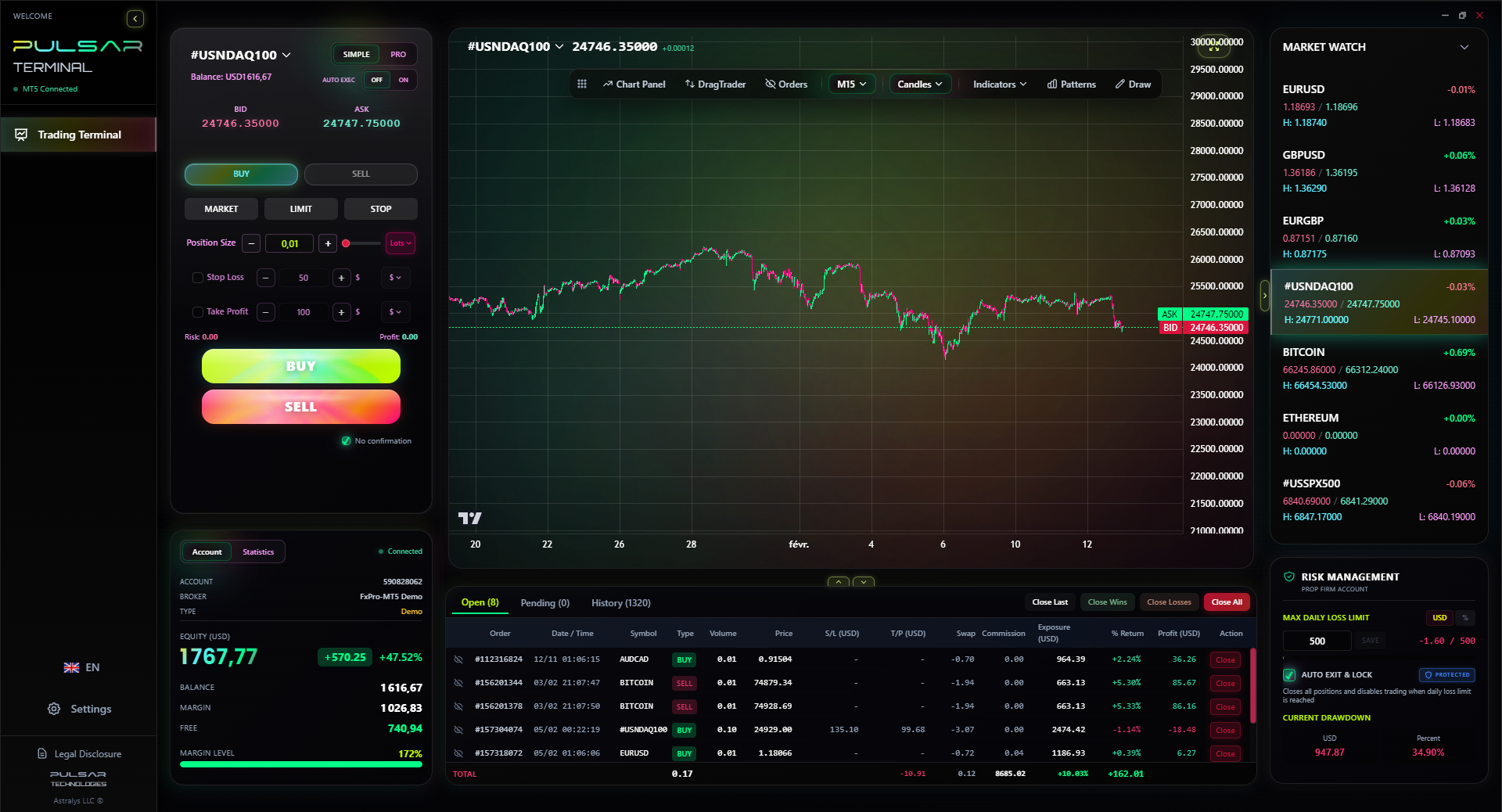
Managing multiple trades and precise risk across different markets is complex, but tools like Pulsar Terminal streamline this with drag-and-drop orders and multi-TP/SL management directly on your MT5 platform.
Pulsar Terminal
A ferramenta MT5 tudo-em-um: ordens drag-and-drop, multi-TP/SL, trailing stop, grid trading, Volume Profile e proteção prop firm. Usado diariamente por 1.000+ traders.
Theory is cheap. Let me give you two real trades from my ledger.
The Forex Whip-Saw: In January 2020, I was short GBP/USD at 1.3200 ahead of Brexit news. I had a 50-pip stop loss. News hit, it spiked to 1.3280, took me out for a R2,500 loss, and then immediately reversed and crashed 150 pips. I was right on the direction, wrong on the timing. The 24-hour market's liquidity evaporated for a second, my stop became a market order, and I got filled at a terrible price. Lesson: In forex, during high-impact news, consider wider stops or staying out. The spread definition becomes theoretical; the real cost is slippage.
The JSE 'Value Trap': In 2018, I bought shares in a well-known SA retailer at R45 per share. The fundamentals looked solid, dividend yield was good. The chart, however, was breaking down. I ignored it, believing in the 'value.' I watched it slide to R35, then R30. I finally sold at R28, a 38% loss on a 'safe' stock. The forex market would have stopped me out mechanically. The stock market let me bleed slowly, convincing myself I was an 'investor.'
The Win That Shaped Me: My most consistent profits have come from combining the two. I use forex for shorter-term, technical trades where I can control risk tightly with stops. I use the JSE for longer-term, smaller positions in companies I want exposure to, almost like a savings plan, but I still use a technical stop. I don't mix the strategies.
“Choose the arena where you can stick around long enough to learn the game.”
Stop overthinking. Answer these questions honestly.
You might be better suited for FOREX if you:
- Have a day job and can only trade nights or early mornings.
- Prefer pure technical analysis over company research.
- Have a smaller starting capital (under R20,000) and need the efficiency of tight spreads and use to make meaningful trades.
- Can handle fast-paced action and the psychological discipline to use stops every single time.
- Want to trade the ZAR directly (like USD/ZAR) based on SA politics and economics.
You might be better suited for the STOCK MARKET (JSE) if you:
- Are a natural researcher who enjoys digging into financial statements and industry trends.
- Have a longer-term time horizon and more patience.
- Want to build a portfolio of assets for potential dividends and capital appreciation over years.
- Are unsettled by the abstract nature of currency trading and prefer owning a 'piece' of something.
- Have a larger starting capital that makes brokerage fees less impactful.
The Hybrid Approach (What I Do Now): Use forex for active, tactical trading where your edge is technical and risk-defined. Use the JSE for strategic, longer-term exposure. Never confuse the two timeframes or methodologies in the same account.
💡 Dica do Winston
Your first profitable system will be boring. It will involve taking small, consistent gains and cutting losses even faster. Glamour is for losers.
Before you risk a single cent:
- Paper Trade BOTH. Open a demo account with a forex broker and a demo with a JSE CFD provider. Trade them side-by-side for 3 months. Track not just your P&L, but your emotional state. Which one feels like work? Which one feels like a puzzle you enjoy?
- Start Smaller Than You Think. Your first live account should be money you are 100% prepared to lose. I don't care if it's R2,000 or R20,000. The goal of your first year is not to get rich. It's to learn, make mistakes, and survive. A margin call is a brutal teacher.
- Specialize. Don't jump from EUR/USD to Gold to Sasol shares in the same week. Pick one market and one instrument to start. Master the pip definition in that context. Understand its daily range, its news drivers. Become a specialist, not a tourist.
- Your Edge is in Routine. The market doesn't care about your genius. It rewards consistency. Build a daily routine: check the economic calendar, review charts, plan your trades, write them down. This routine is more important than any indicator.
The forex vs stock market choice isn't permanent. You can switch. But starting in the wrong one for your personality is a sure way to burn out and lose money before you ever find your edge. Choose the arena where you can stick around long enough to learn the game.
FAQ
Q1Which market is easier to make money in for a beginner?
Neither is 'easy,' but beginners often self-destruct faster in forex due to high use. The JSE can feel slower, but its gaps and lower liquidity present different traps. Ease isn't the metric. Sustainability is. Start with a demo to see which environment you understand better before risking real money.
Q2Can I trade the JSE with the same use as forex?
No. South African regulations are stricter for equity CFDs. While forex use for retail clients is capped at 1:30, use on single-stock CFDs (like JSE shares) is typically much lower, often around 1:5 or 1:10 maximum. This is a protective measure, as individual shares can gap dramatically on news.
Q3Do I need more money to start trading stocks vs forex?
Not necessarily. With forex use, you can control a large position with a small deposit. To buy actual JSE shares, you need the full amount for at least one share (e.g., ~R2000 for one Naspers share). However, through JSE CFDs, you can get exposure with less capital, similar to forex. The real difference is in the cost structure and available use.
Q4Is forex riskier than stock trading?
Risk is a function of your position size and use, not the market itself. A highly leveraged forex trade is incredibly risky. A poorly timed investment in a volatile JSE stock is also very risky. Forex risk is often more immediate and mechanical (stop losses get hit fast). Stock market risk can be a slow bleed where you rationalize holding on. Both can wipe you out if you're reckless.
Q5How do I analyze forex vs stocks?
Forex is primarily technical and macroeconomic. You watch central bank policies, interest rate differentials, and geopolitical events. You live on the chart. Stocks involve fundamental analysis (financial ratios, earnings, management) combined with technicals and sector analysis. You need to understand the company's story. The tools in your analysis toolkit are different.
Q6As a South African, should I just trade USD/ZAR?
Trading your home currency pair is tempting because you understand the news. But USD/ZAR can be wildly volatile and prone to political shocks and liquidity dry-ups. It's not a 'safer' pair. Many pros recommend starting with a major pair like EUR/USD where spreads are tightest and liquidity is deepest, then later applying those skills to ZAR pairs if you choose.
Q7Can I use the same broker for both?
Some international brokers like Exness or IC Markets offer both forex and JSE/global stock CFDs on the same platform (like MT5). This is convenient. For buying actual JSE shares (not CFDs), you'll likely need a separate account with a dedicated South African stockbroker or your bank.
Lição do Prof. Winston
Pontos-chave:
- ✓Forex liquidity is ~$7.5T/day; JSE is ~$1B. This defines spreads and slippage.
- ✓FSCA caps retail forex use at 1:30; JSE equity CFDs are often 1:5.
- ✓Forex profits are taxed as income; long-term JSE gains may qualify for CGT.
- ✓Trade forex if you need after-hours action; trade stocks if you're a researcher.
- ✓Your psychology must match the market's rhythm or you will break.
Quão útil foi este artigo?
Clique em uma estrela
Insights de Trading Semanal
Análises e estratégias semanais grátis. Sem spam.
Sobre o autor
David van der Merwe
Trader de Mercados Emergentes
Trader sediado em Joanesburgo com 11 anos em moedas de mercados emergentes. Especialista em pares ZAR, trading regulado pela FSCA e análise do mercado sul-africano.
Comentários
Aviso de risco
A negociação de instrumentos financeiros envolve riscos significativos e pode não ser adequada para todos os investidores. O desempenho passado não garante resultados futuros. Este conteúdo é apenas para fins educacionais e não deve ser considerado aconselhamento de investimento. Sempre conduza sua própria pesquisa antes de negociar.
Você também pode gostar

Cara Trading Forex Sukses: 7 Prinsip dari Trader Profesional
Cara trading forex sukses dengan 7 prinsip trader pro: manajemen modal, disiplin, journal trading, backtest. Data nyata, bukan janji profit palsu.
Jam Trading Forex Terbaik untuk Trader Indonesia: Panduan Lengkap dengan Tabel Waktu
Panduan jam trading forex untuk trader Indonesia. Tabel 4 sesi dunia, jam emas 20:00-00:00, sesi mana yang harus dihindari. Data akurat + tips dari trader berpengalaman.
Top 5 Sàn Forex Uy Tín Nhất 2026: Review Jujur dari Trader Indonesia
Top 5 sàn forex uy tín 2026 untuk trader Indonesia. Review jujur: spread, deposit, withdraw, dukungan lokal. Exness, XM, IC Markets & lebih.
Obter Pulsar Terminal
Todas essas calculadoras estão integradas ao Pulsar Terminal com dados em tempo real da sua conta MT5.
Obter Pulsar Terminal