


I stared at my trading terminal in late 2023, watching a R42,000 profit on a USD/ZAR trade solidify.

David van der Merwe
Trader de Mercados Emergentes ·  South Africa
☕ 10 min de leitura
O que você vai aprender:
I stared at my trading terminal in late 2023, watching a R42,000 profit on a USD/ZAR trade solidify. The hard part was over, right? Wrong. Getting that money from the broker into my Standard Bank account turned into a two-week saga of SWIFT codes, unexpected fees, and a nasty surprise from SARS. That experience, and a few others since, taught me that in South Africa, the forex withdraw process is a trade in itself. You need a strategy for it, just like you do for the markets.
Let's get the legalities straight first. Trading forex is completely legal here, and the Financial Sector Conduct Authority (FSCA) is the sheriff in town. They license and oversee brokers operating in South Africa. This is good news for your money. An FSCA-regulated broker must keep your funds in segregated accounts. That means your capital is separate from the broker's operating money. If they go under (it happens), your money isn't part of their bankruptcy estate.
You can also use international brokers, and many of us do for better platforms or specific instruments. But here's the catch the FSCA's protection doesn't follow you there. If an unregulated offshore broker decides to play funny with your withdrawal, you have very few recourses. I learned this the hard way early on with a small broker that suddenly had "technical issues" every time I requested a payout. That R5,000 is still in limbo.
There's a big change coming, too. The Conduct of Financial Institutions (COFI) Bill is winding its way through parliament. It's expected to land in 2026 and will likely tighten the screws even further on how all financial firms, including forex brokers, conduct business. For now, sticking with FSCA-licensed names like IC Markets, Pepperstone, or XM is the safest bet for a smooth forex withdraw process.

Warning: Using an unregulated international broker is a calculated risk. You might get better spreads, but you're betting they'll always act honorably when you want your profits back. For your main trading account, I wouldn't risk it.

💡 Dica do Winston
Treat your withdrawal path like a trade setup. Backtest it with a small amount first. A R500 test withdrawal will reveal the true fees and speed before you send your life's savings through the system.
This is where they get you. Your broker might offer "free withdrawals," but that just means they won't charge a fee on their end. The real pain comes from the banking system. When you initiate an international forex withdraw back to South Africa, you're sending a cross-border payment. The banks see this as a payday.
Let me break down what happened with my R42,000 (roughly $2,250 at the time) withdrawal:
- SWIFT Fee: Standard Bank charged me R650 just to process the incoming international wire. This is standard, ranging from R500 to R1,000.
- Exchange Rate Margin: This is the silent killer. The broker sent me $2,250. The real mid-market rate that day was about R18.70/USD. My bank gave me a rate of R18.55. That 0.15 difference is a 0.8% hidden fee. On larger amounts, this margin can be 1.5% to 3% or more.
- Flat Receiving Fee: Another R185 slapped on by the bank.
The Alternative: E-Wallets
After that fiasco, I switched to using Skrill for most withdrawals. The process is faster (often same-day) and the fees are more transparent. Skrill converts to ZAR at a decent rate and deposits directly into my bank account for a small percentage fee. The total cost was about 1.5% compared to the bank's combined 2.5%+. For a R100,000 forex withdraw, that's saving R1,000. PayPal is another option, but their conversion rates to ZAR are notoriously poor.

Example: A R1,000,000 withdrawal via traditional bank wire.
- Amount Sent: $53,475 (at R18.70/$)
- SWIFT/Receiving Fees: ~R800
- Bank Exchange Rate (1.5% margin): R18.42/$
- Amount Received: R984,934
- Total Lost to Fees: R15,066 That's over 1.5% gone before tax. It pays to shop for the best transfer method.
“In South Africa, the forex withdraw process is a trade in itself. You need a strategy for it, just like you do for the markets.”
Alright, you've navigated the broker and the banks. Now comes the permanent partner in your trading journey: the South African Revenue Service. Ignoring them is the fastest way to turn a profitable trading year into a financial nightmare.
Your forex trading profits are considered income by SARS, not capital gains (unless you're a very sporadic, long-term trader, which most of us aren't). This means it gets added to your total annual income and taxed at your marginal rate. Those rates range from 18% up to 45%.
Here's the critical bit: you must register as a provisional taxpayer if your taxable income from non-PAYE sources (like trading) exceeds R79,000 per year. Even if you earn less, you're still supposed to declare it. I made the mistake one year of thinking my R65,000 in profits was "under the radar." SARS didn't agree, and the penalty was not worth the hassle.
You need to keep impeccable records. I use a simple spreadsheet: date, instrument (like EUR/USD), entry/exit price, profit/loss in Rands, and a running total. Your broker statements are your proof. When tax season comes, this log is your bible. If you trade through a registered company, it's a flat 28% rate. For most retail traders, it's the personal income tax scale.

Pro Tip: Open a separate savings account and label it "SARS Provision." Every time you make a profitable withdrawal, immediately transfer 25-30% of the net profit (after banking fees) into that account. When the provisional tax payment is due, the money is already set aside. It removes the temptation and the panic.
💡 Dica do Winston
The bank's 'free' transfer is a myth. The fee is baked into the exchange rate. Always calculate the final ZAR you receive versus the mid-market rate. That difference is your real cost of doing business.
Let's walk through a typical forex withdraw, from the broker to your pocket. Assuming you're using an FSCA-regulated broker and your bank.
- Request on Broker Platform: Log in, go to the withdrawals section. Select your amount and the method (Bank Wire, Skrill, etc.). You'll need your South African bank details: account holder name (must match your trading account), bank name, branch code, SWIFT/BIC code, and your account number. Double-check these. A typo here can delay things for weeks.
- Verification: For first-time withdrawals or large amounts, the broker will likely ask for verification. This usually means a copy of your ID and a recent utility bill or bank statement proving your address. Have these PDFs ready to upload.
- Broker Processing: This takes 1-3 business days for most reputable brokers. You'll get an email confirmation.
- International Transit: The money is now in the banking system. This leg can take another 2-5 business days.
- Bank Notification & Conversion: Your local bank receives the funds in USD/EUR/GBP. They'll notify you (sometimes), apply their fees, convert it to ZAR at their rate, and deposit it.
- Record for SARS: The moment it lands, note the final ZAR amount, the date, and any fees deducted. Update your trading P&L log immediately.
The entire process can take 5-10 business days for a bank wire. E-wallets are faster, often 24-48 hours. For larger sums, I sometimes split the withdrawal into two smaller amounts over two weeks. It feels safer and sometimes helps avoid additional bank scrutiny.
“The bank's exchange rate margin is the silent killer of your trading profits.”
A smooth forex withdraw starts long before you hit the "request" button. It starts with your trading discipline. If you're constantly flirting with a margin call, you'll never have consistent profits to pull out.
Your position sizing is everything. Early on, I'd get a couple of good scalping wins on GBP/USD and immediately increase my lot size, dreaming of a big payout. The next drawdown would wipe out the gains and then some. I wasn't trading to withdraw, I was trading to gamble. Now, I use a strict position size calculator that risks no more than 1% of my account on any single trade. It's boring, but it builds withdrawable capital consistently.
Your trading strategy also dictates your withdrawal rhythm. A swing trading approach that holds trades for weeks will have less frequent, but potentially larger, withdrawal opportunities. A scalper might make small, weekly withdrawals. Plan for it. I set a quarterly withdrawal schedule now. Every three months, I assess my net profit, set aside the tax portion, and withdraw 50% of the remainder. The other 50% stays in the account to compound. This system forces me to only withdraw real, sustained profits, not just lucky wins.
Tools that help you manage trades precisely are a godsend for protecting profits. Being able to set multiple take-profit levels or automate a trailing stop means you're locking in gains systematically, which directly leads to more reliable withdrawals.
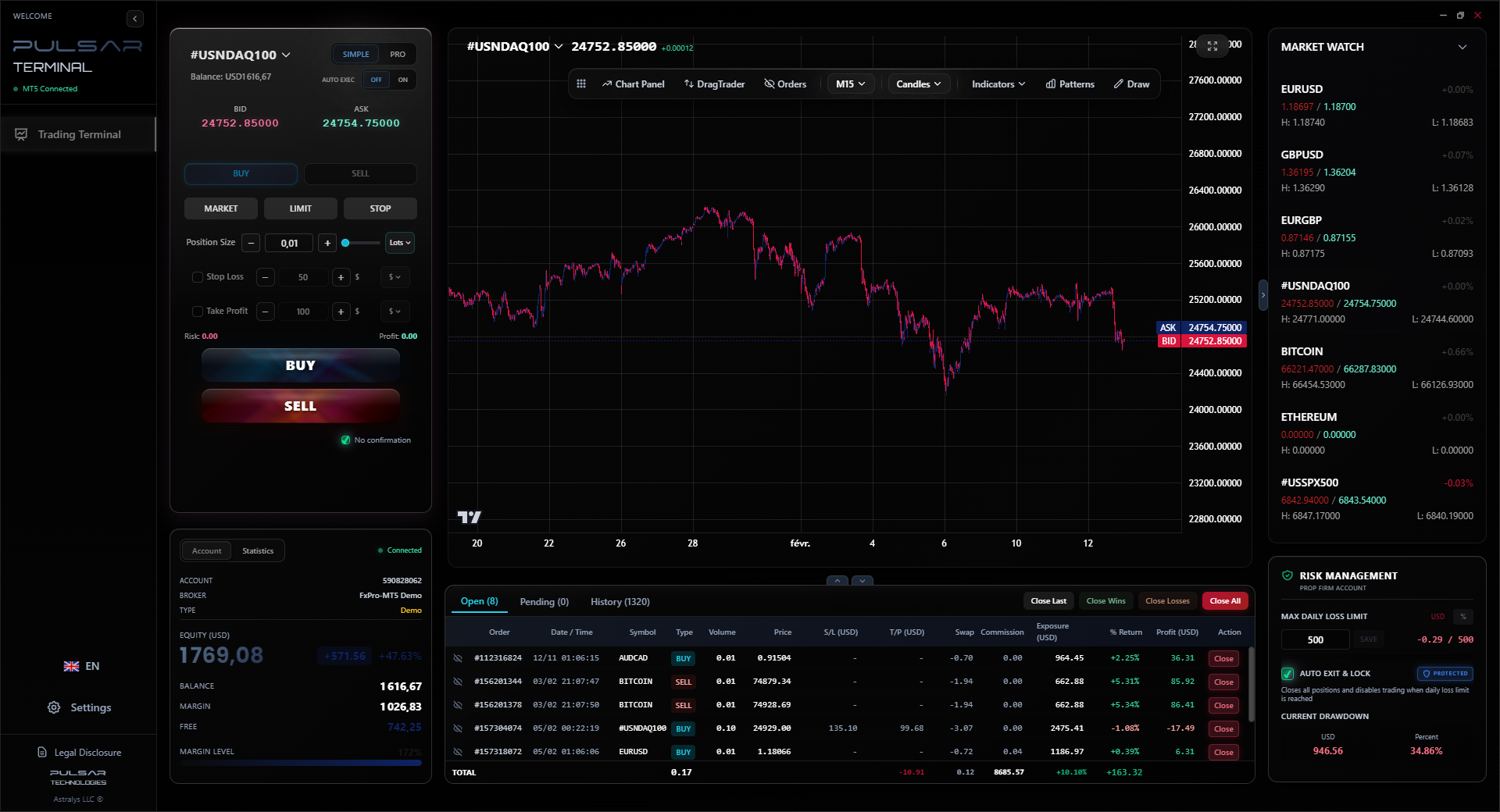
Locking in consistent profits for withdrawal starts with precise trade management, and tools like Pulsar Terminal automate advanced order types like trailing stops and multi-level take-profits directly on your MT5 platform.
Pulsar Terminal
A ferramenta MT5 tudo-em-um: ordens drag-and-drop, multi-TP/SL, trailing stop, grid trading, Volume Profile e proteção prop firm. Usado diariamente por 1.000+ traders.
Not all brokers are created equal when it comes to getting your money out. Here’s what to look for, beyond just the spread on XAU/USD.
Withdrawal Speed & Fees: This is your top criteria. Check the broker's website for clear info on processing times and if they charge a fee. Many FSCA brokers like the ones listed in the briefing offer free withdrawals, which is the baseline you should accept.
Available Methods: A good broker will offer multiple channels. Look for:
- Local Bank Transfer (EFT): The holy grail. Some brokers have local South African banking partners. This means your withdrawal is a domestic EFT, not an international wire. Fees are tiny (like R50) and it's in your account in 1-2 days. Ask about this first.
- International Bank Wire: The standard fallback.
- E-Wallets: Skrill, Neteller, PayPal. Essential for speed.
- Crypto: Some brokers offer withdrawals via USDT or Bitcoin. This can be very fast and low-cost, but you then have to convert crypto to ZAR on a local exchange, which adds another step and fee.
Minimum Withdrawal Amount: Usually not a problem, but check. It's typically around $50 or R500.
Verification Process: A rigorous KYC (Know Your Customer) process is annoying but a sign of a legitimate broker. Expect to provide your ID and proof of address upfront. It's for everyone's security.
My advice? Before you deposit a cent with a new broker, test their support. Send an email asking: "What are your withdrawal methods to South Africa, what are the processing times, and are there any fees?" Their response time and clarity will tell you a lot.
💡 Dica do Winston
SARS isn't your opponent; poor planning is. Your trading journal isn't complete until it includes a column for 'Tax Provision.' A profitable trader who can't pay their tax bill is, in reality, a losing trader.
“A profitable trader who can't pay their tax bill is, in reality, a losing trader.”
I've stepped on most of these landmines so you don't have to.
Pitfall 1: The Bonus Trap. You see a "100% deposit bonus!" offer. It sounds great. But these bonuses almost always come with massive withdrawal conditions. You might need to trade a volume equivalent to 30 or 40 times the bonus amount before you can withdraw any of your own money. I got stuck in one of these for months, trading furiously just to unlock my capital. Now, I avoid deposit bonuses entirely.
Pitfall 2: Inconsistent Account Details. Your withdrawal must go to an account in your name that matches your trading account. If you deposited from your savings account but try to withdraw to your cheque account, it can trigger a fraud alert and a lengthy review. Use one dedicated bank account for all trading activity.
Pitfall 3: Ignoring the Tax Provision. This is the biggest one. You withdraw R80,000, spend it, and then eight months later SARS wants R22,000. You don't have it. Set the money aside immediately, as I mentioned before. It's not your money until SARS gets their share.
Pitfall 4: Chasing Withdrawals with More Trading. You request a withdrawal, and while it's processing, you feel a "gap" in your account balance. The temptation is to jump into a risky trade to "make up for it." This is emotional trading at its worst. The withdrawal period should be a cooling-off time. Step away from the charts.
Finally, if a withdrawal is delayed, don't panic. First, check the broker's status page for announcements. Then, contact support politely but firmly with your withdrawal ID. Having a record of your communication is key. Most delays are just bureaucratic hiccups in the global banking system.
FAQ
Q1How long does a forex withdrawal to South Africa take?
It depends on the method. An international bank wire to a South African bank typically takes 5-10 business days from request to landing in your account. E-wallet withdrawals (like Skrill) are much faster, often within 24-48 hours. The fastest option is if your broker supports a local South African EFT, which can be 1-2 days.
Q2How much tax will I pay on my forex trading profits?
Your profits are added to your other income and taxed at your personal income tax rate (from 18% to 45%). You must register as a provisional taxpayer with SARS if your non-PAYE income (like trading) exceeds R79,000 in a tax year. Always set aside at least 25-30% of your net profit for tax.
Q3Are there forex brokers with free withdrawals to South Africa?
Yes, many FSCA-regulated brokers offer free withdrawals, meaning they don't charge a fee on their end. However, your South African bank will almost always charge fees for receiving an international wire (SWIFT fees, receiving fees) and may give you a poor exchange rate, which is a hidden cost.
Q4What is the best way to withdraw forex profits to avoid high fees?
First, check if your broker offers a local South African EFT option - this is the cheapest. If not, using an e-wallet like Skrill is usually faster and has more transparent, lower total costs than a traditional international bank wire. Always compare the final ZAR amount you receive after all conversions.
Q5Can I withdraw forex profits to a bank account not in my name?
No, you absolutely cannot. Anti-money laundering (AML) regulations require that withdrawals only be sent to an account held in the exact same name as your verified trading account. Attempting this will freeze your withdrawal and likely get your account suspended.
Q6What documents do I need for my first forex withdrawal?
You'll need proof of identity (a clear copy of your South African ID or passport) and proof of residential address (a recent utility bill or bank statement, less than 3 months old). The name and address on these documents must match your trading account details.
Q7My withdrawal is delayed. What should I do?
First, check the expected processing time on your broker's website. If it's past that, contact their support team via email or live chat. Provide your withdrawal reference number and ask for a status update. Be polite but persistent. Most delays are due to banking processes or additional verification checks.
Lição do Prof. Winston
Pontos-chave:
- ✓Test withdrawal channels with small amounts first.
- ✓Immediately set aside 25-30% of profits for SARS.
- ✓Local EFT is king; e-wallets are queen for speed.
- ✓Broker withdrawal policies are as important as their spreads.
Quão útil foi este artigo?
Clique em uma estrela
Insights de Trading Semanal
Análises e estratégias semanais grátis. Sem spam.
Sobre o autor
David van der Merwe
Trader de Mercados Emergentes
Trader sediado em Joanesburgo com 11 anos em moedas de mercados emergentes. Especialista em pares ZAR, trading regulado pela FSCA e análise do mercado sul-africano.
Comentários
Aviso de risco
A negociação de instrumentos financeiros envolve riscos significativos e pode não ser adequada para todos os investidores. O desempenho passado não garante resultados futuros. Este conteúdo é apenas para fins educacionais e não deve ser considerado aconselhamento de investimento. Sempre conduza sua própria pesquisa antes de negociar.
Você também pode gostar

Cara Trading Forex Sukses: 7 Prinsip dari Trader Profesional
Cara trading forex sukses dengan 7 prinsip trader pro: manajemen modal, disiplin, journal trading, backtest. Data nyata, bukan janji profit palsu.
Jam Trading Forex Terbaik untuk Trader Indonesia: Panduan Lengkap dengan Tabel Waktu
Panduan jam trading forex untuk trader Indonesia. Tabel 4 sesi dunia, jam emas 20:00-00:00, sesi mana yang harus dihindari. Data akurat + tips dari trader berpengalaman.
Top 5 Sàn Forex Uy Tín Nhất 2026: Review Jujur dari Trader Indonesia
Top 5 sàn forex uy tín 2026 untuk trader Indonesia. Review jujur: spread, deposit, withdraw, dukungan lokal. Exness, XM, IC Markets & lebih.
Obter Pulsar Terminal
Todas essas calculadoras estão integradas ao Pulsar Terminal com dados em tempo real da sua conta MT5.
Obter Pulsar Terminal