


The biggest lie in South African forex is that you can start with 'just R500' and turn it into a fortune.

David van der Merwe
Trader de Mercados Emergentes ·  South Africa
☕ 10 min de leitura
O que você vai aprender:
- 1The Technical Minimum vs. The Practical Minimum
- 2Breaking Down the Real Costs of Trading
- 3The South African Regulatory & Tax Reality
- 4A Sensible Capital Framework for SA Traders
- 5Where to Put Your Starting Capital (Broker Choices)
- 6The Psychology of Account Size: Why More is Often Safer
- 7Your Step-by-Step Funding Plan
The biggest lie in South African forex is that you can start with 'just R500' and turn it into a fortune. Brokers love that story because it gets you to deposit. The truth is, while you can technically open an account with pocket change, that's a surefire way to blow up. Let's set the record straight with real numbers, FSCA rules, and the cold, hard math of survival.
Let's separate marketing from reality. On paper, the barrier to entry is almost zero.
You can find brokers like XM or FBS that let you open a live account with a $5 deposit (about R90). A cent account at FXTM starts at $200 (R3,600). Khwezi Trade, a local FSCA-regulated broker, asks for R500. So yes, you can 'start trading' with the cost of a decent steak.
But here's the brutal truth: starting with the technical minimum is like trying to drive from Johannesburg to Cape Town on a single litre of petrol. You might move the car, but you're not going anywhere meaningful, and you'll break down spectacularly.
The practical minimum isn't about opening an account. It's about having enough capital to:
- Survive your inevitable losing streaks without a margin call.
- Place trades with sensible position sizes that don't require insane use.
- Pay the costs (spreads, potential commissions) without them devouring your tiny equity.
I learned this the hard way. In 2015, I funded an account with R1,000, thinking I was being 'smart' by starting small. My first ten trades were a mix of small wins and losses. Then I hit a classic losing streak - five trades in a row. Even risking just 2% per trade, my account was down over 10%. The psychological pressure to 'make it back' with my now R900 account was immense, and I promptly broke every rule, doubled my position size, and wiped out the rest. The amount was small, but the lesson was expensive: underfunding is a form of self-sabotage.

Warning: A micro account is for learning the mechanics of a trading platform, not for building a strategy or an income. Treating it as the latter is the most common beginner mistake.

💡 Dica do Winston
Your first loss is your cheapest lesson. A R200 loss on a R20,000 account teaches you the same as a R200 loss on a R2,000 account, but the latter ends your career.
“Starting with the technical minimum is like trying to drive from Johannesburg to Cape Town on a single litre of petrol.”
Before you decide how much you need, you have to know what it costs to play the game. It's not just your trade stake.
The Silent Tax: Spreads & Commissions
This is your biggest, most consistent cost. The spread is the difference between the buy and sell price. On the EUR/USD, a good raw spread might be 0.1 pips, but a standard account might have 1.5 pips. Let's do the math everyone ignores.
If you trade one mini lot (10,000 units) on EUR/USD with a 1.5 pip spread, each trade immediately costs you R23 (1.5 pips * R1.54 per pip on a mini lot). If you're a frequent trader making 20 trades a week, that's R460 a week in spread costs alone, or nearly R2,000 a month. On a R5,000 account, that's a 40% monthly hurdle just to break even. You see the problem?
ECN accounts often have razor-thin spreads but charge a commission per lot. You must calculate your all-in cost per trade. A position size calculator is non-negotiable for this.
The use Trap
South Africa's FSCA caps use at 30:1 for major pairs. This is a protective measure, but beginners see it as a tool to amplify tiny accounts. They think, 'With R1,000 and 30:1 use, I can control R30,000!'
Yes, and you can also lose R1,000 in the blink of an eye. High use on a small account forces you to use stop-losses that are dangerously tight, vulnerable to normal market noise. I once tried scalping the GBP/JPY with high use on a small account. The volatility swallowed my 5-pip stop-losses for breakfast. use doesn't change your edge; it just accelerates the outcome.
Software, Data & Education
While MT4/MT5 is free, serious charting tools or trade journaling software might have monthly fees. Reliable internet is a must. And please, budget for real education - books, courses from reputable sources - not just YouTube gurus selling dreams. This is a business startup cost.
“Underfunding is not being frugal; it's a form of self-sabotage that guarantees failure.”
Your trading capital isn't just for the markets. You need to keep the FSCA and SARS happy.
FSCA Rules & Your Capital
Trading with an FSCA-licensed broker like Khwezi Trade means your funds are segregated and you have local recourse. This safety has a subtle cost: you're limited to that 30:1 use. Some are tempted by offshore brokers offering 500:1, but you lose that local protection. For me, the security of FSCA oversight is worth the use limit. It stops me from doing something catastrophically stupid.
Also, remember the SARB rules. You can't speculate against the ZAR with a local broker. Want to short USD/ZAR on a hunch? You can't. Your forex trading will be on major pairs like EUR/USD or XAU/USD. Large withdrawals back to SA (over R1 million) also involve paperwork. This doesn't affect your starting capital, but it frames your entire trading environment.
The SARS Question
This is critical. Your net trading profits are taxable income. You must keep careful records of every trade. When you're calculating 'how much you need,' you must factor in that a portion of your profits will go to tax. Trading with R10,000 and making a 20% return (R2,000) isn't a R2,000 gain. After tax, it's less. You need a bigger capital base so that your post-tax returns are meaningful. I know traders who had a great year, forgot about tax, and then had to liquidate trading capital to pay their SARS bill, crippling their ability to trade the next year. Don't be that person.
“Underfunding is not being frugal; it's a form of self-sabotage that guarantees failure.”
Let's build a model based on risk, not dreams.
The Absolute Minimum for Serious Practice: R5,000 - R10,000 This is the zone where you can begin to apply real risk management. If you risk a maximum of 1% per trade (R50-R100), your stop-loss can be placed at a technically sound level, not just a few pips away. You can withstand a 10-trade losing streak (which will happen) and only be down 10%. The psychological game changes completely. You can think about the trade, not the money.
The Ideal Starter Capital for Building a Track Record: R20,000 - R50,000 This is the sweet spot for a dedicated beginner. With R20,000, a 1% risk is R200 per trade. This allows for sensible position sizes on standard lots. The costs (spreads) become a smaller percentage of your account. Most importantly, the profits, while still modest, start to feel real. A 5% monthly gain is R1,000. That can cover some bills, reinforcing positive behavior. This size account lets you properly test a swing trading strategy over months.
Why R20,000 is a Magic Number Let's use our position size calculator. Account: R20,000. Risk per trade: 1% = R200. Trading EUR/USD, with a stop-loss of 20 pips. How much can you trade?
Position size = (Account Risk) / (Stop-loss in pips * Pip Value) R200 / (20 pips * R1.54 per pip on a mini lot) = ~6.5 mini lots.
You can trade a meaningful position without use insanity. The stop-loss is wide enough to breathe. This is sustainable.

Example: Starting with R5,000 vs. R20,000.
| Scenario | Account Size | 1% Risk | After a 10-Loss Streak | Mental State |
|---|---|---|---|---|
| Small Account | R5,000 | R50 | R4,500 (Down 10%) | Panicked, likely to revenge trade. |
| Adequate Account | R20,000 | R200 | R18,000 (Down 10%) | Disappointed, but the strategy is intact. |
The second trader is still in the game. The first one is usually on the phone to their broker's support desk.
💡 Dica do Winston
If you're calculating how many trades it will take to double a tiny account, you're already thinking like a gambler, not a trader.
“A larger starting account doesn't make you reckless; it makes you durable enough to survive the learning process.”
Your broker choice can protect or endanger your starting capital. In South Africa, you have two paths.
1. FSCA-Regulated Local Brokers Pros: Client money segregation, use capped at 30:1, local legal recourse, easier ZAR deposits/withdrawals. Cons: Often higher spreads, cannot speculate on ZAR pairs, lower use. Example: Khwezi Trade (Min deposit ~R500). Good for peace of mind.
2. International Brokers (Also FSCA Licensed or Offshore) Many top global brokers have FSCA licenses or accept SA clients. They often have tighter spreads and more advanced platforms.
- Exness: Known for low minimum deposits and flexible accounts.
- IC Markets: A favorite for raw spread ECN accounts. Their commission-based pricing is excellent for active traders.
- XM: Offers a huge range of instruments and a low $5 minimum, great for absolute beginners to test the waters.
- Pepperstone: Another strong ECN broker with great execution.
My advice? If you're starting with under R20,000, the tighter spreads of an international ECN broker like IC Markets or Pepperstone can make a significant difference to your costs. Just ensure they are properly licensed. I use an international broker for the pricing, but I keep my risk per trade low to compensate for the higher available use I don't use.

Pro Tip: Never deposit your entire starting capital at once. Fund your chosen broker with 50%, trade for a month, test withdrawals, get comfortable. Then add the rest. This mitigates the (small) risk of broker issues.
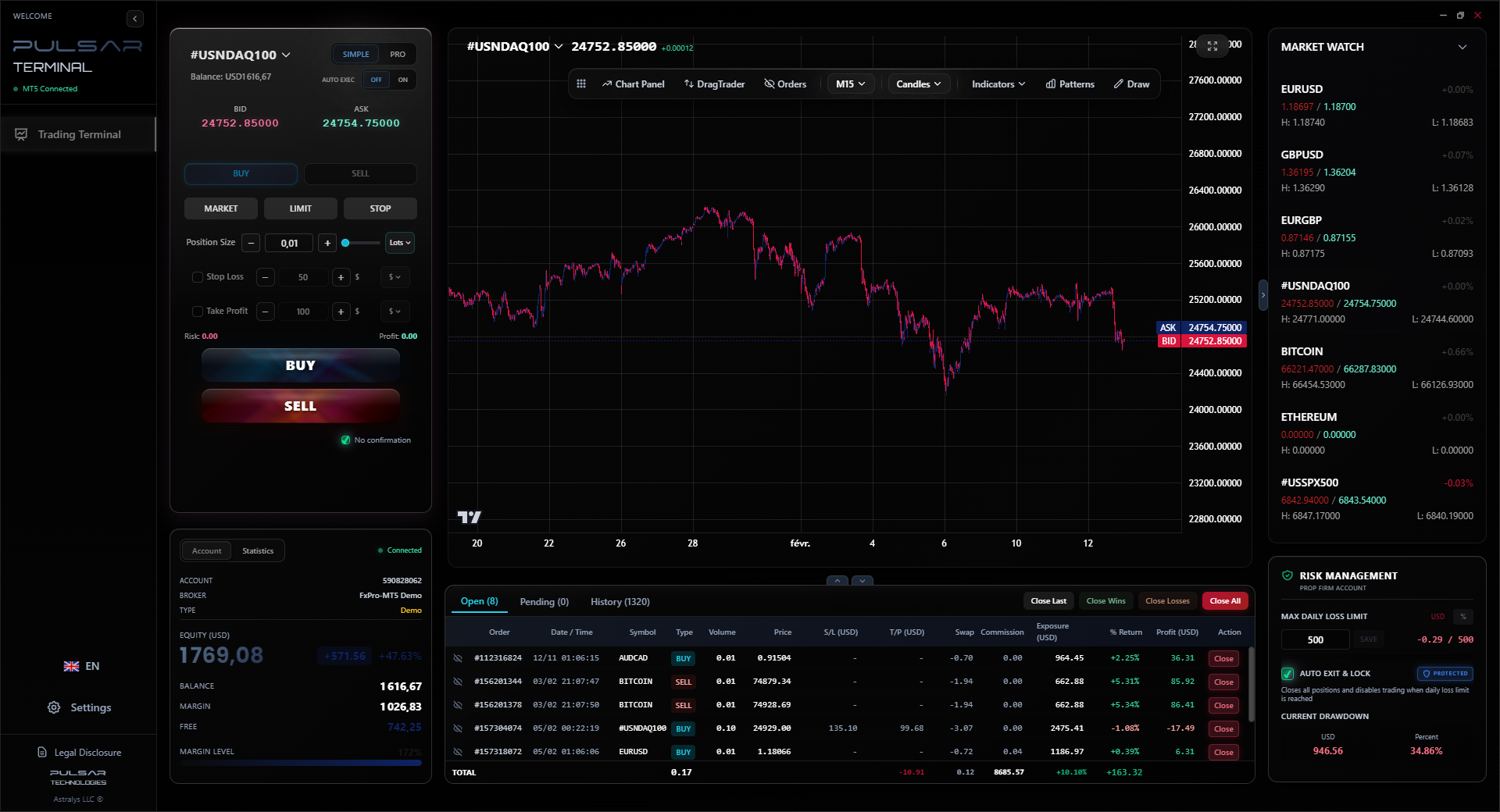
Managing multiple trades and setting precise stop-losses is critical for capital preservation, and tools like Pulsar Terminal automate this directly on your MT5 platform.
Pulsar Terminal
A ferramenta MT5 tudo-em-um: ordens drag-and-drop, multi-TP/SL, trailing stop, grid trading, Volume Profile e proteção prop firm. Usado diariamente por 1.000+ traders.
“A larger starting account doesn't make you reckless; it makes you durable enough to survive the learning process.”
This is the counterintuitive secret. A larger starting account makes you a safer trader.
With a R2,000 account, a R200 loss is 10%. That feels like a disaster. It triggers emotional, irrational decisions. You'll move your stop-loss, you'll overtrade to recover.
With a R20,000 account, that same R200 loss is 1%. It's a cost of doing business. You can shrug it off and stick to your plan. The pressure to be 'right' on every trade evaporates. This is when you start making decisions based on chart patterns and your RSI indicator readings, not on fear and desperation.
I want you to think of your starting capital as a durability fund. Its primary job isn't to generate massive returns immediately. Its job is to be large enough to absorb the punches of the market while you learn. The profits are a secondary byproduct of your growing skill. If you can't afford to lose the money without it affecting your rent or groceries, you are underfunded and will almost certainly lose it.
Your first trading goal should not be 'make 50% this month.' It should be 'survive for 6 months without blowing up.' Only a sufficiently sized account lets you do that.
💡 Dica do Winston
The market doesn't care if you traded 0.01 lots or 100 lots. A 50-pip loss hurts the same percentage. Focus on the percentage, not the rand amount.
“Your starting capital is a durability fund. Its first job is to survive, not to perform.”
Let's turn this into an action plan.
Phase 1: The Demo (Capital Required: R0) Spend 2-3 months on a demo account. Not to 'make fake money,' but to test your emotional reactions to drawdowns. Practice with a virtual R100,000 account, but trade as if it's R20,000. Use proper risk management from day one.
Phase 2: The Micro-Live Test (Capital: R500 - R2,000) Open a live cent or micro account with a small amount. The goal here is to feel the psychological shift of real money on the line and to test broker execution and withdrawals. Do not try to grow this account. Try to preserve it for 3 months.
Phase 3: The Serious Starter Account (Capital: R20,000) This is your real launch. Fund your chosen broker with this amount. Your rules are now set in stone:
- Maximum risk: 1% per trade.
- Use a stop-loss on every single trade.
- Keep a detailed trade journal.
- Your monthly goal is consistency, not a percentage return.
Phase 4: Growth & Scaling Only after 6-12 months of consistent, documented profitability in your Phase 3 account should you consider adding more capital. Profits should be withdrawn periodically to pay yourself and taxes. Reinvest only a portion.
If you don't have R20,000 saved, then save it. Get a side hustle. The discipline required to save that money is the same discipline you'll need to trade it. Starting underfunded is the number one reason I see South African traders quit within a year. Don't rush the most important part.
FAQ
Q1Can I really start forex trading in South Africa with just R500?
Technically, yes. Some brokers accept it. But practically, it's a terrible idea. With R500, proper risk management is impossible. Trading costs (spreads) will eat a huge percentage of your account, and a single small loss will create immense psychological pressure, leading to mistakes. It's a practice account, not a funding strategy.
Q2How does the FSCA 30:1 use limit affect how much I need?
It protects you. It means you can't use insane use to artificially inflate the power of a tiny account. This forces you to have more realistic capital. To control a meaningful position size with 30:1 use, you need more equity in your account. This is a good thing - it prevents you from blowing up in seconds.
Q3Do I have to pay tax on my forex trading profits in South Africa?
Absolutely. SARS views net forex trading profits as income. You must declare it and pay income tax on it. This is a crucial part of your capital calculation. You need to make enough profit that, after tax, your effort is worthwhile. Keep every trade statement for your accountant.
Q4Is it better to use a South African broker or an international one?
It's a trade-off. A local FSCA broker (e.g., Khwezi Trade) offers maximum legal security and easy ZAR transfers. International brokers (like IC Markets or Pepperstone) often have better pricing (tighter spreads). Many top international brokers are also FSCA licensed. For most serious starters, an international broker with good regulation offers the best balance of cost and safety.
Q5What's the single biggest mistake when deciding on starting capital?
Funding an account with 'risk-free' money - money you can't afford to lose. If the loss of your starting capital would cause financial pain or emotional devastation, you are guaranteed to trade scared. You'll break your rules, hold losers, and cut winners short. Your starting capital must be money you can afford to lose completely, even though that's not your plan.
Q6Should I start with a standard account or a cent account?
Start with a cent account for the first 1-2 months of live trading to get used to the psychology of real money. Then, move to a standard or micro account with your proper starting capital (R20,000+). Cent accounts are for learning mechanics, not for building long-term profitability.
Lição do Prof. Winston
Pontos-chave:
- ✓The technical minimum to open an account is under R100, but the practical minimum to apply risk management is R5,000-R10,000.
- ✓An ideal starting capital for a serious beginner is R20,000. This allows for 1% risk per trade and withstands drawdowns.
- ✓FSCA's 30:1 use cap is a protective feature, not a limitation. It demands adequate capital.
- ✓All trading profits are taxable income by SARS. Factor this into your profitability goals.
- ✓Broker choice (local vs. international) impacts your costs. Prioritise tight spreads and strong regulation.
Quão útil foi este artigo?
Clique em uma estrela
Insights de Trading Semanal
Análises e estratégias semanais grátis. Sem spam.
Sobre o autor
David van der Merwe
Trader de Mercados Emergentes
Trader sediado em Joanesburgo com 11 anos em moedas de mercados emergentes. Especialista em pares ZAR, trading regulado pela FSCA e análise do mercado sul-africano.
Comentários
Aviso de risco
A negociação de instrumentos financeiros envolve riscos significativos e pode não ser adequada para todos os investidores. O desempenho passado não garante resultados futuros. Este conteúdo é apenas para fins educacionais e não deve ser considerado aconselhamento de investimento. Sempre conduza sua própria pesquisa antes de negociar.
Você também pode gostar

Cara Trading Forex Sukses: 7 Prinsip dari Trader Profesional
Cara trading forex sukses dengan 7 prinsip trader pro: manajemen modal, disiplin, journal trading, backtest. Data nyata, bukan janji profit palsu.
Jam Trading Forex Terbaik untuk Trader Indonesia: Panduan Lengkap dengan Tabel Waktu
Panduan jam trading forex untuk trader Indonesia. Tabel 4 sesi dunia, jam emas 20:00-00:00, sesi mana yang harus dihindari. Data akurat + tips dari trader berpengalaman.
Top 5 Sàn Forex Uy Tín Nhất 2026: Review Jujur dari Trader Indonesia
Top 5 sàn forex uy tín 2026 untuk trader Indonesia. Review jujur: spread, deposit, withdraw, dukungan lokal. Exness, XM, IC Markets & lebih.
Obter Pulsar Terminal
Todas essas calculadoras estão integradas ao Pulsar Terminal com dados em tempo real da sua conta MT5.
Obter Pulsar Terminal