


My screen was a sea of red.

David van der Merwe
Trader de Mercados Emergentes ·  South Africa
☕ 12 min de leitura
O que você vai aprender:
- 1Forex is Not a Side Hustle, It's a Business (And SARS Agrees)
- 2The FSCA Rules You Can't Ignore
- 3The Real Costs of Trading from SA
- 4Picking a Broker That Doesn't Suck
- 5Trading the ZAR Pairs (Without Getting Smoked)
- 6A Simple System That Actually Works (For Beginners)
- 7Psychology: The Only Real Edge You Have
- 8Putting It All Together: Your First 90 Days
My screen was a sea of red. It was March 2020, the Rand was in freefall, and my short USD/ZAR position was bleeding. I was down R42,000 in an hour, convinced the world was ending. Then, I remembered the first rule: panic is a plan killer. I didn't add to the losing trade. I sat on my hands. The market eventually retraced, and I closed for a smaller, manageable loss. That R42,000 lesson cost me less than blowing up my entire account, which is what happens to most people who ask how to earn in forex. They think it's a quick hack. It's not. It's a grind, especially here. With nearly R400 billion traded daily locally and over 200,000 of us trying, you need more than hope. You need a system, and you need to know the local rules of the game.
Let's get this straight from the start. If you're looking for a 'side hustle' to buy a new braai set, walk away. This is a business with real capital, real risk, and real tax implications. The South African Revenue Service (SARS) doesn't see your trading profits as a lucky windfall. They see it as income. That means it's taxed at your marginal income tax rate, not the lower capital gains rate. I learned this the hard way in 2018 when I had a great year and got a nasty letter. I hadn't kept proper records. Don't be me.
You need to track every single trade: entry, exit, profit, loss, and the broker's fees. Use a spreadsheet or a dedicated journal. When SARS comes knocking - and with their intensified focus as of 2026, they will - you need to show them the paperwork. This isn't optional admin; it's part of the cost of doing business. Thinking of forex as a business changes everything. You start focusing on risk management, not just the next big score. You plan your position size calculator based on your account equity, not your gut. You treat losses as business expenses, not personal failures. This mindset shift is the single biggest factor in moving from a gambler to someone who knows how to earn in forex sustainably.

💡 Dica do Winston
Your first R10,000 profit is the most expensive you'll ever make. You'll pay for it in lessons, sleepless nights, and bad trades. Don't withdraw it. Reinvest it as 'learning capital.'
Trading with an unregulated offshore broker is like buying a car without a license. It might work until you crash. The Financial Sector Conduct Authority (FSCA) is our watchdog. Their job is to stop the worst abuses. Every broker you seriously consider must be on their Financial Service Provider Register. Check it. It takes two minutes.
The use Cap: Your Best Friend
The FSCA's 30:1 use cap for retail traders is the best thing that ever happened to new South African traders. I know, it sounds restrictive. When I started, you could get 500:1. I blew up two small accounts because of it. use amplifies losses faster than gains. At 30:1, a 3.3% move against you wipes out your margin. That's still huge, but it forces you to size your positions properly. It stops you from going 'all in' on a whim. Professional traders can apply for higher use, but you need to prove you know what you're doing. Don't even think about it yet.
Where Your Money Lives
FSCA-regulated brokers must keep your money in segregated accounts. This means if the broker goes belly-up (it happens), your funds are separate from their operating money and should, in theory, be safe. This is non-negotiable. I only keep funds with brokers who offer this basic protection. It's the bare minimum for trust.

Warning: Some big international brokers, like IG, are changing how they onboard South African clients. As of early 2026, new IG clients might be served from an international entity, not their FSCA-licensed one. This means you might not get local legal protection. Always confirm which entity you're signing up with.
“Earning in forex isn't about one magical trade. It's about surviving long enough for the probabilities to work.”
Your broker isn't your friend. They're a service provider you pay. If you don't know what you're paying, you're already losing. There are three main costs that eat into your profits.
The Spread: This is the difference between the buy and sell price. It's how many 'no commission' brokers make their money. For the EUR/USD, expect around 0.6 pips on a standard account. On the USD/ZAR, it can be 80-150 pips because it's less liquid. You're down that amount the second you enter the trade.
Commissions: Some brokers, like Tickmill or Fusion Markets, offer 'raw' accounts with spreads near 0.0 pips but charge a commission. For example, Tickmill's Raw account charges $3 per side per lot. So, opening and closing a standard lot (100,000 units) costs you $6. You need to add this to the spread definition to get your true cost.
Swap Rates: Hold a position overnight? You'll pay or receive interest. For ZAR pairs, this can be significant. If you're long USD/ZAR (earning the higher SA interest), you might get a small credit. If you're short, you'll pay. These rates change daily. I got caught in 2021 holding a short GBP/ZAR position over a long weekend. The swap cost me more than the trade's eventual profit. Always check the swap rate before holding.

Example: Let's say you trade 1 standard lot on USD/ZAR with a 100 pip spread and a $5 commission. Your total cost to enter and exit is (100 pips * R0.70 per pip approximate value) + $10 commission = ~R170. Your trade needs to move over 100 pips in your favor just to break even on costs.
With so many options, choice paralysis is real. I've funded accounts with over a dozen brokers in my time. Here’s the lay of the land for a South African in 2026.
| Broker | Key Thing to Know | Good For... | Watch Out For... |
|---|---|---|---|
| Tickmill | Low costs, FSCA regulated. Raw account: ~0.11 pip spread + $3/side commission. | Serious traders who trade volume and want transparent costs. | Minimum deposit $100. The commission adds up if you're a hyper-active scalping strategy trader. |
| IC Markets | Raw spreads, insane execution speed (35ms). Rebates for high volume. | Tech-focused traders and algorithmic trading. Their raw spread model is excellent. | Can be overwhelming for beginners. Do your own IC Markets review. |
| XM | $5 minimum deposit, ZAR accounts available. | Beginners wanting to test with very little capital. | Spreads on the commission-free account are wider (from 0.8 pips on EUR/USD). |
| AvaTrade | FSCA regulated (license 45984), fixed spreads. | Traders who hate variable spreads and want cost certainty. | Fixed spreads are usually higher than the average variable spread. You pay for the certainty. |
| HFM (HotForex) | High use options (up to 1:2000), Zero Spread accounts. | Experienced traders who understand and can handle extreme use. | That 1:2000 use is a guaranteed account destroyer if misused. Tread carefully. |
My advice? Start with a demo account on two or three. Get a feel for their platform, then deposit the minimum into one. You can always move later. I personally keep accounts with both Tickmill and IC Markets for different strategies.
“If you don't know what you're paying your broker, you're already losing.”
Trading your home currency is tempting. You follow the news, you feel it. But USD/ZAR, EUR/ZAR, GBP/ZAR are a different beast to the majors like EUR/USD guide.
They're volatile. Political news, load-shedding rumors, a Moody's report - anything can send it moving 200 pips in an hour. This is opportunity, but also extreme risk. A standard position size calculator based on a 2% risk might tell you to trade 2 lots. On USD/ZAR, that could mean a R2,800 risk per pip. A bad 50-pip move against you is R140,000. You see the problem.
They have wide spreads. As mentioned, 80-150 pips is normal. This makes short-term trading like scalping nearly impossible. You're fighting an enormous cost from the get-go. These pairs are better suited for swing trading where you're aiming for 500-1000 pip moves over days or weeks.
My ZAR Trade Gone Wrong: In late 2022, I went long USD/ZAR at R17.80, betting on continued dollar strength. I placed my stop at R17.60, a 200-pip risk. Overnight, some positive SA data hit, and the pair gapped down at the open to R17.55. My stop was triggered, but at the worse price. I lost 250 pips instead of 200. The lesson? With volatile pairs, consider wider stops or avoid holding over major news events. Sometimes, the smarter play is to trade global markets (like Gold via XAU/USD guide) and avoid the ZAR rollercoaster altogether.
💡 Dica do Winston
The 200-period EMA isn't just a line on a chart. It's a crowd sentiment gauge. Price above it means the long-term crowd is optimistic. Trade with the crowd, not against it.
You don't need a complicated strategy with 15 indicators. You need consistency. Here's a brutally simple framework I used to turn my trading around after those early blow-ups. It combines price action with one or two indicators.
1. Find the Trend (The 200 EMA Filter): On a 4-hour or daily chart, slap on a 200-period Exponential Moving Average (EMA). If the price is above it, I only look for buy setups. If the price is below it, I only look for sell setups. This keeps you trading with the higher-timeframe momentum. No more trying to pick tops and bottoms.
2. Wait for a Pullback: In an uptrend (price above 200 EMA), wait for the price to dip back down towards a key area. This could be the 50 EMA, a previous support level, or a Fibonacci retracement level (38.2%, 50%).
3. Look for Confirmation: As price reaches this area, I switch to a 1-hour chart. I want to see a sign of the downtrend exhaustion. My favorite is a bullish divergence on the RSI indicator (price makes a lower low, but RSI makes a higher low). Or, a simple bullish pin bar (hammer) candlestick.
4. Enter and Manage Risk: Enter on a break of the high of that confirmation candle. Place your stop loss below the recent swing low. Your take profit should be at least 1.5 times your risk (Risk/Reward of 1:1.5). Use a position size calculator so this stop loss represents 1% of your account.
This isn't a holy grail. You'll have losing trades. But it gives you clear, rules-based entries and exits. It removes emotion. I used a version of this to catch a nice move on GBP/USD in Jan 2026: entered at 1.2650 after a pullback to the 50 EMA on the 4H, stop at 1.2620 (30 pips), target at 1.2700 (50 pips). It hit target in two days. Simple, boring, effective.
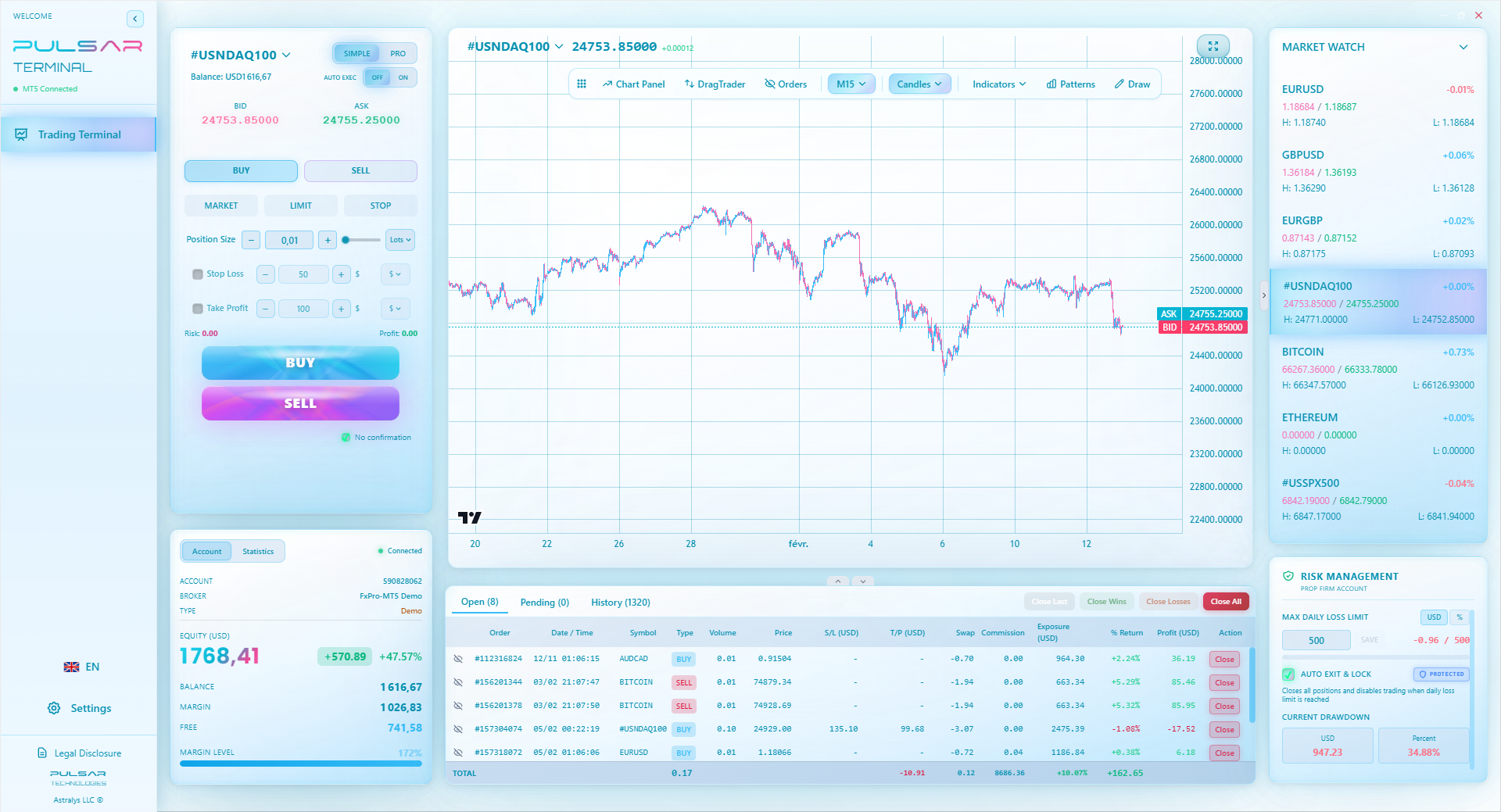
When you're managing multiple trades with a system, manually moving stops to breakeven or trailing them is a chore that leads to mistakes.
Pulsar Terminal
A ferramenta MT5 tudo-em-um: ordens drag-and-drop, multi-TP/SL, trailing stop, grid trading, Volume Profile e proteção prop firm. Usado diariamente por 1.000+ traders.
“Everyone has access to the same charts. The difference between the 10% and the 90% is between the ears.”
Everyone has access to the same charts, the same news, the same brokers. The difference between the 10% who consistently know how to earn in forex and the 90% who don't is between the ears.
Fear of Missing Out (FOMO): You see USD/ZAR ripping higher. You jump in without a plan, way above any sensible entry. It reverses, and you're stuck in a losing trade. I've done it. The cure? Have a daily watchlist. If a pair isn't on your list, you don't trade it. No exceptions.
Revenge Trading: You take a loss. You're angry. You immediately jump into another trade twice the size to 'make it back.' This is the fastest path to a margin call. My rule: After two consecutive losses, I shut the platform down for the day. Go for a walk. The market will be there tomorrow.
Overconfidence: You have three winning trades in a row. You start thinking you're Warren Buffett. You increase your position size recklessly. The next trade wipes out all your profits. The cure is rigid position sizing. Never risk more than 1-2% of your account on a single trade, no matter how 'sure' you are.

Pro Tip: Keep a trading journal. Not just of trades, but of your emotions. Write down how you felt before, during, and after each trade. After a month, you'll see patterns. You'll see that your losing trades often happen when you're bored, tired, or emotional. This self-awareness is more valuable than any indicator.
💡 Dica do Winston
If you can't explain your trade setup in one simple sentence ('I'm buying because price pulled back to the 50 EMA in an uptrend'), you don't have a setup. You have a hope.
Here's your action plan, step-by-step.
Month 1: Paper Trading & Education.
- Open a demo account with an FSCA-regulated broker like XM review or Pepperstone review.
- Practice the simple system I outlined. Don't deviate.
- Learn how to calculate pips, position size, and risk/reward manually.
- Read the FSCA's basic guides on derivative trading. Know the rules.
Month 2: Live Trading (Micro Account).
- Deposit the minimum amount into a live account. R1,500-R2,000 is enough.
- Trade the smallest possible size (0.01 lots, micro lots).
- Your goal for this month is NOT to make money. Your goal is to execute your plan perfectly for 20 trades. Hit your stops without hesitation. Take your profits when they come.
- Get your tax spreadsheet set up from day one.
Month 3: Review & Refine.
- Analyze your 20 live trades. What was your win rate? Your average risk/reward?
- If you followed your plan but still lost, the problem is the plan, not you. Tweak it.
- If you didn't follow your plan, the problem is discipline. Go back to demo until you fix it.
- Start reading price action more. Maybe add the MACD indicator as a secondary trend confirmation tool.
This process is slow. It's boring. But it builds a foundation that doesn't collapse when the market gets wild. Earning in forex isn't about one magical trade. It's about surviving long enough, and being consistent enough, for the probabilities to work in your favor over hundreds of trades. That's the only secret there is.
FAQ
Q1Is forex trading legal and safe in South Africa?
Yes, it's legal, but 'safe' depends on you. It's safe if you use an FSCA-regulated broker (check their register), understand the 30:1 use cap protects you from yourself, and treat it as a high-risk business, not a game. Trading with unregulated offshore entities offers zero local legal protection.
Q2How much money do I need to start forex trading in South Africa?
Technically, you can start with as little as $5 (about R90) with brokers like XM. But realistically, to practice proper risk management (risking 1% per trade on a 0.01 lot), a starting capital of R5,000-R10,000 is more sensible. Remember, your first goal is to learn and preserve capital, not get rich.
Q3How are my forex profits taxed by SARS?
SARS views frequent trading as income-generating, not an investment. Your net profit (total profits minus total losses and trading costs) is added to your other income and taxed at your marginal income tax rate. You must declare it. careful record-keeping of every trade, deposit, and withdrawal is non-negotiable.
Q4What is the best forex trading platform for beginners in SA?
MetaTrader 4 (MT4) is still the king for beginners. It's simple, stable, and almost every broker offers it. There are thousands of free indicators and a massive community for support. Get comfortable with MT4 on a demo account before even thinking about more advanced platforms like MT5 or cTrader.
Q5Can I trade forex using my FNB or Standard Bank account?
Yes, but not directly on a trading platform. You'll use your bank account to deposit ZAR into your broker's account. Most FSCA brokers accept bank wire transfers, and many also accept e-wallets like Skrill or Neteller, which can be linked to your bank account. Always check for deposit/withdrawal fees first.
Q6Why is the spread on USD/ZAR so much wider than on EUR/USD?
Liquidity. EUR/USD is the most traded pair in the world, with billions traded every minute. USD/ZAR has far less trading volume. The wider spread (often 80-150 pips) is the market maker's compensation for the higher risk of holding a less liquid asset. It's a major cost you must overcome to be profitable.
Q7What's the biggest mistake new South African forex traders make?
Two tied for first: 1) Using excessive use, trying to turn R1,000 into R50,000 in a week (this always ends in a margin call). 2) Trading ZAR pairs like USD/ZAR with the same short-term, small-stop strategies they use on majors. The volatility and wide spreads will chew up small accounts.
Lição do Prof. Winston
Pontos-chave:
- ✓Trade forex as a taxed business, not a side hustle.
- ✓Always verify FSCA registration before depositing any money.
- ✓The 30:1 use cap is a protective gift, not a limitation.
- ✓ZAR pairs require wider stops and a swing-trading mindset.
- ✓Risk a maximum of 1-2% of your capital on any single trade.
Quão útil foi este artigo?
Clique em uma estrela
Insights de Trading Semanal
Análises e estratégias semanais grátis. Sem spam.
Sobre o autor
David van der Merwe
Trader de Mercados Emergentes
Trader sediado em Joanesburgo com 11 anos em moedas de mercados emergentes. Especialista em pares ZAR, trading regulado pela FSCA e análise do mercado sul-africano.
Comentários
Aviso de risco
A negociação de instrumentos financeiros envolve riscos significativos e pode não ser adequada para todos os investidores. O desempenho passado não garante resultados futuros. Este conteúdo é apenas para fins educacionais e não deve ser considerado aconselhamento de investimento. Sempre conduza sua própria pesquisa antes de negociar.
Você também pode gostar

Cara Trading Forex Sukses: 7 Prinsip dari Trader Profesional
Cara trading forex sukses dengan 7 prinsip trader pro: manajemen modal, disiplin, journal trading, backtest. Data nyata, bukan janji profit palsu.
Jam Trading Forex Terbaik untuk Trader Indonesia: Panduan Lengkap dengan Tabel Waktu
Panduan jam trading forex untuk trader Indonesia. Tabel 4 sesi dunia, jam emas 20:00-00:00, sesi mana yang harus dihindari. Data akurat + tips dari trader berpengalaman.
Top 5 Sàn Forex Uy Tín Nhất 2026: Review Jujur dari Trader Indonesia
Top 5 sàn forex uy tín 2026 untuk trader Indonesia. Review jujur: spread, deposit, withdraw, dukungan lokal. Exness, XM, IC Markets & lebih.
Obter Pulsar Terminal
Todas essas calculadoras estão integradas ao Pulsar Terminal com dados em tempo real da sua conta MT5.
Obter Pulsar Terminal