


It was March 2025, and the USD/NGN was screaming higher, hitting 1717.

Olumide Adeyemi
Pioneiro do Trading na África Ocidental ·  Nigeria
☕ 10 min de leitura
O que você vai aprender:
It was March 2025, and the USD/NGN was screaming higher, hitting 1717. I had a perfect setup on the daily chart - a clear breakout after a consolidation. My finger hovered over the buy button. I hesitated for three seconds, watching the price jump another 50 pips without me. That moment, that gut punch of missed opportunity, is why you need a system. Knowing how to take trade in forex isn't about guts; it's about a repeatable, disciplined process that works whether you're in Lagos or London. Let's build yours.
Most new traders in Nigeria get this backwards. They see the Naira falling, panic, and jump into a USD/NGN trade without a plan. That's a sure way to donate your capital to the market. Taking a trade starts long before you open your platform.
First, you need a trading plan. This isn't a fancy document; it's a set of rules you write down. What pairs do you trade? (Stick to majors like EUR/USD or GBP/USD when starting). What time of day? London session (2 PM our time) is often best for volatility. What's your maximum daily loss? I use 2% of my account. If I lose that, I'm done for the day. No arguments.
Your broker choice is critical here. You need one that won't disappear with your money. Look for international brokers regulated by bodies like the UK's FCA or Australia's ASIC. Many accept Nigerian clients. I've used Exness and IC Markets for years because their execution is fast and spreads are tight, especially on EUR/USD. A slow platform or wide spread can kill a good trade before it starts.
Finally, know your costs. That 10% capital gains tax on profits is real. The SEC is getting stricter, so keep a clean record. Factor in the spread - the difference between the buy and sell price. On a standard account, a 0.6 pip spread on EUR/USD means the price has to move 0.6 pips in your favor just for you to break even. It adds up.
“Knowing how to take trade in forex isn't about guts; it's about a repeatable, disciplined process.”
You don't need to be a genius. You need to check three boxes before any trade. Most losses happen when you ignore one.
1. The Big Picture (Trend Analysis)
Is the market going up, down, or sideways? On the higher timeframe - like the 4-hour or daily chart - draw some simple lines. Is price making higher highs and higher lows? That's an uptrend. Trade in that direction. Fighting the trend is like swimming against a strong current at Lekki Beach; you'll exhaust yourself and drown. I learned this the hard way shorting a raging bull trend in Gold (XAU/USD) back in 2023. I was right for 10 minutes, then wrong for 200 pips.
2. The Entry Zone (Support & Resistance)
Where should you get in? Look for areas where price has reversed before. These are support (floor) and resistance (ceiling) levels. The market has memory. My best trades come when price pulls back to a previous resistance level that has now become support, then shows signs of bouncing. Don't just buy or sell anywhere.
3. The Trigger (Confirmation)
This is the signal that says "go." It could be a candlestick pattern (like a pin bar rejecting a level), a moving average crossover, or an indicator reading. I often use the RSI indicator to spot overbought or oversold conditions in a trend. But here's the key: the trigger must align with the trend and the key level. If you're looking to buy in an uptrend at support, wait for a bullish candle to close. That's your trigger.

Example: Let's say EUR/USD is in a daily uptrend. It pulls back to a key support level at 1.0850. You watch the 1-hour chart. Price touches 1.0850, forms a bullish engulfing candle, and the MACD indicator histogram turns positive. That's your confirmation. The analysis is complete.

💡 Dica do Winston
Your first 50 trades are for data collection, not profit. Focus on executing your plan perfectly every single time, even if it means taking small losses. The profit comes later, from the consistency.
“Never, ever risk more than 1-2% of your total account balance on a single trade.”
This is where theory meets reality. Your analysis says buy. Now you have to tell your broker. You'll see two main order types: a market order and a pending order.
A market order is "buy right now at the current price." Use this when your trigger has just happened and you need to get in quickly. The risk? Slippage. In fast markets, the price you get might be worse than you expected.
A pending order is an instruction to buy or sell if the price reaches a certain level. This is my preference. If I see EUR/USD approaching my support level at 1.0850, I'll set a buy limit order at 1.0852. This means if price falls to 1.0852, my order is automatically executed. It takes the emotion out and ensures I get my price, even if I'm asleep or at work.
Here's a crucial step almost every beginner misses: setting your stop-loss and take-profit BEFORE you click confirm. If you don't, you're driving a car with no brakes.
- Stop-Loss (SL): This is your emergency exit. It's an order that automatically closes your trade at a loss to prevent a disaster. Place it on the other side of your support/resistance level. If buying at support, put your SL a few pips below that level.
- Take-Profit (TP): This is your profit target. Where do you expect price to go next? A previous resistance level is a good spot. A common technique is to aim for a risk-to-reward ratio of at least 1:2. If you risk 50 pips, aim to make 100 pips.

Warning: Never move your stop-loss further away because the trade is going against you. That's called "widening your stop" and it's the number one habit that blows up accounts. Accept the loss. It's part of the business.
“Never, ever risk more than 1-2% of your total account balance on a single trade.”
You can be wrong 70% of the time and still be profitable. How? Ruthless risk management. This is the most important skill in learning how to take trade in forex.
The core rule is position sizing. How much of your account are you betting on this one trade? Never, ever risk more than 1-2% of your total account balance on a single trade. If you have a $1,000 account, that's $10-$20 max risk per trade.
Don't guess this. Use a position size calculator. You input your account balance, risk percentage, stop-loss distance in pips, and it tells you exactly how many lots or units to trade. Getting this wrong is how a string of losses wipes you out.
Let me give you a real, painful example. In early 2024, I was on a winning streak. Got cocky. I saw a setup on GBP/JPY and risked 5% of my account instead of my usual 1.5%. The trade went against me instantly. I lost $250 in minutes - a loss that would have been only $75 if I'd sized correctly. It took me two weeks of disciplined trading just to dig myself out of that one stupid mistake.
Also, beware of over-use. Your broker might offer you 500:1 use. That doesn't mean you should use it. High use on a large position size is a shortcut to a margin call. Treat use like a powerful tool, not a toy.
💡 Dica do Winston
If you feel a strong urge to override your stop-loss or take early profit, that's your signal to close the platform and walk away for an hour. Emotion is a virus that corrupts your trading logic.
“The excitement isn't in the chaotic gamble; it's in the disciplined execution of a well-crafted plan.”
You're in the trade. Now what? The biggest psychological battle begins. The price ticks in your favor by 20 pips. A voice says, "Take the profit now!" The price ticks against you by 10 pips. Another voice screams, "Close it!" You have to silence these voices. Your plan is your boss.
The simplest method is to set your take-profit and stop-loss and walk away. Let the trade play out. This works well for swing trading where you hold for days.
For more active styles like scalping, you might manage the trade. One advanced technique is moving your stop-loss to breakeven once the trade has moved in your favor by the amount you initially risked. This turns a risky trade into a free roll. Another is taking partial profits. Close half your position at your first target, and let the rest run with a trailing stop.
The key is to decide your exit strategy before you enter. Write it down. "I will move SL to breakeven at +30 pips and close half at +50 pips." Then follow it. Review every closed trade. Did you follow your plan? If you took early profit out of fear, note it. That's a discipline error, not an analysis error.
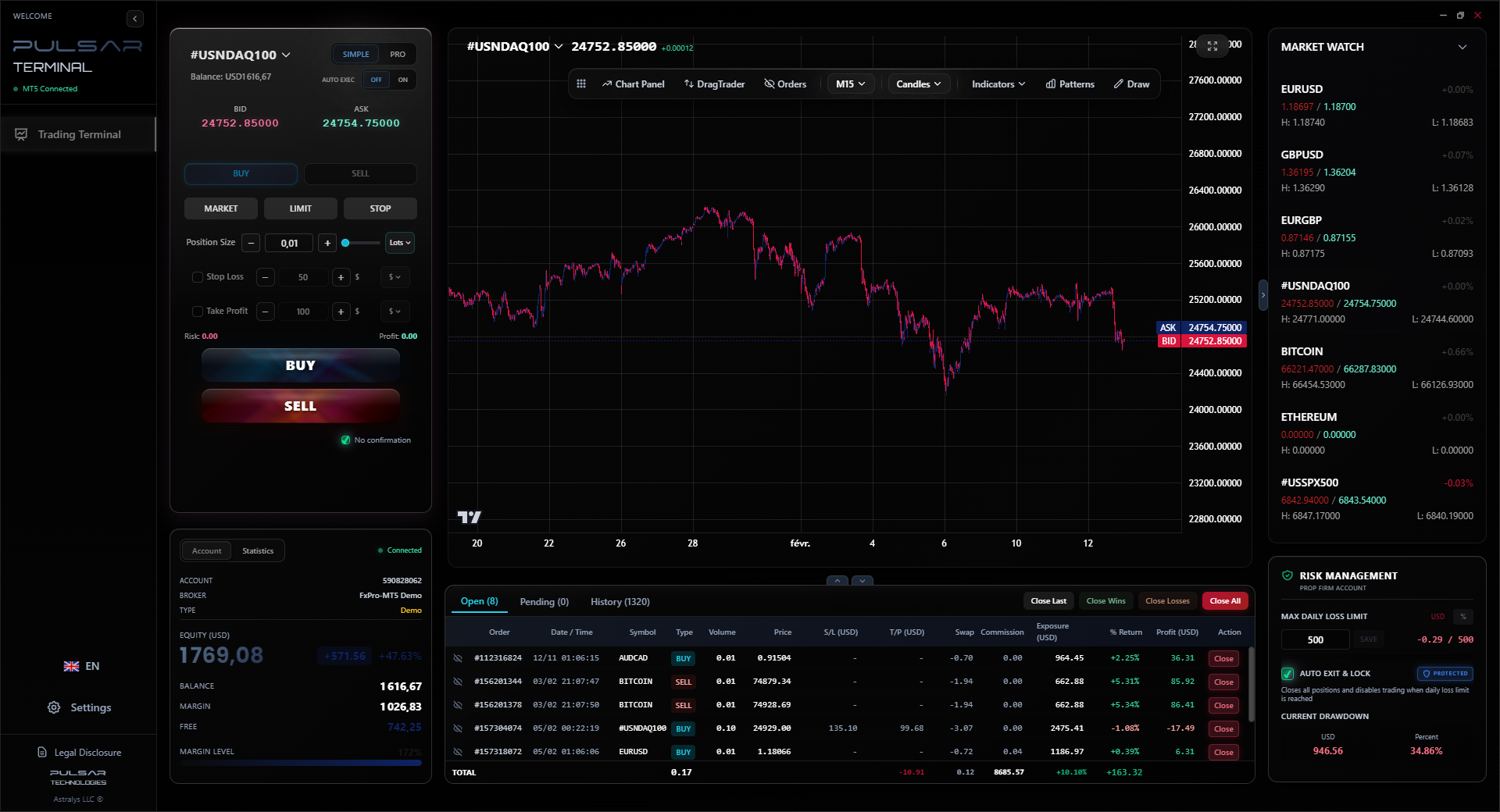
Managing multiple take-profit levels and moving stops to breakeven manually is stressful and error-prone; Pulsar Terminal automates these advanced trade management rules directly on your MT5 charts.
Pulsar Terminal
A ferramenta MT5 tudo-em-um: ordens drag-and-drop, multi-TP/SL, trailing stop, grid trading, Volume Profile e proteção prop firm. Usado diariamente por 1.000+ traders.
“The excitement isn't in the chaotic gamble; it's in the disciplined execution of a well-crafted plan.”
We face unique challenges. Knowing them helps you avoid the traps.
- Trading USD/NGN Emotionally: We live with the Naira's volatility. It's personal. This makes us terrible at trading it objectively. We chase it when it's flying, panic-sell when it dips. Stick to major pairs where you have no emotional baggage until you're consistently profitable.
- Funding & Withdrawal Hiccups: CBN policies can change. Sometimes funding an international broker with your Naira card hits a limit. Always check your broker's local deposit options (like bank transfer to a local intermediary). Factor in possible delays when you need to withdraw profits.
- The "Get-Rich-Quick" Mentality: Fueled by flashy Instagram ads showing Lamborghinis. Forex is a skill, not a lottery. The global daily volume is over $9.6 trillion - you won't beat it with luck. Expect to spend 6-12 months learning before you see consistent profits.
- Ignoring Total Costs: That 0.24 pip spread on EUR/USD? The $7 commission per round turn? The swap fee for holding overnight? They eat into your profits. A strategy that barely works before costs will lose money after them. Always trade with a broker known for low, transparent costs.

Pro Tip: Keep a trading journal. Not just wins and losses. Write down your reasoning for each trade, the time, your emotional state. After 100 trades, you'll see your real patterns. It's the cheapest and most effective mentor you can have.
💡 Dica do Winston
The spread isn't just a cost; it's a filter. If your entry strategy doesn't account for the spread, you're already starting your trade in a hole. Always enter with limit orders, not market orders, to control this.
“A trade without a stop-loss is a plan for financial ruin.”
Let's run through a real example from my journal. This is how to take trade in forex from start to finish.
Date: April 3, 2026 Pair: EUR/USD Account Balance: $2,000
- Analysis: The daily chart showed a clear uptrend. Price was pulling back towards a former resistance zone around 1.0780 that was now likely support. On the 4-hour chart, the RSI indicator was dipping near 40 (not oversold, but cooling off).
- Plan: Enter a buy on a retest of 1.0780. Place a buy limit order at 1.0782. Stop-loss at 1.0755 (25 pips below entry, just under the support zone). Take-profit at 1.0832 (50 pips above entry, near the next resistance). Risk-to-reward: 1:2.
- Execution & Risk: Max risk per trade = 1.5% of $2,000 = $30. My stop-loss is 25 pips. How much can I lose per pip? $30 / 25 pips = $1.20 per pip. On EUR/USD, a standard lot (100,000 units) moves $10 per pip. That's too big. A mini lot (10,000 units) moves $1 per pip. Perfect. I entered a 1.2 mini lot position. (I used my position size calculator for this).
- Management: Order executed. Price dipped to 1.0779, then rallied. I moved my stop-loss to breakeven (1.0782) when price hit 1.0807 (+25 pips). Price hit my take-profit at 1.0832 the next day.
- Result: Profit = 50 pips x $1.20 per pip = $60. Risk was $30, reward $60. Plan followed perfectly.
That's the blueprint. It's boring. It's mechanical. And it's how you survive and grow in this market. The excitement isn't in the chaotic gamble; it's in the disciplined execution of a well-crafted plan.
FAQ
Q1Is forex trading legal in Nigeria?
Yes, it's legal for individuals. However, the regulatory environment is evolving. The SEC is now empowered under the 2025 Investments and Securities Act to regulate online FX platforms. Always use internationally regulated brokers for better protection.
Q2How much money do I need to start trading forex in Nigeria?
You can technically start with as little as $10 on some brokers. But realistically, to practice proper risk management without being wiped out by a single loss, I recommend starting with at least $500-$1000. This allows you to trade sensible position sizes.
Q3What's the most important part of taking a trade?
Setting your stop-loss. It's not the analysis or the entry. It's defining your maximum loss before you enter. Without it, you have no control. A trade without a stop-loss is a plan for financial ruin.
Q4How do I handle the 10% capital gains tax?
Keep careful records of all your trades - profits and losses. You are taxed on your net profit for the year. It's your responsibility to declare this income and pay the tax. Consult a local accountant familiar with trading income to ensure compliance.
Q5Should I trade USD/NGN?
I advise against it when you're new. The emotional connection to the Naira clouds judgment, and the spreads are often much wider than on major pairs like EUR/USD. Learn your craft on the more liquid, stable majors first.
Q6What's a good risk-to-reward ratio?
Aim for at least 1:2. This means your profit target (in pips) is at least twice the size of your stop-loss. This way, you can be wrong more often than you're right and still be profitable, as long as you manage your position size.
Q7How many pairs should a beginner trade?
One or two. Master the behavior of EUR/USD first. It's the most liquid pair with the lowest spreads. Adding more pairs before you're profitable just spreads your attention thin and increases complexity.
Lição do Prof. Winston
Pontos-chave:
- ✓Always set stop-loss & take-profit BEFORE entering.
- ✓Risk maximum 2% of account per trade.
- ✓Aim for a minimum 1:2 risk-to-reward ratio.
- ✓Master one currency pair before adding more.
- ✓Your trading plan is your boss; follow it blindly.
Quão útil foi este artigo?
Clique em uma estrela
Insights de Trading Semanal
Análises e estratégias semanais grátis. Sem spam.
Sobre o autor
Olumide Adeyemi
Pioneiro do Trading na África Ocidental
Um dos educadores de trading forex mais ativos da Nigéria. 8 anos de experiência operando a partir de Lagos. Especialista em estratégias de baixo capital e desafios de prop firms para traders africanos.
Comentários
Aviso de risco
A negociação de instrumentos financeiros envolve riscos significativos e pode não ser adequada para todos os investidores. O desempenho passado não garante resultados futuros. Este conteúdo é apenas para fins educacionais e não deve ser considerado aconselhamento de investimento. Sempre conduza sua própria pesquisa antes de negociar.
Você também pode gostar

Cara Trading Forex Sukses: 7 Prinsip dari Trader Profesional
Cara trading forex sukses dengan 7 prinsip trader pro: manajemen modal, disiplin, journal trading, backtest. Data nyata, bukan janji profit palsu.
Jam Trading Forex Terbaik untuk Trader Indonesia: Panduan Lengkap dengan Tabel Waktu
Panduan jam trading forex untuk trader Indonesia. Tabel 4 sesi dunia, jam emas 20:00-00:00, sesi mana yang harus dihindari. Data akurat + tips dari trader berpengalaman.
Top 5 Sàn Forex Uy Tín Nhất 2026: Review Jujur dari Trader Indonesia
Top 5 sàn forex uy tín 2026 untuk trader Indonesia. Review jujur: spread, deposit, withdraw, dukungan lokal. Exness, XM, IC Markets & lebih.
Obter Pulsar Terminal
Todas essas calculadoras estão integradas ao Pulsar Terminal com dados em tempo real da sua conta MT5.
Obter Pulsar Terminal