


I remember staring at my screen in 2018, watching my AUD/USD trade bleed.

Sarah Collins
Estrategista de Trading ·  Australia
☕ 12 min de leitura
O que você vai aprender:
- 1The ASIC Rulebook: Your First Line of Defence
- 2Picking Your Corner: Australian Forex Brokers Compared
- 3Trading the AUD: It's Not Just Another Currency
- 4The Real Cost of Trading: Spreads, Fees, and the Tax Man
- 5A Strategy Framework That Works on Aussie Time
- 6Classic Aussie Trader Mistakes (I've Made Them All)
- 7Your First Month Blueprint: From Demo to Live
I remember staring at my screen in 2018, watching my AUD/USD trade bleed. I was short from 0.7550, convinced the RBA was about to turn dovish. The rate statement came out, and it was neutral. The pair ripped 80 pips against me in minutes. I hadn't factored in the Asian session liquidity squeeze, a classic Sydney trap. That trade cost me $1,200 and taught me a brutal lesson: trading forex in Australia isn't just about global news. You need to understand the local rules, the unique market rhythms, and how to pick a broker that won't leave you exposed. Let's talk about how to get it right.
Before you even think about a chart, you need to understand the playground. The Australian Securities and Investments Commission (ASIC) sets the rules, and they're some of the strictest in the world. This is mostly good news for you. It means your money is safer, but it also means you can't just YOLO with 500:1 use like you might see advertised offshore.
The big one is use. Since 2021, ASIC has capped it for retail clients. For major pairs like EUR/USD or our beloved AUD/USD, the max is 30:1. That means you need about 3.33% margin. For gold (XAU/USD) and minor pairs, it's 20:1. It feels restrictive if you're used to wilder markets, but honestly, it's saved me from myself more than once. Trying to trade the volatile EUR/AUD with high use is a surefire way to get a margin call.
Other key protections are non-negotiable. Your funds must be held in segregated accounts (so the broker can't use them for their office party), and you have negative balance protection. You can't lose more than what's in your account. They've also banned those dodgy deposit bonuses that used to lure people in. A broker offering you a 50% bonus on an ASIC license? Red flag. Walk away.

Warning: Just because a broker has 'Australia' in its name doesn't mean it holds an ASIC AFSL. Always check the ASIC professional registers online. If they're not on there, you're not getting these protections.
Why These Rules Actually Help You Trade
I used to hate the use limits. Then I did the math. On a $10,000 account, 30:1 use on AUD/USD lets you control a $300,000 position. That's still massive. The limit forces you to think about position size calculator and risk management first, not last. It turns down the noise and lets you focus on the trade, not the panic.

💡 Dica do Winston
The Sydney session open isn't for bold new trends. It's for cleaning up the mess left by New York. Look for reversals of their late moves.
“Trading forex in Australia isn't just about global news; you need to understand the local rules and the unique market rhythms.”
This is where it gets real. You want an ASIC-licensed broker, but which one? I've traded with most of them over the years. The scene is competitive, which is great for us. Low spreads and good tech are the baseline.
Let's break down a few heavy hitters based on my experience and the hard numbers from 2025-2026.
| Broker | ASIC License? | Key Feature for Aussies | My Experience with AUD/USD Spread | Min. Deposit |
|---|---|---|---|---|
| Pepperstone | Yes | Razor account for raw spreads + commission. Great execution. | Consistently 0.1 - 0.3 pips on Razor. | $10 |
| IC Markets | Yes | Raw spreads, huge liquidity. A scalper's favourite. | Often see 0.0 pips, avg. 0.1 pips. | $200 |
| FP Markets | Yes | Strong on MT4/MT5, good for ECN trading. | Reliable 0.2 - 0.5 pips on ECN. | $100 |
| CMC Markets | Yes | NextGen platform is slick, good for CFD variety. | Wider (1-1.5 pips) but commission-free. | $0 |
I've had a live account with Pepperstone review for five years. Their Razor account is my go-to. Why? Speed and consistency. During the RBA announcement last October, my limit order on AUD/JPY filled without slippage when other platforms I was testing choked. That's worth more than a flashy ad.
IC Markets review is another powerhouse, especially if you're into scalping strategy. Their raw spreads are insane, but remember you pay a commission. Do the math: (Spread + Commission) = Your total cost. Sometimes a 0.5 pip spread with no commission is cheaper than 0.0 pips with a $7 round turn.

Pro Tip: Don't get hung up on "zero" deposits. If you're serious, start with at least $500-$1000. It allows for proper position sizing without being wiped out by a single 20-pip move. A $50 account with 30:1 use is basically just paying for an expensive video game.
Platform choice is key. MT4/MT5 are universal, but check if they offer cTrader or TradingView integration if that's your jam. Also, look at funding options. The best brokers offer instant, fee-free deposits via PayID or POLi. Getting money in and out should be easy.
“The ASIC use limit forces you to think about position size and risk management first, not last. It turns down the noise.”
The Australian dollar is your home-team advantage. You hear the economic chatter daily - iron ore prices, China's PMI, RBA gossip at the pub. Use it.
The AUD is a commodity currency. Its fate is tied to what we dig out of the ground. When China's economy sneezes (demanding our iron ore, coal, and LNG), the AUD catches a cold. I have a simple watchlist: Iron ore futures (Singapore), the Shanghai Composite index, and the USD/CNY rate. If all three are dropping, it's a strong headwind for the Aussie.
The RBA and Your Trading Session
The Reserve Bank of Australia's announcements are your Super Bowl. They happen at 2:30 pm AEST (usually on the first Tuesday of the month). Volatility spikes. I learned my lesson from that 2018 trade: don't hold a speculative position into the announcement unless you're a masochist. I now use a strategy of setting orders 30 minutes after the statement, once the initial panic-buying or selling has calmed down.
Your trading day in Australia has unique liquidity pockets. The Asian session (Sydney/Tokyo) is active for AUD, JPY, and NZD pairs. The EUR/USD guide might tell you London is best, but for AUD/JPY, your 7 am - 12 pm AEST window is prime time. The overlap with the early European session (around 5 pm - 7 pm AEST) is also great for EUR/AUD.

Example: In December 2025, I went long AUD/USD at 0.6650. My thesis wasn't complex: iron ore had rallied 15% in a month, and the RBA had paused hikes. I used a simple MACD indicator crossover on the 4-hour chart for entry timing. Took profit at 0.6730 (80 pips) just before Christmas. The trade worked because it aligned the macro (commodity strength) with a technical trigger.
Pairs to focus on: AUD/USD (the "Aussie"), AUD/JPY (for risk sentiment), EUR/AUD (for a slower, swing trading approach). Get to know their personalities. AUD/JPY moves like a caffeinated kangaroo when US stocks are volatile.
“The ASIC use limit forces you to think about position size and risk management first, not last. It turns down the noise.”
Let's talk money, and not just the money you hope to make. The money it costs to play. This is where many new traders get a nasty surprise.
Your main cost is the spread. That's the difference between the buy and sell price. On a standard account with no commission, AUD/USD might be 1.0 pip definition. On a raw spread account, it could be 0.1 pips plus a $7 commission per 100,000 units (1 lot). You need to know which structure suits your style. High-frequency scalper? Go raw spread. Someone placing a few swing trading holds a week? The standard account might be cheaper.
Then there's the swap rate, or overnight financing fee. If you hold a position past 5 pm NY time (which is morning in Aus), you pay or receive interest. Going long AUD/USD when the RBA has higher rates than the Fed? You might earn a tiny bit each night. Doing the opposite? You'll pay. It adds up over time.
The Tax Talk. I'm not an accountant, but I've been through this. In Australia, forex trading profits are generally considered assessable income under the Income Tax Assessment Act 1997. If the ATO sees you're executing frequent trades for profit, you're running a business. That means you declare net profit (after all costs, including platform fees, data subscriptions, even a portion of your internet) on your tax return.
Losses can be deducted against other income if you're classified as a business. This is a grey area. The key factors are the size, frequency, and organisation of your trades. Trading a $5,000 account once a month? Probably a hobby. Actively managing a $50k account with 100+ trades a month, using journals and a defined strategy? That looks like a business. Get professional advice. The few hundred bucks for a tax consultant specialising in traders is the best trade you'll ever make.
💡 Dica do Winston
Your biggest edge trading the AUD is understanding bulk commodity shipping schedules. A delay at Port Hedland can move markets before the news hits.
“Your biggest edge trading the AUD is local knowledge - the economic chatter you hear daily is your home-team advantage.”
You can't just copy a strategy from a New York day trader and expect it to work at 8 am in Sydney. The volume and drivers are different. Here's a simple, two-pronged approach I've used successfully.
1. The Macro-Swing Setup. This plays to our strengths. We're tuned into local and Asian macro news.
- Instrument: AUD/USD or EUR/AUD.
- Timeframe: Daily and 4-hour charts.
- Trigger: A clear shift in the fundamental picture. Example: A sustained rise in key commodity prices (Copper, Iron Ore) while the US Dollar index (DXY) is weakening.
- Entry/Exit: I wait for the price to react on the chart. For a long AUD/USD idea, I'll look for a breakout above a key weekly resistance, confirmed by a bullish RSI indicator divergence. I'll place my stop below the recent swing low. This is a slower, patient game aiming for 150-300 pip moves.
2. The Intraday Liquidity Play. This exploits the Sydney session open.
- Instrument: AUD/JPY or NZD/JPY.
- Timeframe: 15-minute and 1-hour charts.
- Trigger: The 7:00 am - 9:00 am AEST window. Liquidity floods in as Sydney and Tokyo get to work. Big banks are executing client orders.
- Tactic: I watch for a false breakout. If price spikes up at 7:05 am then quickly reverses below the pre-open range, I might go short with a tight stop above the spike high. Target is the other side of the opening range. It's a quick 20-40 pip scalp. Risk is high, so size tiny - 0.5% of account max.
Warning: Avoid trading major USD pairs (like EUR/USD or GBP/USD) in the first and last hour of the Sydney session. The spreads are often wider, and the moves can be erratic and illiquid. Save your ammo for when London or New York joins the party.
The common thread? Context. Is the RBA speaking today? Is it a Chinese public holiday (thin volume)? Your strategy needs an "Aussie filter."
“Your biggest edge trading the AUD is local knowledge - the economic chatter you hear daily is your home-team advantage.”
Let me save you some pain and money by listing my greatest hits of failure.
Pitfall 1: Over-trading the AUD. Because it's familiar, you end up with 3 different AUD pairs in your portfolio. If the Aussie dumps on bad China data, you get triple-whammied. Diversify. Have a USD or EUR idea running too.
Pitfall 2: Ignoring Session Gaps. The forex market closes Friday night NY time and opens Sunday evening our time. Big news over the weekend can cause a "gap" - the price opens at a different level. I once had a long EUR/AUD stop order placed at 1.6200. It opened Monday at 1.6150. My stop was triggered, but at 1.6150, not 1.6200. That's negative slippage, and it hurts. Either don't hold over the weekend, or use guaranteed stops (if your broker offers them, for a fee).
Pitfall 3: Chasing Prop Firm Hype with Poor Risk Management. Prop trading challenges are huge here. The promise is alluring: pass a challenge, trade their capital. But their rules are brutal - strict daily loss limits (e.g., 5% max loss). I blew two challenges early on by treating it like my own account. The pressure changes everything. If you go this route, you need iron-clad, automated rules. A tool that can enforce a hard daily stop-loss is not a luxury; it's a necessity to prevent one bad hour from ending your challenge.
Pitfall 4: Underestimating Costs. That 0.5 pip spread looks small. But if you're a scalper making 10 trades a day, 5 days a week, that's 200 trades a month. Those fractions of a percent add up to a huge hurdle to overcome. Be a cost detective. Review your monthly statements.
💡 Dica do Winston
If you wouldn't explain your trade thesis to a sceptical mate at the pub, don't put it on. Clarity before entry prevents panic after.
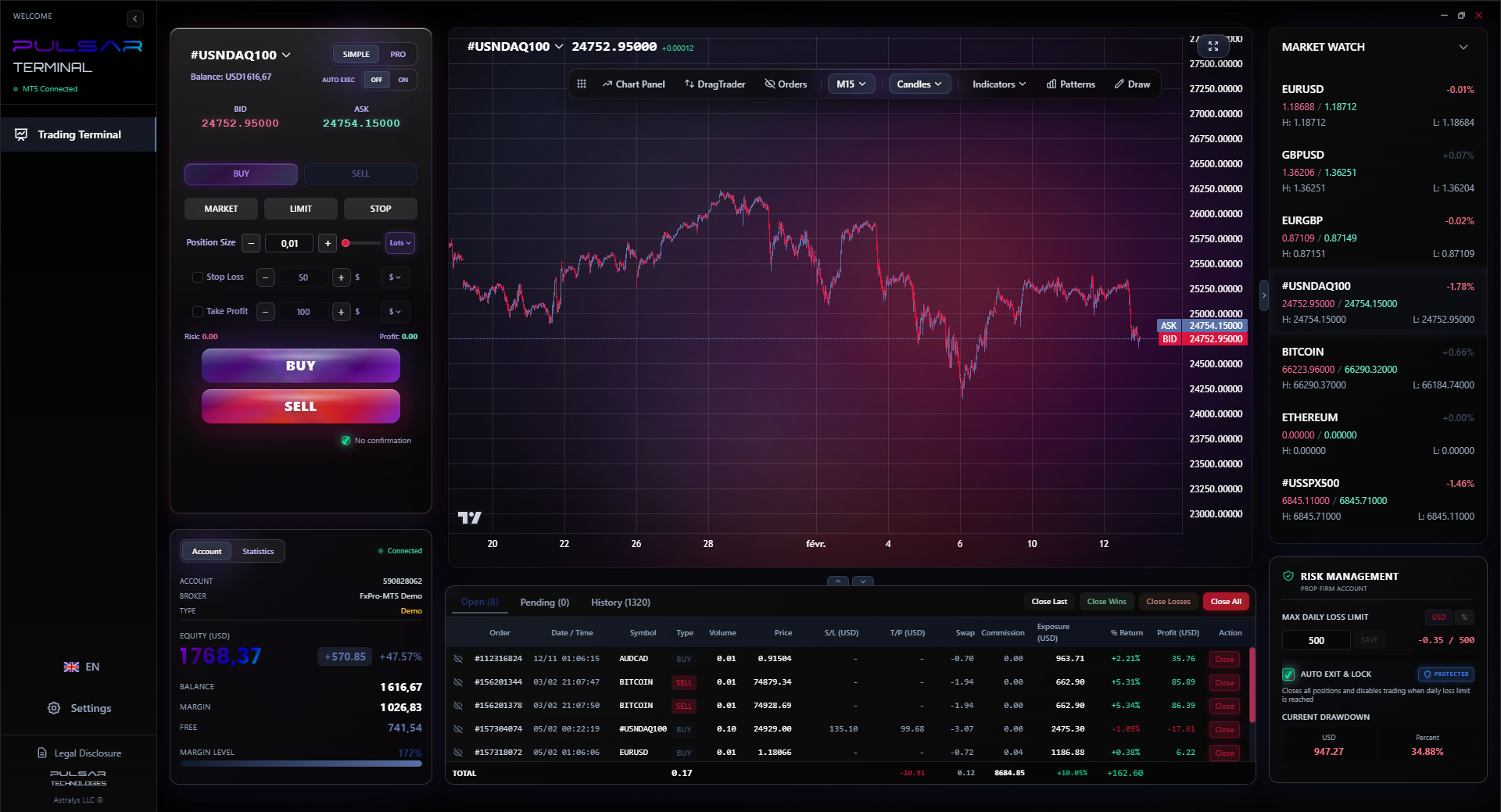
Managing the strict daily loss limits of a prop firm challenge requires robotic discipline, which is where automating your risk rules with a tool like Pulsar Terminal becomes non-negotiable.
Pulsar Terminal
A ferramenta MT5 tudo-em-um: ordens drag-and-drop, multi-TP/SL, trailing stop, grid trading, Volume Profile e proteção prop firm. Usado diariamente por 1.000+ traders.
“One live trade managed with discipline teaches you more than a thousand perfect demo trades.”
Okay, you're fired up. Here's a step-by-step plan to go from zero to your first live trade without blowing up.
Week 1-2: Paper Trading with Purpose.
- Pick one ASIC broker from our list above. Open a demo account.
- Fund it with a virtual $10,000 (a realistic starting amount).
- Your only job is to trade ONE pair. I suggest AUD/USD. Learn its daily range, how it reacts to data.
- Practice placing trades, setting stops and targets. Use the position size calculator every single time. Aim for 1-2% risk per trade max ($100-$200 on your demo).
- Ignore profit/loss. Focus on the process: Did I follow my plan?
Week 3: Introduce a Simple Strategy.
- Adopt the "Macro-Swing" idea from the previous section.
- On your demo, look for one setup per week. Just one. Write down your reasoning before you enter: "Going long AUD/USD because iron ore broke $120/tonne and price is above the 50-day MA."
Week 4: The Live Transition.
- Open a live micro or cent account. Deposit a small, meaningful amount - $500 is a good test.
- Your goal is not to get rich. Your goal is to execute ONE trade with real money and manage the psychology.
- Place that one trade with the same rules as your demo. The feeling will be different. Your heart will race. That's the lesson.
- After the trade closes (win or lose), review it brutally. Was your execution smooth? Did you move your stop out of fear?
If you can complete this month with discipline, you're ahead of 90% of people who just jump in and start clicking buttons. Remember, this is a marathon on a dusty outback road, not a sprint. Pace yourself.
FAQ
Q1Is forex trading legal in Australia?
Yes, completely legal. It's regulated by ASIC. The key is to use a broker that holds an Australian Financial Services Licence (AFSL). This ensures you get crucial protections like segregated funds and negative balance protection.
Q2What's the best time to trade forex in Australia?
It depends on the pair. For AUD pairs (AUD/USD, AUD/JPY), the Asian session (7 am - 4 pm AEST) is most active. For EUR or GBP pairs, the London session overlap (5 pm - 2 am AEST) is better. Avoid the first/last hour of the Sydney session for non-AUD pairs due to wider spreads.
Q3How much money do I need to start trading forex in Australia?
Technically, some brokers let you start with $0 or $10. Practically, I recommend at least $500-$1,000 for a live account. This allows for sensible position sizing under ASIC's 30:1 use limits and lets you withstand normal market moves without being wiped out by a single trade.
Q4Do I pay tax on forex trading profits in Australia?
Generally, yes. If your trading activity is substantial, organised, and profit-seeking, the ATO will likely view it as a business. Your net profits (after deducting all related expenses) are assessable income. It's complex, so consulting a tax professional who understands trading is essential.
Q5Can I use international brokers instead of ASIC ones?
You can, but I strongly advise against it for residents. If you use an offshore broker, you forfeit all ASIC protections - no use limits, no guaranteed segregated accounts, no negative balance protection. You're also likely violating the broker's terms of service, which could see your account frozen.
Q6What's the most traded forex pair in Australia?
AUD/USD is by far the most popular. It's a major global pair with high liquidity and is directly tied to the Australian economy. Other common pairs for locals include EUR/AUD, AUD/JPY, and GBP/AUD.
Q7Are there any good free trading courses in Australia?
ASIC's Moneysmart website has basic, unbiased educational resources. Many reputable ASIC brokers (like Pepperstone or IC Markets) also offer extensive free webinars, tutorials, and trading guides on their sites. Avoid 'gurus' selling expensive courses promising guaranteed results.
Lição do Prof. Winston
Pontos-chave:
- ✓Always verify your broker's ASIC AFSL on the official register.
- ✓Factor in the 30:1 use cap for majors when sizing positions.
- ✓Trade AUD/USD & AUD/JPY during the Asian session for best liquidity.
- ✓Account for all costs: spread, commission, swap, and potential tax.
- ✓Build a strategy that accounts for Sydney's specific market open gaps.
Quão útil foi este artigo?
Clique em uma estrela
Insights de Trading Semanal
Análises e estratégias semanais grátis. Sem spam.
Sobre o autor
Sarah Collins
Estrategista de Trading
Estrategista de trading sediada em Londres com 12 anos em mercados financeiros. Ex-analista numa corretora na City de Londres. Cobre pares GBP, mercados europeus e trading regulado pela FCA.
Comentários
Aviso de risco
A negociação de instrumentos financeiros envolve riscos significativos e pode não ser adequada para todos os investidores. O desempenho passado não garante resultados futuros. Este conteúdo é apenas para fins educacionais e não deve ser considerado aconselhamento de investimento. Sempre conduza sua própria pesquisa antes de negociar.
Você também pode gostar

Cara Trading Forex Sukses: 7 Prinsip dari Trader Profesional
Cara trading forex sukses dengan 7 prinsip trader pro: manajemen modal, disiplin, journal trading, backtest. Data nyata, bukan janji profit palsu.
Jam Trading Forex Terbaik untuk Trader Indonesia: Panduan Lengkap dengan Tabel Waktu
Panduan jam trading forex untuk trader Indonesia. Tabel 4 sesi dunia, jam emas 20:00-00:00, sesi mana yang harus dihindari. Data akurat + tips dari trader berpengalaman.
Top 5 Sàn Forex Uy Tín Nhất 2026: Review Jujur dari Trader Indonesia
Top 5 sàn forex uy tín 2026 untuk trader Indonesia. Review jujur: spread, deposit, withdraw, dukungan lokal. Exness, XM, IC Markets & lebih.
Obter Pulsar Terminal
Todas essas calculadoras estão integradas ao Pulsar Terminal com dados em tempo real da sua conta MT5.
Obter Pulsar Terminal