


Most traders get candlesticks completely wrong.

Olumide Adeyemi
Pioneiro do Trading na África Ocidental ·  Nigeria
☕ 11 min de leitura
O que você vai aprender:
Most traders get candlesticks completely wrong. They memorize dozens of patterns, then lose money because they're reading tea leaves instead of price action. The truth is, you only need to understand a handful of candles to trade effectively. I've made and lost thousands of dollars over 12 years, and I'll show you how to use candlestick in forex trading the way it actually works on the Lagos to London session, not just from a textbook.
Forget the fancy indicators you see on Instagram. For a trader in Lagos or Port Harcourt, candlesticks are your first and most honest source of information. They tell you what the market is doing right now, in real time, without any lag.
In a market where news can be delayed and broker quotes can sometimes feel a bit 'creative', the raw price action shown in a candle doesn't lie. It shows you the battle between buyers and sellers during a specific period - whether that's 5 minutes, 1 hour, or a full day.
When the CBN makes an announcement or there's a shift in oil prices, the initial reaction is captured instantly in the candles. Learning to read that reaction is your edge. It's the foundation for everything else: your strategy, your entry, and your exit. I learned this the hard way early on, ignoring a clear series of bearish candles on USD/NGN because I was convinced the naira would strengthen. The market disagreed, and I watched a $500 position turn into a $300 loss in a single afternoon.

Warning: No candlestick pattern is a 100% guarantee. They show probability, not certainty. Always use them with other forms of confirmation, like support and resistance levels or a simple RSI indicator.
Let's break down a single candle. It only gives you four pieces of information, but they're the four that matter most.
The Body (The Real Story): This is the thick part. If it's green (or white), the price closed higher than it opened - bullish pressure won that period. If it's red (or black), the price closed lower - bearish pressure won. The longer the body, the stronger the winning side's conviction. A massive green body on the EUR/USD chart? That's serious buying interest.
The Wicks (The Rejection): These are the thin lines above and below the body. The top wick shows the highest price reached but rejected. The bottom wick shows the lowest price reached but rejected. A long upper wick on a red candle tells you buyers tried to push price up, but sellers smashed it back down hard.
The Two Most Important Candles for Beginners
If you're starting out, focus on these two first. I wish I had.
The Doji (The Indecision): This is when the open and close are virtually the same, creating a tiny or non-existent body with wicks. It means the bulls and bears fought to a standstill. When you see this after a strong trend, it's a warning sign that momentum might be stalling. It's not a signal to trade by itself, but it tells you to pay attention.
The Hammer (The Rejection Signal): This is a powerful one. It has a small body at the top of the candle's range and a long lower wick that's at least twice the body's length. It forms in a downtrend. The story it tells is this: sellers pushed price way down, but by the close, buyers fought back aggressively to push it near the open. It's a strong sign of a potential bullish reversal. I caught a beautiful hammer on the 1-hour chart for XAU/USD (gold) last year. Price had been falling, formed a hammer right at a key support level I was watching. I entered a buy at $1824. The next three candles were solid green, and I took profit at $1839. That's how it's supposed to work.
Understanding this basic anatomy is more important than memorizing 30 obscure patterns. It's the language of the market.

💡 Dica do Winston
A long wick shows a price level the market visited and decisively rejected. That's more valuable information than where the price finally closed.
“The raw price action shown in a candle doesn't lie.”
Now let's talk about groups of candles, or patterns. These are where the real narrative unfolds. You don't need a huge library. You need a few reliable ones.
Engulfing Patterns (The Power Shift): This is a two-candle pattern. A Bullish Engulfing pattern happens in a downtrend. A small red candle is followed by a large green candle that completely 'engulfs' the body of the first. It shows sellers were in control, then buyers stormed in and took over decisively. The bearish version is the opposite.
This pattern saved me from a bad trade on GBP/JPY. I was short, and a bullish engulfing pattern formed right on a major daily support level. It was a clear message: 'Get out.' I closed my position for a small loss, and price rallied 150 pips over the next day. That small loss felt like a win.
Morning and Evening Stars (The Reversal Trio): These are three-candle patterns that signal a major trend change. A Morning Star (bullish reversal) forms in a downtrend: a long red candle, followed by a small-bodied candle (like a Doji) that gaps down, then a long green candle that closes well into the first red candle's body. It shows selling, then indecision, then strong buying.
Inside Bars (The Consolidation): This is when a candle's entire range (high to low) is inside the range of the previous candle. It shows consolidation and compression. The market is taking a breath. The breakout from this range, especially on a higher time frame like the 4-hour chart, often signals the next strong move. This is a cornerstone of many a swing trading approach.

Pro Tip: Always look at where the pattern forms. A bullish hammer at a major support level is 10x more significant than one in the middle of nowhere. Context is king.
Knowing patterns is one thing. Making money with them is another. Here's a simple, repeatable plan.
Step 1: Find the Trend First. Are you on the 1-hour chart and seeing mostly red candles making lower lows? That's a downtrend. In a downtrend, you give more weight to bearish reversal patterns (like shooting stars, bearish engulfing) for sell entries. In an uptrend, you focus on bullish patterns. Trading with the trend increases your odds dramatically. I ignore all buy signals in a strong daily downtrend. It's a rule.
Step 2: Spot Key Levels. Draw your horizontal support and resistance lines. Where has price bounced or broken before? These are the zones where candlestick patterns become high-probability setups. The market remembers these prices.
Step 3: Wait for the Pattern. Don't force it. Let the pattern come to your level. Be patient. Wait for that engulfing pattern or hammer to print right on your support line.
Step 4: Confirm and Enter. Don't buy the second the hammer closes. Wait for the next candle to start moving in your direction. That's your confirmation. Your entry is at the market price as that confirmation candle begins. For my gold trade mentioned earlier, I entered on the close of the candle after the hammer, once it was clear buyers were following through.
Step 5: Manage Your Risk. This is non-negotiable. Your stop-loss should go just below the low of the pattern (for a buy) or above the high (for a sell). Your profit target should be at least 1.5 times your risk. Use our position size calculator to figure out exactly how many lots to trade so you're never risking more than 1-2% of your account on a single idea. I've blown up an account early in my career by ignoring this. A perfect candlestick setup means nothing if your position size is suicidal.
Step 6: Use Them with Other Tools. Candlesticks are your primary weapon, but have a secondary. I often use the MACD indicator to confirm momentum or a simple moving average to define the trend. It adds another layer of filter.
💡 Dica do Winston
If you can't instantly see whether a candle is predominantly bullish or bearish, you're on too low a time frame. Zoom out.
“A perfect candlestick setup means nothing if your position size is suicidal.”
Trading from Nigeria comes with its own realities. You're not trading in a vacuum.
The Cost of Trading: Every pip counts. You need to be aware of the spread, which is the difference between the buy and sell price. On major pairs like EUR/USD, a good broker like IC Markets or Pepperstone might offer spreads as low as 0.1 to 0.6 pips on their raw accounts. On a standard account, expect 1.0 to 1.5 pips. Why does this matter for candlestick trading? If you're a scalping strategy trader aiming for 5-10 pips, a 3-pip spread from a shady broker will eat half your profit before you even start.
You also have to factor in the 10% Capital Gains Tax on your annual profits to the FIRS. Keep clean records.
Choosing a Broker: This is critical. With the new SEC rules, you want a broker that is reputable and stable. Many Nigerian traders use international brokers. Look for strong regulation (like ASIC for Pepperstone or CySEC for XM), reliable deposits/withdrawals in Naira, and low latency servers. A broker with frequent requotes or slippage will destroy your candlestick-based entries and exits.
Local Session Nuances: Liquidity can be thinner during the Lagos morning compared to the London overlap. This can sometimes lead to more false breakouts and exaggerated wicks on candles. Be slightly more cautious trading major news or breakouts until the European session is fully online.

Example: Let's say you trade a standard lot (100,000 units) on EUR/USD. A 1-pip spread definition costs you $10 immediately. If your profit target is 30 pips ($300), that spread is a 3.3% 'tax' on your trade. On a 0.2-pip spread, it's only $2. This difference compounds over hundreds of trades.
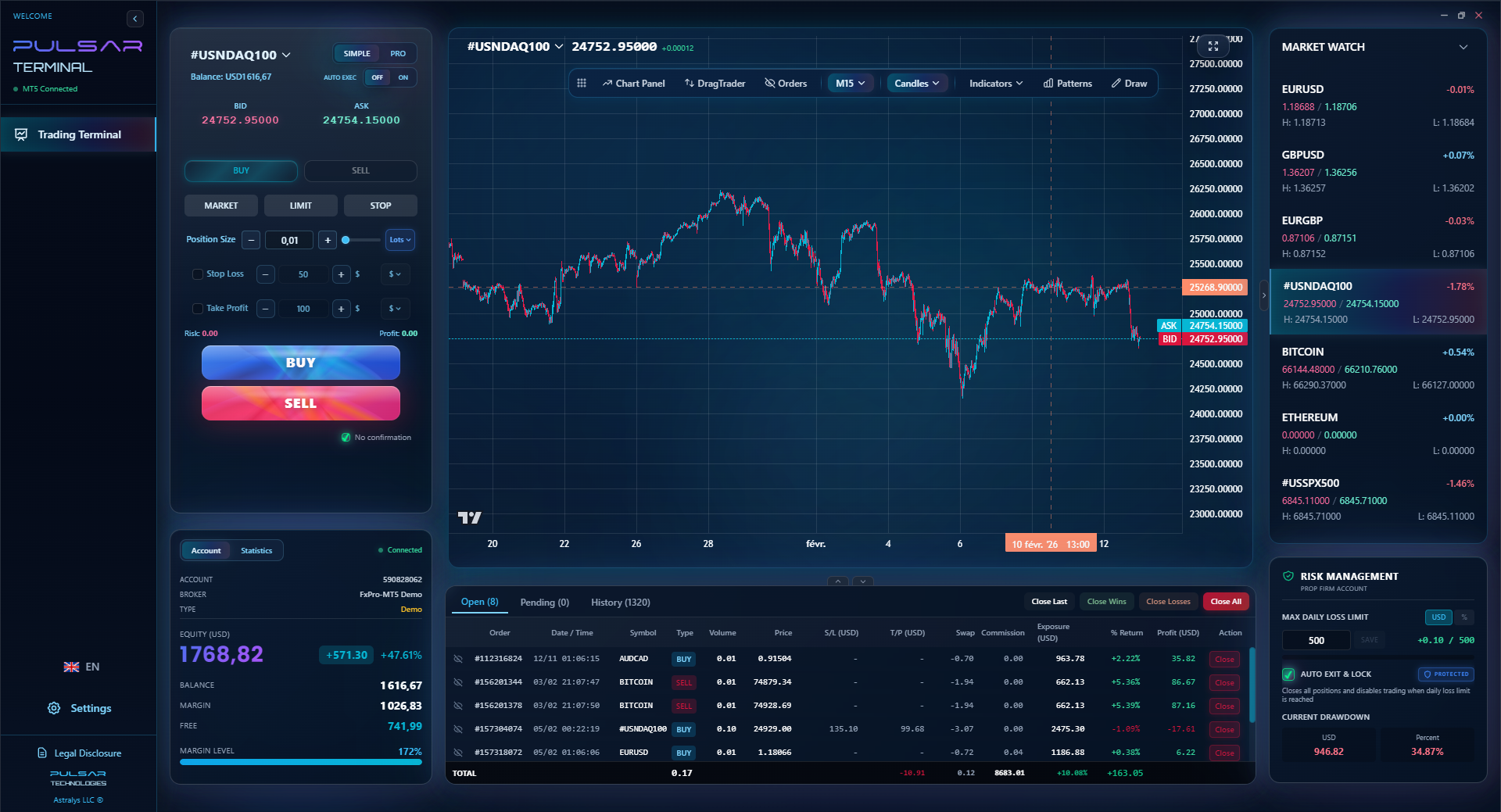
Managing multiple trades based on candlestick patterns is easier with tools that let you set advanced orders like multi-TP/SL and trailing stops directly on your MT5 chart.
Pulsar Terminal
A ferramenta MT5 tudo-em-um: ordens drag-and-drop, multi-TP/SL, trailing stop, grid trading, Volume Profile e proteção prop firm. Usado diariamente por 1.000+ traders.
I've made every mistake in the book so you don't have to.
Mistake 1: Trading Every Doji. The Doji means indecision. It doesn't mean 'reverse immediately.' I used to see a Doji after two green candles and go short, expecting a reversal. Most of the time, the trend just paused and then continued. Now, I only consider a Doji significant if it's at a clear support/resistance level or part of a larger pattern like a Morning Star.
Mistake 2: Ignoring the Time Frame. A perfect hammer on a 5-minute chart is meaningless noise if the 4-hour chart is showing a massive red engulfing bar. Always check the next higher time frame for context. If the daily trend is down, I might use a 1-hour bullish pattern only for a short-term bounce trade, not a long-term investment.
Mistake 3: No Risk Management. This is the killer. You can be right on the pattern 60% of the time and still lose money if your losses are bigger than your wins. Setting a stop-loss based on the candle pattern's structure is mandatory. That hammer trade? Your stop goes just below the low of the hammer's wick. If that wick is 15 pips long, your risk is about 15-20 pips. Size your position accordingly to avoid a margin call.
Mistake 4: Chasing the Wick. You see a long lower wick form and think you need to buy at the very bottom of it. That's the low price, not an entry price. The market touched that price and rejected it. Your entry comes on the confirmation after the rejection, not at the point of rejection itself.
💡 Dica do Winston
The most profitable candle is often the one you don't trade. Patience in waiting for the right setup at the right level is a skill you can't buy.
“Candlestick trading isn't a magic secret. It's a skill.”
Here's a homework assignment. Don't risk a single naira yet.
- Open a Demo Account: Get one with a broker like Exness or IC Markets. They offer realistic conditions.
- Pick One Pair: Start with EUR/USD. It's liquid and has clean charts.
- Go to the 1-Hour Chart: This is a great time frame to learn without the noise of lower time frames.
- Just Observe for 3 Days: Don't trade. Just label the charts. Draw horizontal lines at obvious highs and lows. Every time you see a long-bodied candle, note it. Every time you see a hammer, engulfing pattern, or Doji at one of your lines, circle it. See what price did next.
- Practice the Plan: On day 4 and 5, paper trade using the 6-step plan above. Write down every hypothetical trade: the pattern, the level, your entry, stop-loss, target, and the outcome.
After a week of this, you'll start to see the story the candles are telling. You'll see how a bearish engulfing at resistance often leads to a drop. You'll see how hammers at support get bought. This pattern recognition becomes instinct.
Candlestick trading isn't a magic secret. It's a skill. It's learning to read the footprints of the market. Start slow, be disciplined, and let the price action guide you. The charts are talking. You just have to learn their language.
FAQ
Q1What is the best time frame for candlestick trading in forex?
There's no single 'best' time frame. It depends on your personality. For learning, start with the 1-hour or 4-hour chart. They filter out market noise and show clearer patterns. Day traders might use 5 or 15-minute charts, while swing traders use 4-hour or daily. The key is to always check the next higher time frame for trend direction. A pattern on the 15-minute chart is more powerful if it aligns with the trend on the 1-hour chart.
Q2How many candlestick patterns do I really need to know?
Honestly, less than 10. Focus on the high-probability ones: Doji, Hammer/Shooting Star, Bullish/Bearish Engulfing, and Morning/Evening Star. Master understanding what a long body vs. a long wick means. Knowing 5 patterns inside out is far better than vaguely recognizing 30. Depth beats breadth every time in trading.
Q3Are candlestick patterns reliable for Nigerian traders with slower internet?
Yes, absolutely. In fact, they're one of the best tools if you have latency issues. Unlike scalping which requires millisecond execution, candlestick patterns (especially on 1-hour or higher charts) develop over time. You're not reacting to a single tick; you're waiting for a full candle to close and confirm. A slight delay in your data feed won't invalidate a properly formed hammer or engulfing pattern. Focus on the higher time frames where this matters less.
Q4Do I need to use candlesticks with other indicators?
It's highly recommended. Think of candlesticks as your primary source - they tell you 'what' is happening. Indicators can help with the 'why' or add confirmation. A simple combination is candlesticks with a trend filter (like a 50-period moving average) and a momentum oscillator (like RSI). For example, only take bullish candlestick reversal signals when price is above the moving average (uptrend) and RSI is coming out of oversold territory. This creates a much stronger, multi-factor setup.
Q5How do I handle 'false' candlestick signals?
Every signal has a failure rate. The key is risk management. First, improve your odds by only trading patterns at key support/resistance levels. Second, use a confirmation candle (wait for the next candle to start moving your way before entering). Third, and most importantly, always use a stop-loss. If a pattern fails, your stop gets you out with a small, predefined loss. A 'false' signal should only cost you 1% of your account, not 10%.
Q6What's the biggest mistake beginners make with candlesticks?
Trading in isolation. They see a hammer and immediately buy, without checking if it's in a downtrend or at a logical level. Candlesticks are not standalone trading systems. They are a component of price action. The context - the trend, the volume (implied by range), and the location on the chart - is what gives a pattern its power. Ignoring context is the fastest way to lose money.
Lição do Prof. Winston
Pontos-chave:
- ✓Master the body and wick: they tell the whole story.
- ✓Only trade reversal patterns at clear support/resistance.
- ✓Always wait for a confirmation candle after the pattern.
- ✓Risk a maximum of 1-2% per trade, no exceptions.
Quão útil foi este artigo?
Clique em uma estrela
Insights de Trading Semanal
Análises e estratégias semanais grátis. Sem spam.
Sobre o autor
Olumide Adeyemi
Pioneiro do Trading na África Ocidental
Um dos educadores de trading forex mais ativos da Nigéria. 8 anos de experiência operando a partir de Lagos. Especialista em estratégias de baixo capital e desafios de prop firms para traders africanos.
Comentários
Aviso de risco
A negociação de instrumentos financeiros envolve riscos significativos e pode não ser adequada para todos os investidores. O desempenho passado não garante resultados futuros. Este conteúdo é apenas para fins educacionais e não deve ser considerado aconselhamento de investimento. Sempre conduza sua própria pesquisa antes de negociar.
Você também pode gostar

Cara Trading Forex Sukses: 7 Prinsip dari Trader Profesional
Cara trading forex sukses dengan 7 prinsip trader pro: manajemen modal, disiplin, journal trading, backtest. Data nyata, bukan janji profit palsu.
Jam Trading Forex Terbaik untuk Trader Indonesia: Panduan Lengkap dengan Tabel Waktu
Panduan jam trading forex untuk trader Indonesia. Tabel 4 sesi dunia, jam emas 20:00-00:00, sesi mana yang harus dihindari. Data akurat + tips dari trader berpengalaman.
Top 5 Sàn Forex Uy Tín Nhất 2026: Review Jujur dari Trader Indonesia
Top 5 sàn forex uy tín 2026 untuk trader Indonesia. Review jujur: spread, deposit, withdraw, dukungan lokal. Exness, XM, IC Markets & lebih.
Obter Pulsar Terminal
Todas essas calculadoras estão integradas ao Pulsar Terminal com dados em tempo real da sua conta MT5.
Obter Pulsar Terminal