


Here's a brutal truth most Nigerian trading gurus won't tell you: the hardest part of forex isn't finding the perfect entry.

Olumide Adeyemi
Pioneiro do Trading na África Ocidental ·  Nigeria
☕ 11 min de leitura
O que você vai aprender:
- 1The Withdrawal Mindset: Profit Isn't Real Until It's in Your Bank
- 2Know the Rules: CBN Regulations and Your Money
- 3Choosing Your Withdrawal Method: Pros, Cons & Hidden Fees
- 4The Step-by-Step Withdrawal Process (2026)
- 5Common Problems (And How to Solve Them)
- 6Broker Selection: The Withdrawal Test
- 7Taxes and Record-Keeping: Don't Get Audited
Here's a brutal truth most Nigerian trading gurus won't tell you: the hardest part of forex isn't finding the perfect entry. It's getting your money out. I've seen traders turn a $5,000 account into $25,000, only to watch 20% of that profit vanish into withdrawal fees, terrible exchange rates, and bank processing delays. The Central Bank of Nigeria (CBN) changes rules faster than the market moves, and if you don't know the 2026 landscape, you're setting yourself up for a nasty surprise. This guide isn't about theory. It's a step-by-step manual on how to withdraw from forex in Nigeria without getting robbed by the process itself.
You need to shift your thinking right now. That floating P&L on your MT5 screen? It's a fantasy. It's not your money. I learned this the hard way in 2019. I had a monster run on XAU/USD, turning a $2,000 prop firm challenge account into over $18,000. I got greedy, left it all in, and a single NFP report wiped out 70% of it in minutes. The profit was never real.
Your first profitable trade should trigger a plan for how to withdraw from forex, not a plan for your next Lamborghini color. Treat withdrawals as a non-negotiable part of your strategy, like setting a stop-loss. Every quarter, I pull out my trading profits. It forces discipline, proves your edge is real, and protects you from yourself. The market can't take back what it's already given you.

Warning: If your broker makes withdrawing difficult or charges outrageous fees, they are not a partner. They are a trap. Your first test of a broker should be a small withdrawal, not a large deposit. I always test a new broker like IC Markets or Pepperstone by depositing $100, trading a bit, and then trying to pull out $50. If that's smooth, you're probably in good hands.

💡 Dica do Winston
Withdraw your first profit before you make your tenth trade. It proves the system works and funds your risk capital. Emotionally, it changes everything.
“That floating P&L on your MT5 screen? It's a fantasy. It's not your money.”
Ignorance here is expensive. The CBN's rules directly control how your money moves. The good news? As of 2026, they've made some things easier for forex traders.
The Big Win: Domiciliary Accounts Since June 2023, you can withdraw up to $10,000 daily from your domiciliary account via telegraphic transfer. This is huge. Before this, the limits were a nightmare. If you're serious about trading, you need a domiciliary account. It lets you receive dollars directly from your international broker, avoiding the instant, often terrible, conversion your bank would give you on a Naira receipt.
The Naira Cash Trap Now, here's the catch for when you convert to spending money. As of January 1, 2026, the CBN waived limits on foreign currency cash withdrawals. But they introduced strict new limits on Naira cash. You can only withdraw N500,000 per week across all ATMs and bank counters. Go over that, and you pay a 3% penalty on the excess. So, if you withdraw N1,000,000 in a week, you pay 3% on N500,000, which is N15,000 gone. Just like that.
The Tax Man Cometh This isn't a broker rule, it's a FIRS rule. Your forex profits are subject to Capital Gains Tax at 10%. Yes, even profits made with a broker regulated in Cyprus or Australia. You are responsible for declaring this income and paying the tax. Keep every single statement, every deposit and withdrawal record, for at least seven years. I use a simple spreadsheet logging every transaction. When you finally make that big withdrawal, you need to know exactly what your taxable gain is.

Pro Tip: Structure your withdrawals. Need N1.5 million? Don't take it all in one week. Space it out over three weeks to stay under the N500k weekly limit and avoid the 3% fee. Plan your cash flow like you plan your trades.
“Your first test of a broker should be a small withdrawal, not a large deposit.”
All withdrawal methods are not created equal. Your choice depends on speed, cost, and how you want to use the funds.
Bank Transfer (Telegraphic Transfer)
This is the workhorse for large withdrawals. You get USD sent to your domiciliary account.
- Pros: Best for large amounts ($5,000+). You control the conversion to Naira when you want, potentially getting a better rate. It's traceable and secure.
- Cons: Can be slow (3-5 business days). Your bank will charge an incoming wire fee, usually around $15-$30. You must provide the correct SWIFT/BIC code and your domiciliary account details.
- My Experience: I withdrew $8,000 from Exness to my Zenith domiciliary account last month. It took 4 days. Exness charged no fee, but Zenith deducted a $25 credit fee. Net received: $7,975.
E-Wallets (Skrill, Neteller, PayPal)
These act as a digital middleman.
- Pros: Usually very fast (24 hours or less). Great for smaller, regular profit withdrawals. Many brokers like XM offer free withdrawals to e-wallets.
- Cons: You now have money stuck in the e-wallet. Converting it to Naira and sending it to your local bank often involves a second layer of fees and a poor exchange rate. Skrill's spread on USD/NGN can be brutal, sometimes 2-3% worse than the interbank rate.
- My Mistake: I once used Skrill for a $2,000 withdrawal. The transfer was free and instant. But converting that $2,000 to Naira within Skrill and sending it to my UBA account cost me over N25,000 in hidden spreads and fees compared to a direct bank transfer. Never again for amounts over $500.
Card Withdrawals
Withdrawing back to the credit/debit card you deposited with.
- Pros: Fast and simple.
- Cons: This is the biggest trap. Almost every broker has a strict rule: you can only withdraw up to the amount you deposited back to the card. Your profits must be withdrawn via another method. So if you deposited $1,000 and grew it to $5,000, you can only pull $1,000 back to the card. Plan for this from the start.
Here’s a quick comparison table:
| Method | Best For | Speed | Typical Broker Fee | Hidden Cost |
|---|---|---|---|---|
| Bank Transfer | Large profits ($5k+) | 3-5 days | Often free | Bank's incoming wire fee ($15-$30) |
| E-Wallet | Small, frequent withdrawals | <24 hours | Often free | E-wallet's terrible FX spread & withdrawal fee |
| Card | Reclaiming your initial deposit | 2-5 days | Often free | Cannot withdraw profits this way |
💡 Dica do Winston
The true cost of a withdrawal isn't the broker's fee. It's the spread between the interbank rate and the rate you actually get. Always calculate in Naira what lands in your pocket.
“Your first test of a broker should be a small withdrawal, not a large deposit.”
Let's walk through a real example. You have $10,000 profit with Broker XYZ and want it in your Naira account.
- Log in & Verify: Go to your broker's website or client portal. Navigate to the 'Withdraw Funds' section. Ensure your account is fully verified (ID, proof of address). An unverified account will get your withdrawal rejected instantly.
- Choose Method: Select 'Bank Transfer' or 'Telegraphic Transfer'.
- Enter Details Precisely:
- Beneficiary Name: Must match your domiciliary account name exactly.
- IBAN/SWIFT/BIC: Your bank's international code. (e.g., ZEIBNGLA for Zenith).
- Account Number: Your domiciliary account number.
- Bank Name & Address: Your branch's full address.
- Amount: Specify USD. Do not let the broker convert it for you.
- Review Fees: The broker's portal should show any fee. If it says '$0', you're good. Confirm the amount you'll receive.
- Submit & Authenticate: You'll likely get an email or SMS code to confirm the request. Do it.
- Track It: You'll get a transaction ID or MT103 number. Use this to track the transfer with your Nigerian bank.
- Receive USD: The money lands in your domiciliary account. Your bank will notify you.
- Convert to Naira (Optional): Now you decide. You can leave it in USD, or instruct your bank to convert it at their offered rate. Shop around - sometimes the rate at the bank's online portal is better than the branch rate.
- Withdraw Naira: Transfer the Naira to your local savings account. Remember the weekly N500,000 cash limit if you need physical cash.

Example: You withdraw $10,000. Broker fee: $0. Your bank (GTB) charges a $20 credit fee. You receive $9,980. You convert at N1,450/$. You get N14,471,000. If you need all this as cash, you must spread withdrawals over 29 weeks to avoid the 3% penalty fee. This is why planning is critical.
“Ignorance of CBN rules isn't an excuse; it's a direct tax on your profits.”
You will hit snags. Here's how to handle them.
Problem 1: "Withdrawal Pending" for Over a Week. This usually means your broker is slow processing it, or there's a documentation hiccup. Solution: Contact support immediately with your transaction ID. Politely ask for the MT103/SWIFT copy. Once you have that, you can take it to your bank to trace it on their end.
Problem 2: Bank Rejects the Incoming Wire. This happens if the names don't match or the purpose code is suspicious. Solution: Call your bank's domiciliary account desk before you even initiate the withdrawal. Tell them, "I am expecting an international wire transfer from [Broker Name] for my forex trading profits. The sender name will be [Broker's Payment Agent Name]. Can you confirm this will be accepted?" This pre-approval saves weeks of headache.
Problem 3: You Get a Terrible Exchange Rate from Your Bank. The bank's posted rate is often marked up 2-5%. Solution: Don't convert immediately. Use a fintech app like Grey or a licensed BDC (who can now source from the official market) to compare rates. Sometimes, transferring the USD to a fintech platform gives you a near-parallel market rate. Just ensure they are legitimate.
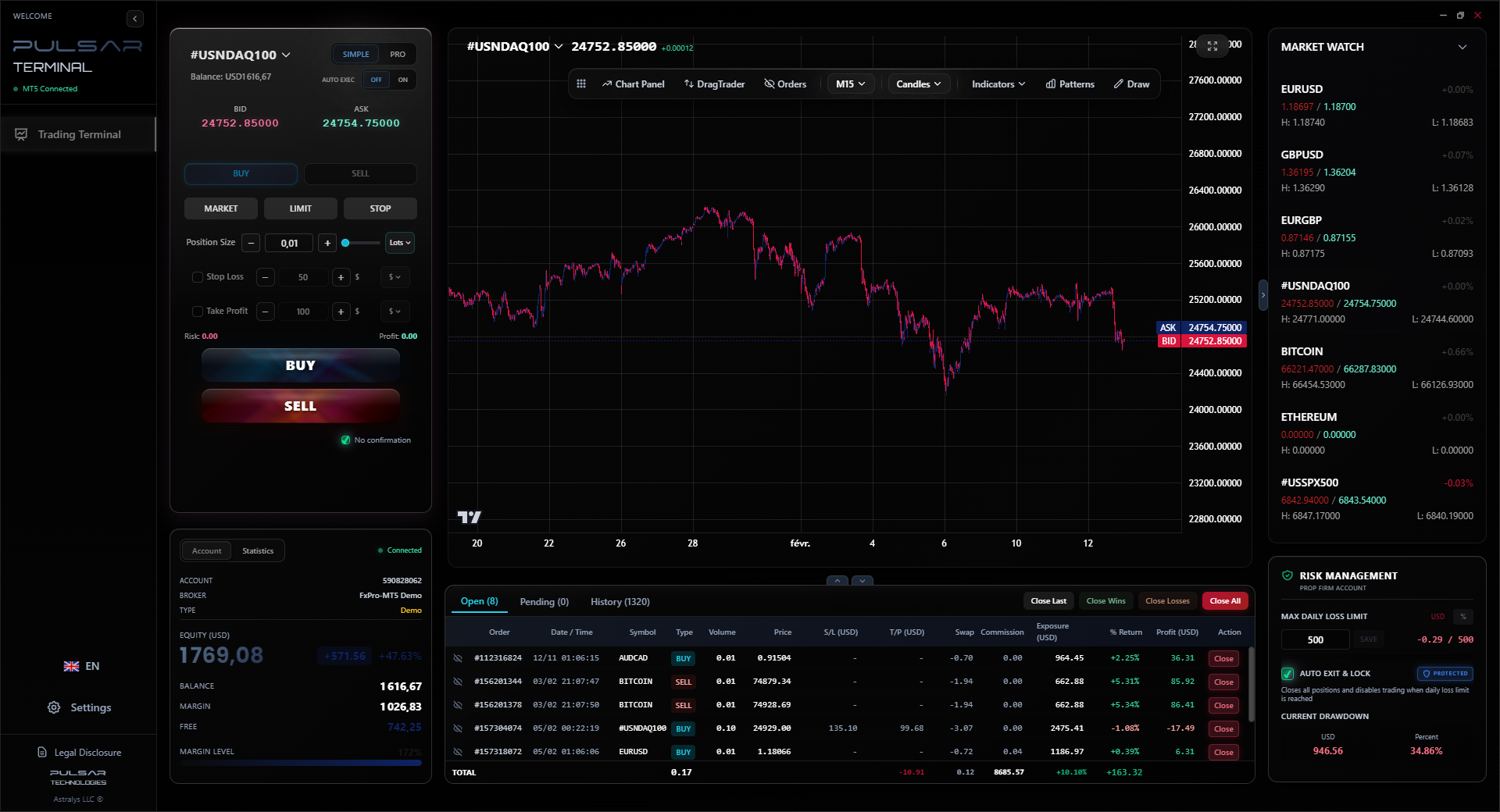
Problem 4: The Withdrawal Puts You Over Your Prop Firm's Daily Loss Limit. This is a sneaky one. If you withdraw profits, your account equity drops. If you then have a losing trade, the loss is calculated from the new, lower equity, potentially breaching a daily loss rule. Solution: This is where tools like Pulsar Terminal's prop firm daily loss protection are a lifesaver. It automatically monitors your equity relative to your starting balance for the day and can halt trading if you're near your limit. Withdraw strategically, preferably after a drawdown period, not right before you plan to trade aggressively.
Managing your equity after a withdrawal is critical for prop firm rules, and Pulsar Terminal's daily loss protection feature automates this monitoring directly on your MT5 platform.
Pulsar Terminal
A ferramenta MT5 tudo-em-um: ordens drag-and-drop, multi-TP/SL, trailing stop, grid trading, Volume Profile e proteção prop firm. Usado diariamente por 1.000+ traders.
“Ignorance of CBN rules isn't an excuse; it's a direct tax on your profits.”
Your broker's withdrawal policy is a report card on their entire business. Here’s what to look for, with real 2026 data:
- Free Withdrawals: This is non-negotiable for me. Brokers like Pepperstone, IC Markets, and Tickmill typically offer one free withdrawal per month. Others charge flat fees ($20-$50), which murders your profits on small withdrawals. Always check the fee schedule.
- Processing Time: Look for "1-2 business days" for processing. The actual wire time is down to the banks, but the broker shouldn't sit on your request.
- Naira Accounts: Some brokers, like Exness and HotForex, offer Naira-denominated accounts. This seems convenient, but understand this: they control the conversion rate from USD to Naira. You are almost certainly getting a worse rate than if you received USD and converted it yourself. I avoid this unless the spread is explicitly published and competitive.
- Minimum Withdrawal: Should be low ($50 or less). This lets you test the system with small amounts.
My personal litmus test? I search for "[Broker Name] withdrawal problems Nigeria" on Twitter and ForexPeaceArmy. If the first page is full of complaints from the last 6 months, I run. A smooth withdrawal process is the clearest sign of a legitimate, client-focused operation.
Pro Tip: When you're sizing your trades, factor in withdrawal costs. If a bank transfer costs you $30, that's 3 pips on a standard EUR/USD lot. Your trading edge needs to be wide enough to absorb these real-world frictions. Use a position size calculator that includes estimated transaction costs.
💡 Dica do Winston
Your broker's withdrawal policy is their most honest marketing. If it's convoluted or expensive, they do not respect you or your capital. Leave.
“Clean financial records turn a tax nightmare into a simple administrative task.”
Let's be blunt: most Nigerian retail traders don't pay their 10% capital gains tax. But as you grow, this becomes a massive risk. The goal is to make your life easy if FIRS ever comes knocking.
Your Simple System:
- One Dedicated Bank Account: Use one domiciliary account for all trading inflows and outflows. No mixing with personal shopping or business revenue.
- The Master Spreadsheet: Create a Google Sheet. Columns: Date, Broker, Action (Deposit/Withdrawal), Amount (USD), FX Rate (if converted), Amount (NGN), Running Profit/Loss.
- Document Everything: Download and save every single statement from your broker (monthly, quarterly). Save every bank statement showing the transfers. I use a folder named "Tax_[Year]" in my Google Drive.
- Calculate Tax Owed Annually: At the end of the year, your spreadsheet tells you your total net profit in Naira. 10% of that is your tax liability. Set that money aside immediately. You can file and pay through the FIRS TaxPro-Max portal.
I'm not a tax advisor, but I am a trader who doesn't want problems. Clean records are your best defense. They turn a potential nightmare into a simple administrative task.
FAQ
Q1Is it legal to withdraw forex profits in Nigeria?
Yes, it is completely legal. There is no law against Nigerian residents trading forex with international brokers or withdrawing their profits. The key is to use brokers regulated by reputable authorities (like FCA, ASIC) and to declare your income for tax purposes as required by Nigerian law.
Q2What is the fastest way to withdraw forex profits to Nigeria?
The fastest method is usually via an e-wallet like Skrill or Neteller, with funds often arriving in under 24 hours. However, this speed comes at a cost - you'll then face high fees and poor exchange rates to get that money into your Nigerian bank account. For the best overall value, a direct bank transfer to your domiciliary account, while slower (3-5 days), is superior for most amounts.
Q3How much does it cost to withdraw from forex?
It depends on your broker and method. Many top brokers offer one free bank transfer per month. You will still pay a fee to your Nigerian bank to receive the international wire, typically $15-$30. If you use an e-wallet, the broker's transfer might be free, but the e-wallet's conversion and withdrawal fees can easily eat 2-5% of your money.
Q4Can I withdraw forex profits to my Naira account?
Some brokers offer this directly. However, they will convert the USD to Naira for you, almost always at an unfavorable rate. It's generally better to withdraw USD to your domiciliary account and control the conversion to Naira yourself, either through your bank or by comparing rates with licensed BDCs/fintech apps.
Q5Why did my bank reject my forex withdrawal?
The most common reasons are: 1) The sender name on the wire (often the broker's payment processor) doesn't match what you told the bank, 2) Your domiciliary account wasn't pre-funded with a small amount to activate it for incoming wires, or 3) The bank's compliance department flagged it for review. Always inform your bank's domiciliary account desk before initiating a large withdrawal.
Q6Do I pay tax on forex profits in Nigeria?
Yes. According to Nigerian law, profits from forex trading are subject to Capital Gains Tax, which is currently 10% of your gross profits. You are responsible for calculating this, declaring it, and paying it to the Federal Inland Revenue Service (FIRS).
Q7What is the weekly cash withdrawal limit for Naira in 2026?
As per CBN policy effective January 1, 2026, individuals can withdraw a maximum of N500,000 in cash per week across all channels (ATM, POS, over-the-counter). Withdrawals exceeding this limit incur a 3% processing fee on the excess amount. This applies to Naira, not foreign currency in your domiciliary account.
Lição do Prof. Winston
Pontos-chave:
- ✓Test withdrawals with $50 before trusting a broker with $5000.
- ✓Use a domiciliary account. Always withdraw in USD, not Naira.
- ✓Factor in the 3% CBN penalty fee on Naira withdrawals over N500k/week.
- ✓Set aside 10% of every net profit immediately for capital gains tax.
- ✓One free withdrawal per month from your broker is a minimum standard.
Quão útil foi este artigo?
Clique em uma estrela
Insights de Trading Semanal
Análises e estratégias semanais grátis. Sem spam.
Sobre o autor
Olumide Adeyemi
Pioneiro do Trading na África Ocidental
Um dos educadores de trading forex mais ativos da Nigéria. 8 anos de experiência operando a partir de Lagos. Especialista em estratégias de baixo capital e desafios de prop firms para traders africanos.
Comentários
Aviso de risco
A negociação de instrumentos financeiros envolve riscos significativos e pode não ser adequada para todos os investidores. O desempenho passado não garante resultados futuros. Este conteúdo é apenas para fins educacionais e não deve ser considerado aconselhamento de investimento. Sempre conduza sua própria pesquisa antes de negociar.
Você também pode gostar

Cara Trading Forex Sukses: 7 Prinsip dari Trader Profesional
Cara trading forex sukses dengan 7 prinsip trader pro: manajemen modal, disiplin, journal trading, backtest. Data nyata, bukan janji profit palsu.
Jam Trading Forex Terbaik untuk Trader Indonesia: Panduan Lengkap dengan Tabel Waktu
Panduan jam trading forex untuk trader Indonesia. Tabel 4 sesi dunia, jam emas 20:00-00:00, sesi mana yang harus dihindari. Data akurat + tips dari trader berpengalaman.
Top 5 Sàn Forex Uy Tín Nhất 2026: Review Jujur dari Trader Indonesia
Top 5 sàn forex uy tín 2026 untuk trader Indonesia. Review jujur: spread, deposit, withdraw, dukungan lokal. Exness, XM, IC Markets & lebih.
Obter Pulsar Terminal
Todas essas calculadoras estão integradas ao Pulsar Terminal com dados em tempo real da sua conta MT5.
Obter Pulsar Terminal