


Let's cut right to it.

Olumide Adeyemi
Pioneiro do Trading na África Ocidental ·  Nigeria
☕ 10 min de leitura
O que você vai aprender:
- 1MBA Forex: The Final Nail in the Coffin
- 2Real Forex Trading vs. a Ponzi Scheme: Spot the Difference
- 3Nigeria's Forex Rules: What's Legal Now?
- 4Choosing a Real Broker: Costs & Real Numbers for Nigerians
- 5Building Real Skills: Your Path After the MBA Forex Debacle
- 6Red Flags: How to Protect Your Capital Now
Let's cut right to it. If you're asking 'is MBA Forex still paying,' you're asking the wrong question. The right one is: 'How did so many of us get burned, and what's the real path forward?' MBA Forex Trading and Capital Investment Ltd was a Ponzi scheme that collapsed over four years ago, taking more than ₦213 billion from over 40,000 Nigerians with it. It's dead. But the desire for financial freedom it exploited is very much alive. This guide isn't about chasing ghosts. It's about understanding what happened, navigating Nigeria's current forex landscape, and building real trading skills that can't be scammed.
I need you to hear this clearly, so there's no ambiguity. MBA Forex is not paying. It will never pay again. It was never a real trading company. The Securities and Exchange Commission (SEC) confirmed it was never licensed. The Central Bank of Nigeria (CBN) froze its accounts. The mastermind, Maxwell Odum, is on the run. As recently as June 2025, the EFCC was still arraigning directors for a separate ₦13.8 billion fraud linked to the scheme. The story is over.
They hooked people with promises of 15-20% monthly returns. Think about that for a second. That's doubling your money in less than half a year. In the real world, a professional hedge fund manager is thrilled with 20% per year. The moment you hear numbers like that, your scam detector should be screaming. I fell for a similar 'investment club' early in my career, lured by the community and the testimonials. Lost $500 before I realized the 'profits' were just new members' deposits. MBA Forex was that on a monstrous, billion-naira scale.
They created an illusion of legitimacy with offices and staff, but it was a classic Ponzi structure. Early 'investors' got paid with money from new victims. It works until it doesn't, and when the music stopped in late 2020, the vast majority were left holding empty bags. Asking if it's still paying is like asking if a tree that's been chopped down, burned, and its ashes scattered is still growing. It's not.

💡 Dica do Winston
A promise of 20% monthly return isn't a trading strategy, it's a confession. The math of compounding makes it impossible at scale without being a fraud.
“MBA Forex was a Ponzi scheme that collapsed over four years ago. It's dead. But the desire for financial freedom it exploited is very much alive.”
This is the most important lesson you can learn. Confusing a Ponzi scheme with actual trading is how people get ruined. Let's break down the difference so you're never fooled again.
How a Real Broker Works: You open an account with a regulated firm like Exness or IC Markets. You deposit your money, which is held in segregated client funds (meaning the broker can't touch it for their own expenses). You then use their platform (like MT5) to place trades directly on the live interbank market. When you buy EUR/USD, there's a real seller on the other side. Your profit or loss comes from the price movement. The broker makes a small fee (the spread or a commission). Your risk is 100% yours. There's no guaranteed return.
How a Ponzi Scheme Works: You 'invest' your money with a company like MBA Forex. They promise a fixed, high return (e.g., 15% monthly). Your money goes into a pooled account they control. There is no real trading, or only a tiny fraction occurs. The 'returns' they pay you are simply the deposits from the next wave of victims. It requires constant, exponential growth to survive. When recruiting slows, it collapses.

Warning: Any 'investment' that promises fixed, high monthly returns without clearly showing you the live trades and market risk is a massive red flag. Real trading is volatile. Some months you lose.
I keep a screenshot of my worst trading month on my desk: a 12% drawdown. It reminds me that this is a skill, not a magic money tree. Real trading involves learning about scalping strategies, managing your position size, and dealing with loss. A Ponzi sells you a dream and skips the work.

“Confusing a Ponzi scheme with actual trading is how people get ruined.”
Okay, so MBA Forex was illegal nonsense. What about real forex trading? Is it even legal for you and me? The answer is yes, absolutely. But you've got to know the lay of the land to stay on the right side of the law and get your money in and out.
Forex trading by individuals is legal in Nigeria. The big players watching the market are the CBN and the SEC. However, here's the key twist for us retail traders: there are no specific Nigerian regulations for online international forex brokers. This means you won't find a 'SEC-licensed' version of Exness or XM. Instead, we rely on brokers regulated by top-tier authorities abroad, like the FCA in the UK or ASIC in Australia. They can legally offer services to us.
The CBN has been busy. Back in October 2023, they unified the exchange rates (the famous 'willing buyer, willing seller' model). In late 2024, they rolled out a new Nigerian Foreign Exchange (FX) Code to clean up practices for big banks and dealers. Most recently, in February 2026, they let Bureau de Change (BDC) operators back into the official market to help with liquidity. This is all about the macro-economy, but it creates a more transparent background for currency movement.
The Funding Headache (And Solutions)
Here's the practical hurdle every Nigerian trader faces: the CBN prohibits using the official FX windows to fund forex trading accounts for speculation. They won't give you dollars at the official rate to go trade on MetaTrader.
So how do we fund accounts? We use international brokers that accept:
- Direct bank transfers in Naira (to a local intermediary account)
- Cryptocurrency deposits (increasingly common)
- Credit/Debit cards
- E-payments like Opay, Moniepoint
Brokers like XM and HFM offer Naira-denominated accounts, which simplifies things massively. You deposit ₦50,000, it's converted internally, and you trade. Withdrawals come back in Naira. It bypasses the official CBN restriction entirely.

Pro Tip: Always use a broker that offers a clear, local Naira deposit method. It's cheaper, faster, and keeps you compliant. Funding in USD through unofficial BDCs is a costly and unnecessary middleman game.
💡 Dica do Winston
Your first ₦50,000 live account is for paying tuition to the market, not for buying a car. If you can't afford to lose it, you can't afford to trade with it.
“The flash is often a distraction from the lack of substance. Guard your capital fiercely.”
Let's talk brass tacks. What does it actually cost to trade, and who should you use? Forget minimum deposits of millions. You can start small while you learn.
Minimum Deposits (You Can Start Today):
- $1: FBS, InstaForex
- $5: XM
- $10: Exness Standard account
- ₦4,000: HFM (HotForex) NGN account
- $0: Some, like XTB, have no minimum.
I started with a $100 account on a demo, then moved to a $50 live account with Pepperstone. Blowing that first $50 was the best education I ever bought. It taught me respect for the market.
Trading Costs & use: Your main cost is the spread (the difference between buy and sell price). It's how most brokers make money. Here's what you can expect on a major pair like EUR/USD:
| Broker | Typical EUR/USD Spread | Key Feature for Nigerians |
|---|---|---|
| IC Markets | From 0.0 pips | Raw spreads, great for scalping |
| Exness | From 0.3 pips | Unlimited use, strong local support |
| XM | From 0.8 pips | Low $5 min deposit, Naira accounts |
| OctaFX | From 0.7 pips | Popular local choice |
use is a double-edged sword. Brokers here offer it high - think 1:500 or even unlimited (Exness). Remember, use amplifies loss just as fast as profit. A 1% move against you on 1:500 use wipes out 500% of your margin. I learned this the hard way early on with a margin call on GBP/JPY.

Example: You trade 1 standard lot (100,000 units) of EUR/USD. A typical cost might be $5-$8 in spread per round turn. If you're swing trading for 100-pip gains, that's fine. If you're scalping for 5-pip gains, that cost eats you alive. Choose your broker and strategy together.
Finally, don't forget the taxman. The FIRS expects a 10% capital gains tax on your trading profits. Keep a clean record of your trades. It's not fun, but it's part of being a legitimate trader.
“The flash is often a distraction from the lack of substance. Guard your capital fiercely.”
The collapse of MBA Forex left a vacuum of distrust. Filling it with genuine knowledge is the only antidote. This isn't about getting rich quick; it's about becoming competent. Here’s a realistic skill path.
Phase 1: Foundation & Demo Trading (Months 1-3) Don't touch live money. Learn the absolute basics: what a pip is, how to calculate position size, what drives currency prices. Pick one major pair like EUR/USD and study it. Use a demo account to practice placing trades and managing stops. Your goal isn't profit, it's consistency in following a simple plan.
Phase 2: Strategy & Backtesting (Months 4-6) Find one simple strategy. Maybe it's based on a moving average crossover or support/resistance. Learn one indicator inside out, like the RSI or MACD. Now, go back in time on your chart. Paper trade your strategy on old data. Did it work? Why or why not? I spent three months backtesting a simple trend-following system on XAU/USD (gold) before I ever risked a dollar on it.
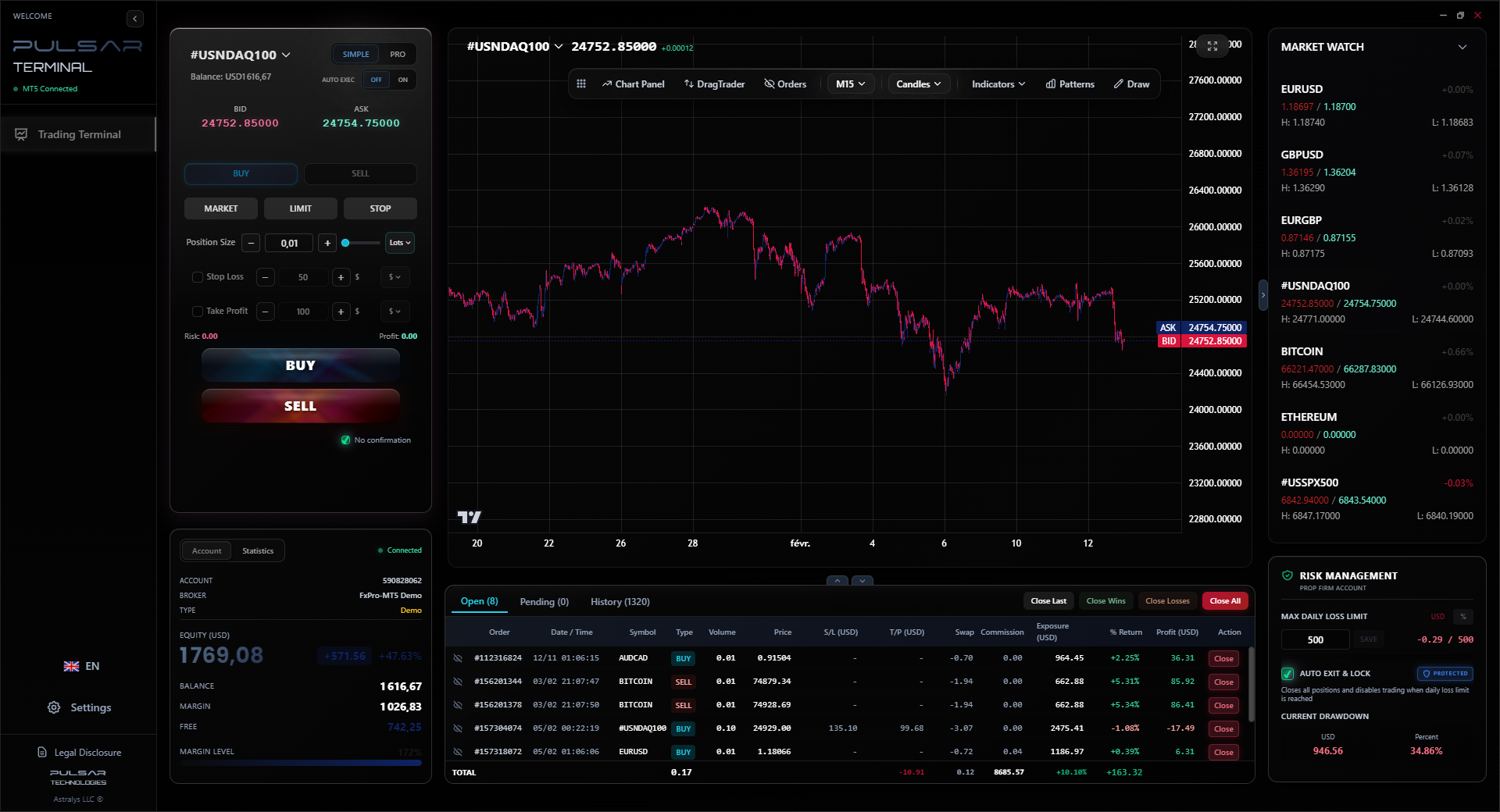
Phase 3: Live Trading with Micro Lots (Month 6+) Fund a small live account, maybe $50-$100. Trade the smallest size possible (micro lots). Your goal is to replicate your demo psychology and execution under real pressure. The market will test you. You'll feel fear and greed. This phase is about managing yourself. A tool that helped me immensely was setting automated trade management rules, which is a core feature of platforms like Pulsar Terminal for MT5. It takes the emotion out of moving stops to breakeven or taking partial profits.
The Mindset Shift: The MBA Forex model was passive: 'give us money, we handle it.' Real trading is active. You are the analyst, risk manager, and executioner. It's a craft. Some weeks you'll be down. A good month might be a 5-10% gain, not 20%. But it's real, it's yours, and no one can collapse it because you understand the engine.
💡 Dica do Winston
The most important indicator on your chart is your position size. A great entry with terrible size management is still a terrible trade.

When you're ready to trade live, managing multiple trades and emotions is the hardest part. A tool like Pulsar Terminal automates your trade management rules directly on MT5, handling partial closes, trailing stops, and breakeven moves so you can focus on analysis.
Pulsar Terminal
A ferramenta MT5 tudo-em-um: ordens drag-and-drop, multi-TP/SL, trailing stop, grid trading, Volume Profile e proteção prop firm. Usado diariamente por 1.000+ traders.
“Your journey is from being an investor in someone else's fairy tale to being a trader in charge of your own reality.”
Never again. Let's make that a promise. Here are the neon-red warning signs that should make you walk away immediately.
- Guaranteed Returns: Any promise of a fixed monthly profit (10%, 15%, 20%) is a scam. Full stop. The market doesn't guarantee anything.
- Vague or Secretive Strategies: If they can't explain in simple terms how they make money ('proprietary AI algorithm,' 'secret signal'), they're lying. Real traders can explain their edge.
- Pressure to Recruit: If earning depends more on bringing in new members than on market performance, it's a Ponzi. Real trading profits don't need a downline.
- Unlicensed/Unregulated 'Investment Houses': Check the SEC's Capital Markets Operator Search (CMOS) for any local entity. For international brokers, verify their license number on the regulator's website (e.g., FCA, ASIC).
- Too-Good-to-Be-True Testimonials: Fancy cars, mansions, 'proof of payment' screenshots are easily faked. Look for realistic, long-term track records, not glamour.
I once met a 'fund manager' at a Lagos seminar who drove a G-Wagon and promised 5% weekly. He spent more time showing off his car than explaining his charts. A year later, he was in the news for defrauding investors. The flash is often a distraction from the lack of substance.
Your capital is your army. Guard it fiercely. Only deploy it with brokers who are transparent about their costs, regulated by reputable authorities, and provide you with direct access to the markets. Your journey is from being an investor in someone else's fairy tale to being a trader in charge of your own reality.

FAQ
Q1Is MBA Forex still operating or paying investors in 2026?
No, definitively not. MBA Forex collapsed as a Ponzi scheme in late 2020/early 2021. The company is defunct, its accounts frozen by the CBN, and its principal is a fugitive. Legal cases against its operators are still ongoing, but no legitimate payments are being made to investors.
Q2What is the current legal status of forex trading in Nigeria?
Forex trading by individuals is legal. However, online retail forex brokers are not specifically regulated by Nigerian authorities like the SEC for that activity. Nigerian traders legally use international brokers regulated abroad (e.g., by the UK's FCA or Australia's ASIC). The CBN prohibits using official FX windows to fund trading accounts.
Q3How can I fund a forex trading account from Nigeria?
The most straightforward way is to use an international broker that offers Naira (NGN)-denominated accounts, such as Exness, HFM, or FXTM. You can deposit Naira directly via bank transfer, card, or e-payment to their local intermediary. The broker handles the conversion. Cryptocurrency funding is also a common option.
Q4What is a realistic monthly return from legitimate forex trading?
Anyone promising consistent double-digit monthly returns is likely running a scam. A skilled, professional retail trader might aim for 5-10% per month, but this is not consistent. Many months will see smaller gains, break-even, or losses. Focus on risk management and long-term growth, not monthly guarantees.
Q5What are the best regulated brokers for Nigerian traders?
Reputable brokers accepting Nigerian clients include XM (CySEC, ASIC), Exness (FSA), IC Markets (ASIC, CySEC), and Pepperstone (FCA, ASIC). Look for those with local Naira deposit options, good customer support, and tight spreads. Always verify their license on the regulator's official website.
Q6Do I pay tax on my forex trading profits in Nigeria?
Yes. The Federal Inland Revenue Service (FIRS) considers forex trading profits as capital gains, which are taxable at a rate of 10%. You are responsible for declaring this income and paying the due tax.
Q7What's the biggest lesson from the MBA Forex scam?
The core lesson is the difference between passive investing in a scheme and active participation in a skill. If you're not in direct control of your trades, don't understand the source of the profits, and are promised unrealistic returns, it is almost certainly a fraud. Real trading requires education, practice, and personal risk management.
Lição do Prof. Winston
Pontos-chave:
- ✓Ponzi schemes promise fixed returns; real trading has variable, uncertain outcomes.
- ✓Verify broker regulation yourself on the official website (FCA, ASIC).
- ✓Start with a micro account; your first goal is survival, not profit.
- ✓10% capital gains tax applies to your forex profits in Nigeria.
Quão útil foi este artigo?
Clique em uma estrela
Insights de Trading Semanal
Análises e estratégias semanais grátis. Sem spam.
Sobre o autor
Olumide Adeyemi
Pioneiro do Trading na África Ocidental
Um dos educadores de trading forex mais ativos da Nigéria. 8 anos de experiência operando a partir de Lagos. Especialista em estratégias de baixo capital e desafios de prop firms para traders africanos.
Comentários
Aviso de risco
A negociação de instrumentos financeiros envolve riscos significativos e pode não ser adequada para todos os investidores. O desempenho passado não garante resultados futuros. Este conteúdo é apenas para fins educacionais e não deve ser considerado aconselhamento de investimento. Sempre conduza sua própria pesquisa antes de negociar.
Você também pode gostar

Cara Trading Forex Sukses: 7 Prinsip dari Trader Profesional
Cara trading forex sukses dengan 7 prinsip trader pro: manajemen modal, disiplin, journal trading, backtest. Data nyata, bukan janji profit palsu.
Jam Trading Forex Terbaik untuk Trader Indonesia: Panduan Lengkap dengan Tabel Waktu
Panduan jam trading forex untuk trader Indonesia. Tabel 4 sesi dunia, jam emas 20:00-00:00, sesi mana yang harus dihindari. Data akurat + tips dari trader berpengalaman.
Top 5 Sàn Forex Uy Tín Nhất 2026: Review Jujur dari Trader Indonesia
Top 5 sàn forex uy tín 2026 untuk trader Indonesia. Review jujur: spread, deposit, withdraw, dukungan lokal. Exness, XM, IC Markets & lebih.
Obter Pulsar Terminal
Todas essas calculadoras estão integradas ao Pulsar Terminal com dados em tempo real da sua conta MT5.
Obter Pulsar Terminal