


Let's get one thing straight: if you're searching for a 'list of registered forex brokers in Nigeria' expecting to find a neat, SEC-approved directory like you would for stocks, you're already lost.

Olumide Adeyemi
Pioneiro do Trading na África Ocidental ·  Nigeria
☕ 11 min de leitura
O que você vai aprender:
- 1The Brutal Truth About Nigerian Forex Regulation
- 2Getting Your Money In and Out: The Naira Problem
- 3The Real List: International Brokers That Work for Nigeria
- 4Costs & Taxes: What They Don't Tell You
- 5My 5-Step Process to Pick a Broker
- 6Platforms, Tools, and the Tech You Need
- 7Classic Nigerian Trader Mistakes (I Made Them All)
- 8The Final Verdict: Your Path Forward
Let's get one thing straight: if you're searching for a 'list of registered forex brokers in Nigeria' expecting to find a neat, SEC-approved directory like you would for stocks, you're already lost. The real game for Nigerian traders isn't about local registration; it's about navigating a grey area to access international brokers who won't vanish with your money. I've traded from Lagos to Abuja for over a decade, watched brokers come and go, and learned the hard way where to park capital. This isn't a generic list. It's a survival guide explaining why the local regulatory scene is thin, how you actually get your money in and out, and which internationally regulated brokers consistently work for Naija traders. Forget what the forums say. Let's talk reality.
Here's the uncomfortable fact most 'experts' won't tell you: Nigeria's retail forex market is poorly regulated. The Securities and Exchange Commission (SEC) and Central Bank of Nigeria (CBN) are the big names, but their focus isn't on protecting you, the retail spot forex trader. The CBN's new FX Code, effective from December 2024? That's for the wholesale market - banks and authorized dealers. Not for you and your MT5 account.
This creates a dangerous vacuum. There's no strong local watchdog ensuring brokers keep client funds segregated or execute trades fairly. This is why chasing a purely 'SEC-registered' local forex broker is a fool's errand. The real protection comes from targeting brokers regulated elsewhere by heavyweight authorities like the UK's FCA, Australia's ASIC, or Cyprus's CySEC. These regulators have strict rules about capital adequacy and client money protection. Your first filter for any broker shouldn't be 'is it Nigerian?' but 'who else is watching them?'

Warning: Any broker aggressively marketing itself as 'fully registered with the SEC Nigeria' for retail forex should raise immediate red flags. Scrutinize their international licensing. That's where your safety net is.
I learned this lesson in 2018. I deposited with a 'local' platform that promised seamless Naira deposits and CBN compliance. When I tried to withdraw a $5,000 profit, the excuses started. 'Bank processing delays.' 'CBN clearance.' It took 3 months of daily calls to get my money. The platform folded a year later. My mistake? Prioritizing convenience over credible, third-party regulation.
This is the single biggest headache for Nigerian traders. The CBN prohibits using official FX windows to fund trading accounts. Your bank card? Many have limits or are blocked for international broker payments. So how do you do it?
The Usual Suspects: Payment Methods
You'll rely on a mix of methods, and your broker's support for these is as important as their spreads.
- Cryptocurrency (USDT, BTC): Increasingly the king. Fast, bypasses banks, but volatile. Most serious international brokers now accept crypto deposits.
- Local Bank Transfer/Flutterwave/Paystack: Some brokers partner with local payment processors. You pay in Naira, they credit your account in USD. Convenient, but check the exchange rate used - it's often worse than the official rate.
- International E-wallets: Skrill, Neteller, PayPal (less common). You'll need to fund these first, which presents the same initial hurdle.
- Direct Card: Still works for some, but expect frequent declines and low limits.
The Withdrawal Dance
Withdrawals are where brokers show their true colors. Crypto is again the fastest. For local bank transfers, expect a 1-5 business day wait and paperwork. Always, and I mean always, test a small withdrawal before you commit large capital. A broker that makes depositing easy but withdrawing a nightmare is a scam.

Example: In January 2024, I deposited $1,000 via USDT to an ECN account. The broker credited it in 10 minutes. I later withdrew $300 profit back to my Binance wallet. It took 4 hours. The cost? The Ethereum network gas fee, about $3. Far better than waiting weeks for a bank transfer.

💡 Dica do Winston
Your first withdrawal is more important than your first deposit. It tells you everything about the broker's real intentions.
“use is dynamite. It can build you a palace or blow up your entire foundation in seconds.”
Forget a static list. Here's a dynamic breakdown of internationally regulated brokers that consistently accept Nigerian clients, with the gritty details that matter. This is based on my experience and that of a network of traders here.
| Broker | Key Regulation For Int'l Clients | Min. Deposit (Approx) | Naira-Friendly? | Why It's On The List |
|---|---|---|---|---|
| Exness | CySEC, FSCA | $10 (Standard) | Excellent. Local Naira deposits via partners. | Raw spreads, unlimited use (use with extreme caution), and perhaps the smoothest local payment system. Read our full Exness review for the deep dive. |
| XM | CySEC, ASIC | $5 | Very Good. Multiple local deposit options. | Low barrier to entry, solid educational resources for beginners, and consistent service. Check the XM review for their account types. |
| IC Markets | ASIC, CySEC | $200 | Good. Primarily crypto & int'l cards. | The gold standard for raw spreads (0.0 pips on EUR/USD) and lightning execution. For serious scalping or algo trading. Our IC Markets review covers their True ECN model. |
| Pepperstone | FCA, ASIC (via KE entity) | $0 | Good. Accepts crypto deposits. | Top-tier execution, fantastic charting tools (TradingView), and great for manual swing trading. The Pepperstone review details their Razor account. |
| HFM (HotForex) | FSCA, CySEC | $0 (on Cent) | Excellent. Offers NGN-denominated accounts. | Direct Naira accounts remove exchange risk. Huge use options (up to 1:2000). Good for micro-lot trading. |
| FBS | CySEC, ASIC | $1 | Very Good. Localized payment methods. | Super low minimums, caters to beginners. Frequent trading contests. |
| Vantage | ASIC, FCA, FSCA | $50 | Good. Crypto & card focus. | Competitive ECN pricing, strong on CFDs for indices and commodities. |
A Critical Note on use: Brokers like Exness and HFM offer insane use (1:Unlimited, 1:2000). This is a double-edged sword. It can amplify tiny account gains, but it will vaporize your account just as fast if you don't understand margin call mechanics. I don't recommend using max use ever. It's a trap for the emotional.
Your profit isn't just entry minus exit. Here's what eats into it.
The 10% Capital Gains Tax
This is non-negotiable. The Federal Inland Revenue Service (FIRS) taxes forex trading profits at 10% on the gross gain. If you make 1,000,000 Naira profit, you owe 100,000 Naira in tax. It applies whether your broker is in Cyprus or the Cayman Islands. You are responsible for declaring this. I keep a simple spreadsheet: date, trade, profit/loss. At year-end, it's calculation time.
Broker Costs: Spreads & Commissions
You have two main account types:
- Commission-Free (Standard): Wider spreads. The broker's profit is baked into the spread. Example: EUR/USD at 1.2 pips. If you're trading 1 standard lot, that's a $12 cost to open the trade (1.2 pips * $10 per pip).
- ECN/Raw Spread: Tighter spreads (0.0 - 0.2 pips) but you pay a commission per lot. Example: EUR/USD at 0.1 pips spread + $7 commission per round lot. Your cost is $0.10 (spread) + $7 = $7.10.
Which is cheaper? For larger positions, ECN is almost always better. For tiny lots, the standard account might be simpler. Always use a position size calculator that includes commission to see your true break-even.

Pro Tip: Don't just look at the advertised spread. Check it during volatile market opens (London, NY). That's when 'variable' spreads can widen to 5-10 pips on a standard account, killing your trade.
💡 Dica do Winston
If a broker's main selling point is their use, run. They're targeting your greed, not facilitating your strategy.
“Your first goal isn't a Lamborghini; it's to consistently protect your capital for 6 months.”
Here's exactly how I vet a broker now, after my early mistakes.
- Regulation First: I go to the broker's website, scroll to the footer, and find their license numbers. Then I go to the regulator's website (e.g., CySEC, ASIC) and verify the license is active and covers retail forex. No verification, no go.
- Deposit/Withdrawal Test: I open a live account (not demo) with the minimum deposit, usually $50-100. I then immediately request a withdrawal of $20-30 back to my preferred method. If this process is smooth and timely, it's a green light. If it's fraught with hidden fees or delays, I withdraw everything and walk away.
- Platform & Execution: I trade during high-impact news (like NFP). I place a limit order and watch the execution slippage and requotes. A good ECN broker should have minimal slippage. I also check if they support the tools I need, like advanced order types crucial for my swing trading plans.
- Cost Analysis: I calculate the all-in cost for my typical trade size on both their standard and ECN accounts. For my usual 2-lot trades on EUR/USD, the ECN account is cheaper.
- Customer Service: I contact support with a technical question. I note the response time and quality. If they can't handle a simple query, imagine a withdrawal problem.
This process saved me in 2022. I was about to fund a new 'high-use' broker. Step 1 failed: their 'FCA license' was for an entirely different, non-trading entity. I avoided what was likely a scam.
MT4 and MT5 are universal in Nigeria. They work on shaky internet, which is a real concern. But the real edge comes from the tools you bolt onto them.
Essential Tools
- Economic Calendar: You must track USD, EUR, and GBP news, but also Nigerian data like inflation figures and CBN announcements. They cause volatility in USD/NGN pairs and can spill into other markets.
- A Reliable VPN: Some broker platforms or analysis sites can be intermittently blocked. A good VPN is part of your trading infrastructure.
- Advanced Charting: MT4/MT5 indicators are fine, but for deeper analysis like Market Profile or better volume tools, you need add-ons. This is where a platform companion can be transformative.
Trading Gold (XAU/USD)
It's massively popular here, often seen as a hedge against the Naira's volatility. But it moves differently to forex. You need to understand its drivers (real yields, dollar strength, geopolitics). Don't trade it like a currency pair. Our XAU/USD guide breaks down its unique personality.
Indicator Reality Check
Everyone searches for the magic indicator. I used to stack them: RSI, MACD, Stochastic, Bollinger Bands. My chart was a rainbow of confusion. I now use price action and one or two indicators for confluence. Clean charts lead to clearer decisions.
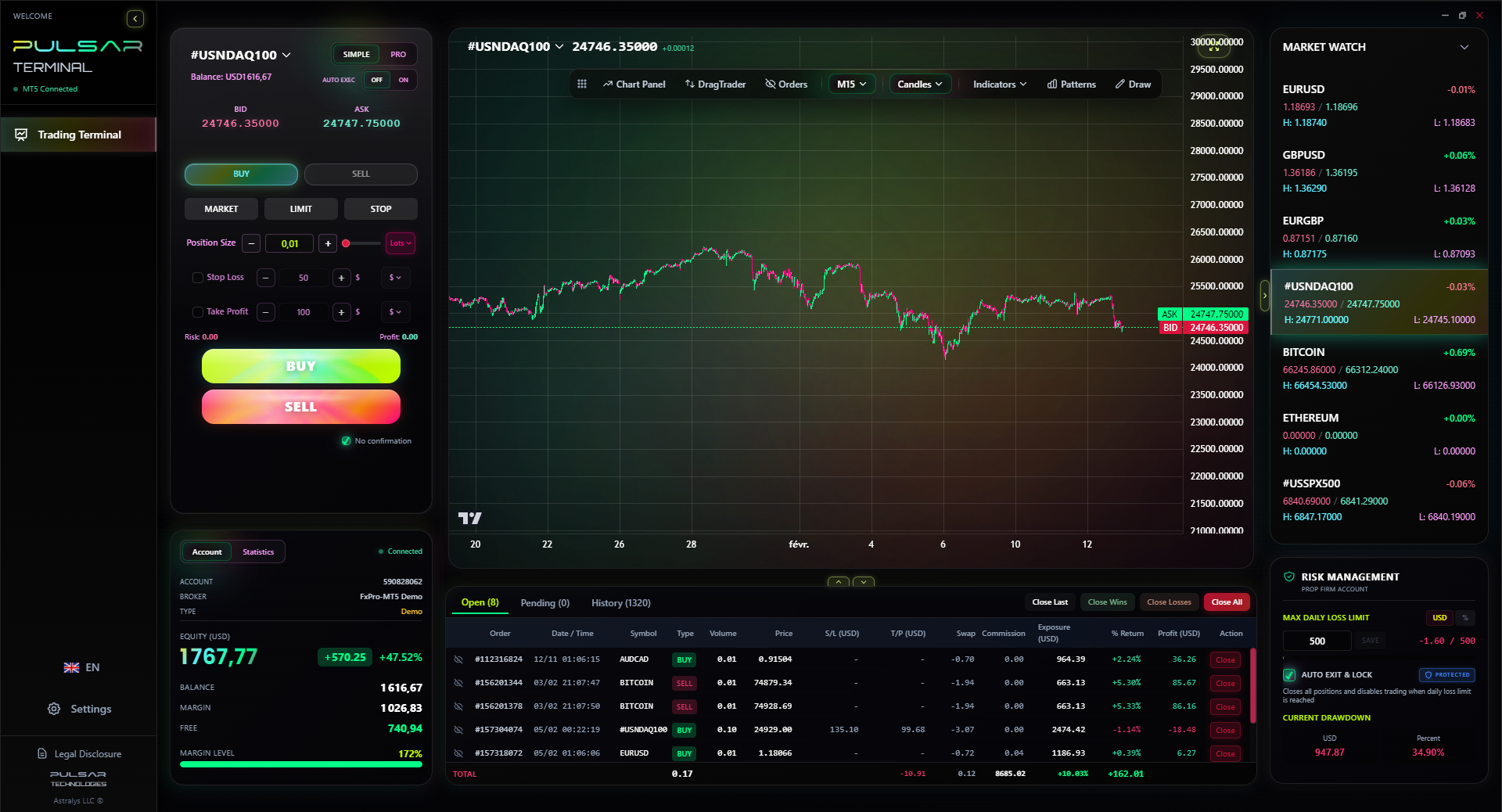
When trading volatile pairs like XAU/USD during news, quick order management is critical; Pulsar Terminal's drag-and-drop orders and multi-TP/SL on MT5 let you adjust your plan instantly without panic.
Pulsar Terminal
A ferramenta MT5 tudo-em-um: ordens drag-and-drop, multi-TP/SL, trailing stop, grid trading, Volume Profile e proteção prop firm. Usado diariamente por 1.000+ traders.
“A broker that makes depositing easy but withdrawing a nightmare is a scam. Always test the exit.”
Let me save you some pain and money.
- Chasing 'Bonuses': A broker offers a 100% deposit bonus. Sounds great, right? The fine print usually ties it to impossible trading volume requirements (turnover of 100 times the bonus amount). You end up over-trading to unlock 'your' money and blow the account. I did this. Ignore bonuses.
- Trading USD/NGN Pairs: Some offshore brokers offer Naira pairs. The spreads are astronomical (50-100 pips), and the liquidity is terrible. It's a casino, not a market. Avoid.
- Ignoring Tax Obligations: Thinking 'my broker is offshore, FIRS won't know.' They can. And when they do, the penalties pile up. Just factor the 10% into your profit targets.
- Over-Leveraging Because You Can: Just because Exness gives you 1:Unlimited doesn't mean you use it. Starting with 1:10 or 1:20 is more than enough to learn proper risk management. use is dynamite.
- Using Unregulated 'Asset Managers': Someone on WhatsApp promises 20% monthly returns managing your forex account. This is the #1 scam. You will lose everything. Manage your own capital or don't play the game.
My worst loss came from a combination of over-use and ignoring a clear MACD divergence on a gold trade. I was in a 5-lot position using 1:100 use. A $15 reverse move triggered a margin call. I lost $7,500 in minutes. The market didn't beat me. My own poor position sizing did.
💡 Dica do Winston
The 10% tax is your cheapest lesson in discipline. If a trade isn't worth the taxman's cut, it's not worth taking.
So, what's the final word on a list of registered forex brokers in Nigeria? The list that matters isn't maintained by the SEC. It's a personal checklist of brokers with solid international regulation, proven Naira funding rails, and a track record of fair play with clients in your region.
Start with the brokers in the table above. Do your own 5-step vetting. Begin with a small, testable amount of capital you can afford to lose. Your first goal isn't a Lamborghini; it's to consistently protect your capital for 6 months. Master a single strategy, whether it's a scalping method on the 5-minute chart or a swing trade setup on the daily. Understand every component of your trade cost, from the spread to the taxman's cut.
The Nigerian forex trading scene is tough, opaque, and full of noise. But the opportunity is real. It demands more discipline, more due diligence, and a thicker skin than traders in more developed markets. Cut through the hype, focus on the fundamentals of broker safety and personal risk management, and you give yourself a fighting chance. Now go do the work.
FAQ
Q1Is forex trading legal in Nigeria?
Yes, it is legal for individuals to trade forex with their personal funds. However, the retail side is poorly regulated by local authorities like the SEC. The legal framework focuses more on banks and institutional players, not on protecting individual traders from broker malpractice.
Q2Which is the best forex broker for beginners in Nigeria?
For a complete beginner, XM or FBS are strong contenders due to their very low minimum deposit ($5 and $1), extensive educational materials, and user-friendly platforms. They also offer good support for Naira deposits. Remember, 'best' also means safest: always verify their international licenses (like CySEC).
Q3How do I pay tax on forex trading profits in Nigeria?
You are required to pay a 10% Capital Gains Tax on your gross trading profits. You must declare this income and pay the tax to the Federal Inland Revenue Service (FIRS). It is your responsibility to keep accurate records of all trades and profits for your tax filing.
Q4Can I use my Nigerian bank card to fund a forex trading account?
It's increasingly difficult. Many Nigerian banks have restricted or blocked international transactions on debit cards. While it might work sporadically, the most reliable methods now are cryptocurrency (USDT) or using a broker's local payment partner that accepts Naira bank transfers.
Q5What is the minimum amount I need to start forex trading in Nigeria?
You can start with as little as $1 (with FBS) or $5 (with XM). However, I strongly advise starting with at least $100-$200. This allows for proper position sizing and risk management without being wiped out by a single small loss or high trading costs relative to your capital.
Q6Are there any Nigerian-owned forex brokers I can trust?
The landscape is risky. I have not encountered a purely Nigerian-owned retail forex broker with the same level of credible, independent regulation (like ASIC or FCA) as the major international firms. Your trust should be placed in verifiable regulation, not the nationality of the brand. Prioritize international regulatory oversight above all else.
Q7How do I verify a broker's international license?
Go to the broker's website, find their regulatory information (usually in the footer). They will list a license number and authority (e.g., CySEC 123/456). Then, go to the official website of that regulator (e.g., www.cysec.gov.cy) and use their public register to search for the license number. Confirm it's active and covers retail forex services.
Lição do Prof. Winston
Pontos-chave:
- ✓Local SEC registration is not a safety net for forex.
- ✓Always verify the international license (ASIC, FCA, CySEC).
- ✓Test a small withdrawal before large deposits.
- ✓Factor in the 10% capital gains tax on all profits.
Quão útil foi este artigo?
Clique em uma estrela
Insights de Trading Semanal
Análises e estratégias semanais grátis. Sem spam.
Sobre o autor
Olumide Adeyemi
Pioneiro do Trading na África Ocidental
Um dos educadores de trading forex mais ativos da Nigéria. 8 anos de experiência operando a partir de Lagos. Especialista em estratégias de baixo capital e desafios de prop firms para traders africanos.
Comentários
Aviso de risco
A negociação de instrumentos financeiros envolve riscos significativos e pode não ser adequada para todos os investidores. O desempenho passado não garante resultados futuros. Este conteúdo é apenas para fins educacionais e não deve ser considerado aconselhamento de investimento. Sempre conduza sua própria pesquisa antes de negociar.
Você também pode gostar

Cara Trading Forex Sukses: 7 Prinsip dari Trader Profesional
Cara trading forex sukses dengan 7 prinsip trader pro: manajemen modal, disiplin, journal trading, backtest. Data nyata, bukan janji profit palsu.
Jam Trading Forex Terbaik untuk Trader Indonesia: Panduan Lengkap dengan Tabel Waktu
Panduan jam trading forex untuk trader Indonesia. Tabel 4 sesi dunia, jam emas 20:00-00:00, sesi mana yang harus dihindari. Data akurat + tips dari trader berpengalaman.
Top 5 Sàn Forex Uy Tín Nhất 2026: Review Jujur dari Trader Indonesia
Top 5 sàn forex uy tín 2026 untuk trader Indonesia. Review jujur: spread, deposit, withdraw, dukungan lokal. Exness, XM, IC Markets & lebih.
Obter Pulsar Terminal
Todas essas calculadoras estão integradas ao Pulsar Terminal com dados em tempo real da sua conta MT5.
Obter Pulsar Terminal