


If you're a US trader and you've heard that MetaTrader 5 is 'banned' or impossible to use, I need you to forget that right now.

James Mitchell
Analista de Trading Sênior
☕ 13 min de leitura
O que você vai aprender:
If you're a US trader and you've heard that MetaTrader 5 is 'banned' or impossible to use, I need you to forget that right now. It's the most persistent myth out there, and it kept me on the sidelines for way too long. The truth is more nuanced, governed by strict CFTC and NFA rules, and access is tightly controlled through a handful of brokers. I learned this the hard way, trying to skirt the system early on and nearly blowing up an account. This guide isn't just the latest MetaTrader 5 news; it's a roadmap from someone who's navigated the regulatory maze, made the mistakes, and finally found a way to trade with this powerful platform legally and effectively.
Let's get the legal stuff out of the way first, because it's non-negotiable. In the US, you don't deal with MetaQuotes directly. You deal with brokers who are registered as Futures Commission Merchants (FCMs) with the CFTC and NFA. This creates a specific trading environment you must understand before placing a single trade.
The big three rules are the FIFO rule (First-In, First-Out), the hedging ban, and use caps. FIFO means you close your oldest trade first. You can't just pick and choose which lot to close for the best tax or risk management outcome. The hedging ban means you can't have a buy and a sell position open on the same currency pair at the same time. This kills certain carry trade or grid strategies that work elsewhere.
And use? Forget the 500:1 or 1000:1 you see advertised offshore. For major forex pairs, you're capped at 50:1. It feels restrictive, especially if you're used to scalping strategies that rely on high use for small moves. I had to completely rework my position sizing. My old 2% risk rule with high use turned into a much smaller effective position. I started using a position size calculator religiously to adapt.

Warning: If you find an offshore broker happily offering you MT5 with 500:1 use and no mention of FIFO, run. They are operating illegally for US clients. Your funds are not protected, and you could face legal headaches. I learned this after depositing $1,000 with one such "broker" only to have my withdrawal stalled for months. I got lucky and eventually got most of it back, but the stress wasn't worth it.
The bottom line? MT5 in the US is a regulated, sanitized version of the global platform. It's less about wild speculation and more about disciplined trading within a protective framework. Once I accepted that, I started looking for the right gatekeepers.

💡 Dica do Winston
Stop fighting FIFO. Design your strategy to have one clear entry and one clear exit point. It forces cleaner analysis and better timing.
As of right now, your options are limited but solid. You're not shopping for 100 brokers; you're vetting a select few. The main players offering MT5 to US residents are FOREX.com and Trading.com. Oanda offers MT4, but their MT5 is generally for non-US clients, though they have special arrangements with some prop firms.
Let's talk real numbers, because marketing spreads lie. When I opened my FOREX.com MT5 account, the advertised EUR/USD spread was "as low as 0.1." In reality, during the London open, I consistently saw 0.8 to 1.2 pips on their standard account. That's the cost of doing business with a fully regulated US entity. If you want tighter spreads, you look at their commission-based accounts.
Here’s a quick breakdown of what you’re really signing up for:
| Cost/Fee Type | Typical Range (USD) | What It Means For You |
|---|---|---|
| Minimum Deposit | $0 - $200 | Usually low barrier to entry. FOREX.com starts at $100. |
| EUR/USD Spread | 0.8 - 1.5 pips (Standard) | Your main trading cost on a no-commission account. |
| Commission (if applicable) | ~$5 per 100k round turn | Added on top of raw spreads (e.g., 0.0 pips + commission). |
| Card Deposit Fee | 2.5% - 4.5% | Use ACH bank transfers instead (usually free). |
| use (Majors) | Max 50:1 | Set by law, not the broker. |
Deposit methods matter. I always use ACH bank transfers. They take 1-2 business days, but they're free. Credit card fees will eat into your capital before you even start. Some brokers integrate with e-wallets like Skrill, but check the fees.
One perk: FOREX.com offers free VPS hosting for your Expert Advisors if you trade over $500 million in monthly notional volume. Otherwise, it's about $30/month. For most retail traders starting out, that's a paid service. I ran a simple EA for a few months and found the VPS crucial for uptime; without it, my home internet hiccup would have stopped my strategy dead. This is a key piece of MetaTrader 5 news for automated traders - factor this cost in.
Asset selection is another reality check. Don't expect to trade a wide array of CFDs on indices or cryptocurrencies through MT5 in the US. You're primarily looking at forex and metals like XAU/USD (gold). This limitation forced me to become much more focused in my analysis.
“MT5 in the US is a regulated, sanitized version of the global platform. It's less about wild speculation and more about disciplined trading within a protective framework.”
This is where the MetaTrader 5 news got really dramatic. For a while, prop firms were a backdoor for US traders to access MT5 with higher use. Then, in early 2024, MetaQuotes cracked down hard. They started shutting off platform access to prop firms that didn't have direct licenses or were serving jurisdictions like the US without proper regulatory backing.
Overnight, forums were flooded with panicked traders who lost access to their challenge accounts. I had a friend in this exact spot. He was halfway through a $100k challenge with a firm using MT5, and one day he just couldn't log in. The firm's support gave vague answers about "platform updates" for weeks. He never got his access back and lost his challenge fee. It was a brutal lesson in the risks of indirect access.
The Comeback
By 2025, the smarter prop firms adapted. Companies like Funding Traders and Funding Pips got their paperwork in order, often by incorporating in places like Saint Lucia, and relaunched MT5 access. The most significant move was FTMO partnering with Oanda, a US-regulated broker, to relaunch services for US traders. This is a game-changer because it links the prop firm model to a regulated entity, adding a layer of security.
If you're going the prop firm route now, this partnership model is the only one I'd consider. It means your trades are being executed through a real, regulated broker's infrastructure (Oanda's), not some shadowy third-party liquidity pool. The use and rules still follow US regulations, but you're using the firm's capital.

Pro Tip: Before giving any prop firm your money for an MT5 challenge, ask them: "Which regulated broker executes the trades for your US clients?" If they can't give you a clear answer (like Oanda), walk away. Your challenge fee is at risk.
This whole saga underscores a critical point: in the US, sustainable MT5 access is tied to regulation. Any workaround is temporary and risky. The latest MetaTrader 5 news tells us the loopholes are closing, and the path is through compliance.
MetaQuotes doesn't let MT5 stagnate. Keeping your platform updated is mandatory - they stop supporting old builds, and if you're on one, you lose access. Support for builds below 4410 ended in December 2024. Builds below 4755 got cut off in July 2025. Update when prompted; it's not a suggestion.
Some of the recent updates are genuinely useful:
- Floating use (Build 4150, Feb 2024): This allows your broker to dynamically adjust your use based on your open position size. In practice, on a US account, you might not see much effect because you're already at the max 50:1, but it's a core feature now.
- Integrated Payments: MT5 now supports over 40 payment methods globally through its system. For US traders, the usual suspects (ACH, card, e-wallet) are there, but it's good to know the infrastructure is expanding.
- The AI Trade Assistant & Upgraded Tester (2025 Update): This is the big one. The Strategy Tester now does multi-symbol backtesting, and they claim it's 30% faster. I tested a simple multi-currency correlation EA, and the backtest did feel snappier. The AI Trade Assistant is... interesting. It gives basic suggestions on trade management. I don't rely on it, but for a new trader, it might highlight something obvious you've missed.
What's more important than flashy AI, in my opinion, are the core tools. The economic calendar integrated into MT5 is decent, but I always cross-reference it. The biggest feature for me remains the ability to code and test my own strategies in MQL5, even within the US constraints. It's where I built my disciplined swing trading systems that work with FIFO and no hedging.
Remember, these updates apply to the platform globally. The US-specific experience - the rules, the use, the brokers - is what you layer on top of this foundation.
💡 Dica do Winston
With 50:1 use, a 20-pip stop loss on EUR/USD represents about 1% risk on a standard lot. Use that math to keep your position size sane.

“I learned about margin calls the hard way early on by ignoring risk management, and I won't do it again.”
Trading MT5 in the US forced me to become a better, less lazy trader. I can't just set and forget a grid EA. I have to be more strategic. Here’s what works for me now.
I focus almost exclusively on EUR/USD and gold. Less noise, deeper liquidity. With the 50:1 use, my positions are larger in notional value than I'd like for the risk, so I use tighter stops. A 20-pip stop on EUR/USD is common for me now, whereas overseas I might have used 50.
I use the MACD indicator and RSI not for direct signals, but for context on momentum and overbought/oversold conditions within a clear trend structure. Because of FIFO, I rarely scale into a position. It's one entry, one exit. This means my entry timing has to be sharper. I wait for stronger confirmations.
Let me give you a real example from last month. I saw EUR/USD bouncing off a key support level on the 4-hour chart. The daily trend was still up. In the old days, I might have entered a half position there and added another half on a slight pullback. Now, I waited for the 1-hour chart to show a clear bullish engulfing candle with RSI climbing from near 40. I entered one full position at 1.0725 with a stop at 1.0705 (20 pips). I couldn't hedge, so that was my only shot. I took profit at 1.0775 for a 50-pip gain. Clean, single trade, managed by the rules.
Risk management is everything. With limited use, the temptation to over-use a small account is huge. I keep my risk per trade at 0.5% of my account balance. I calculate it every time. I also have a daily loss limit of 2%. If I hit it, I'm done for the day. This discipline saved me from revenge trading after a couple of bad losses. I learned about margin calls the hard way early on by ignoring this, and I won't do it again.
The platform itself is strong. I have my charts set up with specific templates, I use alerts extensively, and I've learned to use the Depth of Market (DOM) feature to gauge liquidity, even with the wider spreads. It's a professional tool, and I treat it like one.
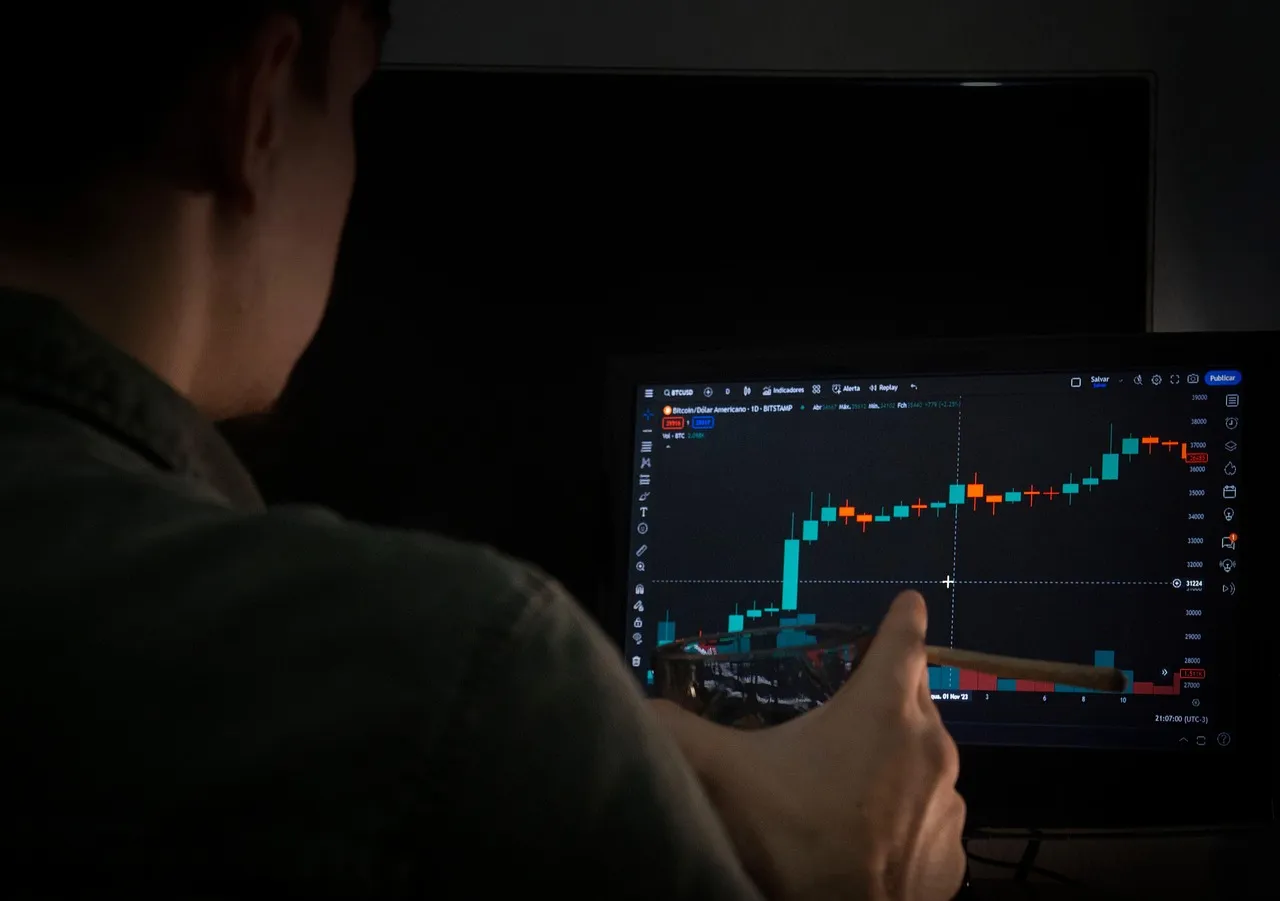
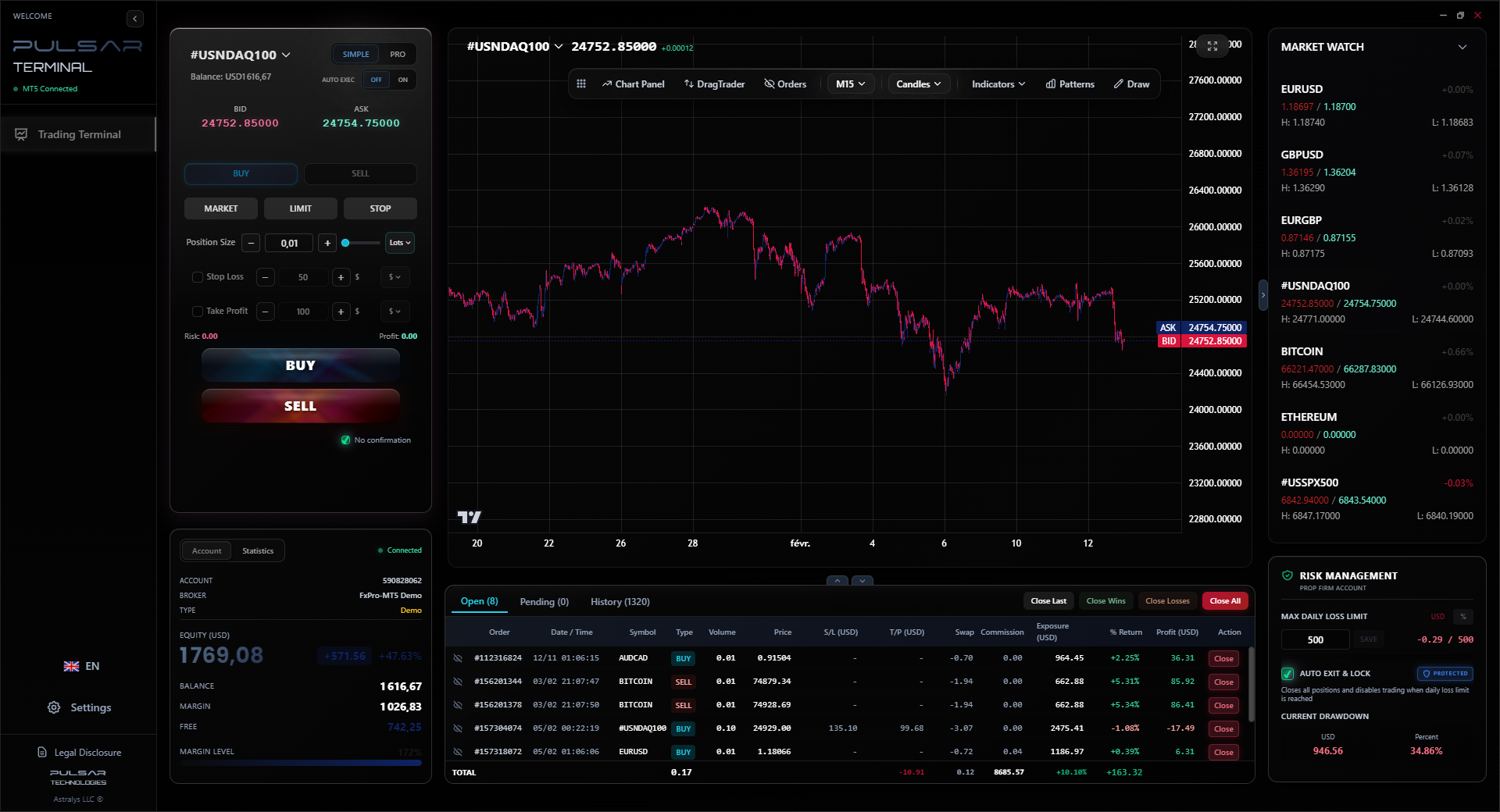
Managing trades under strict FIFO rules requires precision, and Pulsar Terminal's drag-and-drop order management on MT5 makes adjusting take-profits and stop-losses fast and error-free.
Pulsar Terminal
A ferramenta MT5 tudo-em-um: ordens drag-and-drop, multi-TP/SL, trailing stop, grid trading, Volume Profile e proteção prop firm. Usado diariamente por 1.000+ traders.
Getting started is straightforward, but do it right. Go directly to the website of a regulated broker like FOREX.com. Do NOT download MT5 from a generic site and try to connect later. The broker's website will have a dedicated download link that pre-configures the connection to their servers.
During account setup, you'll be asked to verify your identity (a W-9 form is standard) and your address. This is normal for US-regulated entities. Embrace it; it's part of the protection.
Once installed, here's my security checklist:
- Enable Two-Factor Authentication (2FA): Do this immediately in the platform settings. It adds a code from your phone when you log in. Non-negotiable.
- Use Strong, Unique Passwords: Your trading account password should be different from your email password, broker website password, everything.
- Be Wary of "Signal Services" and EAs: The MQL5 market is full of them. I bought a "guaranteed profit" EA for $250 once. It blew my demo account in a week. Test everything extensively on a demo account that uses real US market conditions (same spreads, FIFO rules).
- Log Out: If you're on a shared computer, log out of MT5 when you're done. Your trading terminal is a direct line to your money.
- Monitor Statements: Your broker will provide daily and monthly statements. Review them. Check every trade, every fee. I once spotted a small, erroneous commission fee that customer service fixed promptly because I caught it.
Your security is a shared responsibility between you and your regulated broker. They provide the secure pipeline; you have to manage the keys at your end. The latest MetaTrader 5 news often includes security enhancements from MetaQuotes, but your habits are the first line of defense.
💡 Dica do Winston
The 'prop firm backdoor' is now a regulated hallway. Only use firms that publicly name their US-executing broker partner (like Oanda). Anything else is a gamble with your challenge fee.
“Stop looking for backdoors. The front door is open, it's just got a specific set of rules posted on it.”
So, where does all this MetaTrader 5 news leave us? The trend is clear: consolidation and regulation. The wild west days of accessing MT5 through any random broker are over for US residents. The path forward is through the handful of major, well-capitalized brokers who are willing to navigate the costly US regulatory landscape.
I don't expect a flood of new US brokers offering MT5 anytime soon. The compliance costs are too high. What I do expect is for the existing brokers (FOREX.com, Trading.com) to deepen their integration, perhaps offering more advanced tools or tighter integration with their own research and analysis.
The prop firm model, now linked to regulated brokers, seems to be stabilizing as a viable path for traders seeking larger capital. This is likely the "new normal" for that segment.
For the average retail trader, MT5 in the US will remain a powerful, if somewhat restricted, tool. The focus will continue to be on forex and metals. The platform's strengths - its back-testing, customization, and automated trading capabilities - remain fully intact, even within the US rule set.
The key takeaway? Stop looking for backdoors. The front door is open, it's just got a specific set of rules posted on it. Learn those rules, partner with a legitimate broker like the ones reviewed in our FOREX.com review or IC Markets review (for global context), and build your strategy within that framework. That's how you build something that lasts, without waking up to a "platform unavailable" message. I made my peace with it, and honestly, my trading has been more consistent because of it.
FAQ
Q1Can I legally use MetaTrader 5 in the United States?
Yes, absolutely. It is not illegal. However, you can only use it through a US-regulated broker that is registered with the CFTC and NFA, such as FOREX.com or Trading.com. You cannot download it directly from MetaQuotes or use it with an unregulated offshore broker as a US resident.
Q2What are the biggest limitations for US traders using MT5?
The three major limitations are the FIFO rule (closing trades in the order they were opened), the ban on hedging (no simultaneous buy/sell positions on the same pair), and maximum use capped at 50:1 for major forex pairs. These are US regulatory requirements, not platform limitations.
Q3I heard prop firms stopped offering MT5 to US traders. Is it back?
After a major crackdown in early 2024, several prop firms successfully reintroduced MT5 access in 2025 by partnering with regulated brokers or obtaining proper licensing. The key development is firms like FTMO partnering with US-regulated broker Oanda, creating a more secure and compliant path for US-based prop traders.
Q4How do the costs compare to using MT5 with an international broker?
Costs are generally higher. Spreads on standard accounts are wider (e.g., 0.8-1.5 pips on EUR/USD vs. 0.0-0.5 elsewhere), and use is much lower. However, you gain the protection of US regulation, including segregated funds and recourse through the NFA. There's a trade-off between cost and security.
Q5What assets can I trade on MT5 in the US?
Your selection is primarily limited to forex currency pairs and precious metals like gold (XAU/USD). Contracts for Difference (CFDs) on indices, stocks, or cryptocurrencies, which are commonly offered on MT5 internationally, are generally not available to US retail traders due to regulatory restrictions.
Q6Is my MetaTrader 5 platform up to date? Why does it matter?
You can check your build number under Help > About. It matters critically because MetaQuotes ends support for older builds, cutting off access. Support for builds below 4410 ended in December 2024, and builds below 4755 were cut off in July 2025. Always install updates when prompted by your broker.
Q7Can I use Expert Advisors (EAs) and automated trading?
Yes, the full automated trading functionality of MT5 is available. However, your EAs must be coded or configured to comply with US rules (FIFO, no hedging). You can backtest them in the Strategy Tester. Many brokers offer VPS hosting for EAs, sometimes for a monthly fee unless you meet high volume thresholds.
Lição do Prof. Winston
Pontos-chave:
- ✓US MT5 access is legal only through CFTC/NFA regulated brokers.
- ✓FIFO, no hedging, and 50:1 use are non-negotiable US rules.
- ✓Prop firm access stabilized in 2025 via broker partnerships (e.g., FTMO & Oanda).
- ✓Update your MT5 platform builds; old versions lose support.
- ✓Factor in wider spreads (0.8-1.5 pips) and potential VPS fees for EAs.
Quão útil foi este artigo?
Clique em uma estrela
Insights de Trading Semanal
Análises e estratégias semanais grátis. Sem spam.
Sobre o autor
James Mitchell
Analista de Trading Sênior
Sediado em Nova York com mais de 9 anos de experiência em trading. Focado nos principais pares USD, desafios de prop firms e o cenário regulatório dos EUA.
Comentários
Aviso de risco
A negociação de instrumentos financeiros envolve riscos significativos e pode não ser adequada para todos os investidores. O desempenho passado não garante resultados futuros. Este conteúdo é apenas para fins educacionais e não deve ser considerado aconselhamento de investimento. Sempre conduza sua própria pesquisa antes de negociar.
Você também pode gostar

Cara Trading Forex Sukses: 7 Prinsip dari Trader Profesional
Cara trading forex sukses dengan 7 prinsip trader pro: manajemen modal, disiplin, journal trading, backtest. Data nyata, bukan janji profit palsu.
Jam Trading Forex Terbaik untuk Trader Indonesia: Panduan Lengkap dengan Tabel Waktu
Panduan jam trading forex untuk trader Indonesia. Tabel 4 sesi dunia, jam emas 20:00-00:00, sesi mana yang harus dihindari. Data akurat + tips dari trader berpengalaman.
Top 5 Sàn Forex Uy Tín Nhất 2026: Review Jujur dari Trader Indonesia
Top 5 sàn forex uy tín 2026 untuk trader Indonesia. Review jujur: spread, deposit, withdraw, dukungan lokal. Exness, XM, IC Markets & lebih.
Obter Pulsar Terminal
Todas essas calculadoras estão integradas ao Pulsar Terminal com dados em tempo real da sua conta MT5.
Obter Pulsar Terminal