


You're probably staring at your broker's download page, wondering which one to pick.

James Mitchell
Analista de Trading Sênior
☕ 8 min de leitura
O que você vai aprender:

You're probably staring at your broker's download page, wondering which one to pick. MT4 or MT5? It feels like a big decision, and honestly, it is. I've traded on both for over a decade, and I've made some expensive mistakes by choosing the wrong one for the job. This isn't about which one is 'better' in a general sense. It's about which one is better for you, right now, with your specific goals and style. Let's cut through the marketing and look at what really matters when you're in the trenches.
Most people think MT5 is just MT4 with a fresh coat of paint. That's a dangerous assumption. I learned this the hard way back in 2016. I switched my main account to MT5 because it was 'newer,' assuming all my strategies would just work better. They didn't. The first trade I placed felt off. The execution was lightning fast, sure, but my old hedging technique - opening opposing positions on the same pair - was blocked. The platform literally wouldn't let me do it. That cost me a potential $1,200 adjustment on a EUR/USD trade that went against me. I had to scramble to manage it a different way.
The fundamental difference is architectural. MT4 was built for the retail forex market of the 2000s. It's a specialist. MT5 was built as a multi-asset platform from the ground up. It's designed to handle stocks, futures, and forex all at once. Think of it like this: MT4 is a dedicated sports car for the forex track. MT5 is an all-terrain vehicle. If you only ever drive on the track, the sports car feels more natural. But if you need to handle different terrains, you need the ATV.
This design choice affects everything: the order accounting system, the way indicators are calculated, even the way timeframes are displayed. It's why an Expert Advisor (EA) written for MT4 won't run on MT5 without a significant rewrite. They speak different languages.
This is where MT5 has a clear, technical advantage, but it's not always what you think. The raw engine is faster. Backtesting complex EAs on MT5 can be up to 10x quicker because it can use all your CPU cores. MT4 is mostly single-threaded. For a scalper, that execution speed is tangible.
I remember a specific scalp on GBP/JPY during the London open. On MT4, my market order had a requote. On MT5, using the same broker (IC Markets review), it was instant. That difference was about 1.5 pips, or roughly $15 on my 1-lot trade. Over hundreds of trades, that adds up to real money lost to slippage and requotes.
The Hedging Limitation
But here's the catch for forex traders. MT5 uses a netting position accounting system by default. This means you can only have one position per symbol. You can't buy and sell the same currency pair simultaneously to hedge. Some brokers offer a 'hedging mode' for MT5, but it's a workaround on a system not designed for it. MT4 uses a hedging system, allowing multiple opposite positions. This is crucial for certain risk management styles. If your strategy relies on locking in profits with a hedge or running a grid, MT4's system is more intuitive. For pure directional trading on a single asset, MT5's netting is cleaner and faster.

💡 Dica do Winston
A platform is a tool, not a strategy. Master one before you blame it. I spent six months blaming MT5 for losses that were actually due to a flawed entry signal.

“MT4 is a specialist sports car for the forex track. MT5 is an all-terrain vehicle.”
Beyond the engine, the daily tools matter. MT5 has more built-in technical indicators (38 vs. 30 in MT4) and more timeframes (21 vs. 9). The extra timeframes, like 2-hour or 6-hour charts, can be useful for certain swing trading approaches. The economic calendar is built directly into MT5, which is a nice touch.
However, MT4's simplicity is a feature, not a bug. I found myself missing the straightforward charting on MT5 sometimes. All those extra indicators can lead to analysis paralysis. The MT5 Depth of Market (DOM) is a powerful tool for seeing market liquidity, but if you're just trading forex majors, it's less critical than for trading futures or equities.

Example: Let's talk numbers. On MT4, I could run my old volatility EA on 28 currency pairs simultaneously. It used about 40% of my CPU. Porting it to MT5 reduced the CPU load to under 15% because of the multi-threaded backtesting. But the development time to rewrite the EA took me three weeks. You have to weigh the performance gain against the setup cost.
The object-oriented MQL5 language in MT5 is more powerful than MQL4. It allows for more complex EAs and indicators. But for 90% of retail traders, MQL4 is more than sufficient and has a much larger community library of free scripts and EAs to borrow from.
This is the only question that matters. Don't pick based on hype. Pick based on your plan.
You should probably use MT4 if:
- You are a forex-only trader.
- Your strategy involves hedging or locking trades.
- You use popular third-party EAs or indicators that are only coded for MQL4.
- You trade with a prop firm that requires specific MT4 plugins (many do).
- You prefer a simpler, more established environment with vast community support.
You should seriously consider MT5 if:
- You trade multiple asset classes (forex, stocks, futures).
- You are a high-frequency scalper where execution speed is paramount.
- You develop your own complex EAs and need the computational power of MQL5.
- Your broker offers significantly better raw spreads or conditions on their MT5 servers (some do).
- You rely heavily on built-in economic data and advanced market depth tools.
I run both. My main directional swing trades and prop firm accounts are on MT4. My scalping account and any multi-asset portfolio testing happens on MT5. It's not an either/or. It's about using the right tool for the job.
💡 Dica do Winston
Test execution on a demo during high volatility (like news events). That's where you'll see the real difference in speed and slippage between MT4 and MT5 servers.
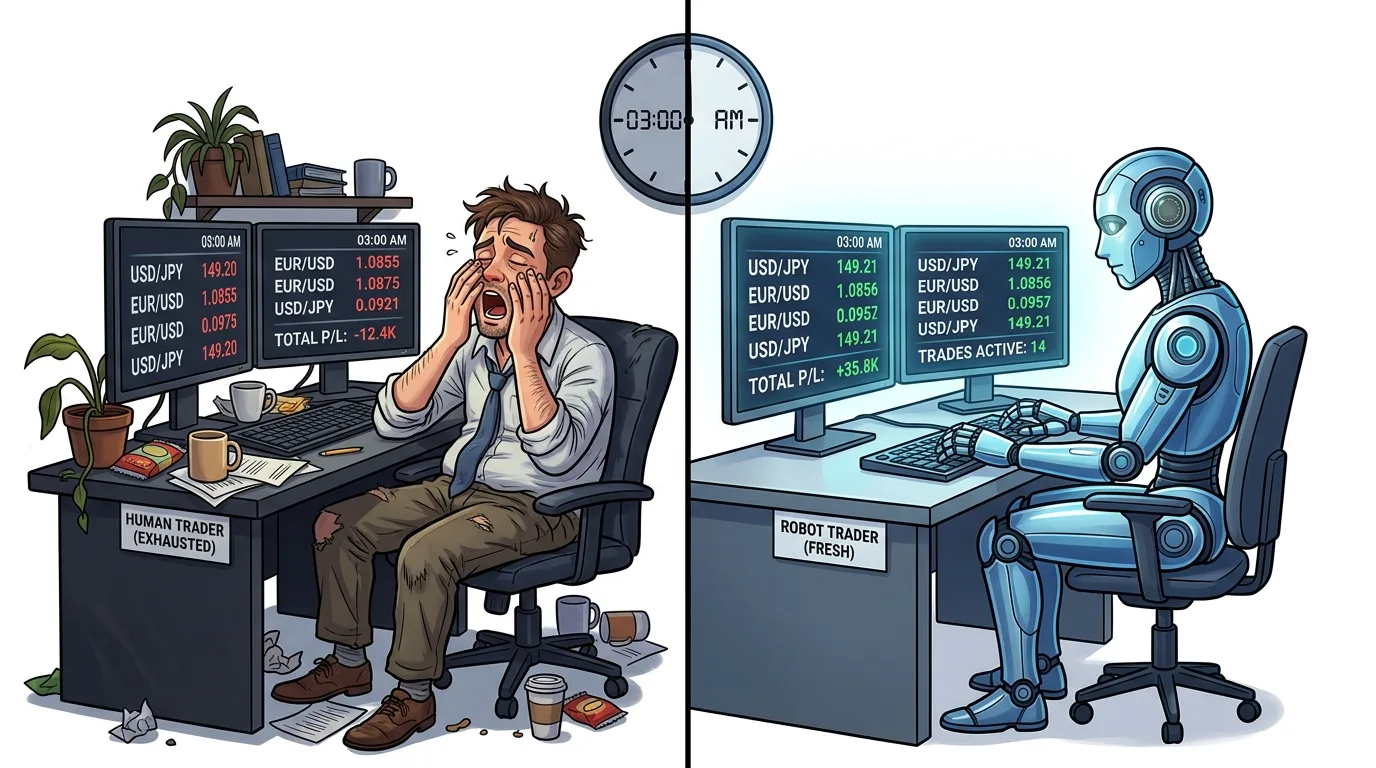
“The best platform is the one that disappears, letting you focus on the market.”
Here's a secret they don't tell you: the platform is only as good as your broker's server connection. A fast MT5 connected to a slow broker is still slow. I've tested this with four different brokers offering both platforms.
My experience with Exness review showed nearly identical execution times on their MT4 and MT5 servers for forex. However, with Pepperstone review, their Razor account on MT5 consistently showed tighter raw spreads by a fraction of a pip on EUR/USD during volatile periods. That's a broker-specific advantage, not a platform one.

Warning: Always check your broker's specification. Some brokers limit certain account types or offer their best raw ECN pricing only on MT4 or only on MT5. Don't assume parity. Your choice of platform might lock you out of the best trading conditions they offer. I made this mistake once, choosing MT5 for a new account only to find out the broker's 'Pro' raw spread account was only available on MT4. I had to reopen another account.

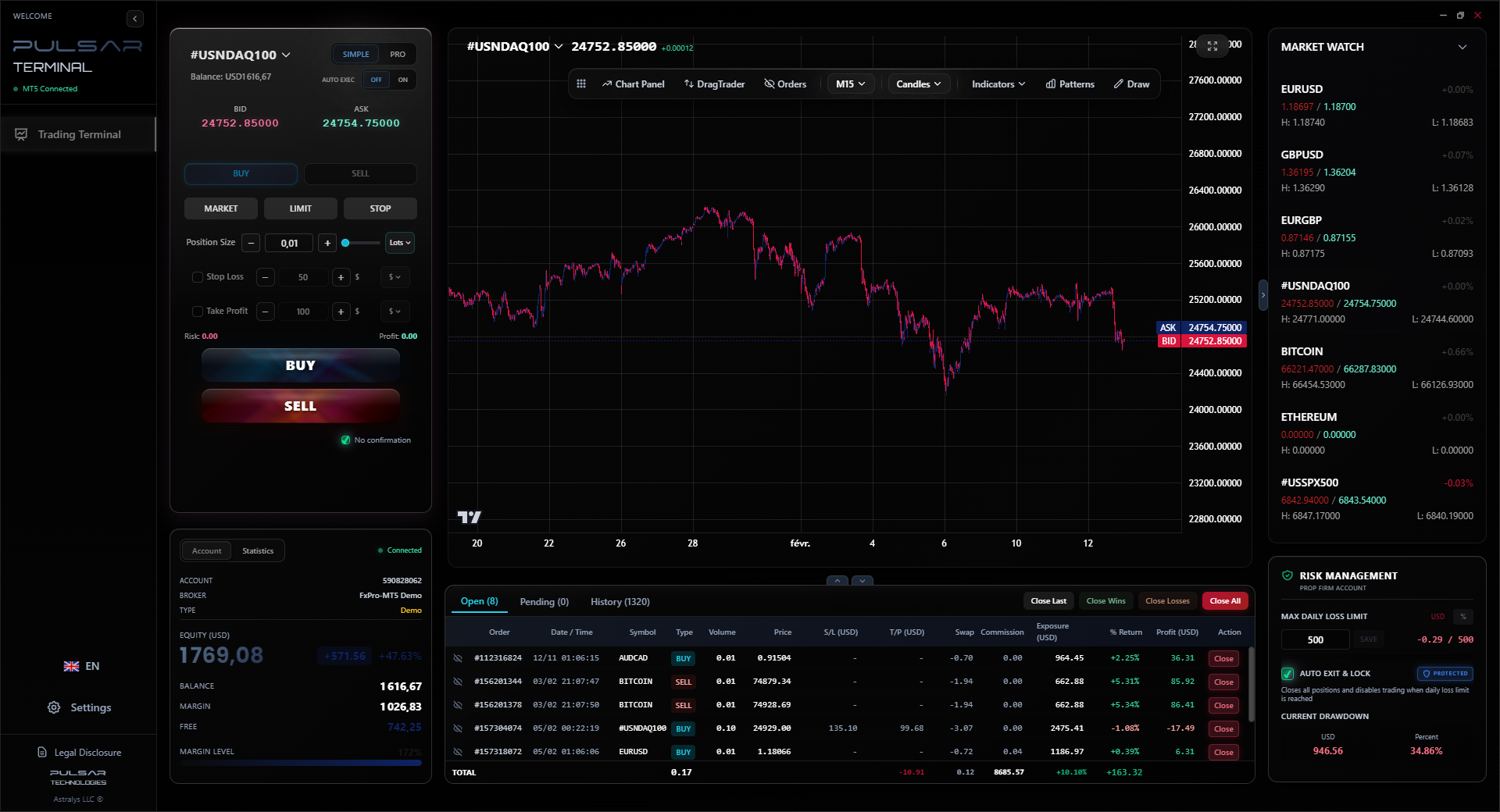
Managing complex trades across MT4 and MT5 is easier with tools that bring advanced order types and risk management to your charts.
Pulsar Terminal
A ferramenta MT5 tudo-em-um: ordens drag-and-drop, multi-TP/SL, trailing stop, grid trading, Volume Profile e proteção prop firm. Usado diariamente por 1.000+ traders.
MetaQuotes, the developer, has stopped selling new MT4 licenses to brokers. They're pushing everyone toward MT5. Does this mean MT4 is dead? Not even close. It's like asking if Windows 10 is dead because Windows 11 exists. The installed base is massive. The amount of money flowing through MT4 terminals ensures it will be supported for a decade or more.
However, for new development, the energy is on MT5. All the new third-party tools, like advanced trade management terminals, are being built for MT5 first. The community forums for MQL5 are more active with modern coding discussions.
The reality is transitional. For the next 5-7 years, you can safely use MT4. But if you're a new trader starting today and plan to be in this for the long haul, learning MT5 might be the more future-proof choice. Just be prepared for a slightly steeper learning curve and a smaller pool of ready-made, free 'plug and play' trading systems compared to MT4's vast archive.
💡 Dica do Winston
Your first margin call will teach you more about platform risk than any manual. Use a strict [position size calculator](/en/calculators) regardless of which terminal you use.

“I learned that $1,200 lesson on hedging so you don't have to.”
So, what's on my screens right now? I have three monitors. Monitor one runs MT4 with my main swing trading journal and a few key charts with my core indicators like the MACD indicator and RSI indicator. This is for my longer-term holds. Monitor two runs MT5 for my intraday scalps on XAU/USD guide and EUR/USD guide. I need the speed there. Monitor three is for analysis and my position size calculator.
My final piece of advice is this: Download both. Most brokers let you. Open a demo account on each. Try placing the same trades. Feel the interface. Try to implement your exact entry and exit rules. See which one gets in your way less.

Pro Tip: Test your strategy's core mechanic. If you need to hedge, try it on the MT5 demo. If the platform fights you, you have your answer. If you backtest a complex EA and it takes 4 hours on MT4 but 20 minutes on MT5, you have your answer.
Don't overthink it based on specs alone. The best platform is the one that disappears, letting you focus on the market. For some, that's the familiar, strong MT4. For others, it's the powerful, expansive MT5. Your job is to figure out which camp you're in before you risk real money. I learned that $1,200 lesson so you don't have to.

FAQ
Q1Can I use my MT4 Expert Advisor on MT5?
No, not directly. MT4 EAs are written in MQL4, and MT5 uses MQL5, a different, more advanced programming language. The code must be manually converted or rewritten, which can be a complex and time-consuming process. Many popular commercial EAs offer separate versions for each platform.
Q2Do all brokers offer both MT4 and MT5?
Most major brokers do, but not all. More importantly, the trading conditions (like spreads, commissions, and available instruments) can differ between the two platforms at the same broker. Always check the specific account specifications for MT4 and MT5 before you fund an account.
Q3Is MT5 better for forex trading?
It's not inherently 'better.' It's technically superior in terms of execution speed and processing power. However, for forex-specific strategies that rely on hedging (opening buy and sell positions on the same pair), MT4's default accounting model is more suitable. MT5 uses a netting model, which prevents this unless the broker enables a special hedging mode.
Q4Will MT4 be shut down soon?
Very unlikely in the short to medium term. MetaQuotes has stopped selling new licenses to brokers, but existing licenses are maintained. The user base is enormous. Think of it like an old, reliable piece of software - it will be supported as long as a critical mass of people and money use it, which will be for many years to come.
Q5Which platform is better for beginners?
MT4 is generally considered more beginner-friendly due to its simpler interface, vast amount of free learning resources, and huge library of free indicators and EAs. The concepts of a pip definition and spread definition are the same, but MT4's environment is less cluttered and easier to navigate when you're starting out.
Q6Can I trade stocks and futures on MT4?
It's very rare. MT4 was built specifically for forex and CFDs. While a few brokers might offer a limited selection of other assets, MT4 is not optimized for it. MT5 is the true multi-asset platform, with built-in infrastructure for equities, futures, options, and bonds, making it the clear choice for multi-asset traders.
Q7Which platform has lower latency?
All else being equal (same broker, same server location), MT5 has a lower latency architecture. Its order routing and processing are more modern and efficient. However, the broker's server quality and your internet connection have a far greater impact on latency than the choice between MT4 and MT5.
Lição do Prof. Winston
Pontos-chave:
- ✓MT5 is faster, but MT4 allows hedging.
- ✓Broker conditions differ by platform; always check.
- ✓MT4 has a larger free EA library for beginners.
- ✓Use MT5 for multi-asset, MT4 for pure forex.
- ✓Test both on demo during volatile news events.
Quão útil foi este artigo?
Clique em uma estrela
Insights de Trading Semanal
Análises e estratégias semanais grátis. Sem spam.
Sobre o autor
James Mitchell
Analista de Trading Sênior
Sediado em Nova York com mais de 9 anos de experiência em trading. Focado nos principais pares USD, desafios de prop firms e o cenário regulatório dos EUA.
Comentários
Aviso de risco
A negociação de instrumentos financeiros envolve riscos significativos e pode não ser adequada para todos os investidores. O desempenho passado não garante resultados futuros. Este conteúdo é apenas para fins educacionais e não deve ser considerado aconselhamento de investimento. Sempre conduza sua própria pesquisa antes de negociar.
Você também pode gostar

Cara Trading Forex Sukses: 7 Prinsip dari Trader Profesional
Cara trading forex sukses dengan 7 prinsip trader pro: manajemen modal, disiplin, journal trading, backtest. Data nyata, bukan janji profit palsu.
Jam Trading Forex Terbaik untuk Trader Indonesia: Panduan Lengkap dengan Tabel Waktu
Panduan jam trading forex untuk trader Indonesia. Tabel 4 sesi dunia, jam emas 20:00-00:00, sesi mana yang harus dihindari. Data akurat + tips dari trader berpengalaman.
Top 5 Sàn Forex Uy Tín Nhất 2026: Review Jujur dari Trader Indonesia
Top 5 sàn forex uy tín 2026 untuk trader Indonesia. Review jujur: spread, deposit, withdraw, dukungan lokal. Exness, XM, IC Markets & lebih.
Obter Pulsar Terminal
Todas essas calculadoras estão integradas ao Pulsar Terminal com dados em tempo real da sua conta MT5.
Obter Pulsar Terminal