


It was October 2020, and NIFTY was screaming higher post-lockdown.

Rajesh Sharma
Analista Forex Sênior ·  India
India
☕ 12 min de leitura
O que você vai aprender:
- 1What Are Options, and Why Should You Bother?
- 2Basic Strategies: Start Here, Not with the Fancy Stuff
- 3Intermediate Playbook: The Income Strategies
- 4Advanced Plays: Trading Volatility, Not Direction
- 5Risk Management: The Only Thing That Matters
- 6Picking Your Tools: Brokers and Platforms in India
- 7Putting It Together: Your Personal Trading Plan

It was October 2020, and NIFTY was screaming higher post-lockdown. I watched a client's screen as he held a handful of 12,000 CE options he'd bought for ₹80. They were now worth ₹12. He didn't sell. He watched them expire worthless two weeks later, turning a 6-lakh paper profit into dust. That moment, more than any win, cemented for me what options trading really is: a game of disciplined exit strategies, not just clever entries. Most guides make it sound like a puzzle you solve. It's not. It's a probability engine you manage, often poorly. Let's talk about how to manage it better.
Forget the textbook definition. In practice, an option is a contract that gives you the right, but not the obligation, to buy or sell an asset at a set price before a certain date. On the NSE, you're mostly dealing with index options (NIFTY, BANKNIFTY) and stock options. The 'why bother' is simple: use and defined risk.
You can control a large notional value of NIFTY with a fraction of the capital needed for futures or stocks. More importantly, your maximum loss as a buyer is limited to the premium you paid. That's the theory, anyway. The reality is that most retail traders in India blow up because they treat options like lottery tickets, not probability tools.
There are two basic types: Calls (CE) and Puts (PE). If you think NIFTY is going up, you might buy a Call. If you think it's going down, you might buy a Put. Selling options (writing them) is a different beast entirely, with theoretically unlimited risk, and we'll get to that. First, you need to understand the language. The strike price is the price at which you can buy/sell. The expiry is the last Thursday of the month for monthly contracts. The premium is the price you pay (or receive).

Warning: The biggest myth in Indian options trading is 'limited risk.' While your loss as a buyer is capped at the premium, that premium can still be 100% of your investment. Losing ₹5,000 ten times in a row is the same as losing ₹50,000 once. The limitation is on per-trade loss, not on your ability to lose your entire account through repeated, poor trades.
Your success won't come from predicting mega-moves. It'll come from consistently applying a few solid options trading strategies that match market conditions, not your gut feeling.

You don't need complex 4-leg strategies. You need one or two you understand inside out. These are the workhorses.
Long Call / Long Put
This is straightforward directional betting. You buy a Call if you're bullish, a Put if you're bearish. Your max loss is the premium. Your profit is theoretically unlimited for a call, or substantial for a put. The catch? Time decay (theta) is your enemy. The option loses value every day, even if the underlying price doesn't move. You need the move to happen, and happen relatively quickly.
I learned this the hard way in 2019. BANKNIFY was consolidating, and I was sure a breakout was coming. I bought weekly ATM (At-the-Money) Calls for ₹180. The index moved sideways for four days. On expiry day, even though it had crept up 50 points, my options were worth ₹25. Time decay ate me alive. I needed a bigger move, faster.
Covered Call
This is one of the few strategies where you sell an option that makes sense for a retail trader. You own shares of a stock (say, 100 shares of Reliance) and you sell a Call option against that holding. You collect the premium, which gives you a little extra income. If the stock rockets past the strike, your shares get called away at that price. You cap your upside but get the premium as a buffer.
It's a decent income strategy in a flat or slowly rising market. In a raging bull market, you'll feel like an idiot watching the stock fly past your strike while you're stuck with just the premium.
Cash-Secured Put
Similar logic. You sell a Put option and set aside enough cash in your account to buy the shares if you're assigned. You get to keep the premium if the stock stays above the strike. If it falls below, you have to buy the shares at the strike price. It's a way to potentially buy a stock you want at a discount (strike price minus the premium received).
These basic strategies form the building blocks. Before you even think about a scalping strategy with options, master the P&L profile of these. Know exactly how much you make or lose at every possible price point at expiry. Use a position size calculator religiously, because the use can deceive you.

💡 Dica do Winston
Forget the lottery. The consistent money in options isn't in buying the next moonshot. It's in selling time decay to the gamblers, using defined-risk spreads. Be the casino, not the punter.
“Options trading is a game of disciplined exit strategies, not just clever entries.”
This is where most semi-serious Indian options traders live: selling premium to collect time decay, not fight it. The goal is to profit from sideways movement or slow, predictable drift. The risk is higher, and broker margin requirements are significant.
Credit Spreads
This is how you sell options without facing unlimited risk. You sell one option and buy a further-out-of-the-money option of the same type (both Calls or both Puts) to cap your risk.
- Bull Put Spread: You're mildly bullish. Sell an OTM (Out-of-the-Money) Put, buy a further OTM Put with a lower strike. You net a credit. Your max profit is that credit. Your max loss is the difference between the strikes minus the credit.
- Bear Call Spread: You're mildly bearish. Sell an OTM Call, buy a further OTM Call with a higher strike.
These are defined-risk strategies. Your profit is limited but your probability of winning (earning the small credit) is often higher than a directional long option play. I use these constantly when NIFTY is in a clear range. For example, if NIFTY is at 22,000 and support is at 21,800, selling a 21,700 Put and buying a 21,600 Put for a net credit of ₹40 can be a sensible play.
Iron Condor
This is a range-bound king. You combine a Bull Put Spread and a Bear Call Spread. You're betting the underlying will stay between two price points. You collect a credit from both sides. Your max profit is the total credit. Your max loss is the width of one spread (minus the credit), which occurs if the price blasts through either side.
They look beautiful on a P&L graph - a nice flat profit zone. In reality, they require active management. When NIFTY starts to test one of your short strikes, you can't just sit and pray. You need to adjust: roll the position out in time, or close one side for a small loss. This is where a tool with advanced order types helps. Managing a multi-leg strategy manually on a volatile expiry day is a recipe for a margin call.

Example: NIFTY at 22,000. You sell an Iron Condor 30 days out. Sell 22,300 Call, Buy 22,400 Call. Sell 21,700 Put, Buy 21,600 Put. Total credit received: ₹90. Max risk: ₹1000 (width of spread 100 points) - ₹90 credit = ₹910. You're betting NIFTY stays between 21,700 and 22,300 for a month. Not a bad bet, but not a sure thing either.

This separates the enthusiasts from the professionals. Options prices are heavily influenced by Implied Volatility (IV) - the market's forecast of future volatility. Sometimes, you want to trade that forecast itself.
Long Straddle / Strangle
You buy both a Call and a Put with the same expiry. Straddle: same strike (usually ATM). Strangle: different strikes (OTM). You don't care if the market goes up or down. You're betting it will make a big move, bigger than the market currently expects (IV is low). Your loss is limited to the total premium paid if the market sits still. Your profit is unlimited on either side.
I use these ahead of major events like RBI policy announcements or budget days, but only when IV is relatively low. Buying a straddle when everyone is already panicking (high IV) is expensive and often a loser. The move has to be massive to overcome the premium you paid.
Short Straddle / Strangle
The opposite. You sell both a Call and a Put. You're betting on low volatility - the market staying in a tight range. This is a premium collection strategy with high risk. Your profit is capped at the credit received. Your loss is theoretically unlimited in both directions. This is not for the faint-hearted and requires insane risk management and capital. Most retail traders should admire this from a distance, like a dangerous animal at the zoo.
Understanding these volatility-based options trading strategies requires you to watch the India VIX (the fear index). When VIX is low (below 14-15), options are cheap, making long volatility plays (straddles) more attractive. When VIX is high (above 20-22), options are expensive, making short premium strategies (like Iron Condors) more lucrative, but also more dangerous if volatility spikes even further.
“Your first year goal is not to make money. Your goal is to not lose money.”
You can have the best strategy in the world and still go bust. Here’s the blunt truth about risk in options.
Position Sizing: Never, ever risk more than 1-2% of your trading capital on a single options strategy. That ₹5,000 premium on a long Call? That's your max loss. Size your position so that if that ₹5,000 is 2% of your capital, your total capital is at least ₹2.5 lakhs for that trade. If it's not, you're over-leveraged. Use a position size calculator for every single trade, no exceptions.
Define Your Exit Before Entry: This is the golden rule. Before you hit the buy button, know three things:
- At what underlying price will you cut your loss?
- At what profit level will you take money off the table?
- What is your time-based exit? (e.g., 'I will close this 7 days before expiry no matter what')
The Greeks Are Your Dashboard: You don't need a PhD, but you must understand Delta (price sensitivity), Theta (time decay), and Vega (volatility sensitivity).
- A long option has negative Theta. You are bleeding money each day.
- A short option has positive Theta. You are collecting money each day. Your broker's platform shows these. Glance at them. If your Theta is -₹50, you're losing fifty rupees every day the market does nothing.
Beware of Expiry Week: Liquidity dries up in far-out-of-the-money options. The spread widens dramatically. You might think you have a profit, but you can't get out at a decent price. Stick to liquid strikes, usually near the current price.
Managing multi-leg strategies manually is a pain. Setting individual stop losses for each leg doesn't work because their values are interconnected. You need to manage the net risk of the entire position. This is where discipline breaks down for most people.
💡 Dica do Winston
Your broker's 'Options Strategy Builder' is a toy. To manage real risk on multi-leg trades, you need a platform that lets you set a stop on the *net position* P&L, not on each leg individually. Otherwise, you're flying blind.


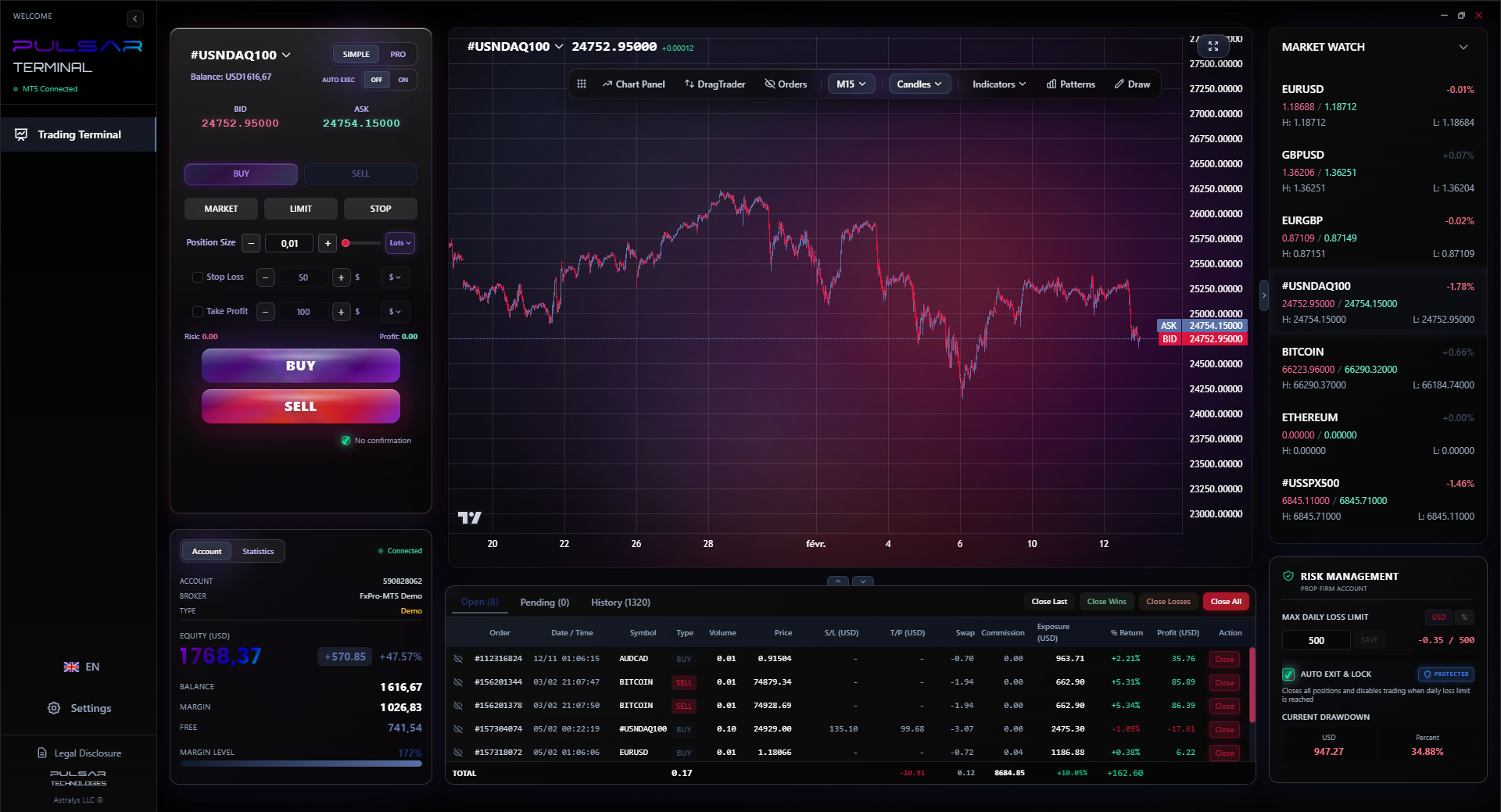
Managing multi-leg options strategies and their net risk is complex, but tools like Pulsar Terminal allow you to set a single stop-loss or take-profit for the entire combined position directly on your MT5 platform.
Pulsar Terminal
A ferramenta MT5 tudo-em-um: ordens drag-and-drop, multi-TP/SL, trailing stop, grid trading, Volume Profile e proteção prop firm. Usado diariamente por 1.000+ traders.
Your broker can make or break your options experience. You need two things: cheap brokerage and a reliable, functional platform.
Most Indian discount brokers (Zerodha, Upstox, Angel One) charge around ₹20 per executed order for options. That's fine. The real differentiator is the trading platform and the margin system.
- Zerodha's Kite: Clean, intuitive, and has excellent analytics for the Greeks. Their margin calculator is transparent. For a retail trader starting out, it's probably the best.
- Upstox Pro Web: Similar to Kite, competitive on pricing.
- Traditional Brokers (ICICI Direct, HDFC Sky): Higher costs, but some offer more research and hand-holding (which you should ignore anyway).
For advanced charting and analysis, many serious traders use TradingView or AmiBroker alongside their broker's platform for execution. The native charting on most broker platforms is mediocre.
The critical point: Test the platform's options chain interface and order placement speed during market hours on a demo. Can you place a 4-leg Iron Condor with one click? Or do you have to place four separate orders, risking a fill in the middle of a fast move? Slippage on complex orders will kill your edge.
If you're also trading forex or global markets, you might use an international broker like Exness or IC Markets for those instruments. Keep your Indian equity and options separate with a dedicated domestic broker. The regulations and product offerings are completely different.
“You don't use a hammer for every job. Read the market first, then select the tool.”
Knowledge is useless without a plan. Here’s how to build yours.
- Pick One Market: Don't trade NIFTY, BANKNIFTY, and 5 stock options all at once. Start with NIFTY. It's the most liquid. Master it.
- Pick One Strategy: For your first 50 trades, only trade one strategy. Maybe it's Long Calls. Maybe it's Bull Put Spreads. Learn every nuance, how it behaves on expiry day, how it reacts to gaps.
- Define Your Edge: Why will you win? Is it selling premium when India VIX is high? Is it buying strangles before earnings season? Your edge must be specific and testable. 'I'm good at guessing' is not an edge.
- Journal Relentlessly: For every trade, note: strategy, strike, premium paid/received, entry/exit prices, P&L, and - most importantly - the reason for the trade. Was it a technical breakout? An overbought RSI indicator signal? A volatility crush play? Review your journal weekly. You'll quickly see if your 'reasons' are actually profitable.
- Adapt to NSE Nuances: Remember, Indian markets have distinct traits. FII flows heavily influence direction. Expiry day volatility (especially on BANKNIFTY) is legendary. The morning gap from global cues (like EUR/USD moves or XAU/USD swings) is a real factor. Your plan must account for this, not pretend you're trading in a vacuum.
Options trading strategies are a toolkit. You don't use a hammer for every job. A quiet, range-bound market calls for an Iron Condor. A high-volatility, trending market might call for a simple directional spread. Your job is to read the market first, then select the tool. Not the other way around.

Pro Tip: Your first year goal is not to make money. Your goal is to not lose money. Focus on executing your plan flawlessly, on risk management, on your journal. If you end the year at breakeven but with a disciplined process, you are in the top 10% of aspiring traders. The money will follow the process, never the other way.

FAQ
Q1What is the best options trading strategy for beginners in India?
Stick to basic directional plays: Long Calls if you're bullish, Long Puts if you're bearish. Keep position sizes very small. Your goal is to learn how premium moves with the underlying, and how time decay works, not to make a fortune. Once you're comfortable, move to defined-risk strategies like Credit Spreads.
Q2How much capital do I need to start trading options?
Technically, you can start with a few thousand rupees to buy a single lot option. Practically, you need enough so that your per-trade risk (the premium) is 1-2% of your capital. If you're risking ₹2,000 per trade, you should have at least ₹1-2 lakhs dedicated to trading. Starting with too little capital forces you to take oversized risks to see meaningful returns, which is a surefire path to blowing up.
Q3What is time decay (Theta) and why is it so important?
Time decay is the loss in an option's value simply due to the passage of time. It accelerates as expiry approaches. For an option buyer, it's a constant drain. An option can lose money even if the stock/index moves in your direction, just not fast enough. This is why buying cheap, far-out expiry options and hoping for a miracle is usually a losing strategy. Sellers of options profit from time decay.
Q4Should I trade weekly or monthly options?
Monthly options (expiring last Thursday) are generally better for beginners. They have slower time decay and give the trade more time to work. Weekly options decay extremely fast and are for very short-term, precise bets. The pressure is immense. Start with monthlies.
Q5How do I choose a strike price?
It depends on your strategy and conviction. For a directional bet, an At-the-Money (ATM) option has the highest sensitivity to price movement but also the highest premium and time decay. Out-of-the-Money (OTM) options are cheaper but require a larger move to become profitable. There's no 'best' strike. It's a trade-off between cost, probability of profit, and potential return. Use your chart analysis to pick a realistic target and choose a strike accordingly.
Q6Is selling options riskier than buying?
In terms of defined risk per trade, selling options (like in a Credit Spread) has a clear, capped max loss. In terms of probability of a loss event, selling options is often higher. A buyer can lose 100% of their premium many times, but a seller of a naked option can face a loss many times greater than the premium received. For retail traders, selling options within defined-risk spreads is generally considered a more consistent approach than constantly buying cheap OTM options.
Q7What's the single biggest mistake Indian options traders make?
Treating options like a leveraged directional bet on steroids and holding them too close to expiry. They buy weekly OTM options hoping for a jackpot, ignore time decay, and watch the premium evaporate. They confuse low premium cost with 'low risk.' A ₹100 option that goes to zero represents a 100% loss, the same as a ₹10,000 option that goes to zero. The mistake is in position sizing and a fundamental misunderstanding of theta.
Lição do Prof. Winston
Pontos-chave:
- ✓Buyers fight time decay; sellers collect it.
- ✓Never risk >2% of capital on a single strategy.
- ✓Define your exit before you enter. Every time.
- ✓Master one market (NIFTY) and one strategy first.
Quão útil foi este artigo?
Clique em uma estrela
Insights de Trading Semanal
Análises e estratégias semanais grátis. Sem spam.
Sobre o autor
Rajesh Sharma
Analista Forex Sênior
Mais de 10 anos operando nos mercados indianos e do sul da Ásia. Começou com derivativos cambiais na NSE antes de migrar para o forex internacional. Especialista em USD/INR e pares de mercados emergentes.
Comentários
Aviso de risco
A negociação de instrumentos financeiros envolve riscos significativos e pode não ser adequada para todos os investidores. O desempenho passado não garante resultados futuros. Este conteúdo é apenas para fins educacionais e não deve ser considerado aconselhamento de investimento. Sempre conduza sua própria pesquisa antes de negociar.
Você também pode gostar

Cara Trading Forex Sukses: 7 Prinsip dari Trader Profesional
Cara trading forex sukses dengan 7 prinsip trader pro: manajemen modal, disiplin, journal trading, backtest. Data nyata, bukan janji profit palsu.
Jam Trading Forex Terbaik untuk Trader Indonesia: Panduan Lengkap dengan Tabel Waktu
Panduan jam trading forex untuk trader Indonesia. Tabel 4 sesi dunia, jam emas 20:00-00:00, sesi mana yang harus dihindari. Data akurat + tips dari trader berpengalaman.
Top 5 Sàn Forex Uy Tín Nhất 2026: Review Jujur dari Trader Indonesia
Top 5 sàn forex uy tín 2026 untuk trader Indonesia. Review jujur: spread, deposit, withdraw, dukungan lokal. Exness, XM, IC Markets & lebih.
Obter Pulsar Terminal
Todas essas calculadoras estão integradas ao Pulsar Terminal com dados em tempo real da sua conta MT5.
Obter Pulsar Terminal