


Here's the hard truth most 'finfluencers' won't tell you: getting a prop firm payouts request approved is often harder than passing the challenge itself.

Sarah Collins
Estrategista de Trading ·  Australia
☕ 11 min de leitura
O que você vai aprender:
- 1What Exactly Is a Prop Firm Payout?
- 2The Australian Rules (And Why They Matter for Your Payout)
- 3The Step-by-Step Payout Request Process
- 4The Real Cost: Fees, Splits, and What You Actually Keep
- 5Getting Paid in Australia: Methods, Speed, and Tax
- 6Why Payout Requests Get Rejected (And How to Avoid It)
- 7Choosing a Prop Firm That Actually Pays
- 8The Future: What 2026 and Beyond Holds for Payouts

Here's the hard truth most 'finfluencers' won't tell you: getting a prop firm payouts request approved is often harder than passing the challenge itself. I've seen too many traders in Sydney and Melbourne celebrate a funded account, only to hit a wall when it's time to get paid. The shiny 90% profit split means nothing if the money never hits your bank account. In this guide, I'll walk you through exactly how the prop firm payouts request process works in Australia, the legal grey areas, and what you must do to ensure you get paid what you've earned.
Let's clear this up first. A prop firm payout isn't a salary or a bonus. It's a profit share from a simulated trading account. You're not an employee; you're a contractor who passed a skills test. The firm gives you virtual capital, you trade it, and if you make a profit while following their rulebook, you get a cut. That request you submit? It's you asking for your share of the simulated profits to be converted into real cash.
The entire model hinges on a legal distinction. These firms argue they're selling an evaluation service, not managing investments. That's why most don't need an Australian Financial Services License (AFSL). It's a clever loophole, but it also means you have fewer protections than with a standard broker. Your payout is a business transaction, not a regulated financial service withdrawal.

Warning: That high profit split percentage (80%, 90%, etc.) is based on simulated profits. The real number that matters is the percentage of those simulated profits that actually become real, withdrawable cash in your pocket after all fees and rules are applied.

ASIC watches this space like a hawk. They haven't banned prop trading, but they've made their concerns crystal clear. In 2024, they started actively monitoring how these firms operate, especially around CFDs. Then in 2025, they slapped warnings on influencers for shilling prop firms without proper disclaimers. This scrutiny directly impacts your prop firm payouts request.
The AFSL Loophole
A prop firm can avoid needing an AFSL if it sticks to a strict script: it only trades its own money, it only offers an evaluation, and it treats you as a contractor. The moment they blur those lines, ASIC gets interested. For you, this means the contract you sign is your bible. It's governed by Australian Consumer Law, not financial services law. If a payout dispute arises, you'll be arguing about unfair contract terms, not breaching financial regulations.
The use Misconception
Remember ASIC's 30:1 use cap for retail clients? That's for licensed CFD brokers like Pepperstone or IC Markets. Prop firms sidestep this because you're not a retail client depositing money. They can offer 1:50, 1:100, or more. This feels like a benefit, but it's a double-edged sword for your payout. Higher use makes it easier to blow through their daily loss limit (often 3-5%) or max drawdown (5-10%), instantly failing the account and voiding any pending payout request. Managing this risk is non-negotiable, and a good position size calculator is your first line of defense.
A personal story: I got comfortable with 1:100 use on a $50k sim account. One volatile morning on XAU/USD, a 15-pip move against me triggered my 5% daily loss. Just like that, the account was reset, and a $1,200 simulated profit vanished. The use giveth, and the use taketh away.

💡 Dica do Winston
A payout is a privilege, not a right. The firm's rules are the law. Your first job is risk manager, not profit seeker.
“Higher use makes it easier to blow through their daily loss limit, instantly failing the account and voiding any pending payout request.”
This is where the rubber meets the road. Missing a single step can delay your money by weeks.
- Hit the Profit Target: First, you need to generate the required profit. This is usually a minimum amount (e.g., $1,000) or a percentage of your account size. You must also be past any "minimum trading day" rule.
- Ensure Rule Compliance: Before you even think about clicking 'request', audit your trades. No violated daily loss? Max drawdown intact? Traded the allowed instruments? Used only permitted strategies (e.g., no news scalping if it's banned)? This is the most common reason for rejection.
- Formal Request: Log into your trader dashboard. There will be a 'Request Payout' or 'Withdraw Profit' button. You'll select the amount (often down to the cent) and your payment method.
- Verification & Review: This is the black box. The firm's back-office checks every trade in the period. They look for rule breaches, correlated trades (overtrading the same idea), and sometimes even "discretionary quality" of trades. This can take 24 hours to 5 business days.
- Approval & Processing: If approved, you get a notification. The money is then sent via your chosen method. The clock for processing (1 hour to 5 business days) starts now.
- Reconciliation: You must report this income to the ATO as business income. Keep all statements and approval emails.

Pro Tip: Request your first payout early and small. Don't wait to hit $10k. Request $500. It tests the entire system - their process, your payment method, the speed - with lower stakes. I did this with my first funded account at a firm similar to FTMO. Requested $300, got it in 36 hours via USDT. That confidence was worth more than the money.
Let's talk numbers. The advertised 90% split is a marketing headline. The fine print holds the real math.
The Standard Profit Split: Yes, 80-90% to the trader is common. Some, like Hola Prime, even offer 100% on the first chunk of profits. But this is before fees.
The Fees You Can't Avoid:
- Performance Fee: This is your split. If you make $10,000 at 90% split, you get $9,000. The firm keeps $1,000.
- Withdrawal/Processing Fee: Many firms charge a flat fee ($10-$50) or a small percentage (1-2%) per payout. Crypto withdrawals might have network fees.
- Platform Fees: Rare, but some firms pass on small data or platform access fees.
The Hidden 'Cost': The evaluation fee you paid upfront. If you paid $500 for a challenge and your first payout is $1,000 (net $900 after fees), your real return on that period isn't 90%, it's (($900 - $500) / $500) = 80%. And that's if you pass on the first try. The stats are brutal: only about 5-10% pass evaluations. The average trader burns through roughly €800 in challenge fees before seeing a single cent.
Here's a table comparing two common scenarios for a $10,000 simulated profit:
| Item | Firm A (90% Split, $30 Fee) | Firm B (80% Split, No Fee) |
|---|---|---|
| Gross Profit Share | $9,000 | $8,000 |
| Withdrawal Fee | $30 | $0 |
| Net Payout | $8,970 | $8,000 |
| Effective Split | 89.7% | 80% |
Always calculate the net, effective split.
💡 Dica do Winston
Treat your first payout as a systems test. Request a small, trivial amount. If that process is slow or problematic, the big one will be a nightmare.
“The average trader burns through roughly €800 in challenge fees before seeing a single cent.”
This is the fun part. How does the money actually arrive?
1. Cryptocurrency (USDT, USDC, BTC): This is the king for speed. Firms like Atlas Funded and many others push this. You can get paid in an hour. It's borderless and avoids traditional banking hiccups. The big change coming? From January 1, 2026, new rules mean you'll get a formal tax statement from exchanges for these transactions. The ATO will know. Convert to AUD on a local exchange like CoinSpot or Swyftx and declare it as income.
2. Bank Transfer (AUD/USD): The old reliable. Can take 2-5 business days. You might get hit with intermediary bank fees ($10-$25). Some firms, using services like Payoneer or Wise, can get AUD into your account faster and cheaper. Always confirm the receiving details are perfect.
3. E-Wallets (Payoneer, Wise): A great middle ground. Faster than bank transfers, usually in AUD, with decent rates. I use Wise for most of my non-crypto payouts. The money lands in my Wise AUD account, and I transfer it to my CommBank account from there.
The Tax Man: I'm not an accountant, but I've learned this the hard way. This is business income. It goes on your tax return. Keep a pristine log: date of request, date received, amount in AUD (use the exchange rate on the day you receive it), the firm's name, and your payment records. The ATO's data-matching is sophisticated; don't think you can hide crypto payouts.
This is the section that will save you headaches. Most rejections aren't malicious; they're traders breaking clear, if sometimes annoying, rules.
The Big Three Rejection Reasons:
- Daily Loss Limit Breach: This is the silent killer. You finish Monday down 4.5%. On Tuesday, your first trade goes 0.6% against you. Boom. Your running daily loss is now 5.1%. You've violated the rule, even if Tuesday's individual trade was small. The account is often instantly invalidated. This rule alone protects the firm's capital more than any other.
- Maximum Drawdown Breach: This is the peak-to-trough limit on your entire account balance, including open trades. If you start at $100,000, peak at $102,000, then drop to $95,500, you've hit a 5% max drawdown (from $102k). It's not from your starting balance! This catches so many people off guard.
- Trading Rule Violations: Trading during high-impact news when it's forbidden, using EAs without permission, hedging when it's not allowed. They will check.
The Grey Area Rejections: These hurt more. "Trade quality," "correlated positions," or "discretionary closing of trades during volatility." Some firms reserve the right to reject payouts if they deem your strategy too risky, even if you didn't break a specific rule. Your defense is your trading journal and a diversified, rule-abiding approach like consistent swing trading.
Warning: If a firm consistently rejects payouts for vague "violations" that aren't in your contract, walk away. That's a major red flag. Legitimate firms like The5ers or FundedNext have clear, automated rules. The review should be a formality, not a negotiation.
💡 Dica do Winston
Your trading journal is your legal defense in a payout dispute. Screenshot your dashboard daily, showing balance, equity, and open trades.
“If a firm consistently rejects payouts for vague 'violations' that aren't in your contract, walk away.”
With hundreds of firms out there, how do you pick one that won't ghost you at payout time?
Do This Due Diligence:
- Check the Contract: Read every word. Look for payout clauses, fee schedules, and the exact drawdown definitions.
- Search for Payout Proof: Don't just watch YouTube reviews. Look on forums like Forex Factory or Reddit for real traders posting screenshots of bank statements or crypto wallet transactions over time.
- Australian Presence or Support: Does they have local support hours? Do they offer AUD payouts? It's not essential, but it shows commitment.
- Regulatory Scrutiny: A firm that's been operating transparently through ASIC's recent monitoring phase (2024-2025) is a better bet than a brand-new pop-up.
My Experience: I've traded with several. The one where I had the smoothest, most predictable prop firm payouts request process had three things: 1) A crystal-clear dashboard showing my daily loss in real-time, 2) An automated payout request button that worked every Friday, and 3) A history of positive, verifiable reviews from other Aussie traders. The one I left had payout "reviews" that took 7 business days and often came back with questionable "correlated trade" flags.
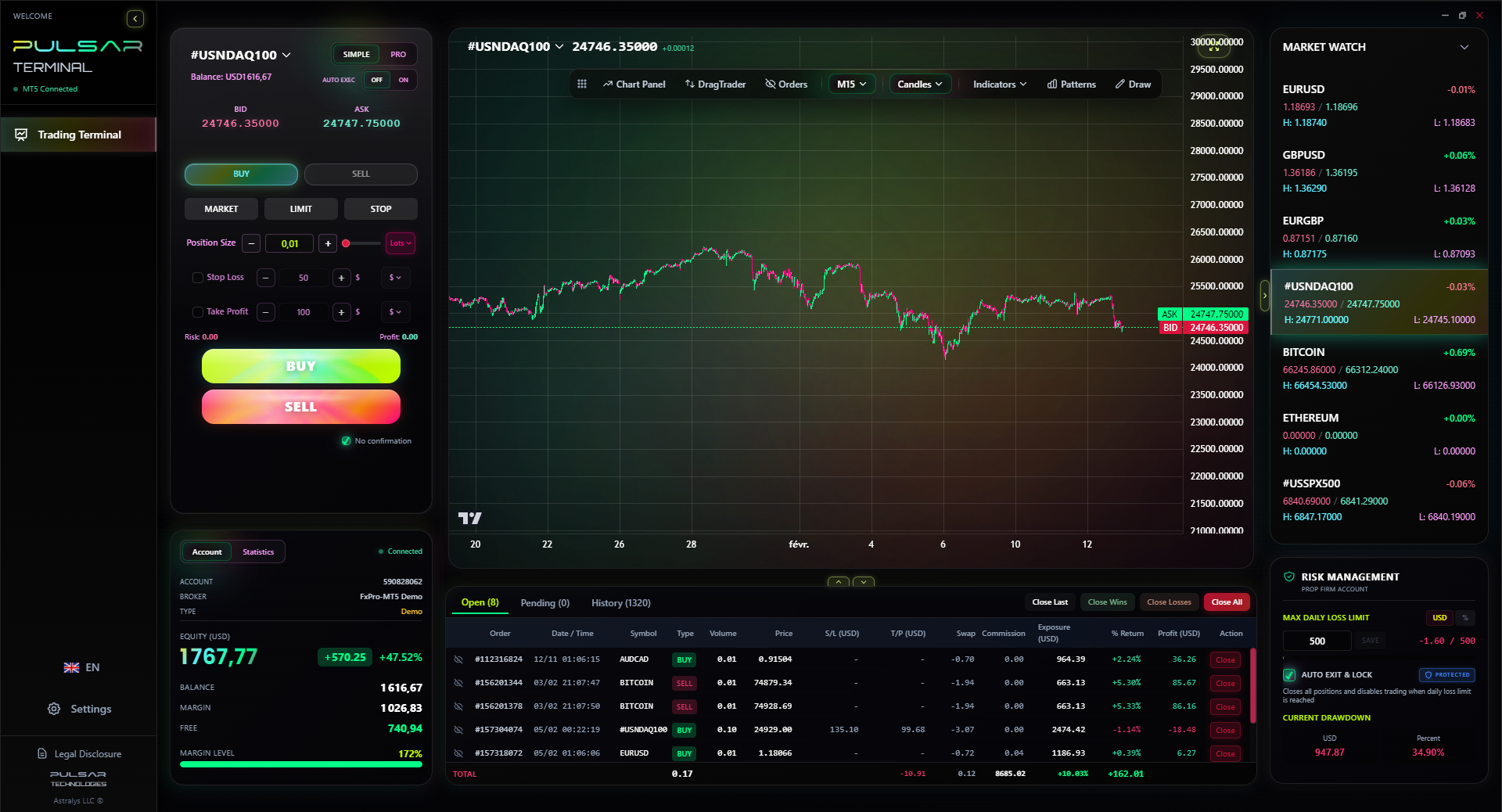
Platform Matters: You'll likely be on MT5. Using a tool that helps you visualize and stick to your risk limits is crucial. This is where discipline turns into dollars.
Managing the complex daily loss and drawdown rules that govern your payout is far easier with a tool that visualizes and automates these limits for you in real-time.
Pulsar Terminal
A ferramenta MT5 tudo-em-um: ordens drag-and-drop, multi-TP/SL, trailing stop, grid trading, Volume Profile e proteção prop firm. Usado diariamente por 1.000+ traders.
The prop firm industry is maturing, fast. The wild west days are ending.
Stricter Rules Are Coming: By 2026, I wouldn't be surprised if ASIC or other major regulators force prop firms into a formal licensing framework. This could mean stricter capital requirements for the firms and better protection for you. Payouts might become more standardized and guaranteed.
The Crypto Reporting Shift: The 2026 crypto tax rules are a game-changer for how many of us get paid. It brings everything into the light. Expect more firms to offer seamless AUD fiat payouts as a result.
Industry Consolidation: The MetaQuotes crackdown in early 2024 wiped out dozens of shaky firms. The ones left standing today, like FTMO, The5ers, and others, are generally more strong. This is good for payout reliability.
The bottom line? The prop firm payouts request of the future will be less of an anxiety-inducing event and more of a routine, automated transaction. But until then, protect yourself. Know the rules inside out, keep your trading clean, and always, always do your homework on the firm. Your profitability depends on it.
FAQ
Q1How long does a prop firm payout take in Australia?
It varies wildly. The fastest is crypto, which can be in your wallet in under an hour from firms like Hola Prime. AUD bank transfers typically take 2-5 business days after approval. The approval process itself can add another 1-5 business days for trade review.
Q2Are prop firm payouts taxable in Australia?
Yes, absolutely. The ATO considers this business income. You must declare the full AUD value of the payout (using the exchange rate on the day you receive it) in your tax return. Keep detailed records of all payout requests and receipts.
Q3What is the most common reason for a payout request to be denied?
Breaching the daily loss limit. Traders often misunderstand it's a running total from the start of the trading day, not per trade. A few small losing trades can add up to breach the limit (usually 3-5%), instantly failing the account and voiding any payout.
Q4Can I use my normal bank account for a prop firm payout?
Yes, for AUD or USD bank transfers. However, you might get better rates and faster service using an intermediary like Wise or Payoneer. Always confirm your BSB and account number are 100% correct to avoid delays or lost funds.
Q5What happens if my prop firm shuts down before my payout?
This is the biggest risk in this unregulated space. If the firm folds, your simulated profits and any pending payout are likely gone. This is why choosing an established, well-reviewed firm with a long track record of payouts is critical. Your 'capital' is not protected like it is with an ASIC-licensed broker.
Q6Do all prop firms allow weekly payouts?
No. Payout frequency varies. Some offer weekly (e.g., every Friday), some bi-weekly, and some have 'on-demand' payouts once you pass a minimum profit threshold. Always check the firm's specific payout schedule before you buy a challenge.
Lição do Prof. Winston
Pontos-chave:
- ✓Daily Loss Limit is your #1 enemy; it's a running total.
- ✓Calculate your NET effective profit split after all fees.
- ✓Crypto payouts are fastest; AUD bank transfers take 2-5 days.
- ✓Only 5-10% of traders pass the initial evaluation.
- ✓Document everything for the ATO; it's taxable business income.
Quão útil foi este artigo?
Clique em uma estrela
Insights de Trading Semanal
Análises e estratégias semanais grátis. Sem spam.
Sobre o autor
Sarah Collins
Estrategista de Trading
Estrategista de trading sediada em Londres com 12 anos em mercados financeiros. Ex-analista numa corretora na City de Londres. Cobre pares GBP, mercados europeus e trading regulado pela FCA.
Comentários
Aviso de risco
A negociação de instrumentos financeiros envolve riscos significativos e pode não ser adequada para todos os investidores. O desempenho passado não garante resultados futuros. Este conteúdo é apenas para fins educacionais e não deve ser considerado aconselhamento de investimento. Sempre conduza sua própria pesquisa antes de negociar.
Você também pode gostar

Cara Trading Forex Sukses: 7 Prinsip dari Trader Profesional
Cara trading forex sukses dengan 7 prinsip trader pro: manajemen modal, disiplin, journal trading, backtest. Data nyata, bukan janji profit palsu.
Jam Trading Forex Terbaik untuk Trader Indonesia: Panduan Lengkap dengan Tabel Waktu
Panduan jam trading forex untuk trader Indonesia. Tabel 4 sesi dunia, jam emas 20:00-00:00, sesi mana yang harus dihindari. Data akurat + tips dari trader berpengalaman.
Top 5 Sàn Forex Uy Tín Nhất 2026: Review Jujur dari Trader Indonesia
Top 5 sàn forex uy tín 2026 untuk trader Indonesia. Review jujur: spread, deposit, withdraw, dukungan lokal. Exness, XM, IC Markets & lebih.
Obter Pulsar Terminal
Todas essas calculadoras estão integradas ao Pulsar Terminal com dados em tempo real da sua conta MT5.
Obter Pulsar Terminal