


I remember staring at my screen in 2015, watching the E-mini S&P 500 futures chart.
James Mitchell
Analista de Trading Sênior
☕ 12 min de leitura
O que você vai aprender:
- 1What Makes Chicago Prop Trading Different?
- 2The Major Players: Chicago Prop Trading Firms Compared
- 3How to Actually Get Funded by a Chicago Prop Firm
- 4The Chicago Trading Styles That Actually Work
- 5The Real Numbers: Costs, Splits, and What You Take Home
- 6The Dark Side: Risks and Common Pitfalls to Avoid
- 7How to Choose the Right Chicago Prop Firm for You
- 8Frequently Asked Questions

I remember staring at my screen in 2015, watching the E-mini S&P 500 futures chart. I was up $1,200 for the day, a solid run. Then, a news spike hit. In 90 seconds, my profit was gone, and I was down $800. My $5,000 personal account couldn't handle the volatility. That's when I realized the problem wasn't my strategy; it was my capital. I needed a bigger bankroll, but I didn't have six figures sitting around. That loss led me to the world of Chicago prop trading firms, where you trade with someone else's money for a split of the profits. It changed everything.
Forget Wall Street for a second. Chicago is the undisputed capital of derivatives and futures trading. It's where the pits were, where open outcry defined a generation, and where risk is measured in ticks, not basis points. Prop trading firms here have a distinct flavor. They're often born from the floor trading culture, which means they have a deep, almost instinctual understanding of market microstructure, order flow, and short-term volatility.
While New York firms might focus on equity swing trading or macro bets, Chicago prop shops are the masters of the short game. Their bread and butter is in products like the E-mini S&P (ES), Nasdaq (NQ), Treasury notes (ZN, ZB), and crude oil (CL). The mindset is different. It's scalping, day trading, and sometimes holding for a few hours, but rarely overnight. The city's energy is pragmatic, midwestern, and focused on execution above all else.

Warning: This isn't passive investing. Chicago prop trading is a job. You're expected to be at your screens, actively managing risk during market hours. If you're looking for a 'set and forget' approach, this path isn't for you.
I traded at a small Chicago-based firm for two years. The education wasn't in fancy seminars; it was in the daily morning meetings where the head trader would dissect the previous day's order flow on the Volume Profile. That hands-on, practical focus is the city's trademark.

💡 Dica do Winston
The market doesn't care about your daily profit goal. It only cares about probability and edge. Focus on executing your plan flawlessly; the money is a byproduct, not a target.
Not all prop firms are created equal. Some are massive institutions, others are boutique shops. Here’s a breakdown of the main models you'll find in Chicago.
The Traditional House-Funded Model
These are the classic prop shops. You come in, prove yourself on a simulator, and they give you a desk and a chunk of their capital. Your losses are their losses, so the vetting is intense. You keep 50-80% of your profits. Firms like Tower Research Capital (though now global, its roots are deep in Chicago's HFT scene) and Eagle Seven operate on this principle. The barrier to entry is high, but the capital allocation can be enormous.
The Modern Evaluation ("Challenge") Model
This is where most retail traders start today. You pay a fee to take a trading challenge. Pass it, and you get a funded simulated account. You trade their capital, and they take a cut of your profits. The key difference? Your risk is limited to your challenge fee. Top firms using this model with strong Chicago ties or focus include Apex Trader Funding and Topstep. They've democratized access to prop trading.
| Firm Type | Capital Source | Your Risk | Profit Split | Best For |
|---|---|---|---|---|
| Traditional Funded | Firm's Balance Sheet | Your job/seat | 50-80% | Experienced traders with a proven track record |
| Evaluation Model | Firm's Capital (after passing) | Challenge Fee ($100-$500) | 75-100% (often 90%) | Retail traders building a track record |
My first funded account was with a challenge-style firm. I passed a $50k evaluation by risking no more than $500 per trade (a 1% rule using their rules). It forced the discipline I lacked with my own money. You can use our position size calculator to work out your exact risk on any evaluation.

“Your goal in the evaluation isn't glory, it's survival. The profit target is a side effect of not hitting the loss limit.”
Let's get practical. Getting funded isn't about hitting a home run. It's about not striking out. Here’s the step-by-step process, especially for the evaluation model.
- Choose Your Instrument: Most Chicago-focused evaluations are built for futures. Start with the Micro E-mini S&P (MES). It's $0.50 per point, so the pip definition (or rather, 'tick') risk is manageable. Don't jump into the big contracts (ES) right away.
- Understand the Rules: This is critical. Every firm has daily loss limits, maximum trailing drawdowns, and profit targets. For example, a common rule is: "No daily loss greater than $1,000, and total account drawdown cannot fall below $48,000 on a $50k account." Your first job is to not break these rules. I failed my first challenge because I ignored the daily loss limit after a bad trade, trying to 'make it back.'
- Trade Like a Risk Manager: Your goal in the evaluation is survival, not glory. Use tiny position sizes. On that $50k account, trading 1 MES contract might be your max. Your edge comes from consistency, not size.
- The Profit Target: Once you hit a specified profit target (e.g., $2,500 on the $50k account), you pass. Then, you get your funded account, usually with more favorable rules.

Pro Tip: During your evaluation, pretend the profit target doesn't exist. Focus solely on not hitting the daily loss limit. Execute your plan, take small wins, and the target will take care of itself. This mindset shift is what finally got me through.
Once funded, the real work begins. Now you have to manage a larger capital pool. This is where tools for advanced order management become useful, moving beyond basic scalping strategy setups.
What are these firms looking for? They want traders who understand liquidity and price action. Here are the styles that thrive.
Order Flow & Footprint Chart Trading: This is pure Chicago. Reading the order book, seeing where large lots are being absorbed, and trading in the direction of the dominant flow. It's about seeing the battle between buyers and sellers in real-time. This requires specialized software, which many firms provide.
Market Profile & Volume-Based Trading: Using tools like Market Profile to identify value areas, poor highs/lows, and single prints. The idea is to fade moves away from value and ride moves back toward it. It's a framework for understanding where price should be, not just where it is.
Short-Term Technical Scalping: This is what most people imagine. Using charts with indicators like the RSI indicator or MACD indicator on a 1, 2, or 5-minute chart to catch 5-10 point moves in the ES. The key is a razor-thin spread definition (which is why futures are ideal) and impeccable execution.
I made my first consistent profits using a simple mean reversion strategy on the 5-minute ES chart. I'd wait for a strong, fast move of 8-10 points, then look for a reversal candle and a divergence on the RSI. My stop was tight, 4 points ($200 risk on 1 ES contract), and my target was 6 points. It was boring, repetitive, and it worked about 55% of the time. That's all you need.
Remember, these firms don't care about your brilliant long-term thesis on Amazon. They care about your ability to make $200, twenty times a week, without losing $500 in a single day.
💡 Dica do Winston
In a prop firm evaluation, your primary indicator isn't RSI or MACD. It's the daily loss limit counter. Manage that first, and the profit target will manage itself.

“The biggest pitfall isn't failing the challenge; it's failing to perform consistently after you get funded.”
Let's talk money, with real examples. The economics are different between models.
Evaluation Model Costs: You'll pay an upfront fee, often monthly. For Apex Trader Funding, a $50k evaluation might cost $150 for a one-time fee or a smaller monthly fee. This is your total risk. If you blow the account, you're out the fee. Some firms offer retakes at a discount.
Profit Splits: This is the best part of the modern model. Splits are very generous. It's common to see 90% or even 100% of the first $X, then a 90/10 split thereafter. In a traditional firm, your split might start at 60/40 and increase with performance.
Other Costs: You'll always pay for data feeds and platform fees (like CQG or Rithmic). This can be $100-$200 per month. The firm usually provides the trading software (like Sierra Chart or TradingView).
A Real P&L Example: Let's say you're funded with a $100k simulated account. You have a 90/10 split.
- In Month 1, you make a gross profit of $6,000.
- Your data fees are $150.
- Your net profit is $5,850.
- Your 90% share is $5,265.
- The firm keeps $585.
Now, what if you have a losing month? You don't owe the firm anything. You just don't get paid. Your responsibility is the monthly data fee. This is the core appeal: your upside is significant, your downside is capped.

Example: My best month in a funded account was a $12,400 gross profit on a $150k allocation. After the 85/15 split and $180 in fees, I took home $10,322. That's life-changing money for someone who started with a $5k personal account. But the next month, I made only $900. The volatility is real.
This isn't a golden ticket. I've seen dozens of traders blow up. Here’s what gets them.
The Overtrading Trap: You pass the evaluation, get funded, and feel pressure to 'justify' the capital. You start taking marginal trades, increasing size to make more. This is a fast track to a margin call scenario (even in a sim account, they'll shut you down).
Ignoring the "Simulated" Reality: Never forget you're trading the firm's capital in a simulated environment. They have every right to change rules, add latency, or even shut down the program. Your track record there doesn't guarantee a future in a traditional firm.
Strategy Hopping: You have a 3-day losing streak, so you abandon your plan and try a new indicator you saw on YouTube. Consistency is king. Stick to one edge and refine it. My move from a pure swing trading mindset to a focused day trading approach was painful but necessary for prop work.
Underestimating Psychological Pressure: Trading with a 'real' $100k behind your clicks feels different than a demo, even if it's simulated. The fear of losing the opportunity can paralyze you or make you reckless.
The biggest pitfall? Thinking the challenge is the hard part. It's not. The hard part is performing consistently after you're funded, month after month, with real payout expectations. That requires professional-grade discipline and tools.


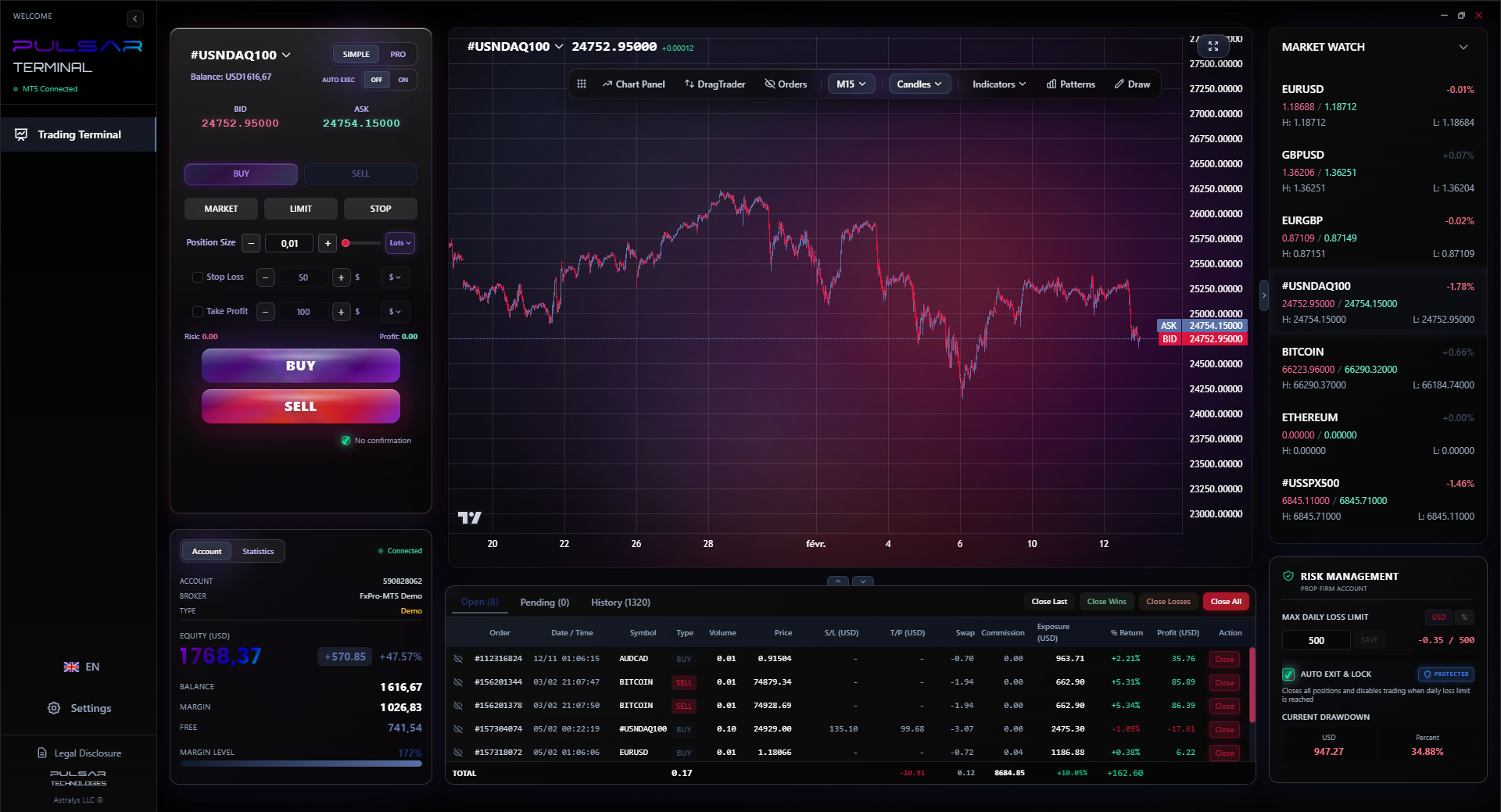
Managing a prop firm's strict daily loss and drawdown rules is a constant mental burden, which is why automating those protections with a tool like Pulsar Terminal directly on your MT5 chart is a game-saver.
Pulsar Terminal
A ferramenta MT5 tudo-em-um: ordens drag-and-drop, multi-TP/SL, trailing stop, grid trading, Volume Profile e proteção prop firm. Usado diariamente por 1.000+ traders.
“You're not trading a market; you're trading a specific firm's rulebook. Know it better than your strategy.”
With so many options, how do you pick? Don't just look at the profit split. Dig deeper.
- Instrument Focus: Do they specialize in futures (very Chicago), or do they also offer forex and stocks? If you want to trade the ES, pick a firm built for that. Check our XM review and Pepperstone review for forex-focused brokers, but know that Chicago prop is futures-land.
- Platform & Tools: What software do they offer? Sierra Chart? TradingView? Do they provide order flow tools (like BookMap or Jigsaw)? Your strategy depends on your tools.
- Payout Schedule & Threshold: How often do they pay? Weekly? Monthly? Is there a minimum payout amount? A firm that pays weekly with a $100 minimum is more useful than one that pays monthly with a $1k minimum when you're starting.
- Scaling Plan: How do you get more capital? Do they automatically increase your size after certain profit milestones? A clear, transparent scaling plan is a sign of a good firm.
- Community & Support: Do they have active traders' chats, weekly reviews, or mentorship? For new traders, this support can be worth more than an extra 5% on the profit split.
I chose my first firm because they used TradingView, which I was comfortable with, and had a clear scaling plan: hit $10k net profit, get bumped to a $200k account. The structure gave me a clear next goal.
💡 Dica do Winston
A 90% profit split of $1,000 is less than a 70% split of $3,000. Choose a firm based on the tools and rules that let you perform, not just the highest split percentage.
Q: Is prop trading in Chicago legal? A: Absolutely. Proprietary trading is a legitimate business where a firm uses its own capital to trade. The "evaluation" model is a modern adaptation. Always ensure the firm is a registered business entity.
Q: Do I need a license to trade at a prop firm? A: For the evaluation/funded model, no. The firm holds the necessary licenses. If you become a direct employee of a traditional firm, they may require you to get a Series 57 license.
Q: Can I trade from anywhere, or do I have to move to Chicago? A: For the vast majority of evaluation-model firms, you can trade from anywhere with a good internet connection. The traditional, house-funded desks sometimes prefer or require you to be local for collaboration and oversight.
Q: What's the typical daily loss limit? A: It varies, but a common structure is 2-3% of the account's starting balance. For a $50k account, that's a $1,000 - $1,500 daily loss limit. Your survival depends on respecting this number.
Q: How is the profit split paid? Is it taxed? A: It's typically paid via wire transfer, PayPal, or similar. The firm will issue you a 1099-MISC or 1099-NEC form for tax purposes. You are responsible for paying income tax on your share of the profits as self-employment income.
Q: Can I trade other instruments like XAU/USD or EUR/USD at a Chicago prop firm? A: It depends on the firm. Pure futures shops may only offer CME products. Some multi-asset firms (often with global offices) will offer forex, commodities, and indices. Check the firm's instrument list first.
FAQ
Q1What is the main advantage of trading with a Chicago prop firm?
The main advantage is access to significant trading capital that isn't your own. This allows you to make meaningful profits from small, consistent percentage gains without risking your personal life savings. It turns trading from a high-risk speculation into a scalable business.
Q2What's the biggest mistake new prop traders make?
The biggest mistake is treating the funded account like a lottery ticket. They increase position size dramatically after a few wins, violating their risk rules. The goal isn't to get rich in a week; it's to preserve the capital and compound gains steadily. Blowing a funded account is heartbreaking and avoidable.
Q3How much starting capital do I need?
For the evaluation model, you only need enough for the challenge fee and first month's data/software fees. This can be as little as $150-$500 total. You do not need to deposit the $50k or $100k you'll be trading. That's the firm's simulated capital.
Q4Are there age or experience requirements?
Most firms require you to be at least 18. There's no formal experience requirement for evaluation firms, but you should have a solid, tested strategy and understand basic risk management. Traditional firms will require a demonstrable track record.
Q5Can I trade part-time?
Yes, many funded traders start part-time. However, you must be active and disciplined during your trading sessions. You can't just set and forget trades. The firms expect active management, especially since many have daily loss limits you must monitor.
Q6What happens if I hit the maximum drawdown?
Your funded account is closed. With evaluation firms, you can usually purchase a 'reactivation' at a discount to restart without going through the full challenge again. It's a setback, not necessarily the end.
Lição do Prof. Winston
Pontos-chave:
- ✓Risk the firm's rules, not your intuition.
- ✓A 2% daily loss limit means your first loss should be tiny.
- ✓Futures are Chicago's language; learn the ticks.
- ✓Simulated capital requires real psychological capital.
- ✓Choose tools that automate discipline, like trailing stops.
Quão útil foi este artigo?
Clique em uma estrela
Insights de Trading Semanal
Análises e estratégias semanais grátis. Sem spam.
Sobre o autor
James Mitchell
Analista de Trading Sênior
Sediado em Nova York com mais de 9 anos de experiência em trading. Focado nos principais pares USD, desafios de prop firms e o cenário regulatório dos EUA.
Comentários
Aviso de risco
A negociação de instrumentos financeiros envolve riscos significativos e pode não ser adequada para todos os investidores. O desempenho passado não garante resultados futuros. Este conteúdo é apenas para fins educacionais e não deve ser considerado aconselhamento de investimento. Sempre conduza sua própria pesquisa antes de negociar.
Você também pode gostar

Cara Trading Forex Sukses: 7 Prinsip dari Trader Profesional
Cara trading forex sukses dengan 7 prinsip trader pro: manajemen modal, disiplin, journal trading, backtest. Data nyata, bukan janji profit palsu.
Jam Trading Forex Terbaik untuk Trader Indonesia: Panduan Lengkap dengan Tabel Waktu
Panduan jam trading forex untuk trader Indonesia. Tabel 4 sesi dunia, jam emas 20:00-00:00, sesi mana yang harus dihindari. Data akurat + tips dari trader berpengalaman.
Top 5 Sàn Forex Uy Tín Nhất 2026: Review Jujur dari Trader Indonesia
Top 5 sàn forex uy tín 2026 untuk trader Indonesia. Review jujur: spread, deposit, withdraw, dukungan lokal. Exness, XM, IC Markets & lebih.
Obter Pulsar Terminal
Todas essas calculadoras estão integradas ao Pulsar Terminal com dados em tempo real da sua conta MT5.
Obter Pulsar Terminal