


Most traders think scalping is all about staring at a one-minute chart, sweating over every tick.

James Mitchell
Analista de Trading Sênior
☕ 13 min de leitura
O que você vai aprender:
- 1What Are Renko Charts and Why Scalpers Love Them
- 2US Regulations You Can't Ignore: PDT and Beyond
- 3Building Your Renko Scalping System: Entry and Exit Rules
- 4Choosing the Right US Broker for Renko Scalping
- 5Risk Management: The Scalper's Best Friend
- 6Common Pitfalls and How to Avoid Them
- 7Putting It All Together: A Sample Trading Session
- 8Advanced Tips and Tools for the Committed Scalper
Most traders think scalping is all about staring at a one-minute chart, sweating over every tick. They're wrong. The real secret to consistent, low-stress scalping isn't speed - it's clarity. That's where Renko charts come in. By stripping away time and noise, they show you only the price moves that matter. I'll show you how to combine this with a strict scalping system that actually works under US regulations, including how to deal with the infamous PDT rule and which brokers won't slow you down.
Forget candles and bars for a second. A Renko chart is built differently. It only plots a new "brick" when price moves a predetermined amount in one direction. Time is irrelevant. If the price sits still for an hour, your chart doesn't get a new brick. This filters out all the tiny, meaningless wiggles that drive most scalpers crazy.
Think of it like this: you're trying to listen to a conversation in a noisy room. A normal chart gives you every single sound. A Renko chart turns down the background music and highlights the actual words. For a scalper, this is pure gold. It makes trends visually obvious and helps you avoid fakeouts that happen in choppy, sideways markets.

Pro Tip: Start with a brick size based on the Average True Range (ATR). For major forex pairs like EUR/USD, a brick size of 5-10 pips is a common starting point for scalping. It's big enough to filter noise but small enough to capture intraday moves.
I made the mistake early on of using too small a brick size - like 2 pips on the GBP/JPY. The chart looked clean compared to a 1-minute, but I was still getting whipsawed. It was just slower whipsaw. When I bumped it up to a 7-pip brick, the real intraday trends started to snap into focus, and my win rate improved. It's a tool for clarity, not magic.

💡 Dica do Winston
A Renko chart doesn't predict the future. It just cleans up the past. Your edge comes from how you react to that cleaner information.

Alright, let's get the boring but critical stuff out of the way first. You can't talk about scalping in the US without talking about the Pattern Day Trader (PDT) rule. It's the big one.
If you're trading in a margin account and you execute four or more day trades within five business days, you get labeled a Pattern Day Trader. The kicker? You must then maintain a minimum of $25,000 in your account equity. Fall below that, and your broker will slap a restriction on your account faster than you can say "margin call."
The $25,000 Reality Check
This isn't a suggestion; it's a rule. I learned this the hard way back in 2019. I had a $15,000 account, was on a hot streak, and got flagged as PDT. The next week, a couple of losing trades brought me below $25k. My broker locked me out of day trading for 90 days. Game over. It was a brutal lesson in regulatory reality.
Your Workarounds and Options
So, what can you do?
- Trade a Cash Account: No PDT rule. The catch? You're subject to Good Faith Violations (GFVs) if you sell a security before the funds from a previous sale have settled. For forex and futures, this is less of an issue, but for stocks, it's a real constraint.
- Trade Futures or Forex: The PDT rule specifically applies to margin accounts trading securities (stocks, options). Many futures brokers and forex brokers (like Oanda or Forex.com) have their own internal rules, but the official FINRA PDT rule doesn't apply. This is a major reason forex is popular with US scalpers.
- Keep Your Day Trades Under Four: This is the most common strategy for smaller accounts. It forces discipline but limits your strategy.

Warning: The PDT rule is under review, and changes (like a potential risk-based model) might come by late 2025 or 2026. Don't bank on it changing soon. Trade by the current rules.
Also, remember all your scalping profits are taxed as short-term capital gains - same as your ordinary income tax rate. Keep a detailed trade log. I use a simple spreadsheet, but dedicated software saves headaches come April.
“The real secret to consistent, low-stress scalping isn't speed - it's clarity.”
Here's a simple, mechanical Renko trading scalping strategy I've used successfully. It uses only price action on the Renko chart and one oscillator for confirmation. The goal is to catch the continuation of a new brick's direction.
Step 1: The Setup (Trend Identification) We only want to trade in the direction of the short-term trend. How do we see it on Renko? It's easy: a series of bricks of the same color. Five green bricks in a row? That's an uptrend. Five red bricks? Downtrend. We're looking for a clear, established brick flow.
Step 2: The Trigger (Pullback Entry) We don't chase. We wait for a pullback against the trend. In an uptrend (green bricks), we wait for a single red brick to form. That's our pullback. Once that red brick is complete, we look to enter long on the next brick.
Step 3: The Confirmation (Oscillator Filter) This is where we avoid false signals. I use the RSI (set to period 5) on the Renko chart. For our long entry after a red pullback brick, I want to see the RSI has dipped below 40 and is now curling back up. It confirms the selling pressure during the pullback is exhausted. You can learn more about fine-tuning this in our guide on the RSI indicator.
Step 4: Entry, Stop Loss, and Take Profit
- Entry: Place a buy stop order 1 pip above the high of the red pullback brick. The trade triggers when the market starts forming the next green brick.
- Stop Loss: Place your stop loss 1 pip below the low of the red pullback brick. On a 5-pip brick, this gives you a risk of about 6-7 pips.
- Take Profit: Aim for a 2:1 reward-to-risk ratio. If your stop is 7 pips away, your take profit is 14 pips above your entry.

Example: EUR/USD, 5-pip Renko bricks. Five green bricks up. A red brick forms (high: 1.0850, low: 1.0845). RSI dips to 38. You place a buy stop at 1.0851. Stop loss at 1.0844 (7 pip risk). Take profit at 1.0865 (14 pip target).
This is a pure scalping strategy framework. It's disciplined and removes emotion. I've taken hundreds of trades with this setup. It's not a winner every time - no strategy is - but the clarity of the Renko chart makes sticking to the plan much easier.
💡 Dica do Winston
The PDT rule feels like a cage. Use it as a governor. It forces you to be selective, which is the scalper's true superpower.
Your broker can make or break a Renko scalping strategy. You need three things: low transaction costs, fast/reliable execution, and a platform that supports Renko charts natively or via plugin.
Here’s a quick comparison of brokers I've used or have solid data on for US-based scalping:
| Broker | Key Feature for Scalpers | Avg. EUR/USD Spread | Commission (per $100K round turn) | Platform with Renko |
|---|---|---|---|---|
| Forex.com | Raw Pricing account, fast US execution | 0.0 pips | ~$7 | MT4, MT5 (needs custom indicator) |
| Oanda | No commission, tight spreads, excellent API | 0.9 pips | $0 | fxTrade, MT4 (needs custom indicator) |
| tastyfx (IG US) | Great for larger orders, tight spreads | 0.8 pips (commission-free) | $0 or variable | Proprietary, MT4 |
| Interactive Brokers | Access to everything (stocks, futures, forex) | Variable, very tight | Low, tiered | TWS (complex), can link to NinjaTrader |
My Experience: I ran my Renko scalping system on both Forex.com and Oanda. Forex.com's Raw account was cheaper per trade on paper (spread + commission), but I found Oanda's execution on their fxTrade platform to be slightly faster during news events, which saved me from slippage a few times. That speed edge was worth the slightly higher spread cost for my style. Always test with small money first.
Most MetaTrader platforms don't have built-in Renko charts. You'll need to download a free Renko indicator or purchase a more strong one. This is a small extra step but non-negotiable. Some proprietary platforms, like those from Pepperstone (not US-regulated but a global scalping favorite) or cTrader, have them built-in, but check their US availability.
Funding is easy here: ACH bank transfers are standard and free. PayPal is almost universal. Just know that withdrawing profits back to your bank usually takes 1-3 business days.
“One bad trade with poor sizing can wipe out 20 good ones.”
Scalping with Renko feels cleaner, but it can lure you into a false sense of security. You still need iron-clad risk rules. One bad trade with poor sizing can wipe out 20 good ones.
The 1% Rule is Your Foundation: Never, ever risk more than 1% of your trading account capital on a single scalp. With a $10,000 account, that's $100 max risk per trade. If your Renko setup has a 7-pip stop loss, that dictates your position size.
Let's do the math: $100 risk / 7 pips = $14.28 per pip. Since a standard forex lot is about $10 per pip (for EUR/USD), you could trade roughly 1.4 mini lots. Use a position size calculator every single time. Don't guess.
Daily Loss Limit: This is even more important than the per-trade limit. Set a hard stop for the day. Mine is 3% of my account. If I lose $300 on my $10k account, I'm done. Close the platform. Go for a walk. This protects you from revenge trading after a few losses - the scalper's death spiral.
use is a Double-Edged Sword: US-regulated brokers cap use for retail forex traders (often 50:1 on majors, 20:1 on minors). This is a good thing. It prevents you from blowing up your account on one trade. With Renko scalping, you're aiming for consistent small wins. You don't need 500:1 use. In fact, high use will work against you by magnifying the impact of every tiny mistake. Treat use as a margin requirement, not a profit accelerator.
I violated my daily loss limit once in 2021 after three quick losses on gold (XAU/USD). I thought, "One good trade will get it back." I took a fourth trade with double my normal size. It lost. I blew past my 3% limit and ended the day down 6.5%. It took me two weeks of disciplined trading to dig out of that hole. The rule exists for a reason.
Even with a great system, you'll face these traps. I've fallen into every one.
Pitfall 1: Over-trading During Flat Markets. Renko charts can go quiet. No new bricks form for long periods. The temptation is to reduce your brick size to "find" trades. Don't. This destroys the noise-filtering benefit. If the market isn't moving enough to form bricks on your chosen size, it's not a scalping market. Wait. This is a business, not a video game.
Pitfall 2: Ignoring Higher Time Frames. Just because Renko filters time doesn't mean you should. Always glance at a higher timeframe Renko chart or a regular hourly/daily chart. If the 4-hour chart is showing a massive red brick downtrend, maybe those little long scalps on the 5-pip chart aren't the best idea. Context matters.
Pitfall 3: Moving Stops Too Early. Renko bricks give clear support/resistance levels. Your stop is placed there for a reason. Because the chart is so smooth, you'll see your trade go 3 pips into profit and think, "I'll just move my stop to breakeven." Then the brick reverses and hits your original stop level, but you're already out at breakeven for a missed win. Let your original plan work. Tools that automate breakeven moves can help, but understand the logic first.
Pitfall 4: Chasing the Brick. You see a big green brick form. You FOMO and buy at the top of it. You're now entering as the pullback brick is likely about to form. You've entered at the worst possible point in the cycle. Always wait for the pullback brick. Discipline is everything.
💡 Dica do Winston
If your Renko chart is forming bricks rapidly, volatility is high. Consider widening your stop by a pip or two to avoid being stopped out by a single flicker.

“The goal isn't adrenaline; it's accumulation.”
Let's walk through a hypothetical morning with a $15,000 account, trading the EUR/USD with 5-pip Renko bricks.
8:30 AM ET: You check the chart. You see a clear sequence: Green, Green, Green, Red (pullback). The RSI on the red brick hit 35. Your system says BUY. You calculate position size: 1% risk = $150. Your stop (below the red brick's low) is 6 pips away. $150 / 6 pips = $25 per pip. You trade 2.5 standard lots. You enter a buy stop order 1 pip above the red brick's high.
8:45 AM: The order fills at 1.0781. Stop loss at 1.0775. Take profit at 1.0793 (12 pips, a 2:1 R:R). You walk away.
9:15 AM: Price moves up, forms two new green bricks. It hits your take profit at 1.0793. Profit: 12 pips x $25 per pip = $300. You're done with that trade.
10:00 AM: Market chops. No clear brick sequences form for an hour. You do nothing. This is a win.
11:00 AM: A new sequence starts: Red, Red, Red, Green (pullback). RSI on the green pullback brick is at 65 and curling down. SHORT signal. You calculate again (same $150 risk). Stop is 7 pips away. You sell at 1.0789, stop at 1.0796, target at 1.0775.
11:30 AM: Price drops one brick, then stalls. It creeps up and takes out your stop loss. Loss: 7 pips x ~$21.4 per pip = -$150.
Session Summary: One win ($300), one loss (-$150). Net +$150, or +1% on your account. You hit your daily profit target (which for me is often 2-3%). You close the platform. That's a successful Renko scalping day. It's boring, mechanical, and profitable. The goal isn't adrenaline; it's accumulation. For more on this patient approach, see our guide on swing trading principles, which apply even to short timeframes.

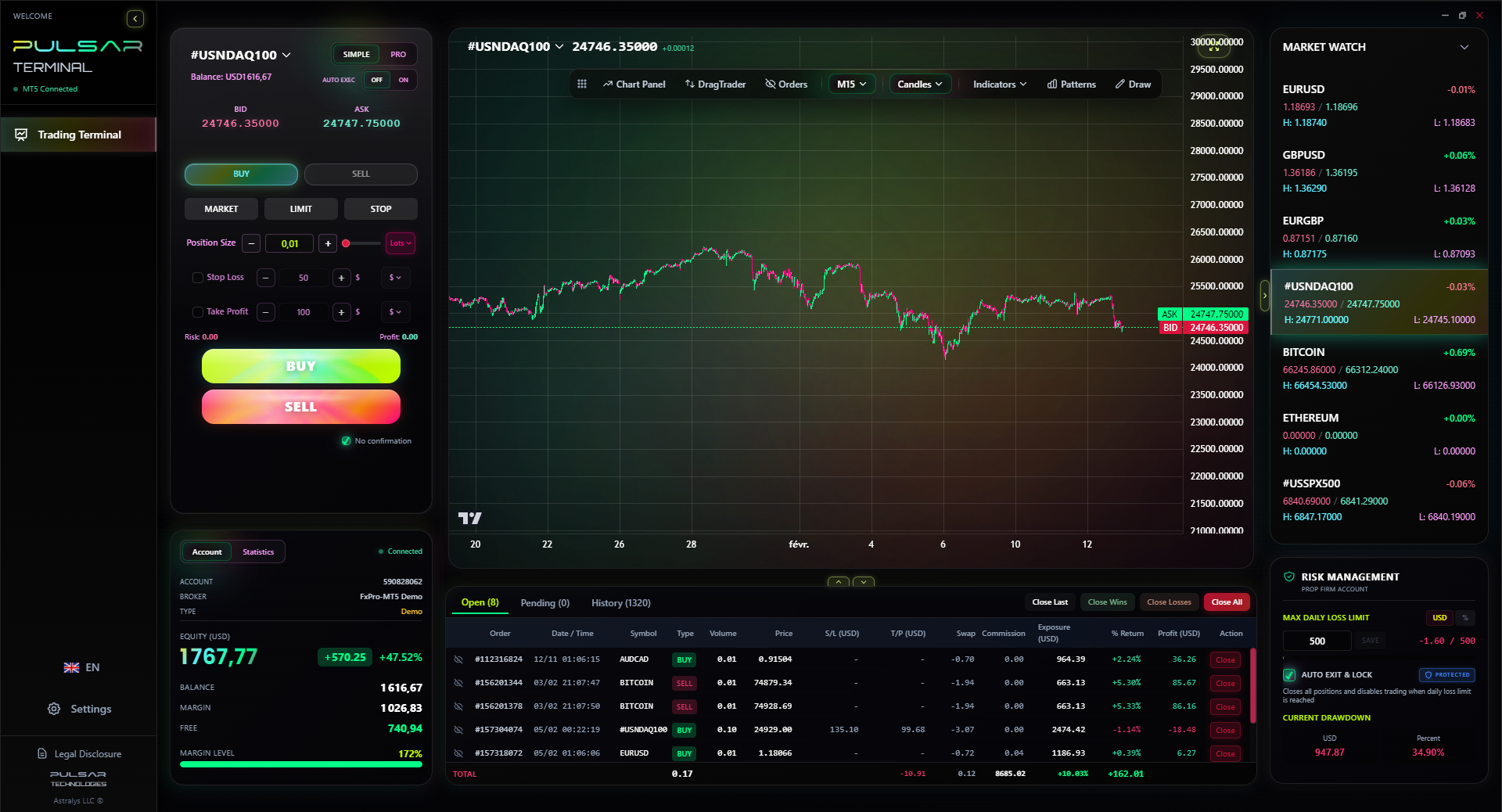
Managing multiple take-profit levels and moving stops to breakeven manually is a distraction; Pulsar Terminal automates these precise exit rules directly on your MT5 chart, so you can focus on finding the next setup.
Pulsar Terminal
A ferramenta MT5 tudo-em-um: ordens drag-and-drop, multi-TP/SL, trailing stop, grid trading, Volume Profile e proteção prop firm. Usado diariamente por 1.000+ traders.
Once you've mastered the basic system, you can explore these refinements.
Multi-Timeframe Renko Analysis: Use a larger brick size (e.g., 10-15 pips) to define the primary trend for the session. Then use your 5-pip brick chart for your actual entry signals. Only take 5-pip chart signals that align with the direction of the larger brick chart. This adds a powerful filter.
Combining with Market Profile/Volume Profile: This is where things get interesting. Renko shows you when price moves meaningfully. Volume Profile shows you where it moved with high activity (high-volume nodes). A Renko breakout from a high-volume node is often a much stronger signal. You need advanced trading software for this.
Automation and Order Management: Manually moving stops to breakeven or trailing a stop can be distracting. Professional tools allow you to set these rules automatically. For example, you could program: "Move stop to entry once price reaches 1.5x my risk." This locks in a small profit and lets the runner go without you babysitting it. It turns a scalp into a potential mini-swing trade on the runner portion.
Backtesting is Non-Negotiable: Don't just trust me. Test this Renko trading scalping strategy yourself. Most platforms with custom Renko indicators allow you to replay historical data. Run through 3-6 months of price action, taking every signal. Write down the results. How does it perform in trending vs. ranging markets? What's the actual win rate and profit factor? Your confidence will come from this data, not from hope. I spent two full weekends backtesting this before I risked a real dollar, and it saved me from several flawed variations I was initially excited about.
FAQ
Q1Is the Renko trading scalping strategy profitable?
It can be, but not because Renko charts are a "secret." Profitability comes from a disciplined system (like the one outlined), strict risk management (the 1% rule), and controlling your psychology. The Renko chart simply provides a clearer view to execute that system. No strategy guarantees profits, and most retail traders lose money.
Q2What is the best Renko brick size for scalping forex?
There's no single "best" size. It depends on the pair's volatility and your tolerance for noise. For major pairs like EUR/USD or GBP/USD, start with a brick size of 5-10 pips. For more volatile pairs like GBP/JPY, you might need 7-12 pips. Use the ATR indicator on a 1-hour chart as a guide - a brick size of 0.5x to 1x the ATR is a common starting point.
Q3Can I use Renko charts for scalping on MetaTrader 4 or 5?
Yes, but not natively. MT4 and MT5 do not have built-in Renko charting. You need to download a custom Renko indicator from the MetaTrader Market or code one yourself (many free versions exist). The indicator will generate the Renko bricks on your chart. Brokers like IC Markets and XM offer MT4/MT5 and support custom indicators.
Q4How does the PDT rule affect Renko scalping?
If you are day trading stocks or options in a US margin account, the PDT rule applies regardless of your chart type. Renko scalping is still day trading. This means you must maintain $25,000+ to make more than 3 day trades in a 5-day period. To avoid this, many US Renko scalpers focus on forex or futures, where the PDT rule does not apply, or they use a cash account (with settlement rules).
Q5What indicators work best with Renko charts for scalping?
Keep it simple. Momentum oscillators that work well with clean price data are best. The RSI (period 5-7) and the MACD (fast settings like 6,13,1) are excellent choices. They generate fewer false signals on Renko than on time-based charts because the underlying data has less noise. See our deep dive on the MACD indicator for advanced settings.
Q6What's the biggest mistake new Renko scalpers make?
Changing the brick size in the middle of a trading session because the market is slow. This destroys your strategy's consistency and often leads to overtrading in low-quality conditions. Pick a brick size based on volatility, backtest it, and stick to it for the entire session or week.
Lição do Prof. Winston
Pontos-chave:
- ✓Renko charts filter noise, not risk. Manage the latter fiercely.
- ✓Never risk more than 1% of your capital on a single scalp.
- ✓The PDT rule is a fixed cost of doing business in US markets.
- ✓A 5-10 pip brick size is the sweet spot for forex scalping.
- ✓Profitability comes from execution, not the chart type.
Quão útil foi este artigo?
Clique em uma estrela
Insights de Trading Semanal
Análises e estratégias semanais grátis. Sem spam.
Sobre o autor
James Mitchell
Analista de Trading Sênior
Sediado em Nova York com mais de 9 anos de experiência em trading. Focado nos principais pares USD, desafios de prop firms e o cenário regulatório dos EUA.
Comentários
Aviso de risco
A negociação de instrumentos financeiros envolve riscos significativos e pode não ser adequada para todos os investidores. O desempenho passado não garante resultados futuros. Este conteúdo é apenas para fins educacionais e não deve ser considerado aconselhamento de investimento. Sempre conduza sua própria pesquisa antes de negociar.
Você também pode gostar

Cara Trading Forex Sukses: 7 Prinsip dari Trader Profesional
Cara trading forex sukses dengan 7 prinsip trader pro: manajemen modal, disiplin, journal trading, backtest. Data nyata, bukan janji profit palsu.
Jam Trading Forex Terbaik untuk Trader Indonesia: Panduan Lengkap dengan Tabel Waktu
Panduan jam trading forex untuk trader Indonesia. Tabel 4 sesi dunia, jam emas 20:00-00:00, sesi mana yang harus dihindari. Data akurat + tips dari trader berpengalaman.
Top 5 Sàn Forex Uy Tín Nhất 2026: Review Jujur dari Trader Indonesia
Top 5 sàn forex uy tín 2026 untuk trader Indonesia. Review jujur: spread, deposit, withdraw, dukungan lokal. Exness, XM, IC Markets & lebih.
Obter Pulsar Terminal
Todas essas calculadoras estão integradas ao Pulsar Terminal com dados em tempo real da sua conta MT5.
Obter Pulsar Terminal