


Let's get one thing straight: the idea of a single 'richest forex trader in the world' is mostly a marketing fantasy sold to you on Instagram.

David van der Merwe
Trader de Mercados Emergentes ·  South Africa
☕ 9 min de leitura
O que você vai aprender:

Let's get one thing straight: the idea of a single 'richest forex trader in the world' is mostly a marketing fantasy sold to you on Instagram. The real money isn't in mimicking some mysterious billionaire's trades; it's in understanding the boring, disciplined systems that create lasting wealth. I've seen too many guys in Sandton blow their bonuses chasing that dream, only to get wiped out by the first real market storm. In this guide, we'll cut through the noise, look at who actually has the verified track records, and I'll show you how to build a sustainable trading approach that works for South Africans, right here, right now.
When people ask about the richest forex trader in the world, they're usually picturing two very different types. On one side, you have the institutional legends. These aren't guys staring at charts on a laptop; they're running hedge funds with armies of analysts.
Take George Soros. His famous bet against the British Pound in 1992 netted over $1 billion. That's the scale we're talking about. His firm, Quantum Fund, had the capital and the political insight to force a central bank's hand. Ray Dalio, Paul Tudor Jones, Bruce Kovner – these names have net worths in the billions, but their wealth is built on fund management fees and decades of macro-economic trading, not just spotting a double top on the USD/ZAR chart.
Then you have the South African scene. Names like Ref Wayne, Sandile Shezi, and Jabulani Ngcobo are thrown around with net worth estimates from a few million to a couple billion. Here's my blunt take: verifying the actual trading-derived wealth of these individuals is nearly impossible. Their public income often comes from courses, speaking fees, and brand deals – the 'education' business around trading. I'm not saying they aren't skilled, but conflating that business model with being the next George Soros is a dangerous mistake for a new trader.

Warning: If someone's primary proof of wealth is their Instagram feed – the cars, the watches, the stacks of cash – be deeply skeptical. Real trading wealth is often quiet. The loudest voices in the room are usually selling something, not trading.
The lesson? Don't worship the individual. Study the principles. Soros's core idea of 'reflexivity' – how market perceptions can change fundamentals – is more valuable to you than any signal he might (but never will) tweet.

💡 Dica do Winston
A 'guru' holding a stack of cash is almost certainly holding someone else's tuition fees, not trading profits. Measure credibility by track record duration, not Lamborghini colour.
Forget finding the richest forex trader in the world and copying them. Their specific trades are irrelevant to your R20,000 account. What matters is their process. Every successful trader, from Soros down to a consistent local scalping strategy practitioner, has a ruthless, repeatable system.
It's All About Risk Management
This is the unsexy truth no one on YouTube wants to lead with. The billionaires are still in the game because they never bet the farm. They risk a tiny percentage of their capital on any single idea. For you, that means using a position size calculator for every single trade. No exceptions. I learned this the hard way early on.
Back in 2015, I was convinced the EUR/USD was going to collapse. I put on a huge position, way beyond my normal risk. I was right on the direction... initially. Then a surprise ECB comment caused a 90-pip spike against me before it continued down. I was stopped out for a 4% account loss - a devastating blow that took weeks to recover from emotionally. If I'd used proper position sizing, that would have been a 0.5% loss, a minor scratch.
Consistency Over Home Runs
You don't get rich from one trade. You get rich from hundreds of small, positive-expectancy trades. Your goal isn't to be a hero; it's to be a robot. Define your entry, your stop-loss, and your take-profit before you click buy. A tool like a trailing stop can help lock in profits, which is a discipline in itself. Whether you're swing trading ZAR pairs or day trading, the process is king.

Pro Tip: Your trading journal is more important than your trading strategy. Write down why you took every trade, what you felt, and the outcome. After 100 trades, you'll see your real edge (or lack thereof). My journal showed me I lost money on 70% of my trades entered after 10 PM. That data changed my behavior more than any indicator.
“A losing trade is not a failure; it's a cost of doing business. If a loss ruins your day, you're risking too much money.”
Trading from South Africa isn't the same as trading from London or New York. We have unique hurdles that can eat into your profits before you even start.
First, the regulations. The FSCA caps use at 30:1 for retail clients. This is actually a good thing, a forced discipline that prevents you from blowing up your account in minutes. But it means you need more margin. Also, remember the SARB rules: you cannot legally speculate against the Rand with a South African broker. You can trade major pairs like EUR/USD, but direct ZAR shorts are a no-go.
Then there's the cost. It's not just the spread definition.
- Broker Fees: Choose your broker carefully. Some have higher commissions or wider spreads on exotics.
- Currency Conversion: Funding your international broker account in ZAR? You'll pay the bank's forex spread, which is terrible. Using your R10 million foreign investment allowance is smarter but more admin.
- Tax: Don't forget about SARS. Trading profits are considered income and are taxable. Keep immaculate records. A R100,000 win feels less great when you haven't set aside 30-40% for the taxman.
I once made a clean R50,000 profit in a quarter. I was thrilled. Then my accountant asked for the records. I hadn't kept track of my dozens of small losses to offset the gains. I ended up paying tax on the gross profit, not the net. That was an expensive lesson in basic administration.
💡 Dica do Winston
If a loss makes you angry, you gambled. If it makes you thoughtful, you invested. The difference is in the planning, not the outcome.

So how do you start building something real? You stop looking for a guru and start building your own framework.
1. Start with the Instruments You Know: Don't jump into volatile exotic pairs. Master one or two major pairs first. The EUR/USD guide is a great place to start - it's liquid and has tight spreads. Even something like gold (XAU/USD guide) can be more intuitive than a random currency cross.
2. Keep Your Tech Simple: You don't need 20 monitors. You need a reliable broker (check our IC Markets review or Pepperstone review for options) and a charting platform you understand. Start with just two indicators. I built my entire early career on just price action and the RSI indicator. Once you master that, then maybe add the MACD indicator. Overcomplicating is the enemy of execution.
3. Embrace the Grind: Your first year is for learning, not earning. Use a demo account until your strategy is consistently profitable for at least two months. Then switch to a live account with money you can afford to lose - I mean really afford to lose, like a bad weekend at Sun City. This mental shift is everything.

Example: Let's say you have R20,000. A sane risk per trade is 1%. That's R200. If your stop-loss on a EUR/USD trade is 20 pips, and each pip is worth R10 with your lot size, you can only risk 20 pips (R200 / R10 per pip). That dictates your position size. This math is non-negotiable. Ignoring it is how you get a margin call.
“Wealth in trading accrues slowly to the disciplined and rapidly vanishes from the reckless.”
This is where the rubber meets the road. You can have the best strategy in the world, but if your psychology is weak, you'll fail. The richest forex traders in the world have ice in their veins. They've been through multiple margin call scares and lived to tell the tale.
Fear & Greed: Your two biggest enemies. Fear makes you cut winners short. Greed makes you let losers run. I've watched a trade go 50 pips in my favor, only to reverse and hit my stop-loss at breakeven because I was too scared to bank the profit. I've also held a losing USD/ZAR trade for days, watching it bleed, because my ego couldn't admit I was wrong. Every. Single. Trader. Does. This.
The Confidence Trap: A few winning trades can make you feel invincible. That's when you increase your position size recklessly. The market exists to humble you. The goal isn't to eliminate emotion - that's impossible. The goal is to have a system so rigid that emotion can't interfere. Your plan says sell, you sell. No debate.
Dealing with loss is the ultimate test. A losing trade is not a failure; it's a cost of doing business. If you have a 60% win rate, you lose 4 out of every 10 trades. You have to be okay with that. If a loss ruins your day, you're risking too much money. Go back to the position size calculator.
💡 Dica do Winston
The market doesn't care about your rent, your ego, or your 'sure thing'. Trade the price you see, not the story you've told yourself.

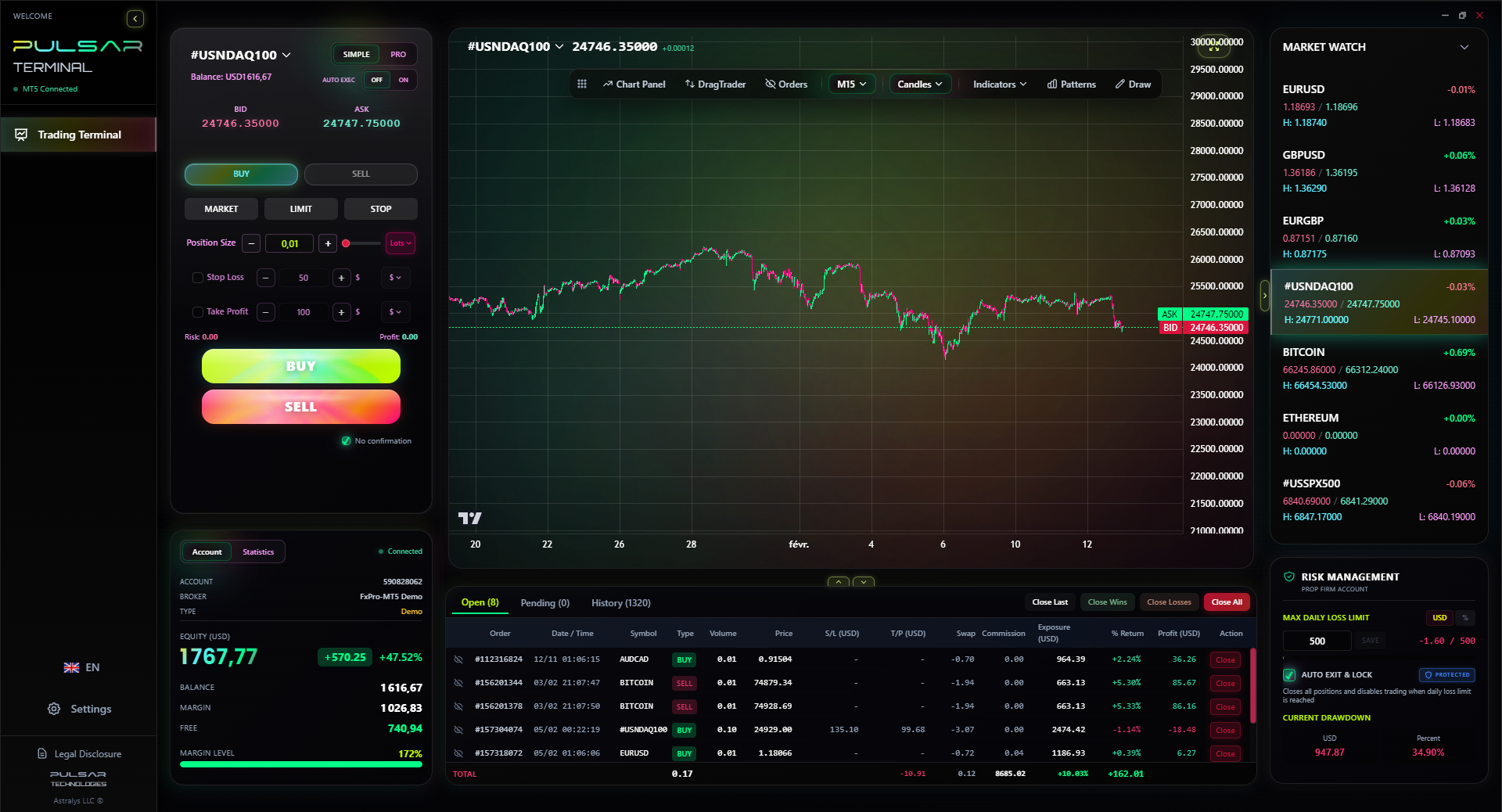
Mastering your psychology means removing emotion from execution, and Pulsar Terminal lets you set advanced orders like trailing stops and multi-level take-profits before you even enter the trade, automating your discipline.
Pulsar Terminal
A ferramenta MT5 tudo-em-um: ordens drag-and-drop, multi-TP/SL, trailing stop, grid trading, Volume Profile e proteção prop firm. Usado diariamente por 1.000+ traders.
Let's circle back. Is there a richest forex trader in the world? Sure, on paper, it's probably a hedge fund founder like Ray Dalio. But that title is meaningless for your journey. Chasing that ghost will only lead you to buy another overpriced course or take reckless risks trying to get rich quick.
The sustainable path is narrower and less glamorous. It's about finding a broker you trust, understanding the true cost of a pip definition, managing your risk on every single trade, and keeping your head while those around you are losing theirs.
Wealth in trading accrues slowly to the disciplined and rapidly vanishes from the reckless. Focus on being a consistent, professional operator with your own capital. That's how you build something that lasts longer than a social media trend. Start small, learn constantly, and protect your capital like it's the only Rands you'll ever have to trade with. Because in the beginning, it is.
FAQ
Q1Who is actually the richest forex trader in the world?
In terms of verifiable, publicly known wealth from trading, individuals like George Soros and Ray Dalio top the list with net worths in the billions. However, they made their money primarily through hedge funds trading macroeconomics, not retail forex as most people imagine it. In South Africa, public figures often have wealth tied to education businesses, not solely verifiable trading profits.
Q2Can I become a millionaire trading forex from South Africa?
It's statistically very unlikely, but possible with extreme discipline, a proven edge, significant starting capital, and years of consistent work. Most who try fail due to poor risk management and psychology. Focus on consistent monthly returns (e.g., 2-5%) rather than a 'get rich quick' mindset. Building sustainable income is a more realistic goal than becoming a millionaire.
Q3What's the biggest mistake new South African traders make?
Two stand out: 1) Using excessive use (even though the FSCA caps it at 30:1, that's still enough to blow an account quickly), and 2) Not accounting for all costs - bank forex fees for funding, broker spreads, and especially tax implications with SARS. They trade for gross profit, not net profit after all expenses.
Q4Do I need to use an international broker, or is a local FSCA one better?
There are good arguments for both. FSCA-regulated brokers offer local support and easier ZAR deposits, but are bound by the 30:1 use cap and SARB rules. International brokers (like those we review) often offer higher use and more instrument choice, but come with currency conversion costs and potentially less direct recourse. Your choice depends on your strategy and need for use.
Q5How much money do I realistically need to start trading forex?
You can technically start with a few thousand Rand, but realistically, you need enough to withstand losses and use proper position sizing. With a R10,000 account, risking 1% per trade is only R100. After broker spreads, it's hard to make meaningful progress. A more practical starting point for active trading is R20,000 - R50,000. Always use a demo account first to prove your strategy.
Q6Is forex trading taxable in South Africa?
Yes, absolutely. Profits from trading are considered income by SARS and are taxed at your marginal income tax rate. You can deduct trading-related expenses (like data subscriptions, broker fees) and offset losses against profits. It is crucial to keep detailed records of every trade for your tax return.
Lição do Prof. Winston
Pontos-chave:
- ✓The 'richest trader' is a hedge fund manager, not a retail guru.
- ✓Risk 1% per trade, no exceptions. Use a calculator.
- ✓Your trading journal is your most important tool.
- ✓Factor in ALL costs: spreads, bank fees, and TAX.
- ✓Psychology, not strategy, breaks most traders.
Quão útil foi este artigo?
Clique em uma estrela
Insights de Trading Semanal
Análises e estratégias semanais grátis. Sem spam.
Sobre o autor
David van der Merwe
Trader de Mercados Emergentes
Trader sediado em Joanesburgo com 11 anos em moedas de mercados emergentes. Especialista em pares ZAR, trading regulado pela FSCA e análise do mercado sul-africano.
Comentários
Aviso de risco
A negociação de instrumentos financeiros envolve riscos significativos e pode não ser adequada para todos os investidores. O desempenho passado não garante resultados futuros. Este conteúdo é apenas para fins educacionais e não deve ser considerado aconselhamento de investimento. Sempre conduza sua própria pesquisa antes de negociar.
Você também pode gostar

Cara Trading Forex Sukses: 7 Prinsip dari Trader Profesional
Cara trading forex sukses dengan 7 prinsip trader pro: manajemen modal, disiplin, journal trading, backtest. Data nyata, bukan janji profit palsu.
Jam Trading Forex Terbaik untuk Trader Indonesia: Panduan Lengkap dengan Tabel Waktu
Panduan jam trading forex untuk trader Indonesia. Tabel 4 sesi dunia, jam emas 20:00-00:00, sesi mana yang harus dihindari. Data akurat + tips dari trader berpengalaman.
Top 5 Sàn Forex Uy Tín Nhất 2026: Review Jujur dari Trader Indonesia
Top 5 sàn forex uy tín 2026 untuk trader Indonesia. Review jujur: spread, deposit, withdraw, dukungan lokal. Exness, XM, IC Markets & lebih.
Obter Pulsar Terminal
Todas essas calculadoras estão integradas ao Pulsar Terminal com dados em tempo real da sua conta MT5.
Obter Pulsar Terminal