


Most traders think a sell limit is just a fancy button you click when you want to short a currency.

David van der Merwe
Trader de Mercados Emergentes ·  South Africa
☕ 10 min de leitura
O que você vai aprender:
- 1What Exactly Is a Sell Limit Order? (Plain English, Please)
- 2Sell Limit vs. Sell Stop: Knowing Which Button to Press
- 3The Best Times to Use a Sell Limit Order (Your Edge)
- 4How to Place a Sell Limit Order in MT4/MT5 (Step-by-Step)
- 5Common Mistakes & Risks (How I've Lost Money So You Don't Have To)
- 6Taking It Further: Advanced Sell Limit Strategies
- 7Your Sell Limit Questions, Answered

Most traders think a sell limit is just a fancy button you click when you want to short a currency. They're dead wrong, and that misunderstanding costs them thousands of Rands every year. In reality, a sell limit is a precision tool for entering a short trade at a higher price than the current market, a concept that flips the typical 'buy low, sell high' logic on its head. I'll show you exactly how this works, when it's your best weapon, and share a few trades from my own book where using it correctly saved my bacon (and where ignoring it burned me).
Let's cut through the broker jargon. A sell limit order is an instruction you give to your trading platform. It says: "Hey, if the price of this pair rises to or above my specified price, please open a short (sell) position for me."
The key word there is rises. You're telling the market you want to sell, but you want to do it at a better price than what's available right now. You're betting the price will go up a bit, hit your order, and then reverse back down.
Think of it like this: You see the USD/ZAR is at 18.50. You've done your analysis and believe that if it rallies to 18.80, it will be massively overbought and ready for a big drop. You don't want to sit and watch the charts all day. So, you place a sell limit order at 18.80. You walk away. If the price hits 18.80, your broker automatically opens a short trade. If it never gets there, nothing happens. No trade, no risk.
This is fundamentally different from a market sell order, where you sell immediately at the current price. The sell limit is all about patience and precision.

Warning: A common rookie mistake is confusing a Sell Limit with a Stop Loss. They are opposites. A Stop Loss closes a trade to limit a loss. A Sell Limit opens a new short trade at a predetermined, higher price. Mixing these up can lead to catastrophic, unintended trades.

This is where most confusion lives. Both orders open short positions, but their logic is mirror-opposite. Getting this wrong is like trying to reverse a Quantum with the handbrake up – you're going to grind some gears.
| Order Type | Logic | When to Use It |
|---|---|---|
| Sell Limit | "Sell ABOVE the current price." | You expect a rally to a resistance level, then a reversal down. You're selling into strength. |
| Sell Stop | "Sell BELOW the current price." | You expect a breakdown below a support level, triggering further declines. You're selling into weakness. |
A Real Example from My Trading
Back in 2021, the EUR/USD was grinding sideways in a range between 1.2050 and 1.2150. I identified 1.2150 as a strong resistance area where sellers had stepped in before.
- My Play: I placed a Sell Limit order at 1.2145 (just below the obvious resistance to ensure a fill).
- The Outcome: Price rallied, tapped 1.2148, filled my order, and promptly reversed. I rode it down to 1.2070 for a clean 75-pip profit. I was at the braai while my trade executed.
Now, imagine if I'd used a Sell Stop. If I placed a Sell Stop at 1.2040 (below support), waiting for a breakdown, I'd have missed that entire move. They are tools for completely different market conditions. Understanding the EUR/USD guide and its typical ranges is key to picking the right one.

Pro Tip: Before you place either order, always ask yourself: "Am I trying to catch a top (Sell Limit) or am I trying to join a breakdown (Sell Stop)?" Your chart's structure should give you the answer.

💡 Dica do Winston
A sell limit is a sniper's rifle, not a shotgun. Use it only when you have a crystal-clear, pre-identified price level where you expect sellers to overwhelm buyers. Patience for the perfect setup is everything.
“A sell limit order is a precision tool for entering a short trade at a higher price than the current market, a concept that flips the typical 'buy low, sell high' logic on its head.”
You don't use a hammer to screw in a lightbulb. Sell limits are specific tools for specific jobs. Here’s when they shine.
1. At Clear Resistance Levels: This is their home turf. When price is approaching a tested horizontal resistance, a trendline, or a Fibonacci retracement level (like the 61.8% or 78.6%), a sell limit lets you automate your entry right in the sell zone. I use them constantly on XAU/USD guide when gold approaches key psychological levels like $2000 or $2050.
2. In Ranging Markets: In a sideways market, the strategy is simple: sell near the top of the range, buy near the bottom. Sell limits are perfect for automating the "sell near the top" part. Set it and forget it.
3. For News Trading Fades: This is advanced and risky, but I've made it work. Sometimes, after a huge news spike (like a SARB interest rate decision), the price overshoots. If you believe the move is exhausted, you can place a sell limit above the current spike, anticipating a quick retracement. Caution: This requires immense discipline and a good understanding of slippage.
4. To Enter on a Pullback in a Downtrend: In a strong downtrend, price often pulls back to previous support (now turned resistance) or a moving average before continuing down. Instead of chasing the move lower, place a sell limit in that pullback zone. You get a better entry price and confirm the trend is resuming.
I learned the hard way that using a sell limit in a roaring, unchecked uptrend is a sure way to get run over. It's a counter-trend entry within a larger trend context. Don't fight the main momentum with it.
Let's get practical. Here’s how you do it on the platforms most of us use, like those from Exness review or IC Markets review.
- Right-click on the chart of the currency pair you want to trade.
- Select "Trading" and then "New Order" (or just press F9).
- The order window pops up. First, ensure the correct Symbol (e.g., USD/ZAR) is selected.
- Change the "Type" dropdown from "Market Execution" to "Pending Order."
- In the new dropdown that appears, select "Sell Limit."
- At Price: This is the critical field. Enter your desired entry price. This must be higher than the current Bid price. If you try to put it lower, the platform will often reject it or convert it to a Sell Stop.
- Stop Loss: Enter your SL price (below your entry).
- Take Profit: Enter your TP price (below your entry).
- Volume: Select your lot size. Always double-check this! Use a position size calculator if you're unsure.
- Expiry: You can set a time for the order to cancel if not filled (optional but good practice).
- Click "Place."
You'll now see a horizontal line on your chart at your entry price, typically in a different colour (like blue) from other lines. That's your pending order, waiting patiently.

Example: Current USD/ZAR Bid is 18.4000. You want to sell at 18.4500. You set your Sell Limit 'At Price' to 18.4500. Your SL at 18.5000 (50 pip risk). Your TP at 18.3500 (100 pip target). Your order sits at 18.4500. If price rises to 18.4500, your short trade opens, and the SL/TP are attached automatically.
💡 Dica do Winston
Always mark your pending orders on the chart with a note. In six months, when reviewing your trades, you'll want to know *why* you placed that order at that level. Was it a Fibonacci level? A previous swing high? Your future self will thank you.
“Using a sell limit in a roaring, unchecked uptrend is a sure way to get run over. It's a counter-trend entry within a larger trend context.”
I've screwed this up so you can learn from it. Here are the classic pitfalls.
Mistake 1: Placing It Too Close to Current Price. In a volatile market, normal noise can trigger your order, only for the price to immediately reverse and hit your stop loss. Give your level some breathing room. If your analysis says resistance is at 18.80, maybe place the order at 18.78.
Mistake 2: Ignoring the Overall Trend. My worst loss on this came with the AUD/USD years ago. It was in a powerful, parabolic uptrend. I saw a little resistance and plonked a sell limit there. Price tapped it, filled me, and then just... kept going up. It didn't even pause. I was fighting the central bank-driven momentum and got absolutely crushed for a 120-pip loss before I manually bailed. A sell limit is not a trend-following tool.
Mistake 3: Forgetting About the Order. 'Set and forget' is good, but 'set and forget forever' is bad. Market conditions change. That key resistance level from two weeks ago might not be relevant anymore. Regularly review and clean out your old pending orders to avoid a nasty surprise fill.
Mistake 4: Not Accounting for Spreads. Your order fills at the 'Ask' price. Remember, there's a spread between the Bid and Ask. If you place your sell limit exactly at a chart level, the Ask might already be slightly above it, causing a fill you didn't expect or missing the fill by a fraction. Know your broker's typical spread definition for that pair.
The psychological risk is complacency. Because it's automated, you might not monitor the trade as closely once it's open. Always manage your open trade, regardless of how it was entered.

Once you're comfortable with the basics, you can layer sell limits into more sophisticated approaches.
1. The Entry Scale-In: Instead of one big sell limit, place 2-3 smaller sell limit orders at progressively higher prices within a resistance zone. This averages your entry price if the rally is gradual. It’s a core technique for a grid trading approach, though that carries its own significant risks.
2. Combining with Indicators: Don't just use naked price levels. Wait for your sell limit price to align with an indicator signal. For example, price hits your 61.8% Fib level AND the RSI indicator is showing divergence above 70. That's a much higher-probability sell limit. The MACD indicator crossing down on the 1-hour chart at your level is another great confluence.
3. For Swing Trading Position Building: As a swing trader, I might identify a major weekly resistance zone. I'll place a primary sell limit for 60% of my intended position size at the first touch. If price reverses, great. If it consolidates and edges higher, I might have a second, smaller sell limit waiting even higher to capture a final exhaustion move.
A Personal Note on Automation: These multi-order strategies are why I love tools that manage complexity for me. Manually placing and adjusting 5 different pending orders is a headache and error-prone.
💡 Dica do Winston
If you find yourself constantly moving your sell limit order a few pips higher, chasing the market up, stop. You've lost your thesis. Cancel the order and re-analyse. Chasing is the death of disciplined trading.

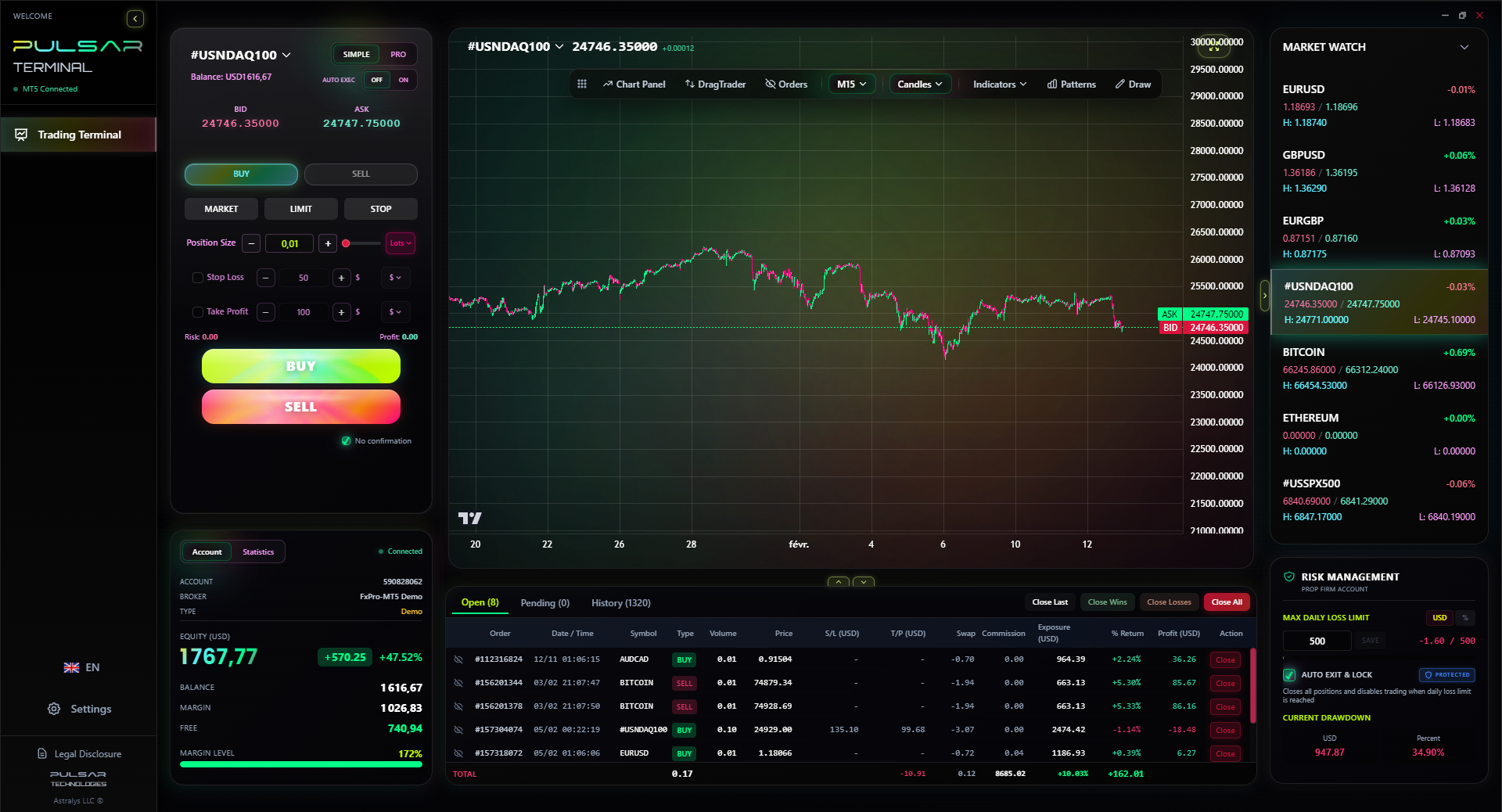
Managing multiple sell limit orders for scaling in or grid strategies is complex, but Pulsar Terminal lets you drag-and-drop entire order grids directly onto your MT5 chart in seconds.
Pulsar Terminal
A ferramenta MT5 tudo-em-um: ordens drag-and-drop, multi-TP/SL, trailing stop, grid trading, Volume Profile e proteção prop firm. Usado diariamente por 1.000+ traders.
“If you find yourself constantly moving your sell limit order a few pips higher, chasing the market up, you've lost your thesis. Cancel the order and re-analyse.”
Can a Sell Limit order be used as a Take Profit?
No, that's a different concept. A Take Profit is an order to close an existing trade at a profit. A Sell Limit is an order to open a new short trade. You could, however, use a Buy Limit order to take profit on a short trade (by closing it at a lower price), but brokers have a dedicated 'Take Profit' field for that.
What happens if the price gaps above my Sell Limit price?
If the market opens or moves sharply and the first available price is above your Sell Limit price, your order will be filled at that first available price (the worse price). This is why using limits around major news events is risky – you might get filled at a much worse level than you wanted.
Is there a fee for placing a Sell Limit order?
No, brokers like XM review or Pepperstone review don't charge for placing the pending order. You only pay the spread (and possibly a commission, depending on your account type) when the order is actually filled and becomes a live trade.
Can I modify or cancel a Sell Limit order?
Absolutely, and you should. Right-click on the pending order line on your chart and select 'Modify or Delete Order.' You can change the entry price, SL, TP, or delete it entirely before it gets triggered.
Should I use Sell Limits for scalping strategy?
It's possible but tricky. Scalping requires speed. The time it takes for price to trigger your limit and then for you to manage the trade might be too slow for very short timeframes. Most scalpers prefer market orders or very tight stop entries for immediate fills.

FAQ
Q1What is the main purpose of a sell limit order in forex?
Its main purpose is to automate a short (sell) entry at a specific price that is higher than the current market price. You use it when you believe the price will rise to a certain level (like resistance) and then reverse, allowing you to sell at a better price without watching the charts.
Q2How is a sell limit different from a regular sell order?
A regular market sell order executes immediately at the current best available price. A sell limit order is a pending order that only executes IF the price rises to your specified level. One is for immediate action, the other is for planned, conditional action at a future price.
Q3Can I place a sell limit order below the current price?
Technically, some platforms might let you, but it defeats the entire point. If you place a sell limit below the current price, it will often be executed immediately as a market order (since the market price is already better than your limit). To sell below the current price, you should use a Sell Stop order.
Q4What's the biggest risk when using sell limit orders?
The biggest risk is the market not behaving as you predicted. If price hits your sell limit and reverses, you profit. But if it hits your sell limit and just keeps climbing aggressively, your short trade will be in a loss immediately. This is why sell limits are dangerous in strong, trending markets.
Q5Do I need more margin for a pending sell limit order?
No. A pending order like a sell limit does not require margin until it is actually triggered and becomes a live trade. Your broker will only reserve or use margin once the order is filled.
Q6Is a sell limit a good strategy for beginners?
It can be, but with a major caveat. It teaches planning and patience, which are great habits. However, beginners often misidentify resistance levels or use sell limits in trends, leading to losses. Start by paper trading with them to understand how they behave before risking real capital.
Lição do Prof. Winston
Pontos-chave:
- ✓A Sell Limit opens a short trade ABOVE current price; a Sell Stop opens one BELOW.
- ✓Use Sell Limits at confirmed resistance, not in the middle of strong uptrends.
- ✓Always set Stop Loss and Take Profit when placing the pending order.
- ✓The spread can affect your fill price; know your broker's costs.
- ✓Regularly review and cancel outdated pending orders.
Quão útil foi este artigo?
Clique em uma estrela
Insights de Trading Semanal
Análises e estratégias semanais grátis. Sem spam.
Sobre o autor
David van der Merwe
Trader de Mercados Emergentes
Trader sediado em Joanesburgo com 11 anos em moedas de mercados emergentes. Especialista em pares ZAR, trading regulado pela FSCA e análise do mercado sul-africano.
Comentários
Aviso de risco
A negociação de instrumentos financeiros envolve riscos significativos e pode não ser adequada para todos os investidores. O desempenho passado não garante resultados futuros. Este conteúdo é apenas para fins educacionais e não deve ser considerado aconselhamento de investimento. Sempre conduza sua própria pesquisa antes de negociar.
Você também pode gostar

Cara Trading Forex Sukses: 7 Prinsip dari Trader Profesional
Cara trading forex sukses dengan 7 prinsip trader pro: manajemen modal, disiplin, journal trading, backtest. Data nyata, bukan janji profit palsu.
Jam Trading Forex Terbaik untuk Trader Indonesia: Panduan Lengkap dengan Tabel Waktu
Panduan jam trading forex untuk trader Indonesia. Tabel 4 sesi dunia, jam emas 20:00-00:00, sesi mana yang harus dihindari. Data akurat + tips dari trader berpengalaman.
Top 5 Sàn Forex Uy Tín Nhất 2026: Review Jujur dari Trader Indonesia
Top 5 sàn forex uy tín 2026 untuk trader Indonesia. Review jujur: spread, deposit, withdraw, dukungan lokal. Exness, XM, IC Markets & lebih.
Obter Pulsar Terminal
Todas essas calculadoras estão integradas ao Pulsar Terminal com dados em tempo real da sua conta MT5.
Obter Pulsar Terminal