


I remember staring at my trading journal in late February 2022, tallying up a decent year of profits.

David van der Merwe
Trader de Mercados Emergentes ·  South Africa
☕ 11 min de leitura
O que você vai aprender:
- 1How SARS Sees Your Trading: Income vs. Capital
- 2What You Can (And Cannot) Claim Back
- 3The Practical Steps: Registration and Filing
- 4The Broker Choice: Local vs. International & Tax Implications
- 5Legit Ways to Reduce Your Tax Bill
- 6Common Pitfalls (And How I Stepped in Them)
- 7Putting It All Together: A Trader's Tax Checklist
I remember staring at my trading journal in late February 2022, tallying up a decent year of profits. The Rand had been volatile, and my EUR/USD swing trades had paid off. Then it hit me. I hadn't set aside a single cent for tax. The cold sweat was real. That panic, and the expensive lesson that followed, is why you need to understand the tax on forex trading in South Africa from day one. It's not just about making money, it's about keeping it.
This is the most important distinction, and getting it wrong can cost you. SARS doesn't have a specific "forex trader" category. They fit your activity into existing boxes: are you running a business of trading, or are you an investor?
Trading as a Business (Income Tax) If you trade frequently, systematically, and with the intention of making a regular profit, SARS will likely view this as a business. Your profits are considered ordinary revenue. This means every Rand you make gets added to your other income (like your salary) and taxed at your marginal rate. For a top earner, that's 45%. The upside? All your legitimate expenses are fully deductible.
Trading as an Investment (Capital Gains Tax) If your activity is more sporadic, long-term, or you're not relying on it for income, your profits might be seen as capital in nature. Here, you pay Capital Gains Tax (CGT). Only 40% of your net capital gain is included in your taxable income. So, if you're in the top tax bracket, your effective maximum CGT rate is 18% (40% of 45%). You also get an annual exclusion: the first R50,000 of your net capital gains is tax-free.

Warning: You don't get to choose. SARS looks at the facts: frequency, volume, organization, and intention. Trading daily with a structured scalping strategy? That's almost certainly income. Placing a few trades a month based on fundamental views? You might have a case for CGT. When in doubt, get professional advice.
My mistake in 2022 was assuming all my trades were capital. I was trading several times a week. My accountant took one look at my trade history and said, "They're going to call this income." He was right. I had to re-file.

💡 Dica do Winston
Your first profitable trade isn't a win until you've accounted for the tax on it. Calculate your post-tax profit before you consider the trade a success.
If you're classified as a trader (income tax), your deductions are your best friend. They directly reduce your taxable profit. Keep every receipt.
Solid, Claimable Expenses:
- Platform & Data Fees: Monthly charges for your trading platform, like MT5. Premium data feeds or news subscriptions used for trading.
- Home Office Costs: A portion of your rent, electricity, and internet. You need a dedicated, regular workspace. Calculate the square meter percentage of your home used exclusively for trading.
- Education: Courses, books, or mentorship directly related to improving your trading. That R5,000 course on price action? Potentially deductible.
- Professional Fees: Your accountant's bill for doing your tax return. Legal fees related to your trading business.
- Bank Charges: Fees for international transfers to fund your broker account.
- Trading Losses: This is critical. Losses from one trade can offset profits from another in the same tax year. If you make a net loss for the year, it can be carried forward to offset future trading profits.
The Grey Areas & No-Nos:
- General Stock Market News Subscriptions: If it's not specifically for forex, it's tough to claim.
- A New Laptop: Only if used exclusively for trading. If you also watch Netflix on it, you can only claim a portion based on usage logs (which you need to keep).
- Losses from a Different Activity: You can't use your forex trading losses to offset your salary income.

Pro Tip: Open a separate bank account just for trading. Pay all your trading-related expenses from it and deposit all profits into it. Come tax time, your accountant will love you, and you'll have a clear audit trail for SARS. I started doing this in 2023, and it cut my admin time in half.
“That R80,000 profit suddenly cost me an extra R12,000 in penalties. It was a brutal, but effective, teacher.”
You can't just hope SARS doesn't notice. Here's the process.
1. Register as a Provisional Taxpayer If you earn any income outside of a normal salary (PAYE), you must register as a provisional taxpayer. This is done via eFiling. It's not optional. It means you'll need to estimate your annual tax liability and pay it in advance, twice a year.
2. The Provisional Tax Payments
- First Payment (August): Due by the end of August. You estimate your total tax for the year and pay 50% of it.
- Second Payment (February): Due by end of February. You top up based on a revised estimate.
- Third Payment (Optional, September): If you still underpaid after your second estimate, you settle the final amount by end of September.
3. Filing Your Annual Return (ITR12) This is where you declare everything. You'll convert all your forex profits and losses from USD (or EUR, etc.) into ZAR. You must use the official SARS average exchange rates for the tax year, not the spot rate you traded at. These tables are published on the SARS website.
4. Record Keeping Keep all records for five years. This includes: all bank statements, broker statements (profit/loss reports are gold), receipts for expenses, and your trading journal. A detailed journal showing your reasoning for trades strengthens your case if your activity level is borderline between income and capital.
I learned about provisional tax the hard way. I made a profit in 2021, didn't register, and only filed in 2022. SARS hit me with underestimation penalties and interest on the late payments. That R80,000 profit suddenly cost me an extra R12,000 in penalties. It was a brutal, but effective, teacher.
Your choice of broker has direct tax and practical implications.
FSCA-Regulated Local Brokers (e.g., Khwezi Trade, IG South Africa)
- Pros: ZAR-denominated accounts. No currency conversion headaches for deposits/withdrawals. Client funds are protected under South African law. use is capped at 30:1 for retail clients (a safety net, honestly).
- Cons: Often higher spreads and fewer instrument options than global giants. That 30:1 use feels restrictive if you're used to more.
International Brokers (e.g., IC Markets, Pepperstone, XM)
- Pros: Typically much tighter spreads, lower costs, access to higher use (through their offshore entities), and more advanced platforms.
- Cons: You trade in USD. Every deposit and withdrawal is a foreign exchange transaction. Your bank will charge you a fee and give you a poor rate. Your broker's profit/loss statements will be in USD, so you must convert everything to ZAR for SARS.
The Tax Reality: SARS taxes South African residents on worldwide income. It doesn't matter if your broker is in Cyprus, Australia, or the Seychelles. You must declare all profits. There's a myth that international brokers are "off the radar." They're not. SARS has international agreements for the exchange of financial information (CRS). While they might not automatically get every single statement, if you're audited and you've been withdrawing profits to your South African bank account, you have some explaining to do.
My setup? I use an international broker for the low costs but treat the currency conversion as a business expense. I use a dedicated forex service for withdrawals to get better rates than my bank, and I keep a careful log of every conversion for my accountant.
💡 Dica do Winston
A trading journal isn't just for strategy. It's your primary evidence for SARS to justify your trading frequency and intent. Write it like a lawyer might read it one day.
“SARS doesn't have a specific 'forex trader' category. They fit your activity into existing boxes: are you running a business of trading, or are you an investor?”
Let's talk about smart, legal tax efficiency. This isn't about evasion; it's about using the system as it's designed.
1. Retirement Annuity (RA) Contributions This is the most powerful tool for active traders paying income tax. Your RA contributions are deductible from your taxable income, up to 27.5% of your annual income (capped at R350,000). If you have a big trading year, pumping money into your RA can drop you into a lower tax bracket.
Example: Let's say your taxable income (including trading profits) is R800,000. You contribute R100,000 to your RA. Your new taxable income becomes R700,000. You've just saved tax at your marginal rate of 39% on that R100,000 – a R39,000 saving.
2. Tax-Free Savings Account (TFSA) You cannot trade forex directly in a TFSA. However, if you withdraw profits from trading, parking some of that capital in a TFSA for long-term investments (ETFs, unit trusts) shields all future growth from tax. Max it out (R36,000 per year) if you can.
3. Trading Through a Company For serious, full-time traders, this can be worth exploring. Companies pay tax at a flat rate of 27%. If your personal marginal rate is 45%, that's a significant saving. However, it comes with setup costs, annual audit requirements, and complexity. Don't do this until your trading profits are consistently high and you have professional advice.
What Doesn't Work: Trying to hide profits. Or claiming ridiculous expenses (like claiming your entire car payment because you "think about trades while driving"). SARS auditors have seen it all. Be reasonable, be documented, and be honest.
I started maximizing my RA contributions after my penalty debacle. It's now a non-negotiable part of my annual financial planning. It forces me to save for the future and saves me a bundle in the present.
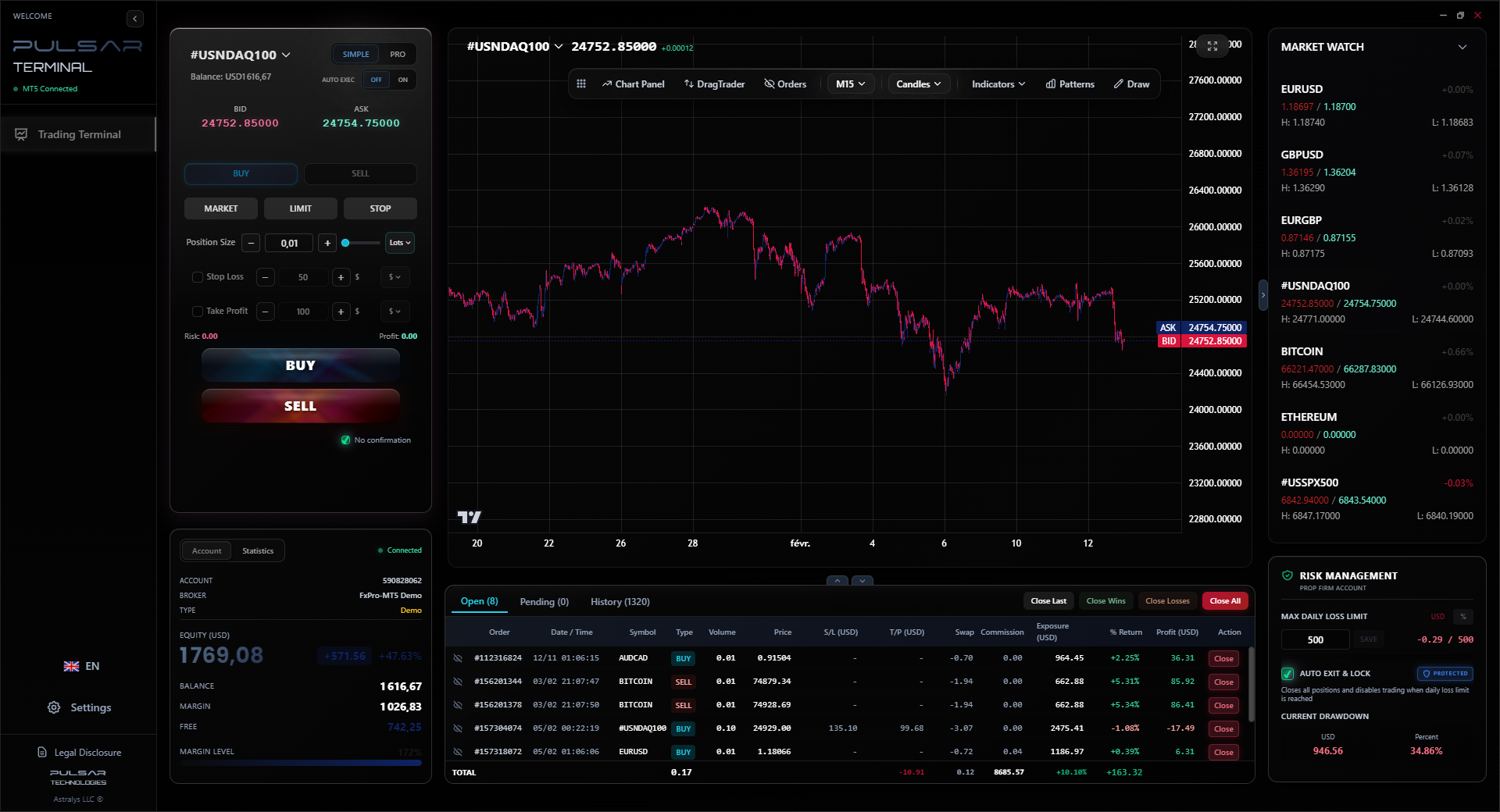
Accurate tax reporting starts with accurate trade tracking, and Pulsar Terminal's detailed trade journal and analytics export directly from MT5 make reconciling your annual P&L straightforward.
Pulsar Terminal
A ferramenta MT5 tudo-em-um: ordens drag-and-drop, multi-TP/SL, trailing stop, grid trading, Volume Profile e proteção prop firm. Usado diariamente por 1.000+ traders.
Learn from my errors so you don't fund SARS's coffee budget with your penalties.
Pitfall 1: Ignoring Provisional Tax As mentioned, this was my big one. You must register and pay. Set calendar reminders for August and February.
Pitfall 2: Poor Record Keeping in ZAR Your broker statement says you made $5,000. You can't just multiply that by today's exchange rate. You must use the SARS annual average rate for the tax year (e.g., 2024 tax year average). If you don't, your numbers won't match if SARS ever checks.
Pitfall 3: Not Understanding the 'Trading as a Business' Test I thought because I had a day job, my trading was automatically an investment. Wrong. The volume and frequency mattered more. If you're executing dozens of trades a month, especially with strategies like scalping, prepare for the income tax treatment.
Pitfall 4: Forgetting About Loss Carry-Forward I had a rough first quarter in 2023. When I finally turned a profit later in the year, I was so relieved I almost forgot I could use those earlier losses to reduce my taxable profit. Your net loss for the year isn't a total waste – it's an asset for next year.
Pitfall 5: Going It Alone For your first year, or any year you have a significant profit, hire a tax practitioner who understands trading. The fee is deductible, and they will save you multiples of their cost in optimized tax and avoided penalties. Trying to save R5,000 on an accountant can cost you R50,000 in mistakes.
💡 Dica do Winston
The cost of a good accountant is a deductible business expense. The cost of a SARS audit and penalties is a 100% loss. The choice is simple.
“Tax on forex trading in South Africa is a part of the business. It's not sexy, but managing it well is what separates the hobbyists from the professionals.”
Here’s your action plan. Stick it on your wall.
Before You Even Start Trading:
- Open a separate business bank account.
- Choose a broker mindfully (weigh ZAR convenience vs. global costs).
- Set up a brutal, detailed trading journal. Not just entries and exits, but your rationale.
Throughout the Tax Year (1 March – 28/29 February):
- Save every single receipt related to trading in a folder (digital is fine).
- Export your monthly broker statements. Don't wait for the year-end.
- Log every deposit/withdrawal and the ZAR amount you actually received/paid after bank fees.
- Use a simple spreadsheet or a position size calculator that also logs trades to track your running P&L.
February (Mid-Tax Year):
- Do a 6-month review of your P&L. Start estimating your total year-end profit.
- Engage your accountant to help with your second provisional tax payment (due end Feb).
After Year-End (March Onwards):
- Get your final annual statement from your broker.
- Convert all USD figures to ZAR using the official SARS average rate for the past tax year.
- Send everything – statements, expense receipts, bank statements, your P&L summary – to your accountant.
- File your return (ITR12) and settle any final tax due by the deadline.
Tax on forex trading in South Africa is a part of the business. It's not sexy, but managing it well is what separates the hobbyists from the professionals. It turns trading from a gamble into a real, sustainable enterprise. Now, go make some taxable profits.
FAQ
Q1Do I have to pay tax on forex trading if I use an international broker?
Yes, absolutely. As a South African tax resident, you are taxed on your worldwide income. It doesn't matter where your broker is based. All profits must be declared to SARS. Using an international broker just adds a currency conversion step to your admin.
Q2What is the difference between paying income tax and capital gains tax on forex profits?
Income tax applies if SARS views your trading as a business (frequent, systematic activity). Your full profit is added to your income and taxed at your marginal rate (up to 45%). Capital Gains Tax (CGT) applies if it's seen as an investment. Only 40% of the net gain is taxed, resulting in a max effective rate of 18%, with a R50,000 annual exclusion. The nature of your trading activity determines the category.
Q3Can I deduct my trading losses from my normal salary?
No, you cannot. Trading losses can only be offset against other trading profits (from the same activity) in the same tax year. If you have a net loss for the year, it can be carried forward to offset future trading profits, but it cannot reduce your salary income from a separate job.
Q4How do I convert my USD profits to ZAR for SARS?
You must use the official SARS average exchange rate for the specific tax year (1 March to 28/29 February). Do not use the spot rate on the day you made the profit. SARS publishes these average rates for all major currencies on their website. Using the wrong rate will cause discrepancies in your return.
Q5When are provisional tax payments due?
There are two main payments: the first half-year payment is due by the end of August, and the second payment is due by the end of February. A third, top-up payment is due by the end of September if you still underestimated. Missing these deadlines results in penalties and interest.
Q6Is trading through a company a good way to save tax?
It can be, but only at a certain scale. Companies pay a flat 27% tax rate. If your personal marginal tax rate is 45%, this is a significant saving. However, it involves setup costs, annual financial statements, and higher accounting fees. It's generally only worthwhile for full-time traders with consistently high, stable profits. Get professional advice first.
Q7What records do I need to keep for SARS?
Keep everything for five years: all broker statements (monthly and annual), bank statements for your trading account, receipts for all claimed expenses (internet, courses, platform fees), a record of currency conversions, and your detailed trading journal. Good record-keeping is your best defense in an audit.
Lição do Prof. Winston
Pontos-chave:
- ✓Register as a provisional taxpayer immediately. Penalties hurt.
- ✓Classify correctly: frequent trading = income tax (up to 45%); sporadic = CGT (max 18%).
- ✓Keep every receipt. Deductions are a trader's legal right.
- ✓Use SARS's official average exchange rates, not spot rates.
- ✓Losses can be carried forward. Don't let a bad year go to waste.
Quão útil foi este artigo?
Clique em uma estrela
Insights de Trading Semanal
Análises e estratégias semanais grátis. Sem spam.
Sobre o autor
David van der Merwe
Trader de Mercados Emergentes
Trader sediado em Joanesburgo com 11 anos em moedas de mercados emergentes. Especialista em pares ZAR, trading regulado pela FSCA e análise do mercado sul-africano.
Comentários
Aviso de risco
A negociação de instrumentos financeiros envolve riscos significativos e pode não ser adequada para todos os investidores. O desempenho passado não garante resultados futuros. Este conteúdo é apenas para fins educacionais e não deve ser considerado aconselhamento de investimento. Sempre conduza sua própria pesquisa antes de negociar.
Você também pode gostar

Cara Trading Forex Sukses: 7 Prinsip dari Trader Profesional
Cara trading forex sukses dengan 7 prinsip trader pro: manajemen modal, disiplin, journal trading, backtest. Data nyata, bukan janji profit palsu.
Jam Trading Forex Terbaik untuk Trader Indonesia: Panduan Lengkap dengan Tabel Waktu
Panduan jam trading forex untuk trader Indonesia. Tabel 4 sesi dunia, jam emas 20:00-00:00, sesi mana yang harus dihindari. Data akurat + tips dari trader berpengalaman.
Top 5 Sàn Forex Uy Tín Nhất 2026: Review Jujur dari Trader Indonesia
Top 5 sàn forex uy tín 2026 untuk trader Indonesia. Review jujur: spread, deposit, withdraw, dukungan lokal. Exness, XM, IC Markets & lebih.
Obter Pulsar Terminal
Todas essas calculadoras estão integradas ao Pulsar Terminal com dados em tempo real da sua conta MT5.
Obter Pulsar Terminal