


I was staring at my screen in late 2024, watching EUR/USD chop around.

Olumide Adeyemi
Pioneiro do Trading na África Ocidental ·  Nigeria
☕ 12 min de leitura
O que você vai aprender:
- 1What Actually Makes a 'Top' Broker for Nigerians?
- 2The Naira Problem: Funding, Fees, and the Real Cost
- 3Broker Showdown: Real Numbers for Nigeria (2026)
- 4Regulation, ISA 2025, and Your Safety
- 5Matching Your Trading Style to the Broker
- 6Red Flags and How to Avoid the Scams
- 7My Personal Experience (And Costly Mistakes)
- 8Your Final Step: How to Test a Broker
I was staring at my screen in late 2024, watching EUR/USD chop around. My broker's spread on the pair was a steady 1.2 pips. A friend on WhatsApp sent a screenshot: he was getting 0.3 on the same pair with a different firm. That was the moment I realized chasing the 'best' broker isn't about fancy ads; it's a ruthless numbers game that changes every year. For us in Nigeria, it's even more complex, with new laws like ISA 2025 and a Naira that's been on a wild ride from ₦460 to ₦1,738 and back. Let's cut through the noise. Here’s my no-BS take on finding the top forex brokers in the world that actually work for you, right here in Naija.
Forget the global 'top 10' lists written by someone in London. A top broker for a Nigerian trader is defined by three non-negotiable pillars, in this order: local accessibility, real cost, and safety net regulation.
First, accessibility. Can you fund your account without losing 15% to crazy bank charges or waiting three business days? Does the broker accept direct Naira deposits, or do you need a domiciliary account? In 2024, I tried funding a well-known European broker. My bank blocked the transaction, flagged it as 'speculative,' and I spent two days on calls. A broker with local payment partners or Naira accounts isn't a luxury; it's a necessity.
Second, cost. This isn't just the advertised spread. It's the spread + commission + any weird fees on deposits or withdrawals. I once took a 'commission-free' trade on GBP/JPY. The spread was 4 pips. My usual broker charges a $5 commission but a 1.8 pip spread. On a standard lot, the 'free' trade cost me $40. The 'commission' trade cost $23. You need to do the math. Use a position size calculator to see the real impact.
Third, the safety net. With the new ISA 2025 law, the SEC is flexing its muscles. But let's be real: the strongest direct protection for your deposit still comes from a reputable international regulator like the UK's FCA, Cyprus's CySEC, or Australia's ASIC. These bodies have client money protection rules. Your broker should have at least one major license, even if they serve you through a global entity.

Warning: A broker offering 1:2000 use and a $5 minimum deposit might be 'accessible,' but it's also a one-way ticket to a margin call if you don't have iron-clad risk management. Accessibility without responsibility is a trap.

💡 Dica do Winston
A broker is a utility, not a partner. Your loyalty should be to your own profitability, not their brand. Be ready to move if conditions deteriorate.
This is where theory meets the hard pavement of Lagos. Your trading edge can be completely wiped out by funding costs and exchange rate slippage.
The Funding Maze
You have options, but they're not all equal. Bank transfers (SWIFT) are slow and expensive, with fees up to $50. Naira debit cards are often blocked for international forex brokers. The smart workarounds? Domiciliary account transfers (if you have one) or e-wallets like PayPal, Skrill, or Neteller. Some brokers, like HF Markets and Exness, now offer direct Naira deposits through local payment processors. This is a game-changer, cutting deposit times to minutes and fees to near zero.
I funded an Exness account with ₦50,000 in March 2025. It converted to dollars at a rate about 2% above the official window - not great, but it was in my trading account in under 10 minutes. The convenience was worth the small premium.
The Hidden Tax: Spreads on Currency Conversion
Here's a dirty secret many miss. When you deposit Naira, the broker (or their payment processor) converts it to USD. They don't use the CBN rate you see on Google. They use their own commercial rate, which includes a markup. This hidden spread can be 1-3%. On a ₦500,000 deposit, that's ₦5,000 to ₦15,000 gone before you place a single trade.

Pro Tip: Always ask customer support for their current Naira/USD deposit conversion rate before you fund. Compare it to the official rate on the CBN website. That percentage difference is your first 'trade' - and it's a loss. Factor it into your start-up capital.
The 10% capital gains tax on profits is another reality. Keep careful records. That winning scalping strategy that generates 100 small trades a month will be an accounting nightmare if you're not organized from day one.
“A low spread is useless if the broker is a scam and you can't withdraw your money.”
Enough talk. Let's look at cold, hard data. The table below compares key metrics from brokers that are consistently viable for Nigerian traders. Remember, 'Standard' account spreads are usually commission-free, while 'Raw/ECN' accounts have tiny spreads but charge a commission per lot.
| Broker | Min. Deposit (NGN/USD) | EUR/USD Spread (Standard) | Max use | Key Regulation for NG Clients | Naira Deposit? |
|---|---|---|---|---|---|
| Exness | $5 (≈₦7,200) | From 0.1 pips (Raw) | 1:2000 | FSA (Seychelles) | Yes |
| HF Markets | ₦4,000+ | From 1.4 pips (Cent) | 1:2000 | FSA (Seychelles) | Yes (NGN accounts) |
| XM | $5 | From 0.8 pips | 1:1000 | CySEC (Cyprus) | Via e-wallets |
| IC Markets | $200 | From 0.0 pips (Raw) | 1:500 | ASIC (Australia) | Via e-wallets |
| OctaFX | $25 | From 0.7 pips | 1:500 | FSA (St. Vincent) | Via e-wallets |
| Vantage | $100 | From 0.0 pips (ECN) | 1:500 | FSCA (South Africa) | Via e-wallets |
What this means for you:
- Starting Small? Exness and XM at $5 are unbeatable for testing the waters. HF Markets' Naira account is great if you want to avoid currency conversion entirely.
- Need Raw Spreads? For high-volume trading, IC Markets and Vantage's raw ECN environments are top-tier. I've used IC Markets for my EUR/USD guide trades; the 0.0 pip spread on majors is real during London hours.
- Chasing use? 1:2000 is a double-edged sword. It lets you control a $100,000 position with just $50. It also means a 5-pip move against you wipes out that $50. I used high use foolishly early on. Don't be me.
Fusion Markets is often cited for the lowest raw spreads. In my testing, they were competitive, but their lack of direct Naira support adds a layer of friction for Nigerians.

Example: A 1-lot (100,000 units) trade on EUR/USD. At a 1-pip spread, your cost is $10. At a 0.2-pip spread + $3.50 commission, your cost is $5.50. On 20 trades a month, that's a $90 difference. That's real money.
The regulatory scene is shifting. The Investments and Securities Act (ISA) 2025 is the big new law. It says any platform offering forex trading in Nigeria must register with the SEC. Sounds strict, right?
Here's the practical truth as of early 2026: The SEC still doesn't directly regulate the day-to-day operations of international spot forex brokers. Their focus seems to be on platforms operating within Nigeria. So, you, as a Nigerian citizen, can still legally open an account with a broker regulated in Seychelles (FSA), Cyprus (CySEC), or Australia (ASIC).
This is why the 'Regulation' column in the table above is crucial. You are relying on that foreign regulator to ensure the broker segregates client funds, undergoes audits, and has a dispute resolution process.
My hierarchy of trust for a Nigerian trader:
- Global Top-Tier Regulators (FCA, ASIC, CySEC): The gold standard. Brokers like IC Markets (ASIC) operate under strict rules. Client money protection is strong.
- Respected International Regulators (FSA Seychelles, FSCA): This is where many 'global' entities serving emerging markets like Nigeria are based. Exness and HF Markets use FSA. It's a legitimate framework, but historically less stringent than FCA/ASIC.
- Offshore/No Regulation: Avoid. If you can't find a clear regulatory license on their website's footer, run.
The SEC's new capital requirements (₦600 million for brokers) are for local Nigerian firms. This could encourage more international brokers to formally register their Nigerian operations, which would be a long-term positive. For now, your primary shield is that international license.
Always check the specific entity you're signing up with. A broker might have an FCA license but open your account under their Seychelles company for higher use. Know which one you're getting.
💡 Dica do Winston
The true cost of a trade is (Spread in Pips x Pip Value) + Commission. Calculate this for your typical trade size at 2-3 brokers. The difference will shock you.
“I lost my planned 50 pips, but I lost them fairly. That's all you can ask for.”
Not all brokers are built for all traders. Picking one of the top forex brokers in the world means picking the right tool for your job.
For Scalpers and High-Frequency Traders: You live and die by spread and execution speed. You need a true ECN/raw spread account. Every pip saved is profit. Brokers like IC Markets, Vantage, and Pepperstone (check our Pepperstone review) are built for this. Their systems handle massive order flow with minimal slippage. I learned this the hard way scalping news events on a standard account; the spread widened to 10 pips, eating my entire profit. Use a scalping strategy only on a broker that supports it.
For Swing Traders and Position Traders: You hold trades for days or weeks. A slightly wider spread matters less than swap rates (overnight financing fees) and platform stability. You might prefer a user-friendly platform like MetaTrader 4/5 with good charting tools. Brokers like XM or HF Markets are solid here. Their swap rates are competitive, and they offer a wide range of instruments for diversification beyond just forex.
For Beginners: Your focus should be on education, low minimum deposits, and excellent customer support. You need a broker that won't vanish with your first ₦50,000. Exness and XM are strong contenders here due to their low entry point and extensive learning materials.
For Gold and Commodity Traders: If you trade XAU/USD (Gold), check the broker's spreads and margin requirements on commodities. They can vary wildly. Some brokers have excellent forex spreads but terrible commodity ones.
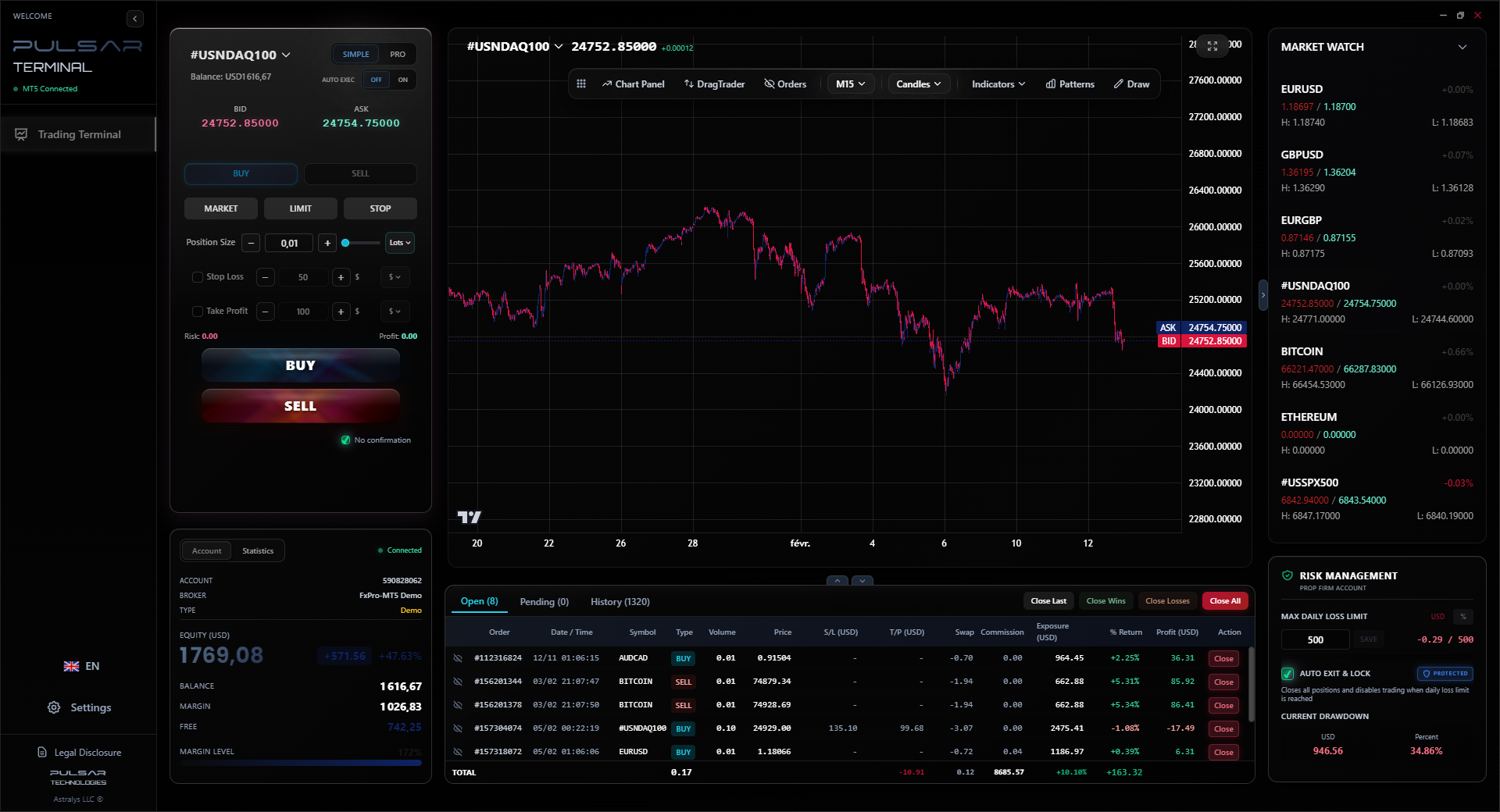
If you're a serious scalper or swing trader, managing multiple trades and complex exits is key; Pulsar Terminal's drag-and-drop orders and multi-TP/SL tools on MT5 turn execution from a chore into a precision advantage.
Pulsar Terminal
A ferramenta MT5 tudo-em-um: ordens drag-and-drop, multi-TP/SL, trailing stop, grid trading, Volume Profile e proteção prop firm. Usado diariamente por 1.000+ traders.
Nigeria has its share of 'get-rich-quick' forex schemes. Here’s how to spot the wolves in sheep's clothing.
The Guaranteed Profit Promise: Any broker or 'account manager' who guarantees weekly profits is lying. Forex is risk. Period. I fell for this in 2015. 'Just give me $1,000, I'll make you 20% a month.' Two months later, the account was at $300 and the guy was unreachable.
Unrealistic Bonuses: 'Deposit $100, get a $500 trading bonus!' Sounds great. The fine print usually says you need to trade a volume of 100 lots before you can withdraw your own money. It's a lock-in mechanism, not a gift.
Difficulty Withdrawing: This is the ultimate test. If a broker makes you jump through endless hoops to withdraw a small profit - more documents, 'processing delays,' fees - it's a major red flag. Before depositing large amounts, try a small withdrawal of $50. See how smooth it is.
No Clear Regulation: As mentioned, if you can't find a verifiable regulatory license number on their website, avoid them. A '.ng' domain alone means nothing.
Pressure to Deposit More: After a loss, a 'account manager' calls you saying you need to deposit more to 'recover' the loss. This is a classic scam tactic. A legitimate broker doesn't care about your individual P&L.
Stick with the established names in the industry, even if their sign-up bonus isn't as flashy. Your capital preservation is the only bonus that matters.
“Trade in USD, think in USD, report your taxes in Naira.”
Let me get vulnerable. I've lost money to bad brokers. In 2017, I was with a 'broker' offering 1:1000 use and crypto CFDs. The platform was slick. I built a position in Bitcoin CFDs using a MACD indicator divergence setup. The price moved in my favor by $800. I went to close the trade. The platform froze. 'Connection lost.' It came back 90 seconds later. My $800 profit was now a $200 loss. I was slipped on the fill. I later found out they were an unregulated bucket shop. That $1,000 lesson was cheap.
A Good Experience: In 2023, I was testing a swing trading system on GBP/JPY. I used IC Markets. I entered at 183.50, targeting 185.00. The trade went against me initially, hitting my stop loss at 183.00. The execution was instant, at my exact price. No requotes, no funny business. I lost my planned 50 pips, but I lost them fairly. That's all you can ask for.
The Naira Rollercoaster: In November 2024, when the Naira hit ₦1,738/$1, my dollar-denominated trading capital in relative terms skyrocketed in Naira value. A $10,000 account was suddenly worth over ₦17 million. The psychological effect was strange. I felt richer, even though my USD P&L was unchanged. It messed with my risk perception. I started over-trading. Don't let currency volatility distort your trading discipline. Trade in USD, think in USD, report your taxes in Naira.
💡 Dica do Winston
Test withdrawal before a large deposit. If they can't return $50 efficiently, they'll never return $50,000.
Don't just take my word for it. Before you commit your life savings, do this:
- Open a Demo Account: Every broker offers one. Test it for at least two weeks. Trade during volatile periods (London open, US news). Watch for platform freezes, spread widening, and execution quality.
- Deposit the Minimum: Open a live account with the absolute minimum deposit. For Exness, that's $5. Make 5-10 small trades. Experience the real spreads and execution.
- Make a Withdrawal: This is the most important step. After you've made a small profit (even $10), initiate a withdrawal back to your payment method. Time how long it takes. If it's smooth, you've passed the first integrity test.
- Contact Support: Ask them a technical question, like 'What is your policy on slippage during news events?' Gauge their response time and knowledge.
- Scale Up Gradually: Only after passing steps 1-4 should you consider depositing more substantial capital.
Your journey to finding one of the top forex brokers in the world is personal. It depends on your size, style, and needs. Use this guide as a filter, but do your own final due diligence. The right broker won't make you a profitable trader, but the wrong one will certainly break you.
FAQ
Q1Is forex trading legal in Nigeria?
Yes, forex trading for individuals is legal in Nigeria. The main laws are overseen by the CBN and SEC. The new ISA 2025 law requires trading platforms operating in Nigeria to register with the SEC, but individuals can still use internationally regulated brokers.
Q2Which broker is best for beginners in Nigeria?
For absolute beginners, Exness or XM are strong starts due to their $5 minimum deposit, extensive educational materials, and generally good customer support. It allows you to learn with very little capital at risk.
Q3How do I avoid high fees when funding my account?
Use brokers that offer direct Naira deposits (like HF Markets) or use e-wallets (Skrill, Neteller, PayPal). Avoid international bank wire transfers (SWIFT) due to high fees. Always ask the broker for their Naira/USD conversion rate before depositing to see the hidden spread.
Q4What is the safest broker for Nigerian traders?
Safety is linked to regulation. Brokers holding top-tier licenses from the UK's FCA or Australia's ASIC (like IC Markets) offer the strongest client fund protection. However, many accessible brokers for Nigerians use the FSA (Seychelles) license, which is a legitimate international framework.
Q5Can I use use of 1:2000?
Technically, yes, brokers like Exness and HF Markets offer it. But you absolutely should not, especially as a beginner. use that high magnifies losses as fast as gains. It's a professional tool that requires extreme discipline. Start much lower.
Q6Do I pay tax on forex profits in Nigeria?
Yes. You are subject to a 10% Capital Gains Tax on your gross trading profits. You must declare this income and pay the tax to the Federal Inland Revenue Service (FIRS). Keep detailed records of all your trades.
Q7What's more important, low spread or good regulation?
Good regulation, always. A low spread is useless if the broker is a scam and you can't withdraw your money. Find a broker with a verifiable, reputable license first. Then, from that pool of safe brokers, choose the one with the best trading conditions for your style.
Lição do Prof. Winston
Pontos-chave:
- ✓Prioritize brokers with direct Naira deposits or e-wallets.
- ✓Always verify the specific regulatory license you're under.
- ✓Test a broker with a minimum deposit and a withdrawal first.
- ✓Match your broker's strengths (ECN vs. Standard) to your trading style.
- ✓Factor in the 10% capital gains tax on all profits.
Quão útil foi este artigo?
Clique em uma estrela
Insights de Trading Semanal
Análises e estratégias semanais grátis. Sem spam.
Sobre o autor
Olumide Adeyemi
Pioneiro do Trading na África Ocidental
Um dos educadores de trading forex mais ativos da Nigéria. 8 anos de experiência operando a partir de Lagos. Especialista em estratégias de baixo capital e desafios de prop firms para traders africanos.
Comentários
Aviso de risco
A negociação de instrumentos financeiros envolve riscos significativos e pode não ser adequada para todos os investidores. O desempenho passado não garante resultados futuros. Este conteúdo é apenas para fins educacionais e não deve ser considerado aconselhamento de investimento. Sempre conduza sua própria pesquisa antes de negociar.
Você também pode gostar

Cara Trading Forex Sukses: 7 Prinsip dari Trader Profesional
Cara trading forex sukses dengan 7 prinsip trader pro: manajemen modal, disiplin, journal trading, backtest. Data nyata, bukan janji profit palsu.
Jam Trading Forex Terbaik untuk Trader Indonesia: Panduan Lengkap dengan Tabel Waktu
Panduan jam trading forex untuk trader Indonesia. Tabel 4 sesi dunia, jam emas 20:00-00:00, sesi mana yang harus dihindari. Data akurat + tips dari trader berpengalaman.
Top 5 Sàn Forex Uy Tín Nhất 2026: Review Jujur dari Trader Indonesia
Top 5 sàn forex uy tín 2026 untuk trader Indonesia. Review jujur: spread, deposit, withdraw, dukungan lokal. Exness, XM, IC Markets & lebih.
Obter Pulsar Terminal
Todas essas calculadoras estão integradas ao Pulsar Terminal com dados em tempo real da sua conta MT5.
Obter Pulsar Terminal