


Thinking about funding your futures trading through a Tradovate prop firm? You're not alone.

James Mitchell
Analista de Trading Sênior
☕ 12 min de leitura
O que você vai aprender:
- 1What Exactly is a "Tradovate Prop Firm"?
- 2The Real Cost Structure: More Than Just an Evaluation Fee
- 3The Rules of the Game: Drawdowns, Targets, and Fine Print
- 4Why Prop Firms Love Tradovate (And You Should Too)
- 5A Realistic Strategy to Pass the Challenge
- 6The Big Risks: Regulation, Payouts, and Firm Survival
- 7What Are Your Alternatives?
Thinking about funding your futures trading through a Tradovate prop firm? You're not alone. The promise of trading a firm's capital for a split of the profits is incredibly seductive, especially when it's paired with a slick platform like Tradovate. But before you hand over your evaluation fee, you need to understand the game you're really playing. I've traded with these setups, funded accounts, and watched more traders blow up than succeed. Let's cut through the marketing and look at what a Tradovate prop firm actually is, how the numbers work, and whether it's a viable path or just an expensive lesson.
First, let's clear up a common confusion. Tradovate itself is not a prop firm. It's a regulated U.S. futures broker and trading platform, registered with the CFTC and NFA. A "Tradovate prop firm" is a separate company that uses Tradovate's technology and brokerage services to administer its proprietary trading programs.
Think of it like this: Tradovate provides the arena and the rules of the game (the platform, data, order routing). The prop firm is the promoter who sets up the challenge, takes your entry fee, and decides if you get a "funded" seat. Firms like Apex Trader Funding, Take Profit Trader, and TradeDay are examples. They handle the evaluation rules, payout structures, and "risk management" - which often just means enforcing a brutal trailing drawdown.
The critical, and often glossed-over, detail is the regulatory gray area. While Tradovate is tightly regulated, the prop firms themselves largely are not. They aren't required to segregate your evaluation fees in protected accounts or maintain specific capital reserves. Your "funded account" is typically a simulated/demo account within Tradovate. If you pass their rules, the firm may (or may not) mirror your trades in their own live capital account and pay you a share. This structure is the entire foundation of the modern prop firm model, and it's full of pitfalls a new trader wouldn't see coming.

Warning: Your "funded" account is almost always a simulated trading environment. The prop firm's obligation to pay you is a contractual one, not a regulatory one. If they go bankrupt or decide not to pay, your recourse is extremely limited.

💡 Dica do Winston
A prop firm's trailing drawdown isn't a risk management tool for you; it's a risk elimination tool for them. Your strategy must be designed to avoid it entirely, not to test its limits.
Everyone looks at the upfront evaluation fee. That's just the tip of the iceberg. To understand if this is worth it, you need to add up all the costs, including the hidden ones.
Prop Firm Evaluation Fees
These vary, but let's use a common $50,000 account target as our example. As of early 2026:
- Apex Trader Funding: ~$167/month subscription.
- Take Profit Trader: ~$102/month for their standard plan.
- Tradeify: As low as $103 one-time (promotional).
Seems cheap for a shot at $50k, right? But that's not your total cost. You also have to factor in the cost of trading on the Tradovate platform itself.
Tradovate Platform Fees
Tradovate has three plans. If you're serious about trading futures, especially micros, you'll likely need at least the Monthly plan to keep commissions manageable.
| Plan | Monthly Cost | Micro E-mini Commission (per side) | Key Consideration |
|---|---|---|---|
| Free | $0 | $0.39 | High commissions eat small profits fast. Inactivity fee of $35. |
| Monthly | $99 | $0.29 | Best for active traders. Lowers cost basis significantly. |
| Lifetime | $1,499 (one-time) | $0.09 | Only makes sense if you'll trade for years. |
Let's run a real numbers example from my own trading. I once traded a 10-lot MES (Micro E-mini S&P 500) scalping strategy during a Tradovate prop firm challenge. On the Free plan, my round-turn commission was $0.78. My average profit target was only 4 ticks ($5). After commissions, my net was $4.22. That's a 15.6% haircut on every winning trade before I even covered losses. I switched to the Monthly plan, dropping the commission to $0.58 round-turn. My net became $4.42. That 20-cent difference saved me hundreds over the evaluation period and was the difference between passing and failing.

Example: If you take 200 round-turn trades in a month on Micros with the Free plan, your commission cost is $78. With the Monthly plan ($99 fee + $58 commissions), your total cost is $157. You need $79 more in net profits just to break even on the platform fee difference. It only pays off if you're trading volume.
Don't forget exchange and NFA fees, which are a few cents per contract but add up. The real cost of a Tradovate prop firm challenge is: Evaluation Fee + Tradovate Platform Fee + Commissions & Exchange Fees + Your Time and Emotional Capital.
“Your 'funded' account is almost always a simulated trading environment. The prop firm's obligation to pay you is a contractual one, not a regulatory one.”
This is where most traders fail. They look at the account size ($50k, $100k) and think of it as their money. It's not. It's a score in a video game with very specific, and often unforgiving, rules.
The two biggest killers are trailing drawdowns and profit targets.
Trailing Drawdowns: This isn't a static loss limit. If the challenge starts with a $2,500 drawdown, and you make $1,000, your new loss limit is now $1,500 below your peak equity. Your safety net rises with you. Many firms use End-of-Day (EOD) drawdown, which is calculated after the daily close. This is slightly more forgiving than intraday drawdown, but it's still a brutal mechanism that forces ultra-conservative trading. One strong winning day followed by a small pullback can violate the rule, even if you're net positive.
Profit Targets: These are usually set as a percentage of the account. For a $50k account, a 6% target is $3,000. This seems achievable until you realize you have to hit it without triggering the trailing drawdown. It encourages overtrading at the worst possible times.
I learned this the hard way with a firm using Tradovate. I passed a $25k challenge, hitting a $1,500 profit target. When I got "funded," the rules changed. The drawdown switched from EOD to intraday, and the profit split was only 50% for the first 60 days. I got stopped out on a volatile open by the intraday drawdown before I even made a cent in the funded phase. All that work, for nothing.

Pro Tip: Read the funded account rules twice as carefully as the evaluation rules. The real game starts after you pass. Look for firms with consistent rules between eval and funded stages. Use a position size calculator religiously to ensure a single trade can never come close to your max loss limit.
💡 Dica do Winston
Add up all potential fees - eval, platform, commissions - and divide by your realistic monthly profit target. If fees eat more than 20% of your target, the challenge is a tax on the desperate.
There's a reason so many prop firms have integrated with Tradovate. From a technical and operational standpoint, it's nearly ideal for this model.
1. Cloud-Based & Stable: The platform runs in your browser. No software to install, no data to download. This makes it easy for prop firms to instantly provision and manage thousands of demo accounts. It also means you can trade from any computer, a huge plus.
2. Commission Clarity: The tiered pricing plans give active traders (which prop firms want) predictable costs. The firms can negotiate their own rates with Tradovate and build them into their fee models.
3. Advanced Tools for Free: The included DOM (Depth of Market), advanced charts, and especially Market Replay are game-changers. Market Replay alone is worth its weight in gold for practicing your scalping strategy without risk. The recent integration with TradingView (for a small extra fee) expands its charting power even further.
4. Automation-Friendly: Tradovate's API and support for platforms like NinjaTrader allow for automated trading. This is critical for prop firm traders who use algorithms. You can't automate effectively on a clunky platform.
From a trader's perspective, if you're going to do a futures prop challenge, Tradovate is one of the best platforms to do it on. The execution is solid, the tools are professional, and the cost structure can be optimized. It's a legitimate professional-grade platform, which is more than I can say for some of the prop firms that use it.
However, mastering the platform is just step one. You still need a strong strategy. Understanding tools like the MACD indicator or RSI indicator on Tradovate's charts is fine, but they won't save you from a bad risk management plan.
“The real cost of a Tradovate prop firm challenge is: Evaluation Fee + Tradovate Platform Fee + Commissions & Exchange Fees + Your Time and Emotional Capital.”
Forget about making a million dollars. Your only goal in the evaluation phase is to survive and hit the target. This requires a completely different mindset than trading your own account.
1. Trade Micros Exclusively (At First). The notional value of the account is irrelevant. What matters is the drawdown in real dollar terms. A 2-lot MES (Micro E-mini) position has a fraction of the risk of a 1-lot ES (Mini E-mini) position. You can control your risk with surgical precision. I passed my first challenge trading almost nothing but MES and MNQ (Micro Nasdaq).
2. Aim for Consistency, Not Home Runs. Your profit target is a marathon, not a sprint. Aim for 1-3 good micro-lot trades per day. A daily goal of $50-$100 net profit on a $50k account is a 0.1%-0.2% gain. That seems tiny, but compounded over 20-30 trading days, you hit your target without ever taking a swing that could trigger the drawdown.
3. Use Hard Stops. Always. You cannot rely on mental stops. Volatility will spike, and you'll be staring at a loss that violates your drawdown before you can blink. Set your stop-loss based on your strategy's logic, and make sure it's a distance that, if hit, represents a loss you can easily recover from. This is non-negotiable.
4. Have a Daily Loss Limit. Even stricter than the firm's drawdown. If you lose $300 in a day (on a $2,500 drawdown), stop trading. Walk away. The psychological pressure to "get it back" is the fastest path to a margin call in this context.
My Personal Blueprint: On a $50k challenge with a $2,500 drawdown, I would risk no more than $50 per trade (2% of my allowed loss). I'd trade 2 MES contracts, with a 5-tick stop ($12.50 risk per contract). My target was 8-10 ticks. This gave me a positive risk/reward (roughly 1:2) and meant I could withstand a string of losses without panic. I tracked every trade in a journal. Boring? Yes. Effective? It got me funded.
💡 Dica do Winston
The only rule that matters is the one that kicks you out. Memorize it. Write it on a sticky note. Every order you place should be checked against that single, brutal line in the sand.
This is the part the affiliate marketers don't talk about. The structural risks of the Tradovate prop firm model are substantial.
Regulatory Gray Area: As mentioned, the prop firm is not your broker. Tradovate has no obligation to ensure the firm pays you. The CFTC and NFA regulate Tradovate's brokerage activities, not the prop firm's payout promises. If a firm delays or denies your payout based on a subjective rule violation, your options are to complain to… well, there's no regulatory body for that. It's a civil contract dispute.
The "Simulated" Reality: You are trading in a demo environment. The firm's promise to mirror trades in live markets is just that - a promise. There is no real-time audit you can access. During periods of extreme volatility, do you think their systems are perfectly mirroring thousands of accounts? I have my doubts.
Firm Solvency Risk: The industry is consolidating. Dozens of firms shut down between 2023-2024. When a prop firm collapses, what happens to your pending payout? It likely becomes an unsecured claim in a bankruptcy proceeding. You're last in line.
Rule Changes: Firms can, and do, change their terms of service. They might introduce new fees, change payout schedules, or alter drawdown rules for existing funded traders. You have little recourse.
Warning: Do not view a funded account as a stable income source. Treat payouts as periodic windfalls. Always have a separate, personal trading account (with a broker like Pepperstone or IC Markets for other instruments) that you control completely. The prop firm account is a bonus, not the foundation of your financial plan.
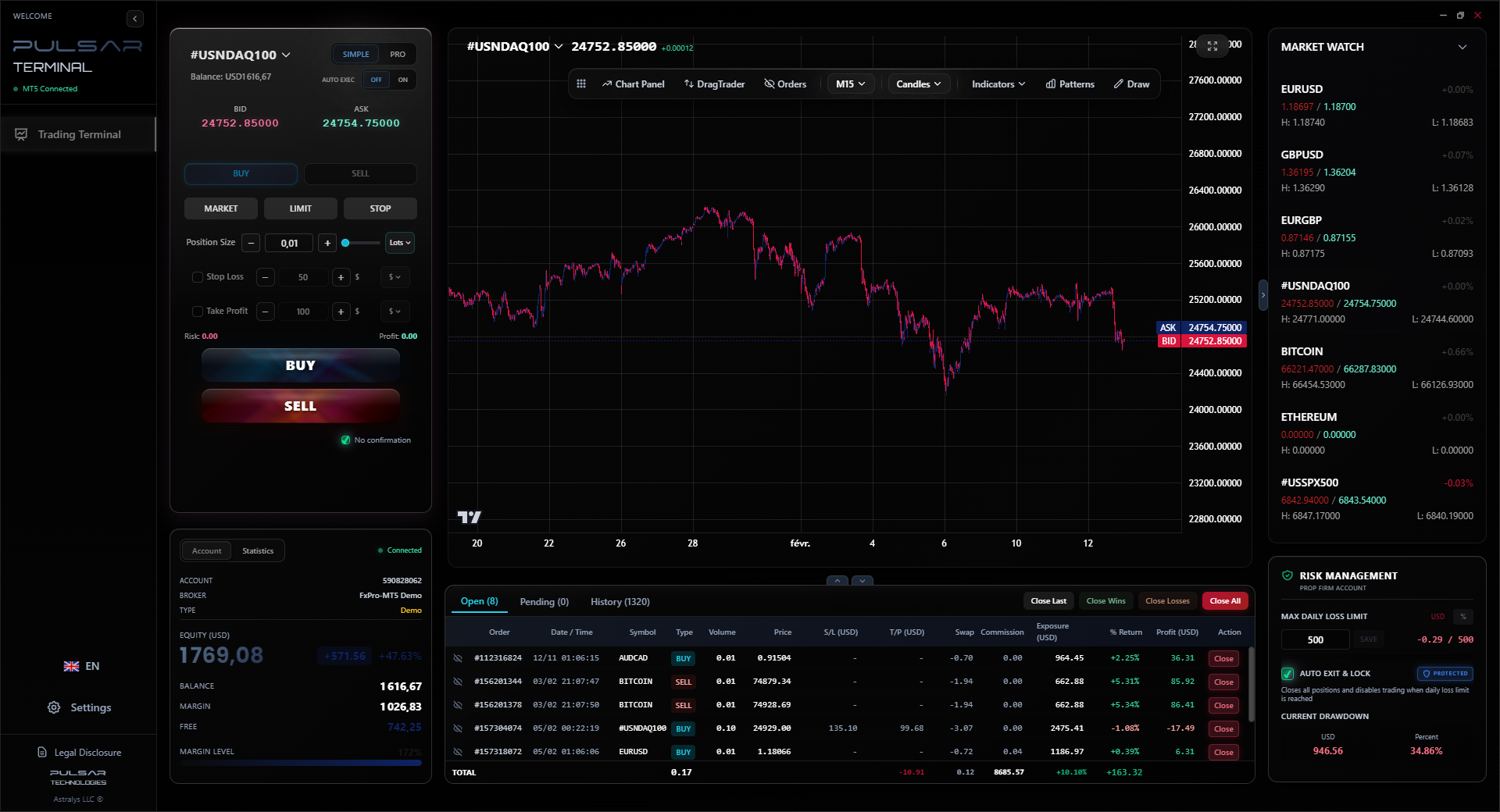
Managing a prop firm challenge requires iron-clad discipline on stops and targets, which is exactly what Pulsar Terminal's automated trade management tools enforce on your MT5 platform.
Pulsar Terminal
A ferramenta MT5 tudo-em-um: ordens drag-and-drop, multi-TP/SL, trailing stop, grid trading, Volume Profile e proteção prop firm. Usado diariamente por 1.000+ traders.
“If you have disciplined risk management and actual risk capital, trading your own money is almost always better long-term.”
If the risks of a Tradovate prop firm give you pause (and they should), consider these paths:
1. Trade Your Own Capital on Tradovate. This is the most straightforward alternative. Open a personal account with Tradovate, deposit what you can afford to lose, and trade micro futures. You keep 100% of the profits, answer to no one's drawdown rules, and your broker is federally regulated. The hurdle? You need actual risk capital. But if you were willing to spend $500 on evaluation fees and resets, that's a start. Scale up from there.
2. Use a Regulated Prop Firm with Direct Market Access. These are rare and have much higher barriers to entry (often a track record and an interview). They give you direct access to a live firm account, not a simulated one. You're an actual employee or partner. This is the old-school prop model.
3. Trade Other Instruments with a Personal Account. The U.S. bans retail CFD trading, but you can trade forex and CFDs through international brokers if you're eligible. The capital requirements can be lower to start. For example, you can practice swing trading XAU/USD or EUR/USD with a broker like XM or Exness to build a track record and a small account.
4. Save and Build. This is the boring, responsible answer. Treat trading as a skilled profession. Use Tradovate's sim (with Market Replay) to practice relentlessly for 6-12 months. Save a portion of your income each month into a dedicated trading fund. When you have a statistically proven strategy and $2,000-$5,000, start live with your own money. You'll learn more, keep all your profits, and sleep better at night.
The allure of trading "house money" is powerful. But often, the fastest way to build real, lasting capital is to start with your own, learn the true cost of a pip and the impact of the spread, and grow it slowly and deliberately. A prop firm challenge can be a costly distraction from that fundamental work.
FAQ
Q1Is Tradovate itself a prop firm?
No. Tradovate is a regulated U.S. futures broker and trading platform. 'Tradovate prop firm' refers to independent proprietary trading firms (like Apex Trader Funding) that use Tradovate's platform to administer their evaluation and funded account programs.
Q2What is the cheapest Tradovate prop firm?
As of early 2026, firms like Tradeify offer one-time evaluation fees as low as $103 for a $50k account. However, 'cheapest' is misleading. You must factor in the Tradovate platform fee ($0-$99/month), commissions, and the higher likelihood of needing resets with a firm that has very strict rules. The lowest upfront cost often leads to higher total cost.
Q3Can I use TradingView with a Tradovate prop firm account?
Yes, but often for an extra fee. Tradovate offers TradingView integration for an additional $9.99/month on any account plan. You must check if your specific prop firm allows this and if you are responsible for paying the fee. The integration is excellent and provides superior charting.
Q4What happens if I pass a challenge? Do I get a live account?
Typically, no. You get a 'funded' simulated account within Tradovate. The prop firm promises to mirror your trades in their live capital account and pay you a share of the profits (e.g., 80%-90%). You do not have direct access to or ownership of a live brokerage account.
Q5Are payouts from Tradovate prop firms guaranteed?
No. Payouts are based on the prop firm's contractual promise, not regulatory mandate. Your claim is against the prop firm, not Tradovate. Firm insolvency, rule violations (as interpreted by the firm), or operational issues can delay or deny payouts.
Q6Is it better to trade my own money on Tradovate or do a prop firm challenge?
If you have disciplined risk management and at least $1,000-$2,000 in risk capital, trading your own money is almost always better long-term. You keep 100% of profits, have no arbitrary drawdown rules, and deal directly with a regulated broker. Prop challenges make sense only if you have zero capital and need a structured, high-pressure test of your discipline.
Lição do Prof. Winston
Pontos-chave:
- ✓Prop firms use simulated accounts, not live capital.
- ✓Trailing drawdowns are designed to eliminate traders.
- ✓Platform fees can destroy a micro-lot strategy.
- ✓Payouts are contractual, not guaranteed.
Quão útil foi este artigo?
Clique em uma estrela
Insights de Trading Semanal
Análises e estratégias semanais grátis. Sem spam.
Sobre o autor
James Mitchell
Analista de Trading Sênior
Sediado em Nova York com mais de 9 anos de experiência em trading. Focado nos principais pares USD, desafios de prop firms e o cenário regulatório dos EUA.
Comentários
Aviso de risco
A negociação de instrumentos financeiros envolve riscos significativos e pode não ser adequada para todos os investidores. O desempenho passado não garante resultados futuros. Este conteúdo é apenas para fins educacionais e não deve ser considerado aconselhamento de investimento. Sempre conduza sua própria pesquisa antes de negociar.
Você também pode gostar

Cara Trading Forex Sukses: 7 Prinsip dari Trader Profesional
Cara trading forex sukses dengan 7 prinsip trader pro: manajemen modal, disiplin, journal trading, backtest. Data nyata, bukan janji profit palsu.
Jam Trading Forex Terbaik untuk Trader Indonesia: Panduan Lengkap dengan Tabel Waktu
Panduan jam trading forex untuk trader Indonesia. Tabel 4 sesi dunia, jam emas 20:00-00:00, sesi mana yang harus dihindari. Data akurat + tips dari trader berpengalaman.
Top 5 Sàn Forex Uy Tín Nhất 2026: Review Jujur dari Trader Indonesia
Top 5 sàn forex uy tín 2026 untuk trader Indonesia. Review jujur: spread, deposit, withdraw, dukungan lokal. Exness, XM, IC Markets & lebih.
Obter Pulsar Terminal
Todas essas calculadoras estão integradas ao Pulsar Terminal com dados em tempo real da sua conta MT5.
Obter Pulsar Terminal