


You're staring at your screen on a Sunday night, aren't you? Scrolling through a dozen different 'expert' weekly forex forecasts, each one contradicting the last, trying to figure out where to put your hard-earned Naira come Monday morning.

Olumide Adeyemi
Pioneiro do Trading na África Ocidental ·  Nigeria
☕ 10 min de leitura
O que você vai aprender:
- 1What a Real Weekly Forecast Is (And Isn't)
- 2Your Sunday Night Ritual: Building the Framework
- 3Picking Your Battles for the Week
- 4Turning Your Forecast into a Trade Plan
- 5Navigating the Naira Factor: It's Not Just Another Pair
- 6Common Forecast Pitfalls (And How to Avoid Them)
- 7Review and Adapt: Your Daily Check-In
- 8Putting It All Together: A Glimpse at a Sample Week

You're staring at your screen on a Sunday night, aren't you? Scrolling through a dozen different 'expert' weekly forex forecasts, each one contradicting the last, trying to figure out where to put your hard-earned Naira come Monday morning. I've been there. The truth is, most of those forecasts are useless noise designed to get clicks, not to make you money. A real weekly forecast isn't about predicting the future, it's about preparing for it. Let's cut through the nonsense and build a forecast you can actually use.
First, let's kill a sacred cow. A weekly forex forecast is not a crystal ball. Anyone who tells you they know exactly where EUR/USD will be next Friday is either lying or about to lose their shirt. I learned this the expensive way back in 2015, betting my entire monthly profit on a 'guaranteed' forecast for GBP/USD. The analyst was famous, the chart looked perfect... and I got stopped out for a 4.2% account loss when some random ECB official mumbled something dovish.
A real forecast is a game plan. It's a map of the battlefield for the week ahead. You're not predicting the weather, you're packing an umbrella, sunscreen, and a raincoat because you've checked the seasonal patterns and know anything is possible. The goal is to identify:
- Key Price Levels: Where did price reverse last week? Where is major support and resistance?
- Scheduled Volatility: What economic data is coming out (CPI, NFP, Central Bank decisions)?
- Market Sentiment: Is risk 'on' or 'off'? Are traders flocking to the USD or running from it?
Your forecast tells you where to look for trades and when to be extra cautious. It doesn't tell you to blindly buy or sell at Monday's open. This mindset shift alone will save you more money than any indicator ever could.

Warning: Nigerian traders, be extra wary of forecasts for GBP/NGN or USD/NGN that don't account for local Central Bank of Nigeria (CBN) actions. Liquidity can dry up or spike based on CBN dollar injections, making technical levels on the black market rate (yes, you know the one) completely unreliable at times.
This is my non-negotiable routine. It takes about 45 minutes, and I do it with a cup of Zobo, not while distracted. You need focus.
Step 1: The Economic Calendar Scan
I open my calendar and look at the entire week. I'm not looking for every event, just the big ones. I mark them on my chart in Pulsar Terminal. For a Nigerian, this means:
- Global Majors: US Non-Farm Payrolls (NFP), FOMC meetings, ECB, BoE decisions. These move EUR/USD, which indirectly affects everything.
- Local Watch: CBN Monetary Policy Committee (MPC) meeting dates. Even rumours can cause wild Naira swings. Also, Nigeria's inflation data.
I draw vertical shaded zones on my charts for these high-impact news times. My rule? No new positions 30 minutes before. If I'm already in a trade, I check my stop loss and consider tightening it.
Step 2: The Multi-Timeframe Post-Mortem
I pull up the weekly, daily, and 4-hour charts for my 3-4 favorite pairs. For me, that's usually EUR/USD, GBP/USD, and maybe USD/JPY. I also glance at GBP/NGN on a separate platform that offers it, like Exness or XM, knowing the spread will be wide.
I ask: Where did the week close? A weekly close above a key resistance is far more significant than a intraday spike. Did price reject a level with a long wick? That's a story. I note these levels as potential areas for action next week.

Example: Let's say EUR/USD weekly chart. Last week's range was 1.0820 to 1.0950. It closed smack in the middle at 1.0885. That tells me there's no strong weekly bias. My job is to watch how price reacts at 1.0820 (support) and 1.0950 (resistance) in the days ahead.

💡 Dica do Winston
Your forecast should fit on one page. If it's longer, you're overthinking. The market doesn't care about your elaborate thesis.
“A real weekly forecast isn't about predicting the future, it's about preparing for it.”
You can't trade everything. Based on your scan, you'll see which pairs are set up for potential moves.
The Clean Chart: Sometimes, one pair will be coiled in a tight range right at a major daily support or resistance. That's your star candidate. It's waiting for a catalyst. If that catalyst is a scheduled news event, you have a clear narrative.
The Messy Chart: Other pairs will be choppy, stuck in the middle of nowhere with no clear levels. Cross these off your list. Forcing a trade here is how you lose 1-2% per day in death by a thousand cuts.
Naira Pairs Specifics: Trading GBP/NGN? You must understand it's a different beast. Spreads can be 50-100 pips easily. Your forecast here is less about precise technicals and more about momentum. Is there a sustained directional move on the daily chart? If yes, maybe you ride it with a wide stop. If it's choppy, avoid it. The spread will eat you alive. I only consider Naira pairs when there's a clear, strong trend and I'm using a broker with decent local execution.
My biggest mistake in 2020 was treating GBP/NGN like EUR/USD. I tried to scalp it. The spread was 80 pips, my target was 120. I needed price to move 200 pips in my direction just to break even. It didn't. Lesson learned painfully.

Now, the actionable part. Let's say your forecast highlights EUR/USD approaching a key daily resistance at 1.0950, with US CPI data due on Wednesday.
Scenario Planning (The 'If-Then'):
- IF price approaches 1.0940-1.0950 early in the week AND shows rejection signs (bearish pin bar, slowing momentum), THEN I may look for a short entry with a stop above 1.0970.
- IF US CPI comes in super hot on Wednesday and price blasts through 1.0950 with strength, THEN my bearish idea is wrong. I scrap it and maybe look for a retest of 1.0950 as new support for a long.
- IF price just chops around below 1.0950 all week, THEN I do nothing. Sitting on your hands is a valid strategy.
Risk First: Every 'then' has a defined risk. Before you enter, know your exact position size. For that potential short at 1.0945, my stop is at 1.0975 (30 pips). If my max risk for the trade is 1% of my account, I calculate my lot size accordingly. No exceptions.
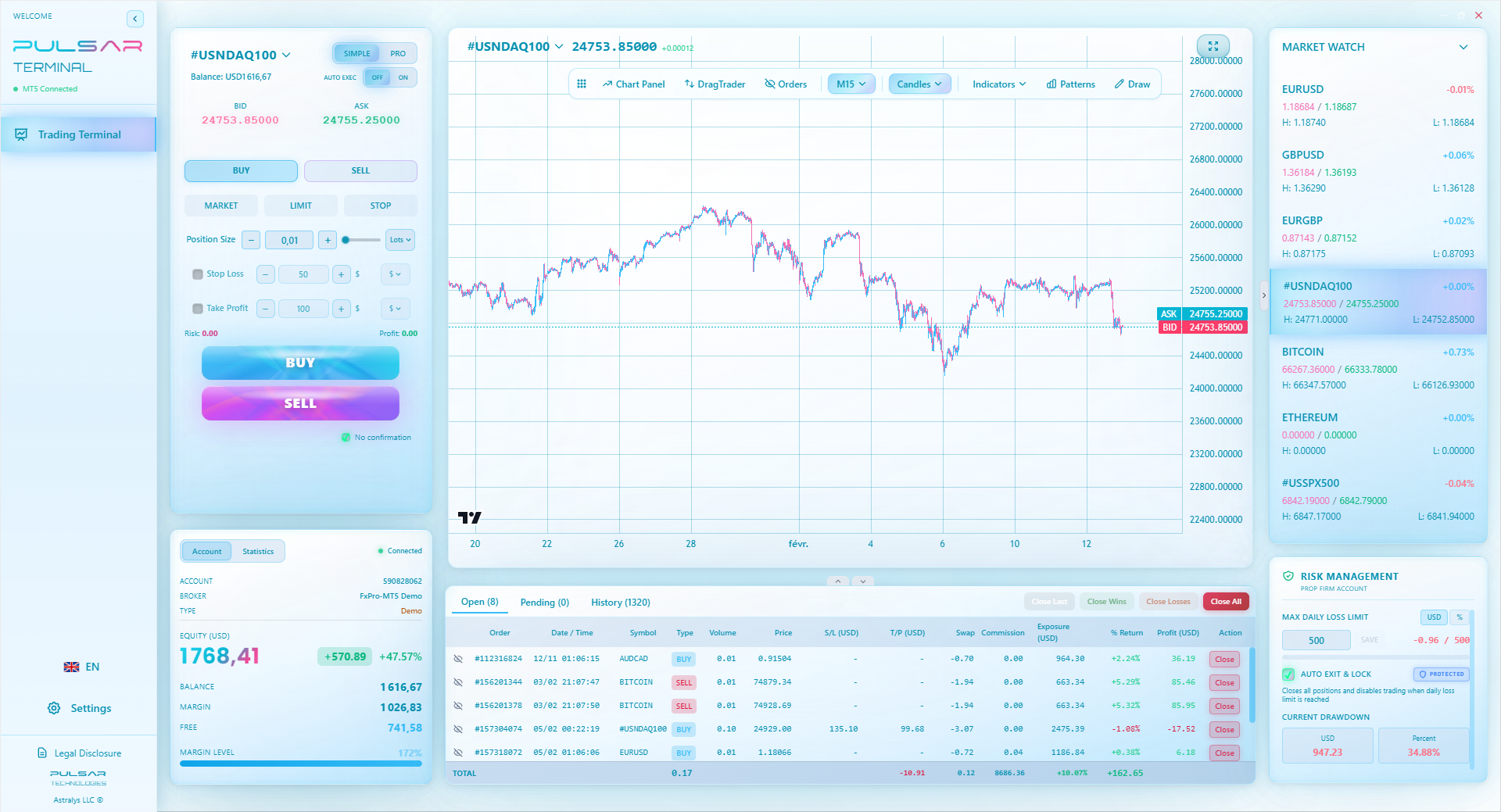
This is where a tool like Pulsar Terminal shines. You can set these potential orders as drafts on your chart, with your pre-calculated lot size and stop loss already attached. It turns your plan from a thought into a one-click action.
Planning multiple 'if-then' scenarios is key, and Pulsar Terminal lets you draft those orders directly on your MT5 chart before the market even moves.
Pulsar Terminal
A ferramenta MT5 tudo-em-um: ordens drag-and-drop, multi-TP/SL, trailing stop, grid trading, Volume Profile e proteção prop firm. Usado diariamente por 1.000+ traders.
“Sitting on your hands is a valid strategy.”
Brother, let's talk straight. Trading Naira pairs is like trading during a hurricane. The winds can change because the CBN governor had a dream. Your technical forecast must have a giant asterisk for liquidity and intervention risk.
What to Watch:
- CBN Dollar Sales: When the CBN injects dollars into the official market, it can temporarily strengthen the Naira. Your black market chart might suddenly gap.
- MPC Statements: The wording on inflation and interest rates can cause knee-jerk reactions. 'Hawkish' tones might briefly support the Naira.
- Global Oil Price: This is the big one. Nigeria's lifeblood. A sustained move in crude oil (like Brent above $90 or below $75) will eventually feed through. A rising oil price can improve dollar supply outlook and support the Naira.
Practical Approach: I use a longer-term chart for Naira pairs. Daily or even Weekly. I'm not looking for 50-pip moves. I'm looking for a 500-1000 pip trend. And I only enter if that trend is already established and I can get in on a pullback. The spread is your enemy, so you need a big target to make it worthwhile. This is classic swing trading, not for the faint-hearted.

Pro Tip: When trading GBP/NGN or USD/NGN, always use a broker that offers local customer support and deposits/withdrawals in Naira. You don't want to be stuck when you need to fund your account or pull out profits. Check our reviews for brokers like IC Markets or Pepperstone to see their local offerings.
💡 Dica do Winston
Always know the value of 1 pip for your planned trade *before* you enter. Surprises here are always expensive.
I've fallen into every one of these traps. Learn from my losses.
Pitfall 1: Confirmation Bias. You forecast a EUR/USD drop. On Monday, it rises slightly. Instead of re-evaluating, you ignore the buying pressure and only see tiny pullbacks as 'your chance' to get short. You end up shorting into a rising market. Fix: Have a clear invalidation level for your forecast idea. If price breaks above it, the idea is dead. Walk away.
Pitfall 2: Overtrading the Forecast. You identified 5 potential setups. By Wednesday, none have triggered perfectly, but you're bored. You start bending your rules to get into a trade, just to be 'in the market.' Fix: Your forecast is a filter, not a mandate. No valid trigger = no trade. Go watch a movie.
Pitfall 3: Ignoring the Intraday Narrative. Your weekly forecast said 'bullish.' But on Tuesday, price makes a clear reversal pattern on the 4-hour chart with strong volume. You ignore it because 'the weekly is bullish.' Fix: The weekly forecast sets the stage, but the shorter-term charts write the scenes. Use the MACD indicator or RSI indicator on the 4H to gauge short-term exhaustion. A weekly uptrend can still have a 200-pip correction.
Pitfall 4 (For Nigerians): Mixing Official and Parallel Rates. Your charting platform shows one rate, your Bureau de Change app shows another. This causes confusion on execution and targets. Fix: Know which rate your broker is using. Most international brokers use a derivative of the official rate. Trade based on the chart in front of you, not the one on the street.

“The spread is your enemy, so you need a big target to make it worthwhile.”
A weekly forecast isn't set in stone on Sunday. It's a living document. Every evening (I do it at 10 PM WAT), I spend 10 minutes.
- Compare: What did I think would happen today vs. what actually happened?
- Adjust: Are my key levels still valid? Did news break my thesis? If yes, I erase the old levels and mark new ones.
- Journal: I write one sentence in my trading journal. 'Tuesday: EUR/USD rejected 1.0950 as forecasted, but buying pressure was stronger than expected. Bias shifting to neutral/up.'
This keeps you engaged with the market's evolving story without causing analysis paralysis. It also helps you see when you're right for the wrong reasons, which is just as dangerous as being wrong.
Let's make this concrete. It's Sunday, April 2026.
My Scan: US CPI on Wednesday. GBP/NGN is in a strong daily uptrend (Naira weakening). EUR/USD is range-bound between 1.0800 and 1.1000.
My Battle Plan:
- GBP/NGN: My forecast is cautiously bullish continuation. I will ONLY look for a buy if price pulls back to a clear 4-hour support level. Wide stop. Target is a new high. I will use my position size calculator to ensure the wide stop doesn't risk more than 1.5%.
- EUR/USD: My forecast is neutral with a volatility warning for Wednesday's CPI. I will mark 1.0800 as support and 1.1000 as resistance. My plan is to do nothing Monday-Tuesday unless price hits one of these extremes with a clear reversal pattern. Wednesday: No trading 30 mins before CPI. I will watch the reaction after.
- Gold (XAU/USD): Often moves with USD news. I'll check its correlation. If it's sitting at a key level, it might be a cleaner play than FX around the CPI. (See our XAU/USD guide for more on trading gold).
Friday Review: Did I follow the plan? Even if I took no trades, that's a success if the plan said 'no clear setups.' A successful week isn't measured by profit, but by discipline. The profit follows the discipline, not the other way around.
FAQ
Q1How accurate should a weekly forex forecast be?
Throw the idea of 'accuracy' out the window. A good forecast isn't about being right on direction; it's about being prepared for all directions. If it helps you identify 2-3 high-probability areas to watch and keeps you out of bad trades, it's 100% accurate in its purpose.
Q2Is it worth paying for a weekly forex forecast service?
Almost never. I did it for a year. They're generic, can't account for your personal risk tolerance, and create dependency. The real skill is learning to build your own. That skill stays with you and saves you the subscription fee forever.
Q3As a Nigerian, should I focus more on Naira pairs or major pairs like EUR/USD?
Start with the majors (EUR/USD, GBP/USD). They have tighter spreads, more predictable liquidity, and cleaner charts. Use them to build your forecasting and risk management skills. Once you're consistently disciplined, then you can cautiously apply those skills to Naira pairs, with the understanding that it's a higher-difficulty, higher-spread environment.
Q4What's the single most important part of the weekly forecast?
Identifying the scheduled economic events. Knowing when NOT to trade is more important than knowing when to trade. Mark those high-impact news events on your chart and have a rule for them (e.g., close positions, widen stops, do not enter new ones).
Q5How do I handle it when my weekly forecast is completely wrong by Tuesday?
Scrap it. Immediately. The market voted, and your idea lost. The biggest mistake is clinging to a dead forecast out of pride or stubbornness. Go back to the charts, assess the new price action, and formulate a new, smaller-scale plan for the rest of the week. Sometimes the best forecast for Wednesday-Friday is 'observe and reset for next week.'
Q6Can I use the same forecast for scalping and swing trading?
The core framework (key levels, news events) is the same. But the execution differs massively. A swing trader's forecast might highlight a weekly support zone for a potential buy. A scalper using that same forecast would wait for intraday price action to confirm a bounce within that zone before taking a quick, small-profit trade. The forecast sets the scene for both, but the strategies have different scripts.
Lição do Prof. Winston
Pontos-chave:
- ✓Forecast key levels, not directions.
- ✓Mark high-impact news: your #1 rule.
- ✓Naira pairs require wider stops & targets.
- ✓Scrap your forecast if price invalidates it.
- ✓A 'no trade' week is a successful week.
Quão útil foi este artigo?
Clique em uma estrela
Insights de Trading Semanal
Análises e estratégias semanais grátis. Sem spam.
Sobre o autor
Olumide Adeyemi
Pioneiro do Trading na África Ocidental
Um dos educadores de trading forex mais ativos da Nigéria. 8 anos de experiência operando a partir de Lagos. Especialista em estratégias de baixo capital e desafios de prop firms para traders africanos.
Comentários
Aviso de risco
A negociação de instrumentos financeiros envolve riscos significativos e pode não ser adequada para todos os investidores. O desempenho passado não garante resultados futuros. Este conteúdo é apenas para fins educacionais e não deve ser considerado aconselhamento de investimento. Sempre conduza sua própria pesquisa antes de negociar.
Você também pode gostar

Cara Trading Forex Sukses: 7 Prinsip dari Trader Profesional
Cara trading forex sukses dengan 7 prinsip trader pro: manajemen modal, disiplin, journal trading, backtest. Data nyata, bukan janji profit palsu.
Jam Trading Forex Terbaik untuk Trader Indonesia: Panduan Lengkap dengan Tabel Waktu
Panduan jam trading forex untuk trader Indonesia. Tabel 4 sesi dunia, jam emas 20:00-00:00, sesi mana yang harus dihindari. Data akurat + tips dari trader berpengalaman.
Top 5 Sàn Forex Uy Tín Nhất 2026: Review Jujur dari Trader Indonesia
Top 5 sàn forex uy tín 2026 untuk trader Indonesia. Review jujur: spread, deposit, withdraw, dukungan lokal. Exness, XM, IC Markets & lebih.
Obter Pulsar Terminal
Todas essas calculadoras estão integradas ao Pulsar Terminal com dados em tempo real da sua conta MT5.
Obter Pulsar Terminal