


Most Nigerian traders get the concept of account size completely backwards.

Olumide Adeyemi
Pioneiro do Trading na África Ocidental ·  Nigeria
☕ 11 min de leitura
O que você vai aprender:
- 1Account Size Defined: It's Not Just Your Balance
- 2Why Your Account Size Matters More Than Your Strategy
- 3How to Choose Your Starting Size: The Nigerian Reality Check
- 4use: The Nigerian Trader's Double-Edged Sword
- 5Funding, Withdrawals & The Naira Reality
- 6Scaling Up: When to Add More Capital
- 7Common Mistakes Nigerian Traders Make
Most Nigerian traders get the concept of account size completely backwards. They think a bigger account is about making more money. Wrong. Your account size is first and foremost a shield against your own stupidity. It's the only thing standing between you and a margin call when the market turns against you. I've seen guys with ₦5 million accounts blow up faster than someone with ₦50,000, because they never understood what that capital was actually for. In this guide, I'll break down the real, gritty numbers for Nigeria, show you how to pick a size that lets you sleep at night, and explain why the CBN's latest moves actually matter to your trading desk.
When we talk about account size in forex, we're not just talking about the number staring at you from your broker's dashboard. That's your balance. Your account size is the total capital you've committed - or are willing to lose - to this trading venture. It's the pool from which all your risk calculations flow.
For you in Nigeria, this gets interesting. You might fund your account in USD, but you're thinking in Naira. That ₦1,500,000 you saved up? At an exchange rate of ₦1,500/$, that's a $1,000 account. Tomorrow, if the rate moves to ₦1,600/$, your Naira value changes even if your USD balance doesn't. This currency risk is a silent partner in every trade you place with an international broker.
Your account size dictates everything: the lot sizes you can trade without gambling, the drawdown you can survive, and frankly, whether a broker will even take you seriously. Start too small (like $10), and you're forced to use insane use just to make a trade worth your time, which is a one-way ticket to a zero balance. I learned this the hard way early on, trying to scalp with a $100 account. The spreads alone ate me alive.

Warning: Your account size is your risk capital. This is money you can afford to lose completely without it affecting your rent, your kids' school fees, or your peace of mind. If you're dipping into emergency savings, you've already lost.
“Your account size is first and foremost a shield against your own stupidity.”
You can have the best scalping strategy in the world, but if your account is too small to handle the natural noise of the market, you'll get stopped out on every trade. The market doesn't care about your genius analysis. It has a spread, it has slippage, and it moves in pips. Your account size is the armor against that reality.
The Psychology of a Crummy Account
A small account creates desperation. When you're trading with ₦75,000 ($50-ish), a 50-pip move in EUR/USD feels like a life-or-death event. You'll micromanage, move stop-losses, and break every rule in your plan. I've been there. In 2018, I turned $200 into $950 in two weeks with a crazy lucky streak on Gold. I felt invincible. Then I gave back every single pip, plus the initial $200, in one bad afternoon because my position sizing was reckless. My account was too small for the volatility of XAU/USD.
The Math of Survival
Let's say you risk 2% per trade (a standard rule). On a $500 account, 2% is $10. If your stop-loss is 20 pips on EUR/USD, that $10 risk allows you to trade a measly 0.05 lots. Your potential profit? Maybe $5 on a good day. That's not trading, that's a hobby. This is why many Nigerians are drawn to high use from brokers like Exness or HFM. It makes a small balance feel powerful, but it magnifies the risk exponentially.
A larger account, say $2,000, with the same 2% risk ($40), allows for more sensible lot sizes and lets you weather a series of losses without your capital being decimated. It provides the psychological space to be wrong, which is the only way you'll ever learn to be right consistently.

💡 Dica do Winston
Your first profitable trade should feel boring. If it's exciting, your position size is too big for your account.
“A small account creates desperation. When you're trading with ₦75,000, a 50-pip move feels like a life-or-death event.”
Forget the brokers advertising "Trade with $1!" That's a marketing gimmick, not a plan. Here’s how to think about it with Naira in your pocket.
First, look at the minimums. Many decent brokers like XM or IC Markets have minimum deposits around $100 (roughly ₦150,000). That's the bare minimum to open an account, not a recommendation.
My strong opinion? If you're serious, don't start with less than $500 (₦750,000+). Here’s the brutal arithmetic:
- Broker Fees & Spreads: You need a buffer. If you trade EUR/USD with a 1-pip spread, a single 0.01 lot trade costs you about $0.10 just to enter and exit. Do 10 trades a day, that's $1 gone before you even make a profit. Over a month, that's a significant chunk of a tiny account.
- Realistic Risk Management: Using a position size calculator, you'll see that with $500, risking 1% ($5) on a trade with a 25-pip stop-loss lets you trade about 0.02 lots. The profit potential is small but real. You can actually practice discipline.
- The Prop Firm Alternative: Many traders now use a small account (like $100) to practice for a prop firm challenge. The goal isn't to get rich from the $100, but to hone a strategy to pass the test and trade the firm's capital. This changes the entire purpose of your personal account size.

Pro Tip: Open a cent account first. A $10 deposit becomes 1,000 cents. This lets you trade "micro-lots" with real money psychology. A 50-pip loss feels like 50 cents, not $50. It's the best training wheels money can buy.
Consider your monthly income. A good rule is never to risk more than 5% of your savings (not income) on trading. If you have ₦3,000,000 in savings, your maximum trading capital should be around ₦150,000. Start with half of that.
“A small account creates desperation. When you're trading with ₦75,000, a 50-pip move feels like a life-or-death event.”
Here’s where the conversation gets spicy. Because the SEC Nigeria doesn't impose strict use limits on retail forex, Nigerian traders have access to some of the highest use in the world - up to 1:2000 with some offshore brokers. This is insane power, and most people have no business touching it.
use is a loan from your broker. A 1:100 use on a $1,000 account means you can control a $100,000 position. Sounds great, right? Here’s what they don’t show you in the ad: a 1% move against you wipes out your entire account. Poof. Gone.
I used 1:500 use in my early days on a $200 account. I bought GBP/JPY (a volatile pair) and walked away for an hour. When I came back, my account was at $12. A swift 94-pip move had obliterated me. I didn't even understand what a pip truly was back then.
A Sane Approach to use
Your account size should dictate your use, not the other way around.
| Account Size (USD) | Suggested Max use | Why |
|---|---|---|
| Under $500 | 1:10 or lower | Survival. Your account is too small to withstand volatility. |
| $500 - $5,000 | 1:30 - 1:50 | Manageable. Allows meaningful positions without extreme danger. |
| $5,000+ | 1:100 - 1:200 | Efficient. For experienced traders with solid risk systems. |
Anything above 1:200 for a retail trader is usually a sign you're either undercapitalized or overconfident. Brokers like Pepperstone offer 1:400 to Nigerian clients, which is more than enough rope to hang yourself with. The use isn't for maximizing profit; it's for efficiently using margin so your capital isn't all locked up. If you're using it to pretend you have a bigger account, you're already on the path to a margin call.
💡 Dica do Winston
Never add money to a losing account. It's like pouring petrol on a fire to put it out. Rebuild your strategy first.
“Throwing more money at a losing strategy is the fastest way to poverty.”
Choosing an account size is one thing. Getting the money in and out is a whole other battle for a Nigerian trader. This is where local specifics hit home.
Funding Your Account:
- Bank Transfer/CC: The classic. But remember CBN restrictions on international transfers with Naira cards. You might hit limits. A domiciliary account (Dom account) is king here. Fund it with USD and transfer directly to your broker.
- E-Wallets: Skrill, Neteller, and even crypto (USDT) are lifesavers. They bypass many traditional banking hurdles. Many brokers accept them. The fee structure varies, so factor that into your initial deposit.
- Local Processors: Some brokers integrate with Paystack or Flutterwave. This is the easiest for Naira deposits, but check the exchange rate they use. It's often worse than the official market rate.
The Withdrawal Game: This is critical. You need to know you can get your profits out. Always test the withdrawal process with a small amount before you deposit your main capital. I once had $2,000 stuck with a shady broker for 8 weeks. Never again.
Your account size should account for these friction costs. If you plan to make 20 trades a month, factor in maybe ₦5,000 in total transaction fees for deposits/withdrawals. That's a 1% drag on a ₦500,000 account before you even trade.

Example: You want a $1,000 trading account. With a poor FX rate from a local processor, your ₦1,500,000 might only get you $950 by the time it hits your broker. Your starting size is now 5% smaller than you planned. Always send more than you think you need.
“Throwing more money at a losing strategy is the fastest way to poverty.”
Throwing more money at a losing strategy is the fastest way to poverty. So when do you increase your account size?
The Right Way (The 6-Month Rule): Only add more capital after you have produced six consecutive months of consistent, modest profitability with your current account size. Not six months of trading. Six months where your equity curve slowly climbs upwards, with manageable drawdowns. This proves your strategy and, more importantly, your psychology can handle the money.
I made this mistake in reverse. After my first profitable quarter, I doubled my account size from $2k to $4k. My risk per trade in dollars doubled, but my psychology hadn't. I started second-guessing trades, taking profits too early, and blew back to $2,500 in a month. I had to shrink my size again to recover my confidence.
The Wrong Way:
- Adding money after a big loss to "make it back quickly."
- Adding money because you got a bonus at work and feel lucky.
- Adding money because you saw a "surefire" signal online.
Think of your account like a business. You only reinvest profits once the business model is proven. Your initial account size is your startup capital. Don't pour in more until the startup is actually making money.
When you do scale, do it incrementally. Increase by 25-50% at a time, not 200%. And recalculate all your position sizes from scratch. A tool that can manage multiple take-profit levels and trailing stops, like those in Pulsar Terminal, becomes useful here, as managing larger, more complex positions manually is a headache.
💡 Dica do Winston
The true test of your account size isn't in a winning trade, but in how you feel during your third consecutive loss. If you're panicking, your size is too big.
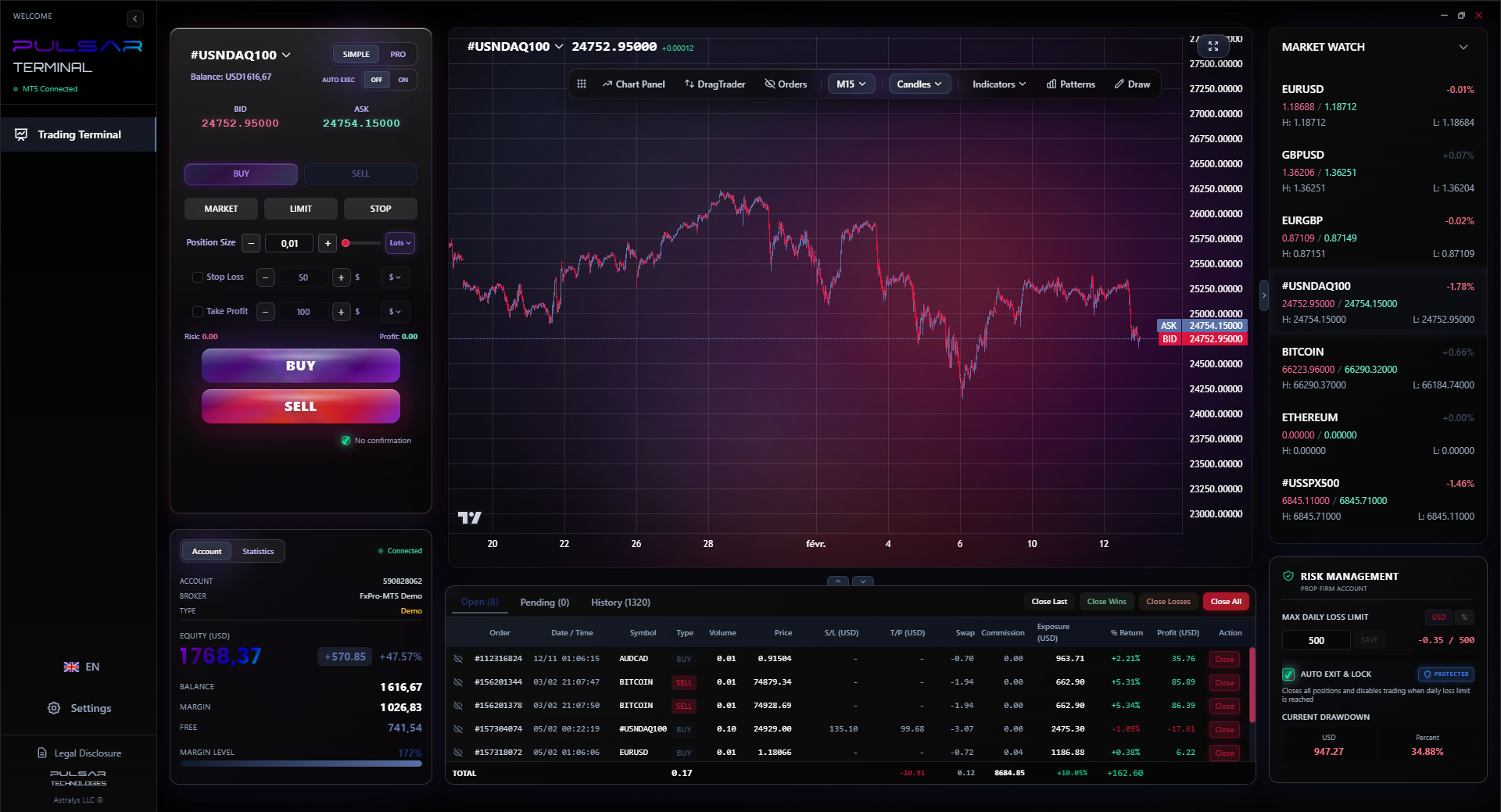
When you scale your account and trade larger positions, managing multiple take-profit levels and trailing stops manually becomes a nightmare; Pulsar Terminal automates this directly on your MT5 chart.
Pulsar Terminal
A ferramenta MT5 tudo-em-um: ordens drag-and-drop, multi-TP/SL, trailing stop, grid trading, Volume Profile e proteção prop firm. Usado diariamente por 1.000+ traders.
“Only add more capital after you have produced six consecutive months of consistent, modest profitability.”
Let's cut to the chase. I've made most of these, and I see them every day in trading groups.
- Starting Too Big, Too Soon: Using your entire savings or a business loan to fund a forex account before you know what a MACD indicator divergence even looks like. This is a catastrophe waiting to happen.
- Ignoring Currency Risk: You deposit USD, profit in USD, but live in Naira. A 20% profit in USD can be wiped out by a 25% devaluation of the Naira by the time you withdraw. You're trading forex, but you're also taking a long-term bet on the USD/NGN pair.
- Chasing High use for Small Accounts: This is the #1 account killer. A $100 account with 1:1000 use is a $100,000 ticket to a margin call. The market will flick you off like a bug.
- Not Accounting for True Costs: The spread, overnight swap fees, withdrawal fees, and poor FX conversion rates all eat into your effective account size. A "$1000 account" might only have $950 of tradable capital after all costs.
- No Clear Risk-Per-Trade Rule: Without this, your account size is meaningless. You'll risk 10% on one trade because you're "sure," and then you're down to $900 before you even blink. Use a calculator, set a rule (like 1-2%), and stick to it religiously.
The bottom line? Your account size is your foundation. A shaky foundation guarantees the house will fall. Take the time to build it right, with realistic numbers for Nigeria, and you give yourself a fighting chance.
FAQ
Q1What is the best account size to start forex trading in Nigeria?
There's no "best," but there's a sensible minimum. I strongly advise starting with no less than $500 (roughly ₦750,000). This gives you enough buffer to absorb spreads, practice real risk management (like 1-2% per trade), and avoid the desperation that comes with a tiny account. Anything less and you're basically just paying for expensive market education.
Q2Is forex trading legal in Nigeria? Can I fund my account with Naira?
Yes, retail forex trading through international online brokers is legal for individuals. The CBN regulates FX flows but doesn't ban you from trading. Many brokers like HFM and Exness offer Naira-denominated accounts, so you can fund directly with Naira. However, be aware of CBN limits on international card transactions and always use reputable brokers.
Q3How does use affect my required account size?
use and account size have an inverse relationship. High use (like 1:500 or 1:1000) allows a small account to control large positions, which dramatically increases risk. A small move can wipe you out. A larger account size allows you to use lower, safer use (like 1:30) to achieve the same position size. Think of a larger account as allowing you to use less use, which is safer.
Q4What percentage of my savings should I use for forex trading?
A strict maximum of 5% of your total savings that you can afford to lose completely. This is risk capital, not investment capital. If you have ₦5,000,000 in savings, your maximum forex fund should be ₦250,000. And when starting, use only half of that allocated fund until you prove you can be consistently profitable over 6+ months.
Q5Should I use a cent account as a beginner?
Absolutely. It's the single best tool for a Nigerian beginner. Depositing $10 gives you 1,000 'cent dollars.' A 50-pip loss feels like 50 cents instead of $5, removing the fear that leads to bad decisions. You can practice real money management with position size calculators and learn the platform without the emotional burden of large sums.
Q6How do CBN policies affect my forex trading account?
Directly. Policies affect how you fund/withdraw and the value of your profits. The re-admission of BDCs in 2026 aims to improve USD liquidity, which could stabilize the Naira and make your profit conversions more predictable. Restrictions on international card transactions mean using domiciliary accounts or e-wallets (Skrill, crypto) is often smoother. Always factor in FX conversion costs when calculating your effective account size.
Q7What's the difference between a standard account and a cent account?
The main difference is the lot size and psychology. In a standard account, 1.00 lot = 100,000 units of currency. In a cent account, 1.00 lot = 1,000 units (it's a micro-lot). So, a 0.01 lot trade in a cent account is a tiny, real-money trade perfect for learning. Your $10 feels like $1,000, letting you practice proper swing trading or scalping mechanics without real financial danger.
Lição do Prof. Winston
Pontos-chave:
- ✓Start with at least $500 (₦750k) to practice real risk management.
- ✓Use use as a tool for efficiency, not to pretend you have a bigger account.
- ✓Your max trading capital should be only 5% of your total savings.
- ✓Test withdrawal before depositing large amounts with any broker.
- ✓Scale your account size only after 6 months of proven profitability.
Quão útil foi este artigo?
Clique em uma estrela
Insights de Trading Semanal
Análises e estratégias semanais grátis. Sem spam.
Sobre o autor
Olumide Adeyemi
Pioneiro do Trading na África Ocidental
Um dos educadores de trading forex mais ativos da Nigéria. 8 anos de experiência operando a partir de Lagos. Especialista em estratégias de baixo capital e desafios de prop firms para traders africanos.
Comentários
Aviso de risco
A negociação de instrumentos financeiros envolve riscos significativos e pode não ser adequada para todos os investidores. O desempenho passado não garante resultados futuros. Este conteúdo é apenas para fins educacionais e não deve ser considerado aconselhamento de investimento. Sempre conduza sua própria pesquisa antes de negociar.
Você também pode gostar

Cara Trading Forex Sukses: 7 Prinsip dari Trader Profesional
Cara trading forex sukses dengan 7 prinsip trader pro: manajemen modal, disiplin, journal trading, backtest. Data nyata, bukan janji profit palsu.
Jam Trading Forex Terbaik untuk Trader Indonesia: Panduan Lengkap dengan Tabel Waktu
Panduan jam trading forex untuk trader Indonesia. Tabel 4 sesi dunia, jam emas 20:00-00:00, sesi mana yang harus dihindari. Data akurat + tips dari trader berpengalaman.
Top 5 Sàn Forex Uy Tín Nhất 2026: Review Jujur dari Trader Indonesia
Top 5 sàn forex uy tín 2026 untuk trader Indonesia. Review jujur: spread, deposit, withdraw, dukungan lokal. Exness, XM, IC Markets & lebih.
Obter Pulsar Terminal
Todas essas calculadoras estão integradas ao Pulsar Terminal com dados em tempo real da sua conta MT5.
Obter Pulsar Terminal