


I remember staring at my screen, my stomach in knots.

David van der Merwe
Trader de Mercados Emergentes ·  South Africa
☕ 13 min de leitura
O que você vai aprender:
- 1Margin in Simple Terms: It's a Deposit, Not a Fee
- 2The use & Margin Connection: A Double-Edged Sword
- 3The Dreaded Margin Call & Stop Out Level
- 4SA Regulations & Broker Rules: What You're Allowed
- 5Calculating Margin: A Practical Walkthrough
- 6Common Margin Mistakes SA Traders Make (I Made #3)
- 7A Smart Margin Management Strategy
- 8The Future: Trends SA Traders Need to Watch
I remember staring at my screen, my stomach in knots. It was 2018, and I had a decent position on USD/ZAR. The trade was going my way, then it wasn't. A sudden spike against me, and before I could even think about adjusting my stop loss, the notification popped up: 'Margin Call.' My R15,000 position was automatically closed, locking in a loss of R3,200. That was my expensive, face-palm moment of truly understanding what margin in forex is. It's not just a number on your platform; it's the gatekeeper to your trading survival. Let's break it down so you don't learn the hard way like I did.
Alright, let's cut through the jargon. When you ask 'what is margin in forex,' think of it like a security deposit for an apartment. You don't pay the full year's rent upfront, right? You put down a deposit to show you're good for it. Margin works the same way.
Your broker lets you control a massive trade (like $100,000) with only a small fraction of your own cash. That fraction you put up is the margin. It's collateral, a 'good faith' deposit to keep the position open. The key thing every new trader in SA misses? It's not a fee. You get it back when you close the trade (provided you haven't lost it all, of course). Brokers make their money from the spread definition, not from taking your margin.
Here’s a local example. Say Khwezi Trade offers 1:100 use on EUR/USD. You want to buy one standard lot (€100,000). Without use, you'd need the full €100,000 (roughly R2 million!). With 1:100 use, the margin required is just 1% of that. So, you only need to lock up about €1,000 (roughly R20,000) from your account to open that trade. That €1,000 is your margin. Simple as that.

Example:
- Trade: Buy 1 lot EUR/USD (€100,000)
- use: 1:100
- Margin Required: €100,000 / 100 = €1,000
- In Rands: ~ R20,000 (depending on EUR/ZAR rate) That R20,000 stays in your account but is 'locked' and unusable for other trades. It's your skin in the game.
You can't talk about margin without talking about use. They're two sides of the same, often dangerous, coin. use is the mechanism, margin is the fuel.
How They Work Together
use is expressed as a ratio, like 50:1 or 400:1. This ratio tells you how much bigger your market exposure is compared to your margin. If your broker offers 50:1 use, it means for every R1 of your margin, you control R50 in the market. The margin requirement is simply the inverse: 1 divided by the use ratio.
- use 50:1 = Margin Requirement of 1/50 = 2%
- use 100:1 = Margin Requirement of 1/100 = 1%
- use 400:1 = Margin Requirement of 1/400 = 0.25%
Higher use means a lower margin requirement. Sounds great, right? You can control bigger positions with less cash. This is what makes forex accessible. But here's the brutal truth I learned: it amplifies everything.
The Amplification Effect
Let's use real numbers from my trading journal. Last year, I used a scalping strategy on GBP/USD with 200:1 use from an offshore broker. My account was $1,000. I put down $50 margin to control a $10,000 position. A 50-pip move in my favor would net me $500 – a 50% return on my account! I was feeling like a genius.
The very next week, same setup. A 30-pip move against me resulted in a $300 loss. That's a 30% account drawdown from one smallish move. The use that supercharged my win also turbocharged my loss. I wasn't trading $10,000 with the risk mindset of someone who had $10,000; I was trading it with the psychology of someone who only had $1,000. That disconnect is where accounts go to die.

Warning: High use is like a high-performance sports car. In the right hands on the right track, it's incredible. In the wrong hands on a busy street, it's a disaster waiting to happen. Most retail traders (myself included in those early days) are not Formula 1 drivers.

💡 Dica do Winston
Margin is permission to risk more, not an instruction. The real pros I know use use under 10:1. They make their money from being right on direction, not from financial steroids.
“Margin is the gatekeeper to your trading survival. Ignore it, and it will manage you right out of the market.”
This is the moment of truth. You've probably heard the horror stories. Understanding this is non-negotiable.
Margin Call: This is your broker's first warning. It happens when your account's equity (your current balance including floating profits/losses) falls below a certain percentage of your used margin. This percentage varies by broker. Let's say your broker's margin call level is 100%. If you have R10,000 in used margin and your equity drops to R9,999, you'll get the call. It's a notification saying, 'Hey, your account is underfunded for these open trades. Add money now or we'll start closing them.'
Stop Out Level: This is where the broker stops asking and starts acting. If your equity falls to an even lower percentage (often 50% or 20% of used margin), the broker's system will automatically start closing your positions, starting with the biggest loser, until your equity is back above the margin call level. This is to prevent your account from going negative.
Here’s a painful personal example. I was swing trading AUD/JPY during a volatile period. My account had R50,000. My open positions required R40,000 in used margin. My stop out level was 50%. I ignored a widening drawdown, thinking it would reverse. My equity dropped to R20,001 (just below 50% of R40,000). Wham. The platform automatically liquidated my largest position, turning a paper loss into a very real, very large loss of nearly R20,000. I didn't get a second chance. The trade eventually reversed, but I was already out.
Managing this is why a position size calculator is your best friend. It forces you to calculate your risk before you enter, so you never get near these levels.
South Africa's trading scene is regulated, but it's got its own flavour. The main watchdog is the Financial Sector Conduct Authority (FSCA). They're the ones making sure brokers don't play funny games with your money.
The Regulatory Lay of the Land
While you can sign up with international brokers (like IC Markets or Pepperstone), using an FSCA-regulated broker is generally smarter for us locals. Why? Easier deposits/withdrawals in ZAR, local customer support, and a regulator you can actually complain to if things go south. Brokers like Khwezi Trade, IG South Africa, and AvaTrade SA have FSCA licenses.
There's no single, hard cap on use for retail traders in SA like there is in the EU or US. This means you'll see a wild range. An FSCA-regulated broker might offer a sensible max of 1:400 for majors. But offshore brokers targeting SA clients? I've seen offers of 1:2000 or even 1:3000. Just because you can get 1:3000 use doesn't mean you should. It's a marketing trap for inexperienced traders.
Broker Comparisons: Margin & Minimums
Here’s a quick look at what some popular brokers offer (as of late 2025/early 2026). Remember, conditions change, so always check their websites.
| Broker | FSCA Regulated? | Typical Max use (Retail) | Min Deposit (ZAR approx.) | Key Margin Note |
|---|---|---|---|---|
| Khwezi Trade | Yes (ODP Auth) | 1:400 | R500 | Local specialist, clear ZAR pricing. |
| IG | Yes | 1:200 | ~R5,750 (£250) | Tier-1 global broker, strong platform. |
| AvaTrade SA | Yes | 1:400 | R1,500 | Fixed spreads, good for beginners. |
| Exness | No (CySEC, FSA) | Up to 1:2000 | R182 ($10) | Very high use, ultra-low minimums. |
| XM | No (CySEC, ASIC) | Up to 1:888 | R85 ($5) | Low minimum, massive use offers. |
| HFM | No (FSCA for SA entity pending) | 1:1000 | R182 ($10) | Popular in SA market, low costs. |
The trend is clear: offshore brokers use insane use and tiny minimum deposits as bait. FSCA-regulated brokers tend to be more conservative, which, ironically, is better for your long-term survival. I started with an offshore broker for the high use. I now use a mix, but for my main account, I prefer the stability of a well-regulated one.
“Higher use means a lower margin requirement. Sounds great, right? But here's the brutal truth: it amplifies everything.”
Enough theory. Let's get our hands dirty and calculate this for a real trade. You don't need a PhD in maths, I promise.
The basic formula is: Margin Required = (Trade Size / use) * Account Currency Exchange Rate
Let's walk through a ZAR-based example.
Scenario: You trade with Exness (just for the calc, not a recommendation). You have a ZAR account. You want to buy 0.5 lots of USD/ZAR.
- Determine Trade Size in Base Currency:
- 1 standard lot = 100,000 units.
- 0.5 lots = 50,000 USD. (The base currency of USD/ZAR is USD).
- Apply Your use:
- Let's say you selected 1:400 use for this pair.
- Margin in USD = 50,000 / 400 = $125.
- Convert to ZAR (if needed):
- If your account is in ZAR, the platform will convert this at the current USD/ZAR rate.
- If USD/ZAR = 18.50, then Margin in ZAR = $125 * 18.50 = R2,312.50.
That R2,312.50 will be locked in your account as 'Used Margin' for as long as that trade is open. Your 'Free Margin' is your equity minus this used margin. This is the money you have available to open new trades or absorb losses.

Pro Tip: Never guess. Every decent platform has a 'calculator' tool or will show you the estimated margin requirement before you click 'buy' or 'sell'. Use it. If you're trading multiple pairs, remember margin is calculated in the account's currency. A big position in USD/JPY and another in EUR/USD both get converted to ZAR for your total used margin. This is where over-leveraging creeps up on you.
💡 Dica do Winston
If you can't calculate your exact margin requirement and potential loss before clicking 'trade,' you have no business being in the market. Period. Ambiguity is the enemy of survival.
We all mess up. Here are the classic blunders I've seen (and committed) in the SA trading community.
1. Confusing Margin with Cost/Risk: This is the big one. "My margin is only R1,000, so I'm only risking R1,000." Dead wrong. You're risking the full value of the position based on where your stop loss is. If that 0.5 lot USD/ZAR trade moves 200 pips against you, that's a loss of 200 pips * 50,000 units. Using a pip definition calculator for ZAR pairs, that's a massive loss, far exceeding your R1,000 margin. Your risk is defined by your stop loss, not your margin.
2. Maxing Out use on Every Trade: Just because your broker offers 1:500 doesn't mean you use it for a long-term position on XAU/USD guide (gold). I used to do this. It leaves no room for error, no room to average sensibly if your thesis plays out slowly, and it absolutely murders you with overnight swap fees on leveraged positions.
3. Ignoring the Impact of Other Open Trades: My most costly lesson. I had three seemingly small trades open: one on EUR/USD, one on GBP/JPY, and one on the JSE Top 40 index. Individually, each used about 15% of my margin. No problem, right? Wrong. A day of global risk-off sentiment hit all three at once. My combined losses across them quickly ate into my free margin, triggering a margin call on all my positions. I was over-exposed to a single market mood. Diversification isn't just about different instruments; it's about uncorrelated risk.
4. Not Accounting for Volatility Around SA Events: Budget speeches, SARB interest rate decisions, ANC conferences – these can cause wild swings in ZAR pairs. If you're heavily margined during these times, a 500-pip spike in USD/ZAR in minutes can vaporise your account before you can blink. Always reduce use ahead of major local news.
“Just because your broker offers 1:500 use doesn't mean you use it. It's a marketing trap for inexperienced traders.”
So how do you use margin without it using you? Here's the simple framework I follow now.
The 5% & 2% Rules:
- Capital at Risk per Trade: Never risk more than 2% of your total account equity on a single trade. This is calculated from your entry to your stop loss, not your margin. This single rule has saved me more than any fancy indicator.
- Total Margin Usage Cap: Never have your total used margin exceed 5-10% of your account equity. If your account is R20,000, aim to never have more than R1,000 to R2,000 locked up in margin across all open trades. This leaves you a huge buffer against volatility and prevents a margin call.
Match use to Your Timeframe & Strategy:
- Scalping (1-15 min trades): You can use slightly higher use (e.g., 1:100) because your stop losses are tight. Your total position size is controlled by your 2% risk rule.
- Swing Trading (Days/Weeks): Use lower use (1:20 to 1:50). Your stops are wider, so a highly leveraged position with a wide stop is a recipe for a catastrophic loss.
- Long-term Position Trading: Use the lowest use you can (1:10 or even 1:5). You're in it for the big move, and you need to withstand months of drawdown without getting stopped out by noise.
Use Technology: This is where modern tools change the game. Manually calculating all this for multiple trades is a headache. A good trading journal or platform plugin can show your real-time margin usage and risk exposure.
Honestly, after my stop-out disaster, I became religious about this. On my main account now, I treat use above 1:30 with extreme suspicion. It's boring. But boring is profitable. The thrill of a 500% return on margin is quickly forgotten after the 90% account wipeout that inevitably follows.
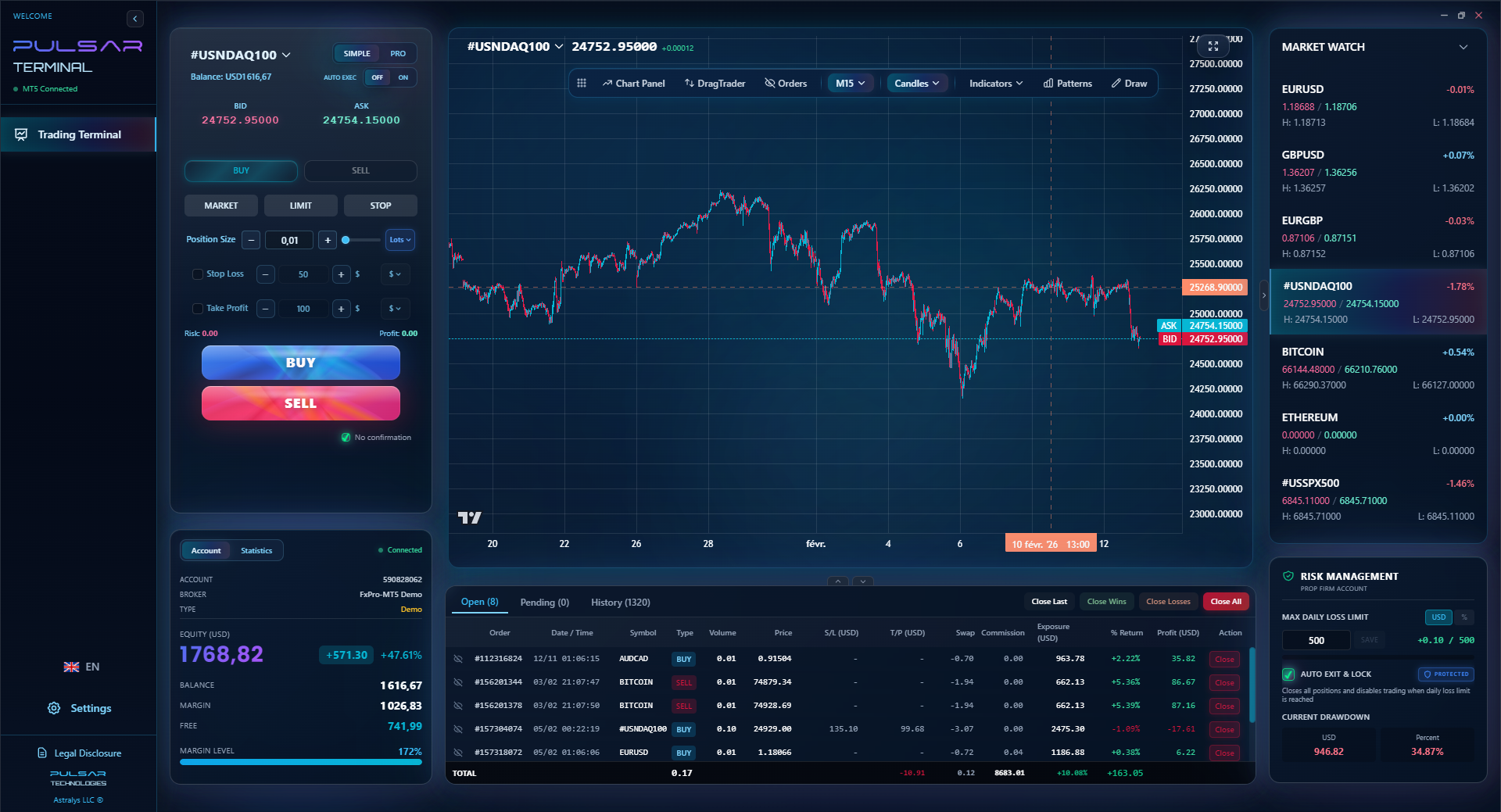
Managing margin and risk across multiple trades is complex, but tools like Pulsar Terminal integrate directly with MT5 to visualize your exposure and automate protective stops, turning a chaotic dashboard into a clear risk management command center.
Pulsar Terminal
A ferramenta MT5 tudo-em-um: ordens drag-and-drop, multi-TP/SL, trailing stop, grid trading, Volume Profile e proteção prop firm. Usado diariamente por 1.000+ traders.
The margin and use landscape isn't static. Here’s what’s on the horizon for us in South Africa.
Regulatory Shift: The FSCA is getting more sophisticated. While they haven't slapped a hard use cap on retail yet, the global trend is toward stricter consumer protection. The upcoming Conduct of Financial Institutions (COFI) Bill could bring changes. Don't be surprised if, in the next few years, FSCA-regulated brokers are forced to offer lower default use or implement more stringent suitability tests. This is actually a good thing for market sanity.
Technology & Risk Management Tools: Platforms are integrating better risk management features directly into the trade ticket. Imagine setting a trade where the platform automatically calculates the maximum position size based on your 2% risk rule and available margin. We're almost there. Tools that visualize your portfolio's margin usage across all correlated assets will become standard.
The Commodity & Rand Volatility Link: As commodities become a bigger focus in 2026, understanding their impact on the Rand is crucial for margin management. A large position in USD/ZAR might seem fine, but if you're also long on platinum stocks (a major SA export), a drop in commodity prices could hit both sides of your portfolio simultaneously, doubling up your margin pressure. Your margin strategy must account for these macro correlations, not just individual trades.
The bottom line? Understanding what margin in forex truly is – a risk amplifier, not just a ticket price – is the foundational skill that separates the gamblers from the traders. Manage it with respect, and it's a powerful tool. Ignore it, and it will manage you right out of the market.
FAQ
Q1Is trading on margin illegal in South Africa?
No, trading forex on margin is completely legal in South Africa. It's a standard feature offered by regulated brokers like those licensed by the FSCA (e.g., Khwezi Trade, IG SA) and international brokers that accept SA clients. The key is to use a reputable broker and understand the significant risks involved.
Q2What's a safe use level for a beginner in South Africa?
There's no 'safe' use, only safer practices. For a complete beginner, I'd recommend starting with no use at all on a demo account. When moving to real money, cap yourself at 10:1 or 20:1 maximum. This forces you to focus on position sizing and real risk management. Using the 1:500 offered in ads is a surefire way to lose your deposit quickly.
Q3Can I lose more money than I deposit when using margin?
With most reputable retail brokers, you cannot lose more than your account balance due to the stop out mechanism. They will close your positions before your balance goes negative. However, in extreme market conditions (like a flash crash or a major gap), it's theoretically possible, but brokers with negative balance protection guarantee you won't. Always check if your broker offers this protection.
Q4What's the difference between 'Used Margin' and 'Free Margin'?
Used Margin is the amount of money currently locked up as collateral for your open positions. Free Margin is your account's Equity (balance + floating P/L) minus the Used Margin. It's the amount you have available to open new trades or to absorb losses on your current trades. If your Free Margin hits zero, you'll get a margin call.
Q5Do I pay interest on the margin I use?
Not directly as an 'interest charge'. However, if you hold a leveraged position overnight (past the broker's rollover time), you will either pay or receive a 'swap' fee. This is based on the interest rate differential between the two currencies you're trading. It can be a significant cost on long-term, highly leveraged positions.
Q6How does margin work for ZAR pairs like USD/ZAR?
The principle is identical. The margin is calculated based on the trade size in the base currency (e.g., USD for USD/ZAR), your chosen use, and then converted to your account currency (ZAR). Be extra careful with ZAR pairs as they can be more volatile than majors like EUR/USD guide, meaning your margin can be depleted much faster if the market moves against you.
Lição do Prof. Winston
Pontos-chave:
- ✓Margin is collateral, not a fee or your max risk.
- ✓use amplifies both profits and catastrophic losses.
- ✓Always know your broker's specific margin call & stop out levels.
- ✓Cap total used margin below 10% of your account equity.
- ✓Match use to your strategy: lower for longer timeframes.
Quão útil foi este artigo?
Clique em uma estrela
Insights de Trading Semanal
Análises e estratégias semanais grátis. Sem spam.
Sobre o autor
David van der Merwe
Trader de Mercados Emergentes
Trader sediado em Joanesburgo com 11 anos em moedas de mercados emergentes. Especialista em pares ZAR, trading regulado pela FSCA e análise do mercado sul-africano.
Comentários
Aviso de risco
A negociação de instrumentos financeiros envolve riscos significativos e pode não ser adequada para todos os investidores. O desempenho passado não garante resultados futuros. Este conteúdo é apenas para fins educacionais e não deve ser considerado aconselhamento de investimento. Sempre conduza sua própria pesquisa antes de negociar.
Você também pode gostar

Cara Trading Forex Sukses: 7 Prinsip dari Trader Profesional
Cara trading forex sukses dengan 7 prinsip trader pro: manajemen modal, disiplin, journal trading, backtest. Data nyata, bukan janji profit palsu.
Jam Trading Forex Terbaik untuk Trader Indonesia: Panduan Lengkap dengan Tabel Waktu
Panduan jam trading forex untuk trader Indonesia. Tabel 4 sesi dunia, jam emas 20:00-00:00, sesi mana yang harus dihindari. Data akurat + tips dari trader berpengalaman.
Top 5 Sàn Forex Uy Tín Nhất 2026: Review Jujur dari Trader Indonesia
Top 5 sàn forex uy tín 2026 untuk trader Indonesia. Review jujur: spread, deposit, withdraw, dukungan lokal. Exness, XM, IC Markets & lebih.
Obter Pulsar Terminal
Todas essas calculadoras estão integradas ao Pulsar Terminal com dados em tempo real da sua conta MT5.
Obter Pulsar Terminal