


Most Nigerian traders get TP completely wrong.

Olumide Adeyemi
Pioneiro do Trading na África Ocidental ·  Nigeria
☕ 10 min de leitura
O que você vai aprender:
- 1TP 101: What Exactly Are You Setting?
- 2Why TP is Non-Negotiable for Nigerian Traders
- 3How to Actually Set Your Take Profit Level
- 4The 3 TP Mistakes Killing Nigerian Trading Accounts
- 5Leveling Up: Partial TPs and Trailing Stops
- 6Choosing a Broker: The TP and SL Fine Print
- 7Your TP Action Plan: From Theory to Practice
Most Nigerian traders get TP completely wrong. They either set it too close and kill their winners early, or they don't set one at all and watch profits evaporate. I've seen it wipe out accounts funded with hard-earned Naira time and again. A Take Profit order isn't just a button you click; it's the single most important decision in your trade after your entry. This article will show you how to use it properly, how it interacts with our unique market costs like the 10% capital gains tax, and why getting this right is the difference between being a consistent earner and another statistic.
A Take Profit (TP) order is an instruction you give to your broker to automatically close a trade once it reaches a specific price level where you want to lock in your gains. Think of it as a pre-planned exit strategy for success. You're telling the platform, "When this trade makes X amount of money, close it and give me my cash."
The opposite is a Stop Loss (SL), which is your exit plan for failure. You must have both on every single trade. Entering a trade without a TP and SL is like driving from Lagos to Abuja with no brakes and no destination - you're just asking for a crash.
On platforms like MT4 and MT5, which are overwhelmingly popular here in Nigeria, you set your TP and SL when you place the order. It's a simple field you fill with a price. Once set, it sits there in the market until either the price hits it or you manually cancel it. This automation is crucial. It removes emotion, the number one killer of trading accounts. When price is racing towards your TP, greed whispers, "Maybe it'll go further." The TP order ignores that whisper and executes the plan.

Pro Tip: Always set your TP and SL immediately when you open the trade. If you're thinking "I'll set it later," you've already lost. Later never comes, and you'll be making emotional decisions with real money on the line.

💡 Dica do Winston
Your first profit target should be to get to breakeven. Move your stop loss to your entry price as soon as the trade is in profit by 1.5x your initial risk. This turns a risky bet into a free roll of the dice.
Let's be blunt: our environment makes disciplined trading harder. Unstable power, expensive data (spending ₦8,000 to ₦15,000 monthly adds up), and market volatility mean you can't always be glued to your screen. A TP order is your loyal soldier standing guard when your light goes out or your data finishes.
The Tax Reality
You make 100,000 Naira on a trade. Great. Now remember, the Federal Inland Revenue Service (FIRS) wants its 10% Capital Gains Tax on your gross profits. This isn't a suggestion. Your TP level needs to account for this. If your profit target is based on a thin 1:1 risk-reward ratio, that 10% bite can turn a winning strategy into a breakeven grind. Your trading plan must have a profit buffer built in for taxes. I learned this the hard way early on, celebrating a ₦500,000 profit month only to get a nasty shock when tax time came around. The profit wasn't what I thought it was.
High use, High Stakes
Many brokers popular here, like Exness or XM, offer use up to 1:1000. That's a double-edged sword sharper than a razor. It magnifies both gains and losses. A well-placed TP secures those magnified gains before the market can snatch them back. Without a TP, a winning trade on high use can reverse and hit your stop loss in minutes, turning a potential payday into a loss. Using a position size calculator is non-negotiable here - it tells you exactly how much to risk so your TP and SL distances make sense for your account size.
“A Take Profit order is your loyal soldier standing guard when your light goes out or your data finishes.”
This is where art meets science. There's no magic number, but there are proven methods. The lazy way is to just pick a random number of pips. The professional way is to base it on market structure.
1. Support and Resistance: This is the classic method. If you're buying, look for the next major resistance level where price has previously reversed. Set your TP just before that level. Why? Because large players often have their orders there, and price tends to react. Selling? Aim for the next support level. For a currency like the EUR/USD, these levels are key. You can learn more about trading this major pair in our EUR/USD guide.
2. Risk-Reward Ratio (R:R): This is your strategic foundation. If your Stop Loss is 50 pips away from your entry, a 1:1 R:R means your TP should be 50 pips in the profit direction. A 1:2 R:R means a 100-pip TP. I aim for nothing less than 1:2. Why? Because it allows you to be wrong half the time and still make money. If you only win 50% of your trades with a 1:2 R:R, you're profitable.
3. Indicator-Based Targets: Tools like the Average True Range (ATR) can show you the average daily movement. Setting a TP at 1x the ATR is a statistically sound target. Moving averages or Fibonacci extensions also provide logical profit zones. Don't just use these blindly, though. Combine them with the support/resistance method for confluence.

Example: You buy GBP/USD at 1.2600. Your analysis shows strong resistance at 1.2700. Your stop loss is at 1.2550 (50 pips risk). A TP at 1.2700 gives you 100 pips of reward. That's a 1:2 Risk-Reward ratio. Perfect.
A common mistake I see is setting the TP on the round number (like 1.2700 exactly). Big banks love to hunt for stops and liquidity around these numbers. I usually place my TP 5-10 pips before the round number. It feels like leaving money on the table, but more often than not, price reverses right at that number and you end up with the full profit.
After mentoring traders from Port Harcourt to Kano, I see the same errors on repeat.
1. Moving the TP Too Early (Greed in Disguise). You set a TP at 1.2700. Price races to 1.2695 and starts to stall. In a panic that you'll lose the profit, you manually close the trade. This is a disease. You've just ruined your plan and taken a worse price. The solution? Set your TP and walk away. Don't touch it unless your original thesis for the trade is fundamentally broken.
2. Not Accounting for the Spread. The spread is the difference between the buy and sell price. If you're buying EUR/USD and the sell price (where you take profit) is 1.1000, but the spread is 2 pips, your order will actually execute at approximately 1.0998. If you set your TP exactly at a key level without considering the spread, you might miss it by a pip or two. Always know your broker's typical spread for your instrument. Brokers like IC Markets or Pepperstone often have very tight spreads, which helps.
3. The "No TP" Gambit (The Worst Offense). This is the "I'll ride this trend forever" fantasy. It never ends well. The market always consolidates or reverses. I once had a fantastic gold (XAU/USD) trade go 3000 Naira in profit. Got greedy, removed the TP. A US news announcement hit, and it reversed all the way to my stop loss. I turned a sure win into a loss because I abandoned my plan. If you're interested in trading gold, which requires careful TP placement due to its volatility, check out our XAU/USD guide.

Warning: Never, ever remove a TP order to "let it run" unless you are moving your stop loss to breakeven first. You must protect your capital before chasing extra profit.
💡 Dica do Winston
If you find yourself constantly moving your TP closer, your position size is too large. You're scared of losing. Reduce your lot size by 50% and see how your discipline improves.
“Entering a trade without a TP and SL is like driving from Lagos to Abuja with no brakes and no destination.”
Once you've mastered the basic TP, these techniques can seriously improve your results.
Partial Take Profits: Instead of one TP for your entire position, you close parts of it at different levels. For example, you buy 1 lot of USD/NGN (or a USD pair). You set a TP for 0.3 lots at a 1:1 R:R, another 0.3 lots at 1:2, and let the final 0.4 lots run with a trailing stop. This banks some profit early, reduces risk, and lets you participate in a big trend. It's a more nuanced approach than the all-or-nothing method.
Trailing Stop Loss: This isn't a TP, but it's its dynamic cousin. You set a stop loss that automatically follows the price as it moves in your favor. If you buy at 1.2600 with a 50-pip trailing stop, and price moves to 1.2650, your stop moves to 1.2600 (breakeven). If it then moves to 1.2700, your stop moves to 1.2650, locking in 50 pips. It lets winners run while protecting profits. Most platforms have this feature, but you often have to activate it manually after the trade is in profit.
The psychological benefit is huge. It takes the "should I close now?" anxiety completely off the table. The system does the work. This is especially useful for swing trading strategies where you hold trades for days, as you can't monitor them constantly.
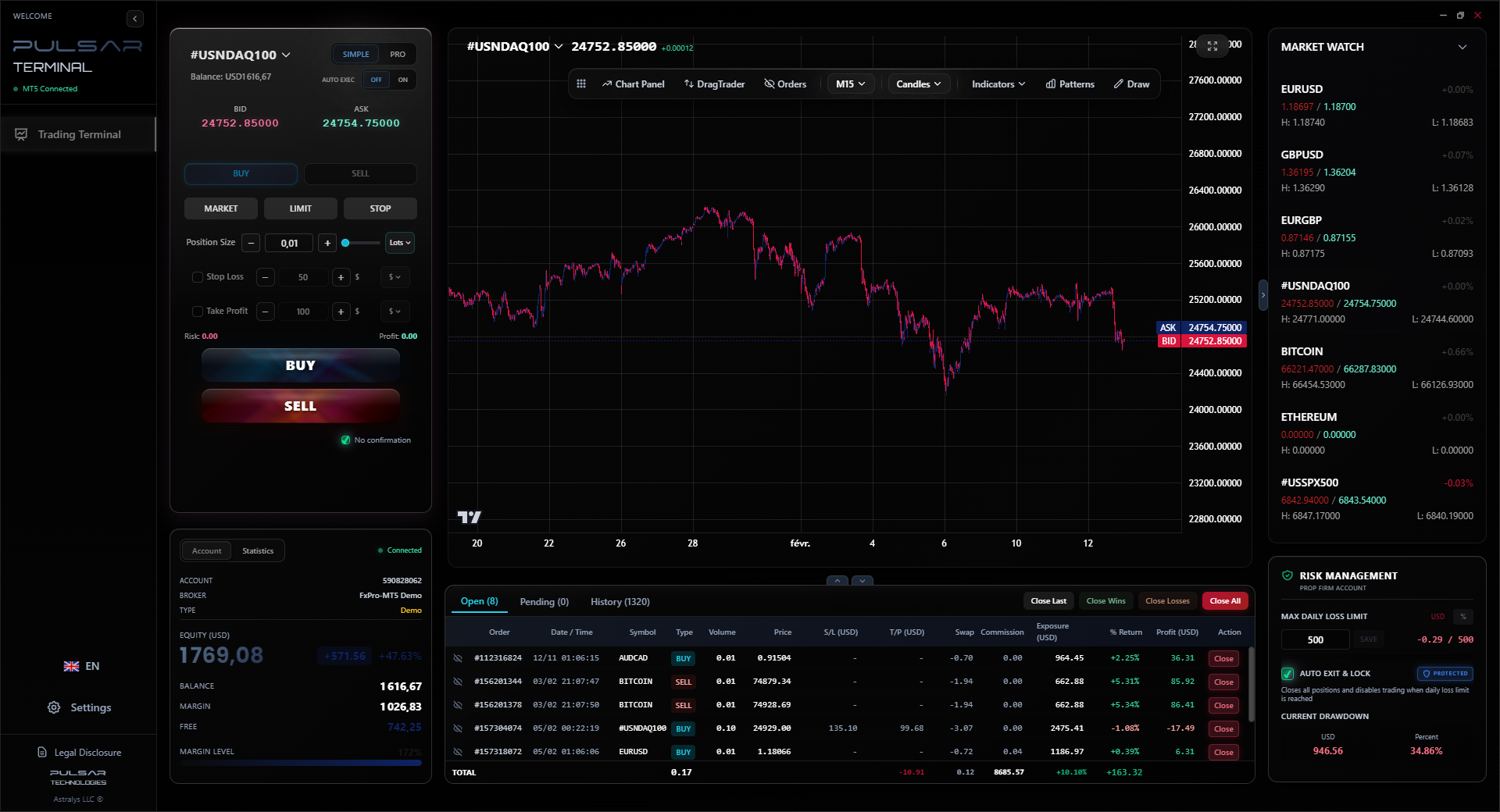
Managing multiple TP levels and trailing stops manually is a hassle, but tools like Pulsar Terminal automate this directly on your MT5 platform, letting you execute advanced exit strategies with a single click.
Pulsar Terminal
A ferramenta MT5 tudo-em-um: ordens drag-and-drop, multi-TP/SL, trailing stop, grid trading, Volume Profile e proteção prop firm. Usado diariamente por 1.000+ traders.
Not all brokers handle orders the same way, and this matters for your TP. You need to understand two things: execution type and requotes.
Execution Type:
- Market Execution: Your TP and SL are triggers. When price hits your level, the broker executes a market order to close your trade. This means you get the next available price, which could be slightly worse if the market is fast (slippage). It's generally reliable.
- Instant Execution: The broker tries to fill you exactly at your requested TP price. If they can't, you might get a requote (a pop-up asking if you'll accept a slightly different price). In a fast market, this can mean missing your TP entirely.
For Nigerian traders, I lean towards brokers with reliable market execution. During high volatility (like around CBN announcements), instant execution can fail you. Check reviews for how a broker handles orders during news events. Brokers like XM or Exness, which are popular here, have detailed policies on this.
Also, test your platform. Place a trade on a demo account and see how smoothly your TP executes. Does it fill at the exact price? Is there noticeable delay? This due diligence is part of your job as a trader.
💡 Dica do Winston
The best TP level is often where it feels a bit uncomfortable, like you're leaving potential profit behind. That's usually the right spot. The comfortable TP is almost always too close.
“The traders who build real wealth are the ones who have learned to say, 'My TP is my TP,' and leave the rest on the table.”
Knowledge is useless without action. Here’s your weekly drill to master TP.
- Backtest with a Focus on Exits. Don't just look for entries. Take 10 old trades from your journal. Re-analyze them. Where should your TP have been based on support/resistance? How would using a 1:2 R:R have changed your outcome? This is eye-opening.
- The Demo Discipline Test. On a demo account, execute 20 trades. Your rule: you must set TP and SL before clicking "buy" or "sell." You cannot modify the TP once set. The goal isn't profit; it's discipline. Can you follow your own plan?
- Calculate Your Real Profit. Take your last winning trade. Calculate the profit in Naira. Now deduct 10% for tax and your estimated data costs for the month. What's your net gain? This keeps you grounded in reality.
Your TP is your contract with yourself. It's the point where you say, "This is enough profit for this trade, given the risk I took." Respect that contract. The market will test you every single day, trying to make you break it. The traders who consistently withdraw profits, pay their taxes, and build real wealth are the ones who have learned to say, "My TP is my TP," and leave the rest on the table for someone else.
FAQ
Q1Is Take Profit the same as selling in forex?
For a buy trade, yes, executing a Take Profit order means selling the currency pair to close the position. For a sell (short) trade, taking profit means buying back the pair to close. TP automates this closing action at your specified price.
Q2What is a good Take Profit level for beginners in Nigeria?
Don't pick a random pip amount. Start by always using a minimum 1:2 Risk-Reward Ratio. If your stop loss is 30 pips away, your take profit should be at least 60 pips away. This builds a profitable habit from day one, even with a modest win rate.
Q3Can I set both Take Profit and Stop Loss on every trade?
Absolutely, and you must. It's non-negotiable. Entering a trade without both is pure gambling. They are two sides of the same coin: your complete exit strategy. Any broker worth using, like those in our Pepperstone review, allows you to set both instantly.
Q4What happens if the price gaps past my Take Profit?
You get filled at the next available price after the gap, which could be much better or worse than your TP level. This is called slippage. It's rare on major pairs but can happen during major news or market opens. A guaranteed stop loss (offered by some brokers for a fee) protects against this, but there's no "guaranteed take profit."
Q5How does the 10% Nigerian capital gains tax affect my TP?
It means your net profit is 10% less than your trading platform shows. When calculating your profit targets and overall strategy returns, you must factor this in. A strategy that yields a 15% gross return yields only a 5% net return after a 10% tax - that changes everything. Plan your TP levels with the taxman in mind.
Q6Should I use Take Profit for scalping?
Yes, even more so. Scalping involves fast trades with small targets (5-15 pips). In such a fast-paced style like scalping, manual closing is too slow and emotional. A pre-set TP ensures you hit your precise target and move on to the next opportunity instantly.
Q7Can I change my TP after placing a trade?
Technically, yes, you can modify the order on your platform. But strategically, you shouldn't unless the fundamental reason for your trade has changed. Moving a TP closer out of fear is a mistake. Moving it further away should only be done if you also move your stop loss to lock in risk-free profit first.
Lição do Prof. Winston
Pontos-chave:
- ✓Always use a minimum 1:2 Risk-Reward Ratio.
- ✓Set TP & SL the moment you enter the trade.
- ✓Factor the 10% capital gains tax into all profit targets.
- ✓Use partial TPs to secure profit and reduce risk.
- ✓Never remove a TP without first moving your stop to breakeven.
Quão útil foi este artigo?
Clique em uma estrela
Insights de Trading Semanal
Análises e estratégias semanais grátis. Sem spam.
Sobre o autor
Olumide Adeyemi
Pioneiro do Trading na África Ocidental
Um dos educadores de trading forex mais ativos da Nigéria. 8 anos de experiência operando a partir de Lagos. Especialista em estratégias de baixo capital e desafios de prop firms para traders africanos.
Comentários
Aviso de risco
A negociação de instrumentos financeiros envolve riscos significativos e pode não ser adequada para todos os investidores. O desempenho passado não garante resultados futuros. Este conteúdo é apenas para fins educacionais e não deve ser considerado aconselhamento de investimento. Sempre conduza sua própria pesquisa antes de negociar.
Você também pode gostar

Cara Trading Forex Sukses: 7 Prinsip dari Trader Profesional
Cara trading forex sukses dengan 7 prinsip trader pro: manajemen modal, disiplin, journal trading, backtest. Data nyata, bukan janji profit palsu.
Jam Trading Forex Terbaik untuk Trader Indonesia: Panduan Lengkap dengan Tabel Waktu
Panduan jam trading forex untuk trader Indonesia. Tabel 4 sesi dunia, jam emas 20:00-00:00, sesi mana yang harus dihindari. Data akurat + tips dari trader berpengalaman.
Top 5 Sàn Forex Uy Tín Nhất 2026: Review Jujur dari Trader Indonesia
Top 5 sàn forex uy tín 2026 untuk trader Indonesia. Review jujur: spread, deposit, withdraw, dukungan lokal. Exness, XM, IC Markets & lebih.
Obter Pulsar Terminal
Todas essas calculadoras estão integradas ao Pulsar Terminal com dados em tempo real da sua conta MT5.
Obter Pulsar Terminal