


I remember my first 'real' forex trade back in 2015.

Olumide Adeyemi
Pioneiro do Trading na África Ocidental ·  Nigeria
☕ 11 min de leitura
O que você vai aprender:
- 1Forex Basics: The Nigerian Angle
- 2The Rules of the Game: Nigerian Regulations & Taxes
- 3Getting Started: Your Practical First Steps
- 4What You're Really Trading: Market Forces & The Naira
- 5The Non-Negotiables: Risk Management for Nigerian Realities
- 6From Theory to Practice: Building Your First Simple Strategy
- 7Pitfalls to Avoid: Lessons from the Trenches
I remember my first 'real' forex trade back in 2015. I'd saved ₦150,000 (about $750 at the time), convinced the USD/JPY was going to drop. I went all in without a stop loss, watching my screen from my Ikeja apartment. The pair moved against me by 80 pips in an hour. I lost ₦48,000 before I panicked and closed. That loss stung for weeks. It taught me that what forex trading is really about isn't quick riches - it's understanding a global market, managing risk in a volatile economy, and navigating Nigeria's unique financial landscape. Let me walk you through what I wish I'd known.
At its core, forex trading is about exchanging one currency for another, betting on which will strengthen or weaken. You're trading currency pairs, like EUR/USD or GBP/JPY. The first currency is the 'base,' the second is the 'quote.' If you buy EUR/USD, you're buying euros and selling dollars, hoping the euro rises.
For us in Nigeria, this has extra layers. Our economy is import-heavy, and the Naira's value directly impacts everything from fuel prices to the cost of your phone data. When you trade forex, you're participating in the same massive, 24-hour market that determines those exchange rates you see on the news. The global daily turnover hit a staggering $9.6 trillion in April 2025. That's more money than changes hands in all the world's stock markets combined.

Example: Let's say you buy 1 standard lot (100,000 units) of GBP/USD at 1.2500. If it moves to 1.2600, that's a 100-pip gain. Since 1 pip on GBP/USD is worth $10 per standard lot, you've made $1,000. But remember, it works the same in reverse for a loss. That's why using a position size calculator before every trade is non-negotiable.
The market is open 24 hours from Monday to Friday, but liquidity - how easy it is to buy and sell - varies. For us on West Africa Time (WAT), the sweet spot is usually between 1:00 PM and 6:00 PM. That's when the London and New York sessions overlap, creating the most movement and opportunity (and risk).

💡 Dica do Winston
Your first investment shouldn't be in a trade, it should be in a journal. Write down every decision, every emotion. The patterns you see in your journal will be more valuable than any indicator.
This is where many new traders get tripped up. Yes, forex trading is legal for individuals in Nigeria. But the regulatory scene has changed dramatically, especially since 2025. You need to know this to protect your capital.
The New Regulatory Reality
For years, online retail forex operated in a bit of a grey area. The Securities and Exchange Commission (SEC) didn't specifically regulate platforms. That changed with the Investments and Securities Act (ISA) 2025. Now, it's illegal for any entity to run an online forex trading platform here without SEC registration. This is a big deal - it means more oversight and, hopefully, more protection against shady local brokers.
The Central Bank of Nigeria (CBN) is the other key player. They manage the Naira and the broader FX market. Their new 'Nigeria Foreign Exchange (FX) Code' aims to promote ethical conduct. More practically for you, the CBN's capital controls can affect how you fund an international trading account. Trying to deposit $5,000 with your Naira debit card might get blocked.
The Tax Man Cometh
Here's a crucial point many 'gurus' skip: your trading profits are taxable. The Federal Inland Revenue Service (FIRS) expects a 10% capital gains tax on your gross profits. I know, I know - it's a pain. But treating this as a business from day one keeps you out of trouble. Keep detailed records of all your trades, deposits, and withdrawals.

Warning: Don't fall for brokers or 'account managers' who promise to hide your profits from the tax authorities. That's a fast track to serious legal issues. Legitimate, internationally regulated brokers like Exness or IC Markets provide proper statements you can use for tax reporting.
“Forex trading isn't about conquering the market today; it's about surviving with enough capital to trade tomorrow.”
So, what's forex trading about in terms of actual setup? Let's break it down without the fluff.
Choosing a Broker in Nigeria
You have two main paths: a locally registered platform (increasingly under SEC rules) or an international broker that accepts Nigerian clients. I've used both. International brokers often offer better technology, tighter spreads, and stronger regulatory oversight from bodies like the UK's FCA or Australia's ASIC.
Look for:
- NGN Account Options: Can you hold and deposit in Naira? Brokers like HFM and OctaFX offer this, which simplifies things.
- Realistic Minimums: You can start with $10, but be honest. A $100-$500 start gives you room to breathe and practice proper risk management. A standard account might need $1,000.
- Payment Methods: Do they accept your preferred method? Common ones here are bank transfers, Naira cards, USSD, and e-wallets like Skrill. Crypto deposits (USDT, etc.) are also popular for bypassing bank limits.
| Broker | Min. Deposit (Approx.) | Key Feature for Nigerians |
|---|---|---|
| XM | $5 | Very low entry, great for micro-lot practice |
| Exness | $10 | Accepts NGN, unlimited use (use cautiously!) |
| Pepperstone | $0 | Razor-thin spreads, top-tier regulation |
| OctaFX | ₦30,000 | Naira accounts, local support |
The Trading Platform
MetaTrader 4 (MT4) or MetaTrader 5 (MT5) are the industry standards. They're reliable, packed with tools, and every broker supports them. Spend your first week just learning the platform - how to place orders, set stops, read charts. Don't even think about real money until you can navigate it blindfolded.
Your First 'Capital'
This isn't just about money. It's about knowledge capital. Budget for learning. It can range from ₦0 (YouTube, babypips.com) to ₦350,000 for high-end mentorship. I spent about ₦80,000 on books and a basic course early on - it was worth every kobo. Your trading edge will come from understanding concepts like the MACD indicator or a scalping strategy, not from a magic signal.
Here's the secret: you're not just trading lines on a chart. You're trading economic expectations, interest rates, and geopolitical stability. This is what forex trading is truly about.
For a Nigerian trader, you must watch the CBN's Monetary Policy Committee (MPC) meetings like a hawk. In 2024, they hiked interest rates to 27.5% to fight inflation. Why does this matter? Higher rates can strengthen a currency by attracting foreign investment seeking better returns. This dynamic drives pairs like USD/NGN (though trading the Naira directly is restricted for retail traders).
You're also trading global sentiment. When the US Federal Reserve hints at rate cuts, the US dollar often weakens against currencies like the Euro. That's your EUR/USD pair in motion. Your job is to interpret news and data - Non-Farm Payrolls in the US, inflation reports in the EU - and gauge how they'll shift the supply and demand for currencies.

Pro Tip: Don't try to trade every news event. The volatility is insane. I learned this the hard way trying to trade the UK GDP release. The spread widened to 15 pips on GBP/USD in seconds, and my stop loss was executed at a terrible price. Now, I either close positions before major news or stay out entirely.
The health of Nigeria's own forex reserves (nearly $50 billion in early 2026) and reforms like the 'willing-buyer, willing-seller' framework impact the Naira's stability. A stable or strengthening Naira can change how you view your profits when you convert them back from dollars. It adds a layer of macro thinking that separates the pros from the punters.
💡 Dica do Winston
In Nigeria, your greatest asset isn't use; it's patience. The market will present a clear opportunity if you wait for it. Impatience is what feeds the brokers' pockets.
“The 10% capital gains tax isn't a penalty; it's the receipt that proves you're running a real, profitable business.”
If I could only teach you one thing, it's this. What forex trading is about, more than anything else, is survival. The market will always be there tomorrow, but only if you have capital left to trade.
The 1% Rule (And Why You'll Ignore It)
The golden rule is to never risk more than 1-2% of your account on a single trade. On a $500 account, that's $5-$10. Sounds easy, right? But when you're down for the month and see a 'sure thing,' the temptation to risk 10% or 20% is overwhelming. I've broken this rule and paid for it. A single bad trade risking 15% can set you back months.
Always use a stop loss. Every. Single. Time. It's not a suggestion; it's a seatbelt. A stop loss defines your maximum loss before you enter the trade. If you don't know where your pip risk is, you have no business being in the market.
use: Your Double-Edged Sword
Brokers in Nigeria often offer insane use - like 1:500 or even 1:1000. This means with $100, you can control a $50,000 position. It's tempting because it magnifies gains. But it magnifies losses even faster. That $5 risk on a $500 account? With high use, a few pips against you can blow through that and trigger a margin call.
My advice? Start with use no higher than 1:10 or 1:20 while you're learning. It forces you to commit more capital per trade, which makes you think harder about each entry. I used 1:100 early on and wiped a $200 account in two trades during a volatile London open. The loss wasn't huge in naira, but the lesson was.
Psychology & The 'Lagos Market' Mentality
We have a hustler's spirit in Nigeria. That's great for business, but dangerous in forex. Forex isn't like buying and selling peppers in Mile 12 Market. You can't just 'hold on' until the price comes back if you're over-leveraged. The market doesn't care about your rent deadline. You have to check your emotions at the door and follow your trading plan, even when it's boring. Especially when it's boring.
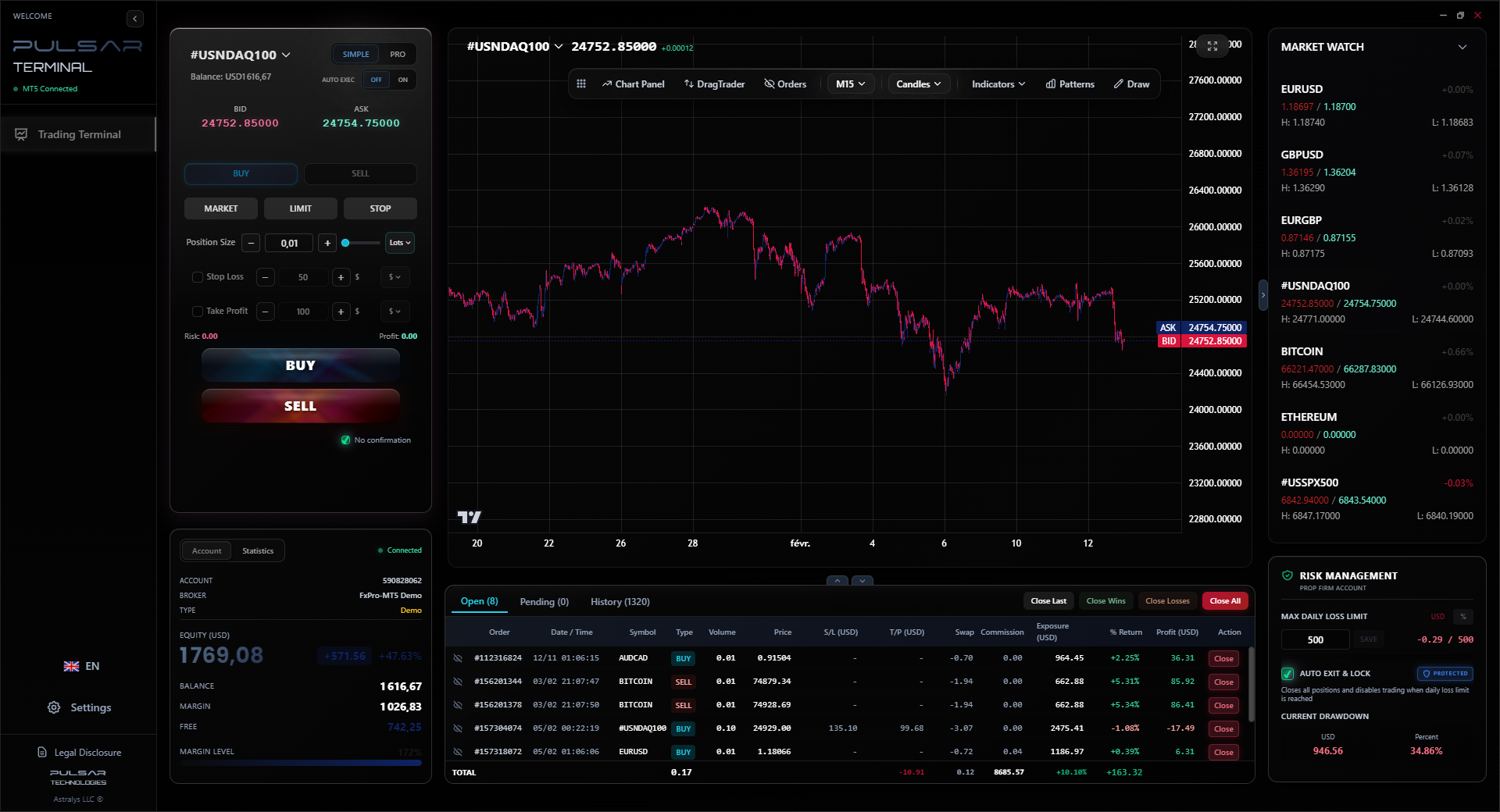
Sticking to your risk management rules is the hardest part of trading, which is why automating your stop losses and take profits with a tool like Pulsar Terminal directly on MT5 is a game-saver.
Pulsar Terminal
A ferramenta MT5 tudo-em-um: ordens drag-and-drop, multi-TP/SL, trailing stop, grid trading, Volume Profile e proteção prop firm. Usado diariamente por 1.000+ traders.
You need a repeatable process. A strategy isn't a crystal ball; it's a set of rules for finding higher-probability setups. Here's a basic framework you can adapt.
Find the Trend
Is the market generally moving up, down, or sideways? Use higher time frames like the 4-hour or daily chart. Don't try to buy a currency pair in a strong downtrend just because it looks 'cheap.' I wasted months trying to catch falling knives in USD/JPY before I learned to trade with the trend.
Wait for a Pullback
In an uptrend, price doesn't go straight up. It rallies, then pulls back (retraces) slightly. Use an indicator like the RSI indicator to help identify when a pullback might be ending. Look for the RSI to dip near 40 (in an uptrend) or pop above 60 (in a downtrend) and then start turning back.
Look for a Confirmation Signal
This is your trigger to enter. It could be:
- A specific candlestick pattern (like a bullish engulfing bar after a pullback in an uptrend).
- The price breaking above a recent minor resistance level.
- The MACD histogram turning positive.
Define Your Exit Before You Enter
Where will you take profit? Where will you admit you're wrong (stop loss)? A common approach is to aim for a risk-to-reward ratio of at least 1:1.5. If you're risking 20 pips, your target should be at least 30 pips away.
This is just a skeleton. The key is to test it in a demo account for at least 50-100 trades. Write down every trade - why you took it, the outcome, how you felt. Review your journal weekly. You'll start to see your own biases (I was always too early on my entries) and refine your rules.
For a different approach, you might explore swing trading, which involves holding trades for several days, perfect if you can't watch the charts all day.
💡 Dica do Winston
Treat your trading capital like a seed for a mango tree. You wouldn't dig it up every day to check on the roots. Give your strategy and compound growth time to work.
“A stop loss isn't a suggestion; it's a financial seatbelt. You only realize you need it when it's too late.”
Let me save you some pain and lost money by sharing the most common mistakes I see.
Chasing 'Account Managers' on WhatsApp: If someone DMs you promising 50% returns a month if you send them your money, run. No legitimate, profitable trader has time to manage random people's accounts for a small fee. This is a huge scam environment.
Over-Trading: This was my biggest flaw. I'd sit at my screen in Port Harcourt, bored, and take trades just for the excitement. More trades don't equal more money. Quality over quantity. Sometimes the best trade is no trade at all.
Ignoring the Cost of Trading: The spread and potential commissions are the cost of doing business. On a broker with a 2-pip spread on EUR/USD, you start every trade down $20 on a standard lot. Your first 2 pips of movement just break you even. That's why seeking brokers with tight spreads, like Pepperstone or IC Markets, can make a real difference to your bottom line over hundreds of trades.
Not Having a Life Outside Trading: Forex can consume you. It's 24/5, and the charts are always there. If your mood is dictated by your daily P&L, you'll burn out. Have other hobbies, a job, or a business. It gives you the mental stability to stick to your rules.
Remember, the market has been around for decades and will be here long after us. Your goal isn't to conquer it today. Your goal is to learn, manage risk, and grow steadily. That's what sustainable forex trading is about.
FAQ
Q1Is forex trading legal and safe in Nigeria?
Yes, forex trading is legal for individuals in Nigeria. The safety aspect has improved with the new Investments and Securities Act (ISA) 2025, which requires online forex platforms to register with the SEC. For greater safety, many Nigerians use well-regulated international brokers with strong track records.
Q2How much money do I need to start forex trading in Nigeria?
Technically, you can start with as little as $5-$10 with some brokers. However, for practical learning and proper risk management, a starting capital of $100 to $500 (roughly ₦20,000 to ₦100,000, depending on the exchange rate) is more realistic. This allows you to trade micro lots and survive the inevitable learning-curve losses.
Q3How do I pay taxes on my forex trading profits?
You are required to pay a 10% capital gains tax on your gross trading profits to the Federal Inland Revenue Service (FIRS). You must keep detailed records of all your trades, deposits, and withdrawals throughout the year. It's wise to consult with a local accountant familiar with forex trading income.
Q4What is the best time to trade forex in Nigeria?
The most active and liquid trading session for Nigerian traders is between 1:00 PM and 6:00 PM West Africa Time (WAT). This overlaps with the late London session and the early New York session, when the highest volume of trades occurs, leading to better opportunities and tighter spreads.
Q5Can I trade the Nigerian Naira (NGN) directly?
Direct trading of the Naira (like NGN/USD) on major retail forex platforms is very limited due to CBN restrictions on the currency. Most Nigerian traders focus on major international pairs like EUR/USD, GBP/USD, and XAU/USD (gold). Some brokers offer Naira-denominated accounts, but you're still trading the global pairs.
Q6What's the difference between a demo account and a live account?
A demo account uses virtual money and simulates real trading conditions. It's for practice and testing strategies risk-free. A live account uses your real money. The key difference is psychology - the fear and greed you feel with real capital can lead to mistakes you don't make on demo. Always practice extensively on demo first.
Lição do Prof. Winston
Pontos-chave:
- ✓Risk a maximum of 1-2% per trade, no exceptions.
- ✓Master the 4-hour chart trend before the 5-minute noise.
- ✓Document 100 demo trades before going live.
- ✓Factor the 10% capital gains tax into your profit goals.
Quão útil foi este artigo?
Clique em uma estrela
Insights de Trading Semanal
Análises e estratégias semanais grátis. Sem spam.
Sobre o autor
Olumide Adeyemi
Pioneiro do Trading na África Ocidental
Um dos educadores de trading forex mais ativos da Nigéria. 8 anos de experiência operando a partir de Lagos. Especialista em estratégias de baixo capital e desafios de prop firms para traders africanos.
Comentários
Aviso de risco
A negociação de instrumentos financeiros envolve riscos significativos e pode não ser adequada para todos os investidores. O desempenho passado não garante resultados futuros. Este conteúdo é apenas para fins educacionais e não deve ser considerado aconselhamento de investimento. Sempre conduza sua própria pesquisa antes de negociar.
Você também pode gostar

Cara Trading Forex Sukses: 7 Prinsip dari Trader Profesional
Cara trading forex sukses dengan 7 prinsip trader pro: manajemen modal, disiplin, journal trading, backtest. Data nyata, bukan janji profit palsu.
Jam Trading Forex Terbaik untuk Trader Indonesia: Panduan Lengkap dengan Tabel Waktu
Panduan jam trading forex untuk trader Indonesia. Tabel 4 sesi dunia, jam emas 20:00-00:00, sesi mana yang harus dihindari. Data akurat + tips dari trader berpengalaman.
Top 5 Sàn Forex Uy Tín Nhất 2026: Review Jujur dari Trader Indonesia
Top 5 sàn forex uy tín 2026 untuk trader Indonesia. Review jujur: spread, deposit, withdraw, dukungan lokal. Exness, XM, IC Markets & lebih.
Obter Pulsar Terminal
Todas essas calculadoras estão integradas ao Pulsar Terminal com dados em tempo real da sua conta MT5.
Obter Pulsar Terminal