


So you're sitting there, maybe with a cup of rooibos, scrolling through trading forums and wondering, 'Should I really get into this forex thing?' Everyone talks about it, but is it just hype or a genuine opportunity for someone in SA? I get it.

David van der Merwe
Trader de Mercados Emergentes ·  South Africa
☕ 9 min de leitura
O que você vai aprender:
- 1What Is Forex, Really? (It's Not What You Think)
- 2The Biggest Advantages for SA Traders
- 3The Flip Side: Risks and Realities No One Likes to Mention
- 4Getting Started: Your Practical First Steps in SA
- 5Forex vs. Other Markets: JSE, Crypto, and Property
- 6Building a Sustainable Trading Approach
- 7So, Is Forex Right for You?
So you're sitting there, maybe with a cup of rooibos, scrolling through trading forums and wondering, 'Should I really get into this forex thing?' Everyone talks about it, but is it just hype or a genuine opportunity for someone in SA? I get it. I had the same questions over a decade ago. Let's cut through the noise and talk about what trading the forex market actually means for you, with our unique perspective here at the southern tip of Africa.
Forex, or foreign exchange, is simply the market where currencies are traded. When you buy euros with US dollars, you're trading forex. But here's the thing most beginners miss: you're not just betting on a price. You're trading the relative strength of one economy against another.
For us in South Africa, this is huge. It means we can trade the Rand's value against major currencies like the USD (USD/ZAR) or the Euro (EUR/ZAR). You're getting a front-row seat to global economics. The market is open 24 hours a day, five days a week, because when we're sleeping, Tokyo is open, and when we're having braai, London is trading.

Example: Let's say you believe the Rand will strengthen against the Dollar. You'd buy the ZAR and sell the USD, which in trading terms is going long on USD/ZAR (wait, that's confusing, right?). Actually, if the pair goes DOWN, the Rand is getting stronger. This inverse relationship trips up a lot of new traders. Getting your head around the quote is job number one.
The sheer size of the market - trillions traded daily - means it's very hard for any single entity to manipulate prices for long. That's a level of fairness you don't always get in smaller stock markets. But with that size comes volatility, especially for exotic pairs like USD/ZAR, which can have wild swings during local political announcements or global risk-off events.

💡 Dica do Winston
Your first R10,000 in the market is tuition, not investment. Expect to pay for your education, but make sure you're actually learning from each loss.
Let's talk about the real draws, especially from our local viewpoint.
Access and Low Barriers
You don't need millions. I started with a demo account, then put in R5,000. That's it. Compared to trying to buy a portfolio of JSE shares with proper diversification, the entry point is low. International brokers like Exness or IC Markets offer accounts to South Africans with low minimum deposits. You can trade micro-lots, which means you're risking a few hundred Rand per trade, not your life savings.
Trade the Rand Directly
This is our superpower. We live and breathe the economic news that moves the ZAR. Eskom loadshedding announcements, SARB interest rate decisions, political developments - you feel their impact immediately. You can use that local knowledge. While a trader in the US is asleep, you're watching the ZAR react to local data.
Liquidity and Speed
Major pairs like EUR/USD are so liquid you can get in and out of trades in milliseconds. This is perfect for certain styles, like scalping, where you're aiming for small, frequent profits. Just remember, liquidity in USD/ZAR isn't quite the same as in EUR/USD. Spreads can be wider, so factor that into your costs.

Pro Tip: Don't just trade ZAR pairs because they're familiar. Sometimes the best opportunities are in majors like EUR/USD where spreads are tightest. Use your local knowledge for context, not as your only tool.
use: A Double-Edged Sword
South African brokers, under the FSCA, and international ones offering services here, provide use. This means you can control a R100,000 position with maybe R2,000 in your account. It magnifies both gains and losses. I learned this the hard way early on. A 50-pip move against you on a highly leveraged account can trigger a margin call faster than you can say 'eish.'
“Forex is a fantastic market for active, tactical trading. It's not a 'set and forget' investment.”
Alright, time for some real talk. The forex marketing makes it look easy. It's not. Here's what they don't put in the brochure.
First, the majority of retail traders lose money. I was part of that statistic in my first year. I blew up two small accounts because I treated it like gambling, not a business. I didn't use a position size calculator, I chased losses, and I ignored my own stop-losses. It was a brutal, expensive lesson.
use is the main culprit. It makes small market movements feel huge. A 1% move in the underlying market can be a 20% move on your account with 20:1 use. That's exciting when it's in your favor, devastating when it's not.
Then there's the psychological grind. It's lonely. You're staring at charts, often against the world. When you're in a losing streak, doubt creeps in. I once held a losing USD/ZAR trade for two weeks, hoping it would come back, turning a small R500 loss into a R2,500 loss. Hope is not a strategy.
Finally, costs eat into profits. The spread - the difference between the buy and sell price - is a cost you pay on every single trade. With exotic pairs, these spreads are higher. Overnight financing charges (swap rates) can also add up if you hold positions for days or weeks, which is common in swing trading. You have to make enough to cover these costs first, before you see any profit.
Convinced to give it a go? Here's how to start without lighting your money on fire.
- Education First, Money Later: Don't deposit a cent yet. Open a demo account with a reputable broker. XM and Pepperstone offer great demo platforms that mirror live conditions. Practice for at least 2-3 months. Treat the virtual money like it's real.
- Learn the Lingo: Understand what a pip is, how to calculate its value in Rands, what a spread is, and what margin means. If you don't know these, you're driving blind.
- Pick a Style: Are you a scalper, in and out in minutes? A day trader? A swing trader holding for days? Your personality dictates this. I'm impatient, so I found longer-term swing trading forced discipline on me, which was good.
- Start Absurdly Small: When you go live, start with a micro account. Risk no more than 1% of your account on any single trade. Use that position size calculator every single time. No exceptions.
- Focus on One or Two Pairs: Don't try to watch 20 currency pairs. Start with a major like EUR/USD (liquidity is great) and maybe USD/ZAR if you want to apply local insight. Learn their personality - how they move during different sessions.

Warning: Beware of 'gurus' selling secret forex systems, especially those targeting South Africans with promises of easy Rand riches. If their system was so foolproof, they'd be trading it, not selling it for R499. Your best education is screen time and managing real emotions with real risk.
💡 Dica do Winston
The ZAR is a sentiment gauge for emerging markets. When global investors get scared, they sell ZAR first. Watch USD/ZAR as a global 'risk-off' indicator.
“Hope is not a strategy. I learned that by turning a R500 loss into a R2,500 loss.”
Let's put forex in context with other options you might be considering.
| Market | Pros for SA Traders | Cons for SA Traders |
|---|---|---|
| Forex | 24/5 access, high liquidity, low entry cost, direct ZAR trading. | Very high use risk, emotionally intense, dominated by global news. |
| JSE Shares | Tangible companies you know (Shoprite, Sasol), dividends, less volatile intraday. | Limited diversification (SA economy risk), higher brokerage fees, slower settlement (T+3). |
| Crypto | Extreme volatility for big swings, 24/7 market, decentralized. | Extreme volatility (wipes accounts), unregulated, high scam risk, complex custody. |
| Property | Tangible asset, can use use (bond), rental income. | Illiquid, high transaction costs, massive capital required, not passive. |
My take? Forex is a fantastic market for active, tactical trading. It's not a 'set and forget' investment. The JSE is better for long-term wealth building through equities. I use both: a core portfolio of JSE stocks for growth, and forex trading for active income generation. They serve completely different purposes in my financial life.
Crypto? I dabble with money I'm prepared to lose completely. It's a casino with better graphics. Property is a foundation asset, but it's not trading. Don't confuse them.
Making one winning trade is luck. Making consistent profits over years is a system. Here's the framework that saved me from myself.
Your Three Pillars
- A Clear Strategy: This is your rulebook. It must define your entry triggers, your exit targets, and your stop-loss level. Is it based on price action? MACD indicator crossovers? RSI indicator divergence? It doesn't have to be complex. My most reliable strategy for years was simple support/resistance breaks on the 4-hour chart. Backtest it on historical data first.
- Iron-Clad Risk Management: This is non-negotiable. Decide your risk per trade (e.g., 1% of account) and stick to it. Use stop-losses on EVERY trade. Period. I don't care if you 'have a feeling.' This one habit separates the survivors from the casualties.
- The Right Mindset: You will have losing trades. Many of them. A good strategy might only win 40-50% of the time. You need the emotional discipline to follow your plan even after three losses in a row. This is the hardest part.
Tools That Help
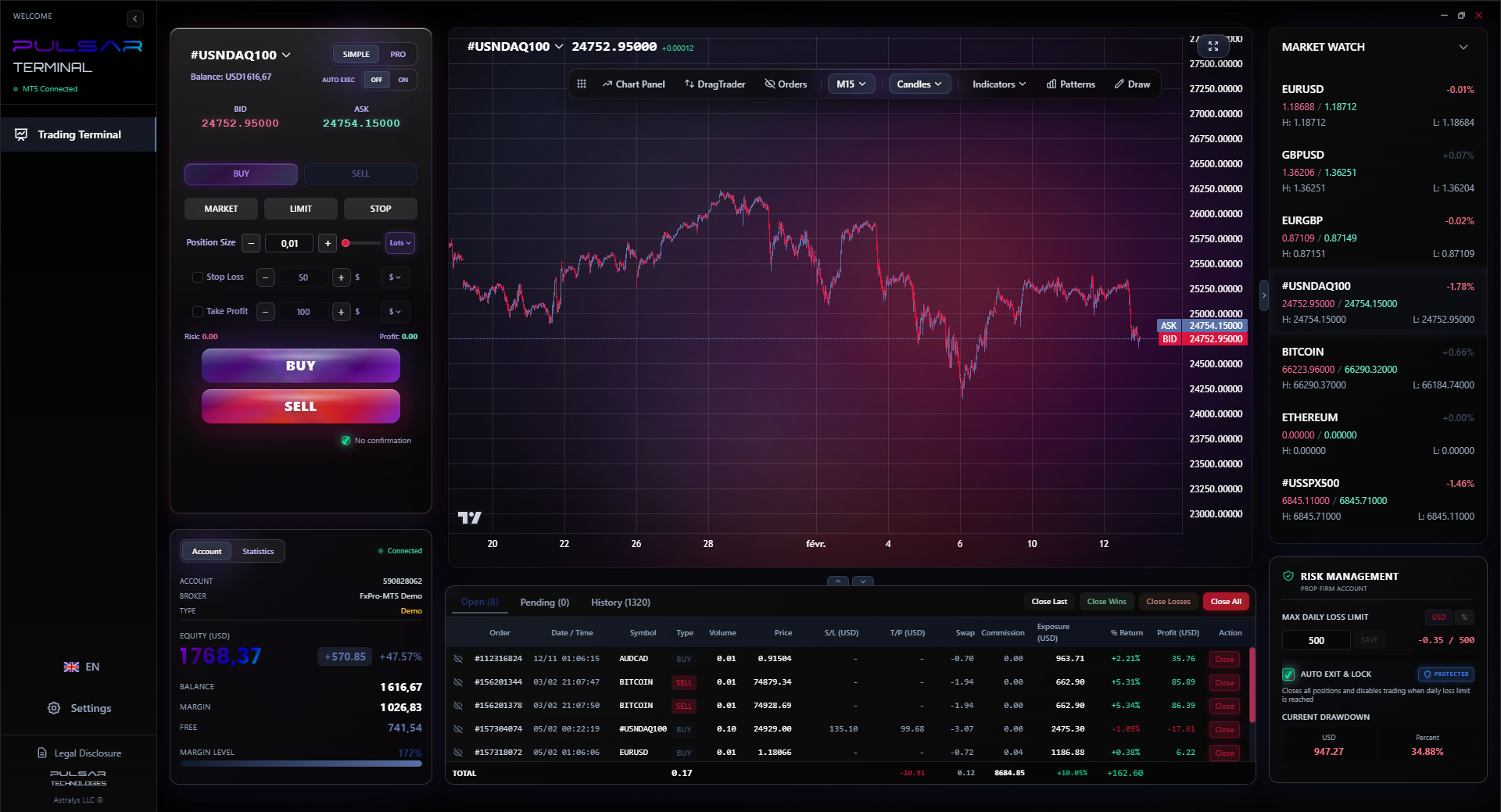
This is where technology bridges the gap between intention and action. Managing multiple trades, setting trailing stops, and protecting your daily drawdown manually is stressful and error-prone.
Having a tool that automates these mechanics - like setting a breakeven stop once a trade is in profit, or a trailing stop to lock in gains - lets you focus on analysis, not just clicking buttons. It enforces the discipline your emotions might fight against.
💡 Dica do Winston
If you find yourself constantly moving your stop-loss further away, just close the trade. Your analysis was wrong. Admit it, take the small loss, and wait for the next setup.
Sticking to a risk management plan is the hardest part of trading, which is why tools like Pulsar Terminal that automate stop-loss, take-profit, and breakeven orders directly on MT5 can be a game-saver for discipline.
Pulsar Terminal
A ferramenta MT5 tudo-em-um: ordens drag-and-drop, multi-TP/SL, trailing stop, grid trading, Volume Profile e proteção prop firm. Usado diariamente por 1.000+ traders.
“Your first R10,000 in the market is tuition, not investment.”
Let's circle back to the original question: why trade forex?
Trade forex if: you're fascinated by global economics, you can handle stress, you're disciplined enough to follow rules (especially when losing), you view it as a skill to be learned over years, and you have risk capital you can afford to lose.
Don't trade forex if: you need quick cash, you're prone to gambling, you can't control your emotions, you expect to get rich overnight, or you're using money meant for rent, school fees, or savings.
For me, trading forex has been a journey of constant learning. It's humbling. It's given me financial independence and a deep understanding of how the world's financial plumbing works. But it also cost me sleep, money, and a fair bit of frustration along the way.
Start slow. Start small. Respect the market. It doesn't care about your hopes, your mortgage, or your ego. But if you approach it with the seriousness it demands, it can offer opportunities you won't find anywhere else, right from your desk in Cape Town, Johannesburg, or Durban. Maybe start by mastering one pair, like EUR/USD, before venturing into the volatile but familiar waters of XAU/USD or USD/ZAR. Good luck, and trade safe.
FAQ
Q1How much money do I need to start trading forex in South Africa?
Technically, you can start with a few hundred Rand thanks to micro accounts. Realistically, I'd suggest a minimum of R5,000 - R10,000 in risk capital (money you can afford to lose) for a live account. This allows for proper position sizing and surviving the inevitable drawdowns without blowing up your account on a few bad trades. Always start on a demo first, though.
Q2Is forex trading legal and taxed in South Africa?
Yes, it's completely legal. You can trade with both local FSCA-regulated brokers and reputable international ones. For tax, the South African Revenue Service (SARS) views trading profits as income if you're trading frequently (seen as carrying on a business). This income is added to your other income and taxed at your marginal rate. Keep detailed records of all your trades, profits, and losses.
Q3What's the best time to trade forex from South Africa?
The most volatile (and opportunity-rich) overlap for us is the London session, from around 10:00 SAST to 19:00 SAST. This is when the European markets are in full swing and liquidity is high. The New York session overlap (from about 15:00 SAST) also brings big moves. The Asian session (overnight for us) is typically quieter for major pairs, but can set the tone for the day.
Q4Which currency pairs should a South African beginner start with?
I strongly recommend starting with a major pair like EUR/USD. It has the tightest spreads, massive liquidity, and tons of free analysis available. It removes the variable of wide spreads from the equation while you learn. Once you're comfortable, then consider pairs involving the ZAR, like USD/ZAR, but be ready for wider spreads and more volatile moves driven by local news.
Q5Can I make a living trading forex from South Africa?
It's possible, but it's incredibly difficult and shouldn't be your initial goal. Most professional traders have years of experience, a large enough capital base to generate meaningful income without excessive risk, and treat it like a full-time business. Aim to become consistently profitable with a small account first. Thinking about 'making a living' from day one puts immense pressure on every trade, which usually leads to bad decisions.
Q6What's the biggest mistake new South African forex traders make?
Two stand out: 1) Over-leveraging. Using too much use because their account is small, which turns a normal market fluctuation into an account-ending event. 2) Trading USD/ZAR based on emotion or local news headlines without a technical plan. Just because you think the Rand 'should' strengthen doesn't mean the market agrees at that moment.
Lição do Prof. Winston
Pontos-chave:
- ✓Start with majors like EUR/USD, not just ZAR pairs.
- ✓Risk a maximum of 1% of your capital per trade.
- ✓Demo trade for 3 months before using real money.
- ✓use magnifies losses faster than gains.
Quão útil foi este artigo?
Clique em uma estrela
Insights de Trading Semanal
Análises e estratégias semanais grátis. Sem spam.
Sobre o autor
David van der Merwe
Trader de Mercados Emergentes
Trader sediado em Joanesburgo com 11 anos em moedas de mercados emergentes. Especialista em pares ZAR, trading regulado pela FSCA e análise do mercado sul-africano.
Comentários
Aviso de risco
A negociação de instrumentos financeiros envolve riscos significativos e pode não ser adequada para todos os investidores. O desempenho passado não garante resultados futuros. Este conteúdo é apenas para fins educacionais e não deve ser considerado aconselhamento de investimento. Sempre conduza sua própria pesquisa antes de negociar.
Você também pode gostar

Cara Trading Forex Sukses: 7 Prinsip dari Trader Profesional
Cara trading forex sukses dengan 7 prinsip trader pro: manajemen modal, disiplin, journal trading, backtest. Data nyata, bukan janji profit palsu.
Jam Trading Forex Terbaik untuk Trader Indonesia: Panduan Lengkap dengan Tabel Waktu
Panduan jam trading forex untuk trader Indonesia. Tabel 4 sesi dunia, jam emas 20:00-00:00, sesi mana yang harus dihindari. Data akurat + tips dari trader berpengalaman.
Top 5 Sàn Forex Uy Tín Nhất 2026: Review Jujur dari Trader Indonesia
Top 5 sàn forex uy tín 2026 untuk trader Indonesia. Review jujur: spread, deposit, withdraw, dukungan lokal. Exness, XM, IC Markets & lebih.
Obter Pulsar Terminal
Todas essas calculadoras estão integradas ao Pulsar Terminal com dados em tempo real da sua conta MT5.
Obter Pulsar Terminal