


I was glued to my screen, watching EUR/USD tick at 1.0850.

Rajesh Sharma
Analista Forex Sênior ·  India
India
☕ 9 min de leitura
O que você vai aprender:
- 1Zero Spread is a Marketing Gimmick. Here's the Math.
- 2The Ugly Legal Truth for Indian Traders
- 3Broker Comparison: Spreads, Commissions & The Indian Angle
- 4Who Actually Benefits from a Zero-Spread Account? (Hint: It's Not Everyone)
- 5The Hidden Fees That Will Eat Your Profits
- 6A Pragmatic Path for the Indian Trader

I was glued to my screen, watching EUR/USD tick at 1.0850. My broker's platform flashed '0.0 pips' in bright green. I felt like a genius, getting in with no spread cost. Two hours later, I closed the trade for a 15-pip gain. My profit? About $8.50. That's when the commission hit - $7 flat. My 'zero spread' victory netted me a grand total of $1.50 before other fees. That's the reality they don't put in the ads. Let's cut through the marketing and talk about what a zero spread forex broker actually means for you, an Indian trader navigating a minefield of regulations.
There's no such thing as a free lunch, and there's no such thing as truly free trading. When a broker advertises 'zero spread,' they're almost always talking about the raw interbank spread. Their profit comes from a separate commission, usually charged per lot traded.
Think of it like a restaurant with 'free' water but a ₹500 cover charge. The cost is just moved to a different line item. For a standard lot (100,000 units), a common commission structure is $7 per round turn (open and close). On a micro lot (1,000 units), that might be $0.07. It's not hidden, but it's easy to miss when you're dazzled by that 0.0 on the chart.

Example: Let's say you buy 1 standard lot of EUR/USD on a 'zero spread' account. Entry at 1.08500, exit at 1.08650 (a 15-pip move).
- Gross Profit: 15 pips x $10 per pip = $150
- Commission: $7 (open) + $7 (close) = $14
- Net Profit: $136 On a standard account with a 1.5-pip spread and no commission, your net on the same move would be $135. The difference is negligible for most trades. The real benefit isn't cost, it's precision for certain strategies like scalping.
I learned this the hard way early on. I was scalping the EUR/USD for 3-5 pip moves, thinking the zero spread was my edge. After 20 trades in a day, I was up 42 pips gross. My commission bill was $280. I ended the day down $38. My edge wasn't the spread; it was my strategy, and the commission structure completely erased it. Always, always use a position size calculator that includes commission inputs.

💡 Dica do Winston
A 'zero spread' is just a price tag without a number. The invoice always comes later, usually as a commission. Calculate the total cost per trade, not just the advertised spread.

This is the part most 'broker review' sites gloss over because it's inconvenient. For an Indian resident, the legal framework is brutally clear, and it makes the search for an international zero spread forex broker a legally gray area, at best.
What's Actually Legal
You are allowed to trade currency derivatives on Indian exchanges like the NSE, BSE, and MSE. The permitted pairs are all INR-based: USD/INR, EUR/INR, GBP/INR, and JPY/INR. You do this through a SEBI-regulated broker like Zerodha, Upstox, or Angel One. These are not 'zero spread' environments; they have defined costs and excellent regulation.
What's NOT Legal (The Big One)
Trading major forex pairs like EUR/USD, GBP/USD, or XAU/USD with an offshore broker is prohibited for speculative purposes under FEMA (Foreign Exchange Management Act). The RBI has explicitly stated you cannot use the Liberalised Remittance Scheme (LRS) to fund speculative forex trading accounts abroad.
So, when you see an ad for IC Markets or Pepperstone offering glorious 0.0-pip spreads to Indian clients, understand the context. You are dealing with that broker's offshore entity (often in Cyprus, Mauritius, or the Seychelles). You are technically breaking Indian law if you deposit funds and trade non-INR pairs.
The enforcement risk is generally considered low for retail traders, but it's not zero. Banks can block transactions, and the tax implications are messy. I know dozens of traders who do it. I've done it. But going in, you must know you're operating in a regulatory shadow.
“For an Indian trader, the search for a zero spread broker is often a walk into a legal gray area.”
Let's look at real numbers. Forget the flashy headlines; we need to see the total cost of a typical trade. The table below compares common structures. Remember, 'Min. Deposit' is what you need to start, but your real concern should be the cost per trade.
| Broker (Int'l) | Account Type | Avg. EUR/USD Spread | Commission (per lot rt) | Min. Deposit | Accepts IN Clients? |
|---|---|---|---|---|---|
| IC Markets | Raw Spread | 0.0 pips | $7.00 | $200 | Yes (Offshore) |
| Pepperstone | Razor | 0.0 pips | $7.00 AUD | $200 | Yes (Offshore) |
| FP Markets | Raw ECN | 0.0 pips | $6.00 | $100 | Yes (Offshore) |
| XM | Standard | 1.6-1.8 pips | $0.00 | $5 | Yes (Offshore) |
| Exness | Pro | 0.1-0.3 pips | $0.00 | $200 | Yes (Offshore) |
| SEBI Broker | Standard | N/A (INR Pairs) | Brokerage + Fees | ~₹500 | Yes (Fully Legal) |

Warning: That 'Accepts IN Clients?' checkmark is not a legal blessing. It means the broker's compliance department will open your account. It does not mean the RBI or SEBI approves of your activity. Funding these accounts often involves international bank transfers or crypto, adding 3-5% in payment processing fees on top of everything else.
Notice XM and Exness in the list? They often use a different model: slightly higher raw spreads but no commission. For a high-volume scalper, the zero-commission model can sometimes work out cheaper than zero-spread-plus-commission. You have to run your own numbers based on your average trade size and frequency.
My personal experience? I ran accounts with both models simultaneously for a month. On my scalping strategy, doing 5-10 trades a day on micro lots, the XM-style account was cheaper. For my friend doing 2-3 large swing trading positions per week, the IC Markets raw spread account was better. There's no universal winner.
If you're a new trader with a ₹50,000 account, chasing a zero spread forex broker is a distraction. It's like a new driver obsessing over the turbo boost in a Formula 1 car. You need to learn control first.
You might need a raw spread account if:
- You are a high-frequency scalper. When your profit target is 3-5 pips, a 1.5-pip spread eats 30-50% of your potential gain before you even start. Every fraction of a pip matters.
- You trade large volumes. On a $100,000 position, a 0.5-pip difference in spread is $50. Over hundreds of trades, that adds up.
- You use automated strategies (EAs) that rely on ultra-precise entry and exit levels. Slippage and wide spreads can break a good algorithm.
You should probably avoid it if:
- You are a beginner. Focus on your strategy, not shaving 0.2 pips off your cost.
- You are a swing trader holding positions for days or weeks. A 2-pip spread is meaningless on a 200-pip move.
- Your account size is small. The commission will be a disproportionately large chunk of your profits.
- You cannot consistently maintain strong risk management. Lower trading costs won't save you from poor discipline and a margin call.
I made the mistake of switching to a raw account way too early. My psychology changed. I felt pressure to 'use' the tight spreads, leading me to overtrade. I was making twenty 2-pip scalps instead of two well-planned 20-pip swings. My broker loved the commission flow. My account did not.
💡 Dica do Winston
Your first ₹50,000 in trading losses is tuition. Don't pay extra for a 'premium' zero-spread account during your education. A standard account teaches the same lessons cheaper.
“Choosing between spread and commission isn't about getting a better deal; it's about matching the cost structure to your strategy.”
Brokers are brilliant at moving costs around. You think you've beaten the system with your zero spread account, but they'll get their money elsewhere. Here’s where to look:
1. The Funding Fee (The Indian Special): Depositing to an offshore broker? If you use an international card or bank transfer, your bank will charge a forex markup (2-4%) plus an international transaction fee (₹200-500). If you use a crypto gateway, there's a network fee. That ₹10,000 deposit might only be $110 in your trading account. That's an instant 4-5% loss before trade one.
2. The Inactivity Fee: Many brokers charge $5-15 per month if you don't place a trade. Read the fine print.
3. The Currency Conversion Fee: If your account is in USD but your money is in INR, every deposit and withdrawal gets converted. The broker's rate is always worse than the mid-market rate. A 0.5-1% skim here is standard.
4. The Withdrawal Fee: Getting your money back can cost $20-50 per transaction. Some brokers offer one free withdrawal a month; others charge every time.
5. The 'Guaranteed' Stop Loss Fee: Some brokers offer this 'protection' for a premium if your stop is triggered. It's rarely worth it.

Pro Tip: Before funding any account, google '[Broker Name] + withdrawal fee India'. The forum complaints will tell you the real story. I once spent $35 in fees to withdraw $150 profit from a broker. That was the last time I traded with them.

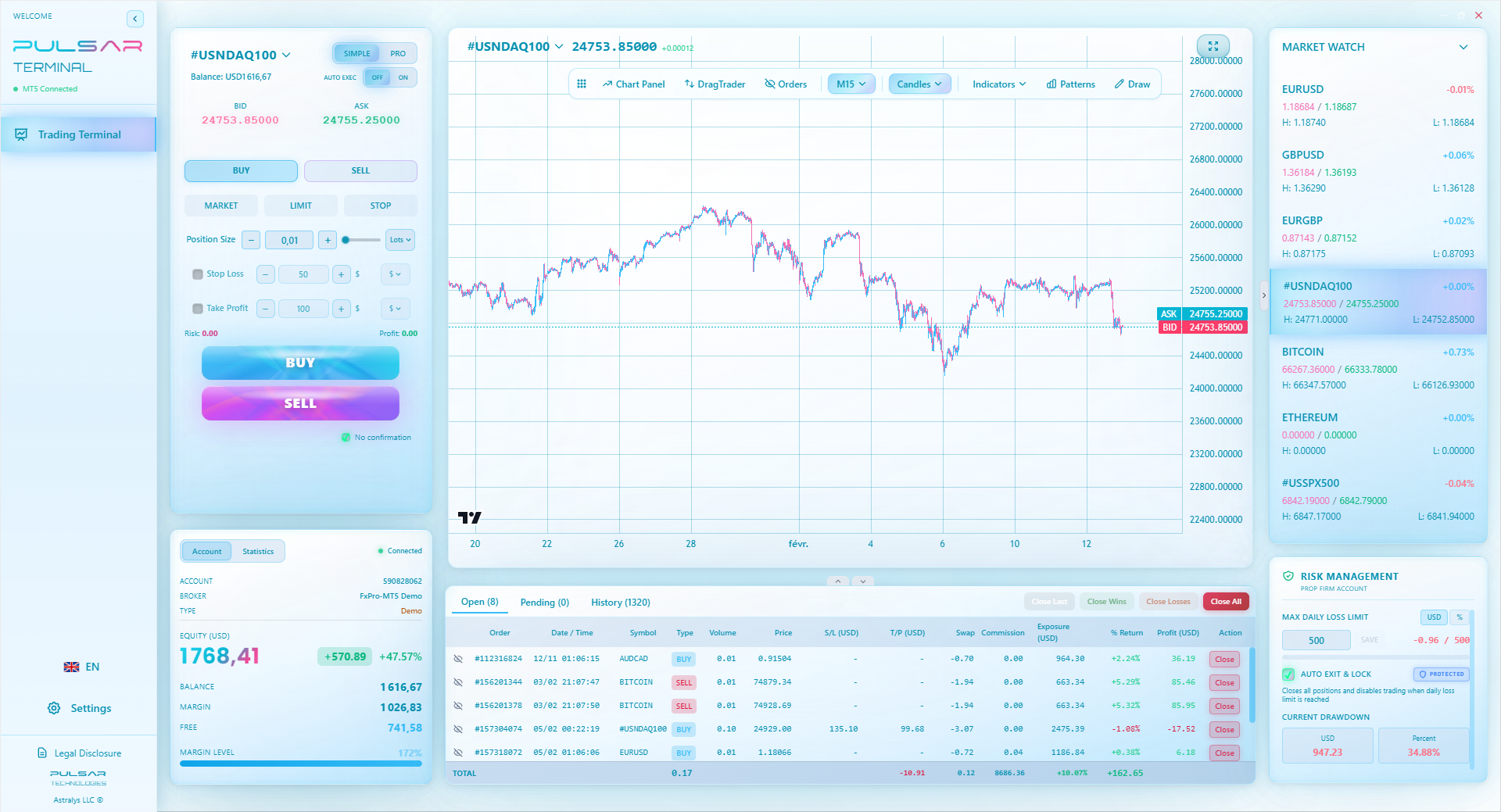
Managing complex trades across multiple lots is where raw spread accounts shine, and a tool like Pulsar Terminal lets you execute advanced order types like multi-TP/SL and trailing stops directly on MT5 with precision.
Pulsar Terminal
A ferramenta MT5 tudo-em-um: ordens drag-and-drop, multi-TP/SL, trailing stop, grid trading, Volume Profile e proteção prop firm. Usado diariamente por 1.000+ traders.
Given the legal tightrope and the cost complexities, what's a sensible approach?
Step 1: Start Legally. Open a demo account with a SEBI broker and trade USD/INR futures. Learn how the markets work, how use functions, and how to manage risk in a fully regulated, low-stress environment. Your goal here is education, not getting rich.
Step 2: If You Go Offshore, Be a Ghost. If you decide to trade majors with an international broker, understand it's a business decision with legal risk. Choose a reputable, well-regulated broker (like ASIC or FCA-regulated, though many have shifted clients to offshore entities). Exness and IC Markets are popular for a reason: they are stable and have clear pricing. Start with the smallest possible deposit to test the funding/withdrawal process.
Step 3: Choose Your Account Type Based on Strategy.
- Scalper: Look at raw/ECN accounts from IC Markets or Pepperstone. Factor the commission into every single trade plan.
- Swing/Position Trader: A standard commission-free account from someone like XM might be simpler and just as cheap.
- Beginner: Stick with a standard account. The spread difference is not your problem yet.
Step 4: Master Your Tools. If you are trading actively, a good trading terminal is non-negotiable. Manually moving stop losses or trying to set multiple take-profit levels on a fast market is a recipe for missed opportunities and frustration.
Finally, keep careful records for taxes. Assume you will need to explain every inbound and outbound transaction to your bank or the taxman someday. Trading with a zero spread broker won't save you from that conversation.
FAQ
Q1Is it illegal for an Indian to trade with a zero spread forex broker like IC Markets?
It is illegal to use the Liberalised Remittance Scheme (LRS) to fund an offshore account for speculative forex trading in pairs like EUR/USD. Trading INR pairs (USD/INR) on Indian exchanges is legal. Many Indians still trade with international brokers, but they are operating outside RBI guidelines, assuming enforcement risk.
Q2What is cheaper: a zero spread account with commission or a standard account with a wider spread?
It depends entirely on your trade size and frequency. As a rough rule: High-volume scalpers benefit from zero spread + commission. Low-frequency swing traders and beginners are often better off with a standard, commission-free account. You must calculate the cost per trade for your specific strategy.
Q3What is the minimum deposit for a good zero spread account?
Most reputable international brokers offering raw/ECN accounts require a minimum deposit of $100 to $500. Some like XM have lower minimums ($5) but on different account types. Remember, the minimum deposit is not your trading capital. You need enough to withstand losses and meet margin requirements.
Q4Can I use indicators like RSI or MACD on a zero spread account?
Absolutely. Your account type (spread/commission) has no bearing on the trading tools available on the platform. You can use the RSI indicator, MACD indicator, or any other tool regardless of whether you pay via spread or commission.
Q5Do Indian brokers like Zerodha offer zero spread trading?
No. Indian brokers offer trading in USD/INR, EUR/INR, GBP/INR, and JPY/INR futures and options on the NSE. The cost structure is based on brokerage fees, exchange charges, and GST, not a spread model. The concept of 'zero spread' as marketed by international CFD/Forex brokers does not apply here.
Q6What's the biggest hidden cost with international brokers for Indians?
The funding and withdrawal fees. Currency conversion charges, international transaction fees, and payment processor markups can easily add 3-7% to your costs on the way in and out. This often outweighs any savings from a tight spread.
Lição do Prof. Winston
Pontos-chave:
- ✓Zero spread always has a commission, typically $5-$7 per lot.
- ✓Trading non-INR pairs offshore violates RBI's FEMA rules.
- ✓Funding fees can add 5%+ to your costs instantly.
- ✓Scalpers need raw spreads; swing traders don't.
Quão útil foi este artigo?
Clique em uma estrela
Insights de Trading Semanal
Análises e estratégias semanais grátis. Sem spam.
Sobre o autor
Rajesh Sharma
Analista Forex Sênior
Mais de 10 anos operando nos mercados indianos e do sul da Ásia. Começou com derivativos cambiais na NSE antes de migrar para o forex internacional. Especialista em USD/INR e pares de mercados emergentes.
Comentários
Aviso de risco
A negociação de instrumentos financeiros envolve riscos significativos e pode não ser adequada para todos os investidores. O desempenho passado não garante resultados futuros. Este conteúdo é apenas para fins educacionais e não deve ser considerado aconselhamento de investimento. Sempre conduza sua própria pesquisa antes de negociar.
Você também pode gostar

Cara Trading Forex Sukses: 7 Prinsip dari Trader Profesional
Cara trading forex sukses dengan 7 prinsip trader pro: manajemen modal, disiplin, journal trading, backtest. Data nyata, bukan janji profit palsu.
Jam Trading Forex Terbaik untuk Trader Indonesia: Panduan Lengkap dengan Tabel Waktu
Panduan jam trading forex untuk trader Indonesia. Tabel 4 sesi dunia, jam emas 20:00-00:00, sesi mana yang harus dihindari. Data akurat + tips dari trader berpengalaman.
Top 5 Sàn Forex Uy Tín Nhất 2026: Review Jujur dari Trader Indonesia
Top 5 sàn forex uy tín 2026 untuk trader Indonesia. Review jujur: spread, deposit, withdraw, dukungan lokal. Exness, XM, IC Markets & lebih.
Obter Pulsar Terminal
Todas essas calculadoras estão integradas ao Pulsar Terminal com dados em tempo real da sua conta MT5.
Obter Pulsar Terminal