

Spread
/sprɛd/since Early days of trading marketsSpread — spread is the gap between what you can buy for and sell for — basically the built-in cost of every trade you make.
§1So, what IS this spread thing anyway?
Okay, picture this: you walk into a used car dealership. The dealer tells you they'll buy your old car for $8,000 (that's their bid), but if you want to buy the shiny red convertible from them, it'll cost you $10,000 (that's their ask). That $2,000 difference? That's their spread — their built-in profit for making the market. In trading, it's exactly the same game, just with currency pairs instead of cars. The spread is simply the difference between the price you can buy at (the ask) and the price you can sell at (the bid). Think of it as the toll booth on your trading highway — you gotta pay it to get on and off the road. And trust me, I've seen traders blow accounts by ignoring this little gap! It's your broker's primary way of getting paid for connecting you to the market. So yeah, it sounds fancy, but it's really just the cost of doing business.
§2The math (don't run away — it's simpler than it looks!)
Okay, deep breath. The formula is actually beautifully simple: Spread = Ask Price - Bid Price. That's it! No calculus, no advanced algebra. You just take the higher number (what you buy at) and subtract the lower number (what you sell at). The result is usually expressed in pips — those tiny price movements we traders obsess over. For most pairs, one pip is 0.0001. For JPY pairs, it's 0.01. See? Not so scary. The spread is literally just measuring the gap between two prices. It's like measuring the space between your couch and coffee table — you're just seeing how much room is there. And that measurement tells you exactly how much the market needs to move just for you to break even. My first year trading, I lost money on winning trades because I didn't account for this gap. Don't be like young Prof. Winston!
§3Here's how it plays out in real life
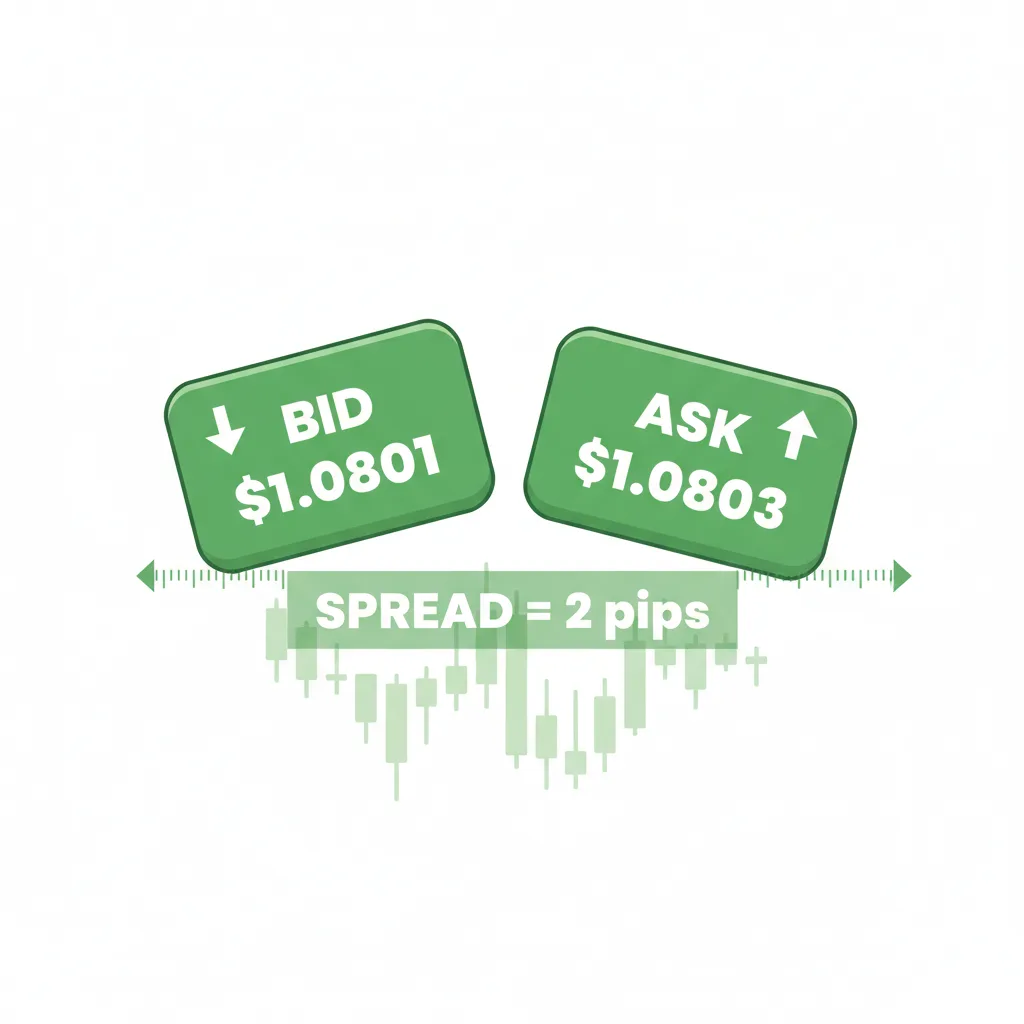
Let's say you're eyeing EUR/USD. Your broker shows Bid: 1.0801, Ask: 1.0803. That means if you want to sell right now, you get 1.0801. If you want to buy, you pay 1.0803. The spread? 1.0803 - 1.0801 = 0.0002, which is 2 pips. So if you buy at 1.0803, the price needs to rise above 1.0803 by at least those 2 pips before you're even at breakeven if you sell. It's like starting a race 2 meters behind the starting line — you have to make up that distance first. For GBP/USD at 1.3089/1.3091, same deal: 1.3091 - 1.3089 = 0.0002 = 2 pips. USD/JPY at 120.40/120.42? 120.42 - 120.40 = 0.02 = 2 pips (remember, JPY pips are different!). See the pattern? That gap is always there, waiting for you.
§4The weird exceptions nobody warns you about
Alright, time for the fine print. First up: JPY pairs. They're the quirky cousin at the family reunion. While most pairs count pips at the fourth decimal (0.0001), JPY pairs use the second decimal (0.01). So when USD/JPY moves from 120.40 to 120.41, that's 1 pip, not 0.1 pip. Got it? Good. Next: spreads can go wild. During major news like Non-Farm Payrolls or interest rate decisions, spreads can widen dramatically — like a rubber band stretching way out. Liquidity dries up, volatility spikes, and brokers protect themselves by making that gap bigger. Same thing happens during quiet hours (Asian session, weekends) or with exotic pairs. Oh, and fixed vs. variable spreads? Fixed stays constant (predictable but often wider), variable floats with the market (tighter normally but can balloon). Choose your adventure!

§5Three examples that'll make it click
Let's get concrete. Imagine you buy EUR/USD at 1.0803 (ask). The bid is 1.0801, so spread = 2 pips. Price needs to hit 1.0805 for you to be up 2 pips net. Scenario 2: You trade GBP/USD at 1.3091 with a 2-pip spread. If it moves to 1.3095 and you sell at bid (1.3093), you gain 2 pips after covering the spread. Scenario 3: Exotic pair with 20-pip spread — you're starting 20 pips in the hole! Here's a quick comparison:
| Scenario | Pair | Entry (Ask) | Exit (Bid) | Spread | Breakeven Price |
|---|---|---|---|---|---|
| Major Pair | EUR/USD | 1.0803 | 1.0801 | 2 pips | 1.0805 |
| JPY Pair | USD/JPY | 120.42 | 120.40 | 2 pips | 120.44 |
| Exotic | Exotic | 1.2000 | 1.1980 | 20 pips | 1.2020 |
See how that starting gap changes everything?
§6Where this thing even came from
The spread isn't some newfangled invention — it's been around since traders first gathered in market squares. The word itself comes from Old English 'sprǣdan,' meaning 'to stretch out.' Perfect, right? It's literally stretching out the gap between prices. In the old stock market days, market makers would shout out bid and ask prices, creating that spread naturally. With electronic trading, it became standardized across forex, stocks, everything. While events like the 2008 crisis didn't create spreads, they definitely made them widen dramatically — volatility does that. And regulators? They've stepped in with leverage caps (like Europe's 30:1 for majors) to protect traders from themselves. The spread has evolved, but its core purpose — that built-in cost — remains as relevant as ever.
§7Key takeaways
- The spread is your broker's built-in fee — typically 0.5-3 pips for majors, 20+ for exotics — that you pay on every single trade.
- You start every trade in a hole equal to the spread; price needs to move that far just for you to break even.
- Spreads widen dramatically during news events and off-hours — sometimes doubling or tripling without warning.
- Always calculate your total cost (spread + commission) rather than just chasing the lowest spread number.
§8Frequently asked questions
QWhat does spread mean in forex?
QWhy do forex spreads widen?
QIs a lower spread always better?
QWhat's the difference between fixed and variable spreads?
QHow do I calculate the spread in pips?
§See also
§References
- Forex Trading Basics: Spreads, Pips, and Leverage — The Trading Mentor Research
- Market Microstructure: Bid-Ask Spreads in Electronic Trading — Financial Markets Journal