


Most lists of the 'best forex websites' are useless for Nigerians.

Olumide Adeyemi
West African Trading Pioneer ·  Nigeria
☕ 9 min read
What you'll learn:
Most lists of the 'best forex websites' are useless for Nigerians. They recommend brokers that won't accept you, tools priced in dollars you can't afford, and ignore the regulatory circus happening right here. I've watched students blow accounts following that garbage. This isn't about shiny platforms; it's about finding websites that let you trade from Lagos or Port Harcourt without getting your money stuck or your account closed. I'll show you what matters, what to avoid, and name names.
Forget global rankings. A good forex website for you boils down to three brutal realities: access, cost, and survival.
Access is everything. Can you fund your account? The best broker in the world is worthless if your GTBank transfer bounces. You need sites that accept local deposits - bank transfers, maybe USSD, sometimes cards - without a 48-hour drama. Withdrawal is the real test. If a broker's website makes withdrawing your profit feel like extracting a promise from a politician, run.
Cost isn't just the spread. It's the conversion fee from Naira to USD to fund the account. It's the withdrawal fee. It's the invisible cost of a wide spread on the Naira pairs you probably watch too closely. A 'zero commission' site can still gut you with a 3-pip spread on EUR/USD if they're not competitive. I learned this the hard way early on, trading a fancy European broker. My 'low costs' were erased by terrible execution on news events. My first major loss, about $420 on a GBP/USD trade, wasn't just bad analysis; it was slippage on a platform not built for my internet connection.
Survival means regulation you can understand. The CBN doesn't license international forex brokers. So you're looking at foreign regulation. But not all are equal. A broker licensed by a serious authority (like the FCA in the UK or ASIC in Australia) is less likely to pull a fast one. However, many of these now restrict Nigerian clients due to compliance headaches. So you often end up with brokers under other jurisdictions (like CySEC or offshore). The website should make its regulatory status crystal clear, not hide it in footnotes.

Warning: If a website's 'Contact Us' page only has a support ticket form and no physical address or direct phone line for its licensed entity, be suspicious. You want a real entity you can complain to, not just a digital ghost.

💡 Winston's Tip
A website's 'About Us' page should list a real regulatory license number. If it doesn't, or the number is fake, that's not a broker. It's a story.
Let's get specific. These are brokers whose websites and services I've seen function consistently for traders here. This isn't a paid promotion; it's field observation.
Exness is the elephant in the room. Their website is straightforward, and they've mastered the local payment issue. Funding via bank transfer (Naira) is usually quick. Their spreads are tight on majors, and they offer a local client office. The trade-off? They're not regulated by a top-tier authority for Nigerian clients (they serve you via a global entity). For many, the sheer convenience outweighs that. I've used them for scalping when I need fast entries. Our full Exness review breaks down the pros and cons.
IC Markets is a favorite for serious technical traders. Their website is a portal to Raw Spread accounts with some of the lowest costs in the industry. Execution is excellent. The catch? Funding. You'll likely need to use a card or an international transfer, which adds cost and time. Their platform stability, especially for scalping strategies, is top-notch. I ran a prop firm challenge through them last year, and the precision mattered for hitting those strict profit targets.
XM and Pepperstone are also solid contenders. XM's website is beginner-friendly, offers lots of educational resources, and accepts a wide range of deposit methods. Pepperstone, like IC Markets, offers razor-sharp execution and great platform support (especially for MetaTrader).
| Broker | Key Strength for Nigerians | Big Caveat |
|---|---|---|
| Exness | Local Naira deposits/withdrawals, speed | Lower-tier regulation for int'l clients |
| IC Markets | Ultra-low costs, superb execution | Funding can be slower/more expensive |
| XM | Easy to use, many deposit options | Spreads can be wider than 'raw' accounts |
| Pepperstone | Great platforms & tools, reliable | Similar funding issues to IC Markets |
You need to visit their websites yourself. Don't just look at the homepage. Go to the 'Deposit' page. See the options. Check the 'Specifications' page for spreads on EUR/USD and XAU/USD (gold). That's your real research.
“Guessing your position size is a recipe for a margin call.”
You can't afford Bloomberg Terminal. Good news: you don't need it. These free websites provide most of the firepower you need.
TradingView is the charting king. Their free plan is massively powerful. The social aspect is a double-edged sword - lots of noise, but also the ability to see how others are interpreting the same chart. I build all my analysis on TradingView first, then execute on my broker's platform. Their stock and crypto coverage is also great if you diversify.
Forex Factory is the old reliable for the economic calendar. It's ugly, but it works. Filter for 'High' impact events. The real value is in the comments during news events - a chaotic but sometimes insightful pulse of market sentiment. Just don't trade based on forum hype.
Babypips (despite the silly name) is the best free structured education website, period. Their 'School of Pipsology' will teach you more than any paid course from a 'guru'. Use it.
Investing.com and DailyFX are good for quick news headlines and basic analysis. Don't treat their 'analyst forecasts' as gospel, but use them to understand the mainstream narrative.

Pro Tip: Create a dedicated browser bookmark folder for these. Your trading day should start with Forex Factory's calendar, then charts on TradingView, using news from Investing.com for context. This routine costs nothing and beats 90% of paid signal services.
💡 Winston's Tip
The most important button on any broker's website isn't 'Deposit'. It's 'Withdraw'. Test that process with a small amount first.
This is where most traders are lazy, and it costs them money. Guessing your position size is a recipe for a margin call.
A proper position size calculator is non-negotiable. You must know exactly how many lots or units to trade based on your account size, risk percentage per trade, and stop-loss distance. Don't do this in your head. Our own position size calculator is built for this, but any reliable one will do. Here's a real example from a trade I took last month: Account: $2,000. Risk: 1% ($20). Stop-loss on EUR/USD: 25 pips. Pip value for a micro lot (0.01): ~$0.10. So, $20 risk / (25 pips * $0.10) = 8 micro lots (0.08). That's the math. No guesswork.
Economic Calendars (beyond Forex Factory): Check Myfxbook's calendar. It's clean and shows historical data for previous events, which is crucial. Seeing how a currency pair reacted to last month's CPI print is more valuable than just knowing the upcoming number.
Correlation Matrices: Tools like the one on OANDA's website show you how pairs move together. Why does this matter? If you're long EUR/USD and also long GBP/USD, you're not as diversified as you think. You've doubled your risk on a similar market move. I made this mistake early on, thinking I was 'spread out'. A sharp dollar rally wiped out both positions.
“If a website seems desperate for your deposit rather than confident in its services, close the tab.”
The Nigerian forex space is a hunting ground. Here’s how to spot the predators.
'Guaranteed Profit' Websites: Any site, signal service, or 'mentor' guaranteeing weekly profits is lying. Full stop. They make money from you, not for you.
Unregulated Broker 'Offices' in Lagos: A fancy office in Victoria Island doesn't mean a broker is legit. Check their actual online regulatory license. Many 'local' offices are just marketing fronts for unregulated offshore entities.
Websites with Poor Grammar & Pressure Tactics: Professional financial firms invest in professional communication. If the website copy is full of errors and pop-ups scream 'DEPOSIT NOW FOR BONUS!', it's a casino, not a broker.
Bonus Abuse: That 100% deposit bonus? It usually comes with impossible withdrawal conditions (trade 10,000 lots before you can touch your money). Often, it's just a tool to make you over-trade so you lose your deposit faster. I learned this lesson with a $500 deposit years ago. The bonus locked my funds into a cycle of ever-increasing volume requirements. I blew the account trying to reach it.
The 'Prop Firm' That's Too Easy: Legitimate prop firms (like those whose challenges Pulsar Terminal helps manage) have strict rules. If a website offers you a $100,000 account after a simple quiz or a tiny fee, it's a scam. You're just buying a demo account with fake money.
The rule is simple: if a website seems desperate for your deposit rather than confident in its services, close the tab.
💡 Winston's Tip
Your analysis website (like TradingView) and your execution website (your broker) should be on separate monitors. Confusion leads to mistakes.
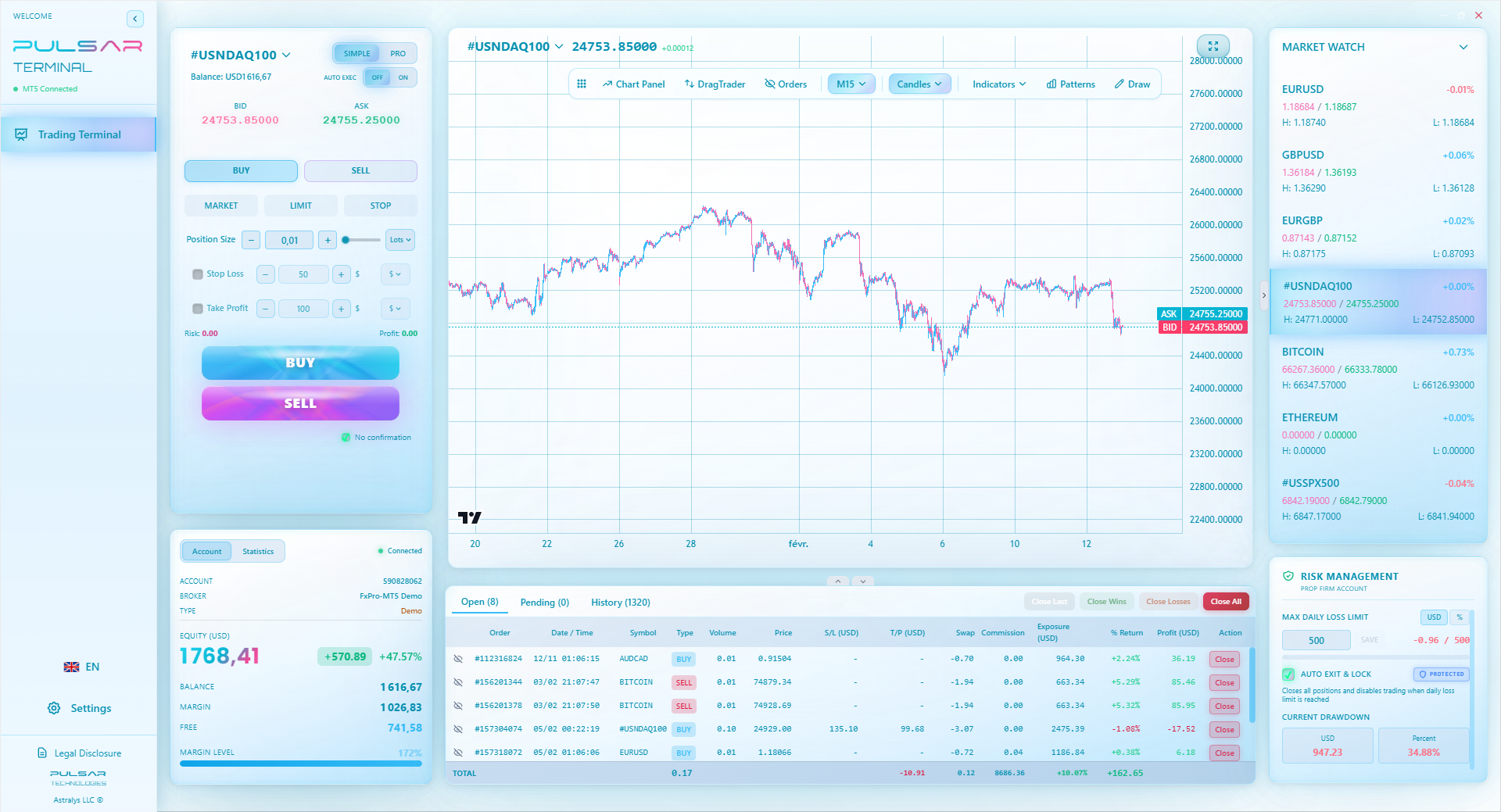
Managing risk on multiple trades across different pairs is complex, but tools like Pulsar Terminal let you set and trail stops for your entire portfolio from one MT5 window.
Pulsar Terminal
The all-in-one MT5 companion: drag-and-drop orders, multi-TP/SL, trailing stop, grid trading, Volume Profile, and prop firm protection. Used by 1,000+ traders daily.
Here’s how to use these best forex websites effectively. This is the routine I follow and teach.
Pre-Market (30 mins):
- Open Forex Factory. Scan for High-impact news scheduled for the day. Note the time (convert to WAT).
- Open TradingView. Look at the daily charts of your 2-3 main pairs (e.g., EUR/USD, XAU/USD). Identify key support/resistance levels.
- Check Investing.com headlines. What's the narrative? Risk-on? Risk-off?
Analysis & Planning:
- Zoom in to your preferred timeframe (H1 or H4 for me). Look for confluences between price action (like a pin bar at a key level) and an indicator like the RSI indicator showing divergence.
- THIS IS CRITICAL: Once you see a potential trade, open your position size calculator. Input your account balance, risk %, stop-loss in pips. Let it tell you the position size. Write this down.
- Set your entry, stop-loss, and take-profit levels on the chart. Only then do you log into your broker's website.
Execution & Management:
- Go to your broker's platform (MT4/MT5 via their website/client). Place the trade EXACTLY as planned. No last-minute doubling the size because you 'feel good'.
- Manage the trade. If you're swing trading, you might just monitor. If scalping, you're active.
- Never, ever move your stop-loss further away. Only to breakeven or to trail it.
Post-Market: Review. Why did the trade win or lose? Was it your analysis, or just luck? Update a simple journal. This process, using these specific tools, turns noise into a disciplined business.
FAQ
Q1Is forex trading legal in Nigeria?
Trading forex with international brokers is in a gray area. The CBN prohibits banks from processing payments for 'unauthorized' forex trades, but it doesn't directly criminalize individuals for trading with offshore firms. The risk is on the funding/withdrawal side, not the act of trading itself. This is why using brokers with established local payment channels is critical.
Q2What is the minimum deposit for forex trading in Nigeria?
It varies wildly by broker. Some like Exness allow deposits from as low as $10 (a few thousand Naira). Others like IC Markets might have a $200 minimum. Never deposit the bare minimum. You need enough capital to trade with proper position sizing without risking 10% of your account on a single trade. A realistic starting point for a beginner is $200-$500.
Q3Which forex broker is best for beginners in Nigeria?
For a total beginner, a broker with an easy-to-use website, local deposit support, and good educational materials is key. XM and Exness are strong contenders here. The priority should be learning, not making money. Use a demo account on their platform for at least 3 months before risking real cash.
Q4How do I fund my forex account from Nigeria?
The most common ways are: 1) Direct bank transfer in Naira (to the broker's local partner bank), 2) Debit/Credit cards (though banks sometimes block these), 3) Cryptocurrency (increasingly popular due to its bypass of bank restrictions). Always check the broker's website for their current, specific deposit options for Nigerian residents.
Q5What is a good spread for a forex broker?
For major pairs like EUR/USD, a 'good' spread is under 1.5 pips on a standard account, and often below 0.5 pips on a raw spread/ECN account. Always check the live spread on the broker's website during your main trading hours (London/NY overlap is best). A spread that balloons to 3+ pips regularly will eat your profits. Check our spread definition for more detail.
Q6Can I use Binance for forex trading?
No. Binance is a cryptocurrency exchange. While it offers crypto/fiat pairs (like BTC/USD) and some tokenized stock/forex products, these are not the actual spot forex market. The liquidity, pricing, and risks are different. For trading actual EUR/USD, you need a dedicated forex broker.
Q7How do I avoid forex scams in Nigeria?
Stick to the known international brokers with verifiable regulation (check their license number on the regulator's website). Avoid any 'investment scheme' promising fixed daily returns. Never give your trading account login details to a 'account manager'. If an opportunity sounds too good to be true from a website you found on Instagram, it is.
Prof. Winston's Lesson
Key Takeaways:
- ✓Access trumps all: A broker must accept your Naira.
- ✓Always verify the regulatory license online yourself.
- ✓Use a position size calculator for every single trade.
- ✓Start your day with an economic calendar, not charts.
- ✓Test withdrawals before making a large deposit.
How useful was this article?
Click a star to rate
Weekly Trading Insights
Free weekly analysis & strategies. No spam.
About the Author
Olumide Adeyemi
West African Trading Pioneer
One of Nigeria's most active forex trading educators. 8 years of experience trading from Lagos. Specializes in low-capital strategies and prop firm challenges for African traders.
Comments
Risk Disclaimer
Trading financial instruments carries significant risk and may not be suitable for all investors. Past performance does not guarantee future results. This content is for educational purposes only and should not be considered investment advice. Always conduct your own research before trading.
You Might Also Like

Cara Trading Forex Sukses: 7 Prinsip dari Trader Profesional
Cara trading forex sukses dengan 7 prinsip trader pro: manajemen modal, disiplin, journal trading, backtest. Data nyata, bukan janji profit palsu.
Jam Trading Forex Terbaik untuk Trader Indonesia: Panduan Lengkap dengan Tabel Waktu
Panduan jam trading forex untuk trader Indonesia. Tabel 4 sesi dunia, jam emas 20:00-00:00, sesi mana yang harus dihindari. Data akurat + tips dari trader berpengalaman.
Top 5 Sàn Forex Uy Tín Nhất 2026: Review Jujur dari Trader Indonesia
Top 5 sàn forex uy tín 2026 untuk trader Indonesia. Review jujur: spread, deposit, withdraw, dukungan lokal. Exness, XM, IC Markets & lebih.
Get Pulsar Terminal
All these calculators are built into Pulsar Terminal with real-time data from your MT5 account. One-click position sizing, automatic risk management, and instant calculations.
Get Pulsar Terminal