


I see the question pop up all the time in trading groups: 'Is Blueberry Prop Firm legit for Indian traders?' Here's the hard truth upfront: if you're searching for a specific 'Blueberry Prop Firm' in India, you're probably chasing a ghost.

Rajesh Sharma
Senior Forex Analyst ·  India
India
☕ 11 min read
What you'll learn:
- 1Prop Firms in India: Myth vs. Reality
- 2Your Actual Legal Forex Trading Options
- 3The International Prop Firm Loophole: GIFT City
- 4Real Numbers: Costs, Fees, and Profit Splits
- 5Red Flags: How to Avoid Scams and Bad Deals
- 6A Practical Path Forward for the Indian Trader
- 7The Right Tools and Mindset for Success

I see the question pop up all the time in trading groups: 'Is Blueberry Prop Firm legit for Indian traders?' Here's the hard truth upfront: if you're searching for a specific 'Blueberry Prop Firm' in India, you're probably chasing a ghost. More importantly, you might be walking straight into a regulatory trap. The real story isn't about one firm's name; it's about understanding the complex, often confusing rules that govern how Indians can access capital and trade global markets. Let's cut through the noise and set the record straight on what's actually possible, legal, and profitable for you right now.
The dream is seductive: pass a test, get a massive account, keep most of the profits. For Indian traders, this dream gets tangled in a web of regulations that most international prop firms don't bother explaining. The first myth to bust is that all prop firms work the same way everywhere. They don't.
In India, a proprietary trading firm can legally operate, but it has to play by SEBI's rulebook. This usually means they are registered stockbrokers trading their own capital on Indian exchanges like the NSE or BSE. They might hire traders, but you'd be trading INR-based products - think Nifty futures or Bank Nifty options - not the EUR/USD pairs you see on YouTube.
The second, bigger myth is that you can freely use any international prop firm you find online. This is where the RBI's Foreign Exchange Management Act (FEMA) steps in. The RBI has been crystal clear: you cannot use the Liberalised Remittance Scheme (LRS) to send money abroad for speculative forex trading. Sending a $99 challenge fee to a firm based in Cyprus or the UK to trade GBP/JPY? That's a direct violation. I learned this the hard way early on when a bank temporarily blocked a transaction, asking for a purpose code. "Services" didn't cut it; they wanted specifics.
So, if a firm like a hypothetical 'Blueberry Prop Firm' is offering you direct access to trade XAU/USD or NASDAQ from India, the first question isn't about their profit split. It's 'How is this legally possible for me?' If their answer is vague, run.

Warning: Using international payment gateways like PayPal or Stripe for prop firm fees doesn't make the transaction legal. It just moves the compliance risk to you. The RBI's rules are about the purpose of the fund transfer, not the method.

💡 Winston's Tip
A firm's willingness to explain its legal standing in your jurisdiction is the first test of its legitimacy. If they're vague on compliance, they're not a partner; they're a liability.


Okay, so the global spot forex market is mostly off-limits. What can you actually do? Your legal playground is the currency derivatives market on Indian exchanges. This isn't a consolation prize; it's a real, liquid market with its own opportunities.
You can trade futures and options contracts based on currency pairs, but with a crucial twist: the Indian Rupee (INR) must be one side of the trade. The major pairs available are USD/INR, EUR/INR, GBP/INR, and JPY/INR. You're trading the value of these currencies against the rupee, with contracts settled in INR. The liquidity is fantastic, especially in USD/INR, which is one of the most traded contracts in the world.
How It Works in Practice
You need an account with a SEBI-registered broker like Zerodha, Upstox, or Angel One. Your funds are in INR, your profits are in INR, and everything is taxed in India. It's straightforward. The trading psychology, however, is different. You're not just analyzing the Euro; you're analyzing the Euro relative to the Indian Rupee. Domestic factors like RBI policy, inflation data, and foreign inflows play a huge role.
I made a classic mistake when I started. I'd see a strong bearish signal on the EUR/USD chart and short EUR/INR, only to get stopped out because the rupee weakened even more than the Euro. You have to trade the cross rate. Tools like a good position size calculator are non-negotiable here, as contract sizes are large.

Pro Tip: Don't ignore the currency futures market because it's 'local.' The average daily turnover hit $60 billion in 2024. That's more than enough liquidity for any retail trader. Focus on mastering one pair, like USD/INR, and its unique rhythms before adding others.
“Forget the search for a magical 'Blueberry Prop Firm.' Focus on becoming a consistently profitable trader within the legal framework.”
Now, here's the fascinating part of the puzzle. There is a government-sanctioned, fully legal way for you, as an Indian resident, to trade global markets. It's through the GIFT City (Gujarat International Finance Tec-City). The RBI has explicitly allowed the use of the LRS to invest in securities within GIFT City.
What does this mean? You can fund an account with a broker registered in the GIFT International Financial Services Centre (IFSC). These brokers can provide access to trade international products - global stocks, commodities, and yes, even forex pairs like EUR/USD and XAU/USD.
This is the closest you'll get to a 'legal prop firm' structure for global markets. Some international prop firms might be exploring setting up entities within GIFT City to serve the Indian market compliantly. If you come across a firm claiming to be accessible, ask if they operate through an IFSC-regulated entity. This is the key.
The process isn't as simple as clicking a sign-up button on a .com website. It involves KYC with the IFSC broker, transferring funds under the LRS limit for 'investment in securities,' and trading on their provided platforms (often MT5). The costs might be slightly higher due to the structure, but you have the peace of mind of full compliance.

Example: Let's say the LRS limit is $250,000 per financial year. You can allocate a portion of that to fund a trading account with a GIFT City broker. Your profits and losses are in that account. When you withdraw, the funds return to your Indian bank account. You get a Foreign Inward Remittance Certificate (FIRC), making tax filing clear.

Let's talk numbers, because that's where dreams meet reality. Whether it's a domestic prop firm, an international challenge, or a GIFT City account, the economics determine if it's worth your time.
For domestic Indian prop firms (trading on Indian exchanges), the model is often salary + bonus, or a direct profit split (like 70/30 in your favor). There's usually no 'evaluation fee.' You're interviewed for a job.
For international prop firm challenges, the numbers from the research are telling. Evaluation fees range from as low as $49 (about ₹4,000) for a small account to over $1,200 for a $200,000 account. Profit splits are advertised as high as 80% or 90% to the trader. Sounds great, but remember the legal hurdle. Also, these fees are often non-refundable. I once paid a $250 fee for a 'two-phase challenge,' passed the first phase, and then blew the account in the second phase on a single bad swing trading idea in the DAX. That $250 was gone forever.
For GIFT City brokers, you'll see more traditional brokerage fees: commissions per lot or spreads. You won't typically see a 'profit split' model because you're trading your own allocated capital (within the LRS).
Here’s a quick comparison:
| Model | Typical Cost/Fee | Profit Mechanism | Key Legal Consideration |
|---|---|---|---|
| Domestic Prop Firm | None (Salary role) | Salary + Performance Bonus | Fully SEBI-compliant. |
| Int'l Prop Challenge | $49 - $1,200+ fee | Split (e.g., 80/20) | Likely violates FEMA for forex trading. |
| GIFT City Broker | Commissions/Spreads | Keep 100% of P&L | Fully compliant via LRS for 'securities'. |
The biggest cost isn't always the fee; it's the opportunity cost and risk of using an illegal channel. A tax notice or a blocked bank account costs far more than any challenge fee.
💡 Winston's Tip
Your trading edge doesn't come from accessing a 'secret' market. It comes from knowing one market better than anyone else. USD/INR is a deep, liquid ocean - learn to swim in it first.

“The biggest cost isn't the challenge fee; it's the opportunity cost and risk of using an illegal channel.”
The prop firm space, especially where regulation is gray, is a magnet for misleading marketing and outright scams. If you're evaluating any firm, here are the red flags that should make you close the tab immediately.
- Vague or Incorrect Legal Answers: If you ask 'Is this legal for Indian residents?' and the support chat says 'Yes, traders from India are welcome!' without explaining how, be very suspicious. A legitimate operation understands compliance and will explain it.
- Pressure to Use Crypto for Fees: Some firms suggest paying evaluation fees in cryptocurrency to 'avoid bank issues.' This is a massive red flag. It's a tactic to circumvent financial regulations and makes tracing your money impossible.
- Overly Generous, Guaranteed Offers: 'Pass our simple test and get a $100,000 account!' Real trading with firm capital is a serious risk for them. Their evaluation should be rigorous. If it seems too easy, the firm likely makes money from failed challenge fees, not from successful traders.
- No Clear Data on Brokerage: Which broker do you trade on? Is it a reputable name like IC Markets, Pepperstone, or an obscure white-label? You need to know who holds the funds. I got burned early on with a firm that used a broker with massive slippage and requotes, making a scalping strategy impossible.
- Ignoring Indian Tax (TDS/GST): Any profits you make are taxable in India. A firm that doesn't provide proper financial statements or invoices makes it a nightmare for you to file taxes correctly.
Your best defense is a simple rule: if you can't clearly see the path from your Indian bank account to the trading platform and back again, fully compliant with RBI and tax laws, don't take the first step.

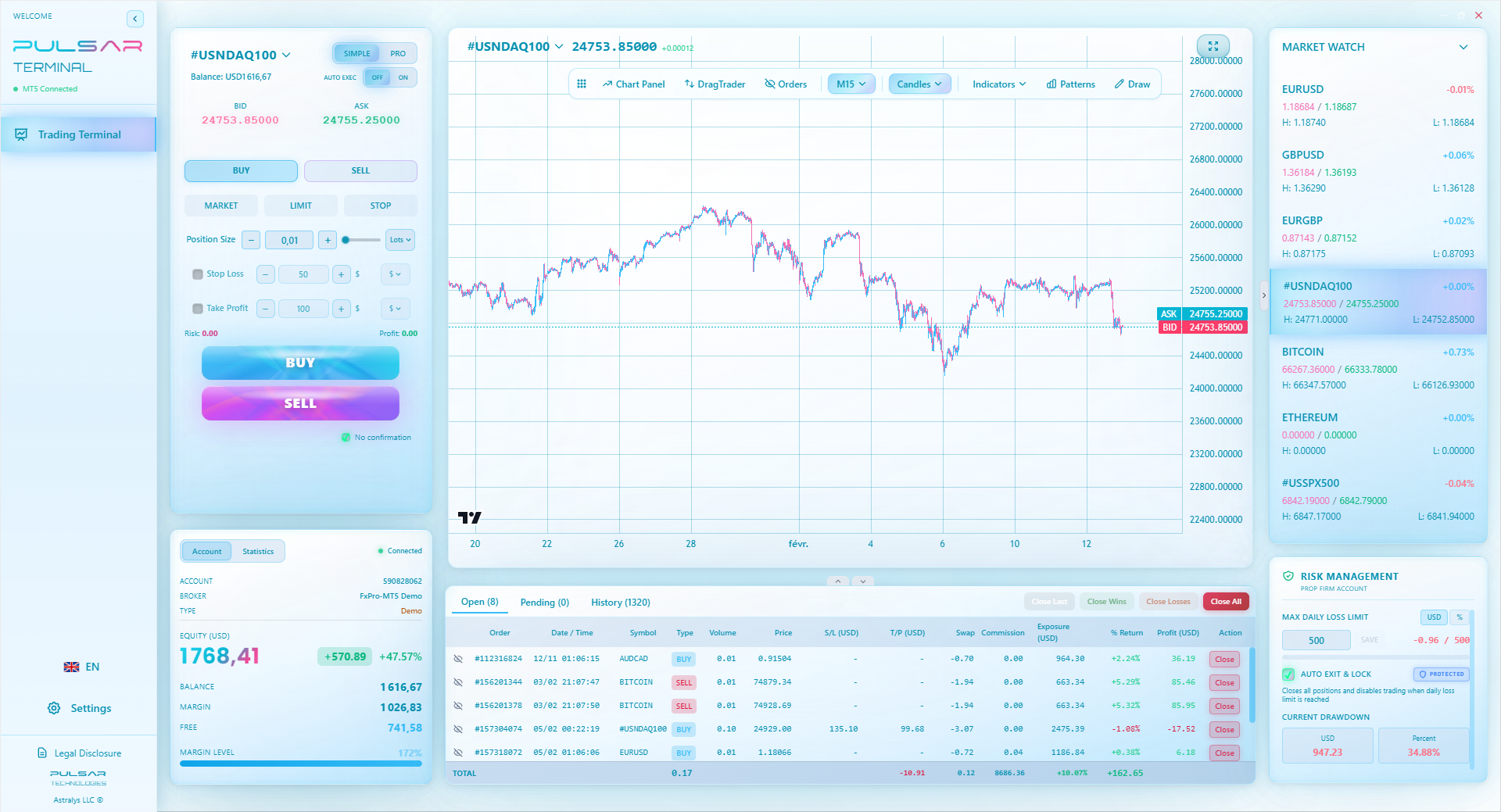
Managing a prop firm challenge or any live account requires iron-clad discipline, which is where tools like Pulsar Terminal automate critical risk rules directly on your MT5 platform.
Pulsar Terminal
The all-in-one MT5 companion: drag-and-drop orders, multi-TP/SL, trailing stop, grid trading, Volume Profile, and prop firm protection. Used by 1,000+ traders daily.
So, with all these walls and warnings, what should you actually do? Here’s a step-by-step, realistic path I wish someone had given me.
Step 1: Master the Legal Markets First. Open a demo account with a major Indian broker and trade currency derivatives (USD/INR futures). Get a feel for the platform, the liquidity, and how global news affects the INR. Paper trade until you have a consistently profitable strategy over 3-6 months. This builds skill without any legal or financial risk.
Step 2: Build a Track Record with Your Own Capital. Move to a live account with a small amount of risk capital - maybe ₹50,000. The goal isn't to get rich, it's to build a verifiable, audited track record of profitability. This record is your new resume. Document every trade, the rationale, and the outcome. This process will teach you more about real risk management and emotional control than any challenge ever could.
Step 3: Explore Compliant Capital Access. With a proven track record, you now have options:
- Apply to a Domestic Prop Firm: Your P&L statements are your ticket. Firms want proven winners, not hopefuls.
- Research GIFT City Thoroughly: If your edge is in global markets, deeply research the brokers in the IFSC. Understand all costs, transfer processes, and tax implications. Start small.
- Consider Partnership Models: Some traders form legal partnerships (LLPs) to pool capital for trading. This is complex and requires a good lawyer, but it's a structured, compliant way to scale.
Forget the search for a magical 'Blueberry Prop Firm.' Focus on becoming a consistently profitable trader within the legal framework. The capital will find you. I spent years looking for shortcuts and funding hacks. The only thing that finally worked was grinding it out in the USD/INR pit, building a history of green months, and having that performance speak for itself.
💡 Winston's Tip
The most important profit split is the one between you and the tax department. Always calculate your returns after tax from the very first trade. It changes everything.
“If you can make money in USD/INR, you're a trader. The instrument is irrelevant.”
Whether you're trading INR futures or, through a compliant route, global markets, your toolkit and psychology are what will separate you from the 90% who fail.
Platforms & Tools: On Indian platforms like Zerodha's Kite, learn the advanced order types. For global trading via MT5, consider a companion app that adds functionality. The key is having precise control over your risk. Automated trade management is a force multiplier, letting you set rules and stick to them.
Mindset Adjustments for India:
- Accept the Constraints: Fighting the RBI's rules is a losing battle. See the constraints (like trading INR pairs) as a defined arena where you can become a specialist.
- Taxes are Part of the Plan: From Day 1, calculate your returns after tax (Short-Term Capital Gains at your slab rate). A 15% return before tax is very different from a 10% return after tax.
- Beware of the 'Global Trader' Ego: There's no trophy for trading the Australian Dollar from Mumbai. There's only a P&L statement. If you can make money in USD/INR, you're a trader. The instrument is irrelevant.
I used to think I needed a fancy international account to be 'legit.' My turnaround started when I embraced the USD/INR chart as my home ground. I learned its spread patterns, its liquidity hours, and how it reacted to RBI announcements. That focus, more than anything else, built my career. Don't let the search for a specific firm's name distract you from the real work of trading.

FAQ
Q1Is Blueberry Prop Firm a real company I can use in India?
Based on complete research and regulatory checks, there is no verified, legally operating proprietary trading firm named 'Blueberry Prop Firm' serving Indian residents for global forex trading as of 2026. Be extremely cautious of any website using this name, as it could be a scam or an operation ignoring RBI regulations.
Q2Can I legally pass a prop firm challenge from an international company?
For trading international forex pairs (like EUR/USD), the answer is generally no. Using the LRS to pay the fee for speculative forex trading violates RBI rules under FEMA. Even if you pass, funding the account and withdrawing profits creates significant legal and tax compliance risks for you in India.
Q3What is the single safest way for an Indian to trade forex?
The safest and fully legal method is to trade currency derivatives (futures & options) on Indian exchanges like the NSE through a SEBI-registered broker (e.g., Zerodha, Upstox). You trade pairs like USD/INR and EUR/INR, with all transactions in rupees and under Indian regulatory protection.
Q4How does GIFT City make trading global forex legal?
GIFT City is a special economic zone with its own financial regulator (IFSCA). The RBI explicitly permits using the Liberalised Remittance Scheme (LRS) to 'invest in securities' there. You fund an account with an IFSC-registered broker, who can then legally provide you access to global markets, including forex. This is the compliant pathway.
Q5What happens if I use an international prop firm and get caught?
Potential consequences include your bank blocking further foreign transactions, penalties from the RBI for violating FEMA, and complications with the Income Tax Department regarding the source and taxation of any profits. It can lead to frozen funds and legal notices.
Q6Do Indian prop firms offer accounts to trade gold or US stocks?
Typically, no. A standard SEBI-registered domestic prop firm will trade products available on Indian exchanges (stocks, indices, currency derivatives). To trade international commodities like gold (XAU/USD) or US stocks, you would need to explore the GIFT City route or work for a firm with a specific IFSC entity.
Q7What's the #1 thing I should look for in any trading firm?
Transparent, accurate compliance information for Indian residents. Before asking about profit splits, ask for their legal opinion or documentation on how their service aligns with RBI's FEMA rules and SEBI regulations. If they can't provide a clear answer, it's a major red flag.
Prof. Winston's Lesson
Key Takeaways:
- ✓International prop firm challenges for forex likely violate RBI's FEMA rules.
- ✓Your only fully legal forex arena is INR-based derivatives on NSE/BSE.
- ✓GIFT City is the RBI-sanctioned gateway to global markets.
- ✓A verifiable track record in legal markets is your true capital.
How useful was this article?
Click a star to rate
Weekly Trading Insights
Free weekly analysis & strategies. No spam.
About the Author
Rajesh Sharma
Senior Forex Analyst
Trading Indian and South Asian markets for over 10 years. Started with NSE currency derivatives before moving to international forex. Specializes in USD/INR and emerging market pairs.
Comments
Risk Disclaimer
Trading financial instruments carries significant risk and may not be suitable for all investors. Past performance does not guarantee future results. This content is for educational purposes only and should not be considered investment advice. Always conduct your own research before trading.
You Might Also Like

Cara Trading Forex Sukses: 7 Prinsip dari Trader Profesional
Cara trading forex sukses dengan 7 prinsip trader pro: manajemen modal, disiplin, journal trading, backtest. Data nyata, bukan janji profit palsu.
Jam Trading Forex Terbaik untuk Trader Indonesia: Panduan Lengkap dengan Tabel Waktu
Panduan jam trading forex untuk trader Indonesia. Tabel 4 sesi dunia, jam emas 20:00-00:00, sesi mana yang harus dihindari. Data akurat + tips dari trader berpengalaman.
Top 5 Sàn Forex Uy Tín Nhất 2026: Review Jujur dari Trader Indonesia
Top 5 sàn forex uy tín 2026 untuk trader Indonesia. Review jujur: spread, deposit, withdraw, dukungan lokal. Exness, XM, IC Markets & lebih.
Get Pulsar Terminal
All these calculators are built into Pulsar Terminal with real-time data from your MT5 account. One-click position sizing, automatic risk management, and instant calculations.
Get Pulsar Terminal