


Most new traders I meet think you have to chase the market.

David van der Merwe
Emerging Markets Trader ·  South Africa
☕ 11 min read
What you'll learn:
- 1What Exactly Is a Buy Limit Order? (Plain English, Please)
- 2When Should a South African Trader Use a Buy Limit?
- 3How to Set Up a Buy Limit Order on MT4/MT5 (Step-by-Step)
- 4Costs, Risks & The South African Reality Check
- 5Choosing a Broker in SA: Execution Quality is Everything
- 6Advanced Tips: Weaving Buy Limits Into Your Strategy
- 7Common Mistakes I've Made (So You Don't Have To)
Most new traders I meet think you have to chase the market. They see price moving up on EUR/USD and panic-click the buy button, often getting the worst possible entry. I did this for my first six months, and it cost me. The truth is, smart traders don't chase - they let the market come to them. That's where mastering the buy limit forex order becomes your secret weapon. It's not just a button; it's a disciplined strategy for entering at your price, on your terms. Let's break down exactly how it works for us trading from SA.
A buy limit order is an instruction you give to your broker: "Buy this currency pair for me, but only if the price drops to this specific level or lower." It's a pending order, meaning it sits and waits. The key thing to remember is that the limit price must be below the current market price. You're saying you want a better deal than what's available right now.
Think of it like putting in a lowball offer on a house. The asking price is R2.5 million, but you believe the seller might accept R2.3 million if you wait. You tell your estate agent, "Only buy it if it hits R2.3 million." You don't sit by the phone; you go about your day. That's a buy limit order.
Why is this so powerful? It removes emotion. You're not watching the screen, getting FOMO (fear of missing out), and making a rash decision. You've done your analysis, identified a support level or a pullback zone, and set your trap. The market either triggers it or it doesn't. This is the foundation of disciplined swing trading.

Pro Tip: A common mix-up is with a stop-loss order. A stop-loss closes a losing trade. A buy limit opens a trade. They're opposites. Don't confuse them when setting up your order ticket.
“A buy limit order isn't just a button; it's a disciplined strategy for entering at your price, on your terms.”
You don't use a buy limit order randomly. It's a tactical tool for specific market conditions. Here are the two main scenarios where I find them indispensable.
Trading a Pullback to Support
This is my bread and butter. Let's say USD/ZAR is in a clear uptrend, but it's had a strong run and is looking overextended. My analysis shows solid support at 18.50. The current price is 18.70. Instead of buying now, I'll set a buy limit order at 18.52. I'm anticipating a small dip or pullback to that support level before the uptrend resumes. If price pulls back to 18.52, my order triggers, and I'm in the trend at a much better price. If it doesn't pull back and just rockets higher, I miss the trade. That's okay. There's always another opportunity.
I learned this the hard way with GBP/USD a few years back. I saw a beautiful trend but got impatient. I bought at 1.3200, only to watch it immediately dip to 1.3150, hit my stop-loss, and then rally to 1.3300. A buy limit at 1.3155 would have caught the perfect entry. A R5,000 lesson in patience.
Fading a False Breakout (A More Advanced Play)
Sometimes, price will smash through a known support level, triggering a bunch of stop-losses, and then quickly reverse back above it. This is a false breakout or "stop hunt." A buy limit can be placed just below that broken support level to catch the reversal if the breakout fails. This is riskier and requires real confidence in the broader market structure. I'd only recommend this once you're very comfortable reading price action.

Warning: Never use a buy limit order to try and "catch a falling knife." If a market is crashing with no signs of support, a buy limit is just a way to lose money faster. Always wait for a clear technical reason for your entry level.

💡 Winston's Tip
A buy limit order is a patience tax. The market rewards those who can wait for their price, not those who chase.
“The biggest benefit isn't technical; it's psychological. Using buy limits forces you to plan your trade before you're in it.”
Since most of us in SA use MetaTrader, here's exactly how to do it. I'm using MT5 as an example, but MT4 is almost identical.
- Right-click on the chart of the pair you want to trade (e.g., EUR/USD).
- Select "Trading" and then "New Order." A ticket will pop up.
- In the "Type" dropdown, change it from "Market Execution" to "Pending Order."
- Another dropdown will appear. Select "Buy Limit."
- Set your price: This is the most critical part. You need to manually enter the exact price you want your order to trigger at. Don't guess. Click on the chart where your desired entry level is, and the price will auto-fill. For example, if EUR/USD is at 1.0850 and you want to buy at 1.0820, you enter "1.08200".
- Set your volume (lot size): Use a position size calculator here. If your account is R20,000 and you're risking 1%, your risk in Rands should dictate your lot size based on the distance to your stop-loss.
- Set your Stop-Loss (SL) and Take-Profit (TP): Do this NOW. I can't stress this enough. Your SL and TP prices are based on your trade plan, not a random number. Enter them in the SL and TP fields.
- Click "Place."
You'll now see a horizontal line on your chart at your entry price, often with another line for your TP. Your order is live and will execute automatically if the market hits your price.

Example: Let's say you're trading XAU/USD (Gold). Price is at $2350. You identify support at $2330. You set a Buy Limit at $2332 (giving it a 2-dollar buffer). You decide to risk $200 on the trade, with a stop-loss at $2322. That's a $10 risk per ounce. Your position size should be 20 ounces, or 0.20 lots on a standard gold contract. Your TP might be at $2355. The trade manages itself from there. For more on gold, check our XAU/USD guide.
“The biggest benefit isn't technical; it's psychological. Using buy limits forces you to plan your trade before you're in it.”
Trading isn't free, and understanding the local costs is non-negotiable. When your buy limit order triggers, you're opening a trade, and all the standard fees apply.
Spreads & Commissions: This is your main cost. If you're with a broker like IC Markets on a Raw account, you might get spreads as low as 0.0 pips on EUR/USD, but you'll pay a commission (say $7 per lot). If you're with XM on a Standard account, you'll pay no commission but a slightly higher spread (maybe 0.8 pips). Your buy limit order executes at your specified price, but the actual fill includes the spread. So if your buy limit is at 1.08200 and the spread is 1 pip, your trade opens at 1.08200, but you're immediately 1 pip in the red.
Slippage: This is a big one with pending orders. In super fast markets, price can blow straight through your level. Your order might get filled at a worse price than you set. I've had this happen on USD/ZAR during local news events. My buy limit was at 18.4000, but the fill came at 18.4025. It's not always the broker's fault; it's market liquidity.
The FSCA & use: Remember, our regulator caps use at 30:1 for major pairs. This directly affects your buy limit orders. That R5,000 trade you want to place? With 30:1 use, you only need about R167 in margin. But this also means your potential loss is magnified. Always calculate your position size based on your stop-loss, not on how much margin you have free. A margin call is a quick way to blow your account.
SARB Allowances: This is a uniquely South African point. If you're funding an international broker, you're using part of your annual offshore allowance (R11 million total, with R2 million being discretionary). Keep records. A buy limit order that turns into a winning multi-week trade doesn't change this fundamental rule.
💡 Winston's Tip
Always set your stop-loss the moment you place the limit order. Your future self, filled with hope as the trade triggers, cannot be trusted to do it rationally.
“I've had buy limits slip on USD/ZAR during local news. It's not always the broker's fault; it's market liquidity.”
For buy limit orders to work as intended, you need a broker with fast, reliable execution. A slow broker means more slippage. Here’s a quick look at some top options for South Africans, focusing on factors that matter for limit orders.
| Broker | FSCA Regulated? | Key Feature for Limit Orders | Min. Deposit | Good For... |
|---|---|---|---|---|
| Khwezi Trade | Yes (Local) | Tight spreads on ZAR pairs, local support | R500 | Traders who want a pure SA broker & ZAR accounts. |
| Exness | Yes | Very fast execution, low minimums | $10 | Beginners & those who want to start small. See our Exness review. |
| IC Markets | Via Global Entity | Raw spreads, excellent execution speed | $0 | Serious traders who value tight pricing. |
| Pepperstone | Via Global Entity | cTrader platform is great for order management | $0 | Traders who like cTrader or advanced tools. |
| XM | Yes | $5 minimum, lots of educational resources | $5 | Absolute beginners learning the ropes. |
My personal experience? I've run accounts with both IC Markets and Pepperstone. For my scalping strategy, where a 0.5 pip slippage can ruin a trade, IC's raw spread account has been stellar. For swing trades where I set buy limits and leave them for days, both have been perfectly reliable. The choice often comes down to your preferred platform (MT5 vs. cTrader) and whether you prioritize raw spreads or an all-inclusive price.
Always, always verify the FSCA license number on the broker's website and cross-check it on the FSCA's official register. It's your first line of defense.
“I've had buy limits slip on USD/ZAR during local news. It's not always the broker's fault; it's market liquidity.”
Once you're comfortable with the basics, you can get creative. A buy limit forex order isn't a standalone strategy; it's a tool within one.
Combining with Indicators: Don't just plop a buy limit on any old level. Use your tools. I often use the RSI indicator to spot oversold conditions in a trend. If EUR/USD is trending up and the RSI dips below 40, I'll look for a key support level to place my buy limit. It confirms the pullback might be ending. Similarly, a MACD indicator histogram curling back up from below zero can be a good signal to place a limit order on a retest.
The Mental Shift: The biggest benefit isn't technical; it's psychological. Using buy limits forces you to plan your trade before you're in it. You define your entry, stop, and target in a calm state. You're not making decisions when adrenaline is high. This one habit improved my win rate more than any indicator ever did.
Partial Entries & Scaling In: You don't have to commit your full position at one price. You can set multiple buy limit orders at different levels in a support zone. For example, place a small buy limit at the top of the zone, and a larger one near the bottom. This averages your entry price. This is where advanced trading software really helps manage the complexity.
💡 Winston's Tip
If you find yourself constantly moving your buy limit order to a slightly better price, you're not trading a plan. You're gambling on ticks. Close the platform and walk away.
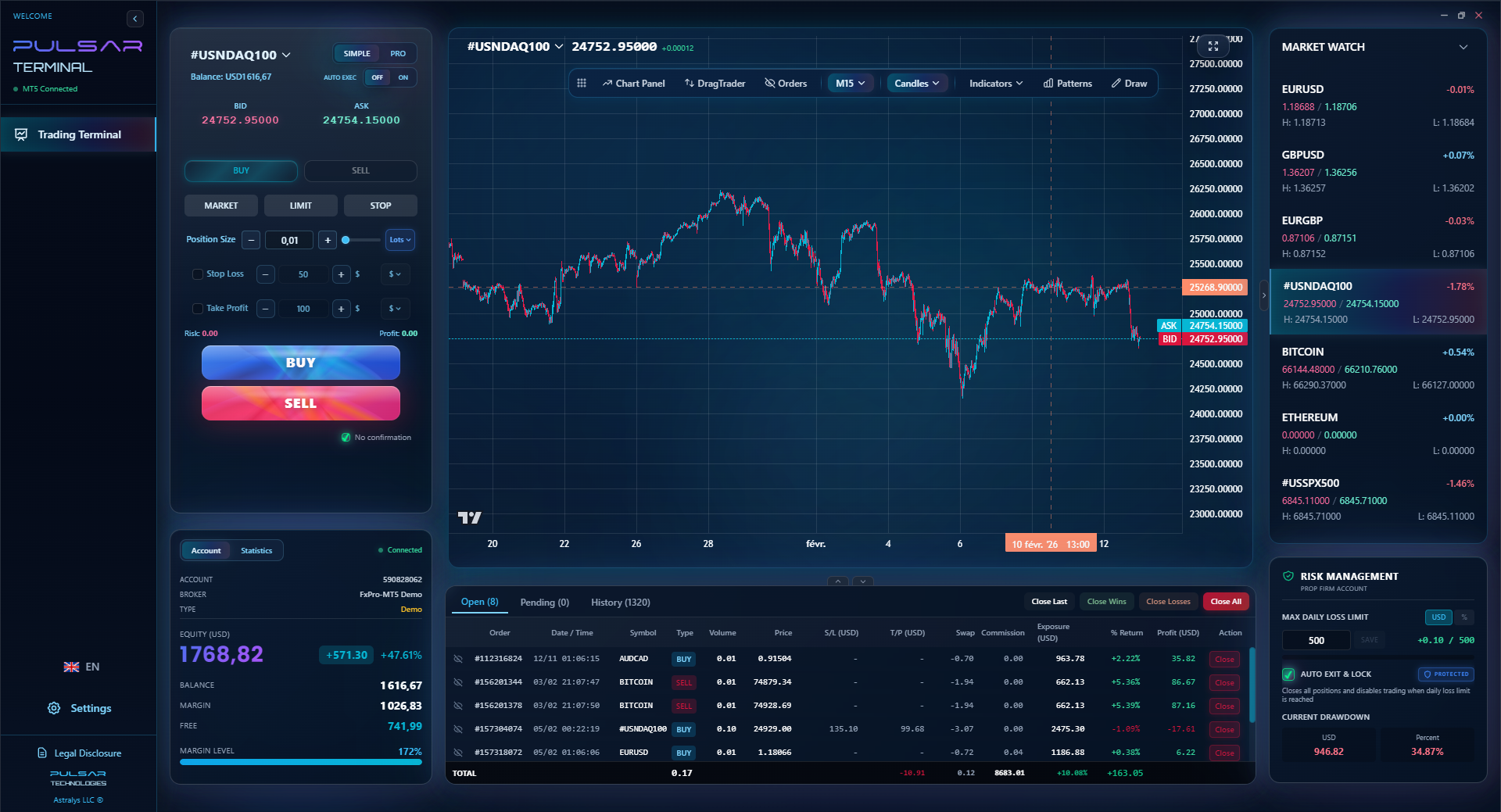
Managing multiple buy limit orders and moving stops to breakeven is manual hassle, but tools like Pulsar Terminal automate this directly on your MT5.
Pulsar Terminal
The all-in-one MT5 companion: drag-and-drop orders, multi-TP/SL, trailing stop, grid trading, Volume Profile, and prop firm protection. Used by 1,000+ traders daily.
“Complexity is the enemy of execution. Start with one clear order at one clear level.”
Let's get real. I've messed this up so you can learn.
- Setting the Limit Too Close to Current Price: Early on, I'd set a buy limit 3 pips below the market, thinking I was being smart. All it did was get me into mediocre trades with no real pullback. The market would tick down, trigger my order, and then continue falling. Give your trade room to breathe. Wait for a proper technical level.
- Forgetting About Major News: I once set a beautiful buy limit on GBP/USD ahead of a UK inflation report. The number was catastrophic. Price gapped down 80 pips through my level, my order triggered at the worst possible moment, and I was stopped out instantly. Always check an economic calendar. Remove pending orders before high-impact news unless that's specifically part of your strategy.
- Not Moving to Breakeven: This is a post-trade mistake. Your buy limit triggers, the trade goes in your favor, and you do nothing. Then it reverses and turns a winner into a loser. Once price moves a decent distance in your favor (e.g., 1.5x your risk), move your stop-loss to your entry price. This locks in a "no loss" scenario. It's a simple habit that protects profits.
- Overcomplicating It: You don't need 10 buy limits in a grid. Start with one clear order at one clear level. Master that before trying fancy stuff. Complexity is the enemy of execution.
FAQ
Q1What's the difference between a Buy Limit and a Buy Stop order?
A Buy Limit is set below the current price to buy on a dip. A Buy Stop is set above the current price to buy if the market breaks out to new highs. They're for opposite market expectations.
Q2Can my buy limit order be partially filled?
Yes, especially with larger orders. If there's only enough liquidity at your price to fill half your lot size, you might get a partial fill. The rest of the order will stay active until it's completely filled or cancelled.
Q3How long does a buy limit order last?
On MT4/MT5, by default, it lasts until you cancel it or until a set expiry date (which you can specify). Most brokers also have a policy of cancelling all pending orders if your account is inactive for several months, so check their terms.
Q4Do I pay any fee just for having a buy limit order placed?
No. You only incur costs (spread/commission) if and when the order is triggered and becomes a live trade.
Q5Is a buy limit order guaranteed to execute at my exact price?
Not guaranteed, but it's the instruction. In normal market conditions with a good broker, it should. During high volatility (like news events), slippage can occur, and the fill price may be worse.
Q6Can I use buy limit orders with any forex pair in South Africa?
Yes, with any pair your broker offers. They are especially useful with major pairs like EUR/USD or GBP/USD that have tight spreads and good liquidity. Be extra cautious with exotic pairs that include the ZAR, as spreads can be wider and slippage more common.
Q7What happens if the market price gaps past my buy limit level?
If the market opens or moves so fast that it skips from above your price to below it without trading at your price, your order may not be filled. This is called a gap. Some brokers have specific policies (like "Fill by Kill") for these scenarios, so it's worth checking.
Prof. Winston's Lesson
Key Takeaways:
- ✓Buy Limits are for entries BELOW current price.
- ✓Use them at confirmed support levels, not random dips.
- ✓Always pre-set your stop-loss and take-profit.
- ✓FSCA use is 30:1 - size your trades accordingly.
- ✓Broker execution speed matters to avoid slippage.
How useful was this article?
Click a star to rate
Weekly Trading Insights
Free weekly analysis & strategies. No spam.
About the Author
David van der Merwe
Emerging Markets Trader
Johannesburg-based trader with 11 years in emerging market currencies. Specializes in ZAR pairs, FSCA-regulated trading, and South African market analysis.
Comments
Risk Disclaimer
Trading financial instruments carries significant risk and may not be suitable for all investors. Past performance does not guarantee future results. This content is for educational purposes only and should not be considered investment advice. Always conduct your own research before trading.
You Might Also Like

Cara Trading Forex Sukses: 7 Prinsip dari Trader Profesional
Cara trading forex sukses dengan 7 prinsip trader pro: manajemen modal, disiplin, journal trading, backtest. Data nyata, bukan janji profit palsu.
Jam Trading Forex Terbaik untuk Trader Indonesia: Panduan Lengkap dengan Tabel Waktu
Panduan jam trading forex untuk trader Indonesia. Tabel 4 sesi dunia, jam emas 20:00-00:00, sesi mana yang harus dihindari. Data akurat + tips dari trader berpengalaman.
Top 5 Sàn Forex Uy Tín Nhất 2026: Review Jujur dari Trader Indonesia
Top 5 sàn forex uy tín 2026 untuk trader Indonesia. Review jujur: spread, deposit, withdraw, dukungan lokal. Exness, XM, IC Markets & lebih.
Get Pulsar Terminal
All these calculators are built into Pulsar Terminal with real-time data from your MT5 account. One-click position sizing, automatic risk management, and instant calculations.
Get Pulsar Terminal