


Ever watched a market make a huge move, then pause and drift sideways, and wondered if it's about to explode again in the same direction? That's the exact question the flag pattern forex setup answers.

Olumide Adeyemi
West African Trading Pioneer ·  Nigeria
☕ 12 min read
What you'll learn:
- 1What Exactly Is a Flag Pattern? Breaking Down the Anatomy
- 2Spotting Real Flags in the Nigerian Context: Noise vs. Signal
- 3My Step-by-Step Trading Strategy: Entry, Stop Loss, and Take Profit
- 4Critical Risk Management for the Nigerian Trader
- 5Best Timeframes & How Your Broker Choice Matters
- 6The Mistakes I Made (So You Don't Have To)
- 7Making It Stronger: Combining Flags with Other Indicators
- 8A Practical Trade Walkthrough: From Screen to P&L
Ever watched a market make a huge move, then pause and drift sideways, and wondered if it's about to explode again in the same direction? That's the exact question the flag pattern forex setup answers. It's one of the cleanest continuation patterns in technical analysis, but here's the thing I learned the hard way: spotting the shape is easy. Trading it profitably, especially with Naira volatility and our unique market access, is a different ball game. I've taken some painful losses and scored some of my biggest wins using this pattern. Let me walk you through exactly how I trade it now, with all the local context you need.
Forget the complex definitions. A flag pattern is simply the market catching its breath. Picture this: price makes a strong, almost vertical move (that's the flagpole). Then, instead of reversing, it consolidates in a small, slanted channel that goes against the main trend (that's the flag). This consolidation looks like a small rectangle or parallelogram tilting down in an uptrend, or tilting up in a downtrend. The psychology is simple: after a big move, some traders take profits, while new ones hesitate. The imbalance that caused the initial move hasn't gone away, so once this brief pause ends, the trend typically resumes with force.
There are two main types: Bull Flags and Bear Flags. A bull flag forms after a sharp rally, with the consolidation channel sloping slightly downward. A bear flag forms after a sharp drop, with the consolidation channel sloping slightly upward. The slope is key - it shows the counter-trend hesitation. The pattern is complete when price breaks out of the channel in the direction of the original trend.

Example: On USD/NGN in 2023, I saw a classic bull flag. The pair shot up 450 pips in two days (flagpole). It then drifted down in a tight 120-pip range for three days (the flag). The breakout above that channel led to another 300-pip rally. The initial move was the signal; the flag was the invitation.
This is where most new traders, myself included, get wrecked. Not every sideways move after a trend is a flag. In our market, with brokers like Exness or IC Markets offering high use, fakeouts are common. Here’s my checklist to separate the real deal from the noise.
The Flagpole Must Be Strong
The initial move needs conviction. I look for a near-vertical price movement on the 1-hour or 4-hour chart. On a 15-minute chart, this might be a 50-80 pip move on EUR/USD. On USD/NGN, given its volatility, it could be 200+ pips. If the ‘pole’ is wimpy, the pattern is weak. The pole should represent a clear breakout from a previous range or level.
The Flag Must Be a Tight Consolidation
The consolidation should have relatively parallel boundaries. I draw two trendlines. The price should generally respect these lines, with the oscillations getting smaller (decreasing volume often accompanies this). If the ‘flag’ is as wide or chaotic as the prior trend, it’s just noise, not a pattern. The flag should typically retrace no more than 38.2% to 50% of the flagpole’s length. A deeper retracement suggests a potential reversal, not a continuation.
Volume is Your Secret Weapon
While spot forex doesn’t have centralized volume, you can use tick volume or the volume indicator on your MT4/MT5 platform (from brokers like XM or Pepperstone). The ideal sequence: High volume on the flagpole creation, noticeably declining volume during the flag formation, and a surge in volume on the breakout from the flag. That volume confirmation saved me from entering a false breakout on GBP/USD last month. No volume spike? I stay out.

Warning: A common mistake is forcing the pattern. If you’re squinting at the chart trying to make two messy lines fit, it’s not a flag. Real flags are obvious to the trained eye. Wait for the clean ones.

💡 Winston's Tip
The flag's slope should whisper, not shout. A violently sloped flag often fails. Look for that gentle, hesitant counter-trend drift.
“A common mistake is forcing the pattern. If you're squinting at the chart trying to make two messy lines fit, it's not a flag.”
Let’s get tactical. Here’s the exact process I follow, refined after blowing up a $500 account early on by getting this wrong.
- Identify the Pattern: Confirm a strong flagpole and a subsequent consolidation flag. Wait for the price to trade within the flag for at least 5-10 candles on your chosen timeframe.
- Place the Entry Order: I never buy or sell the breakout the moment it happens. That’s how you get caught in false breaks. Instead, I place a buy stop order just above the upper flag trendline (for a bull flag) or a sell stop order just below the lower flag trendline (for a bear flag). This automates the entry only if the breakout is genuine.
- Set the Stop Loss: This is non-negotiable. My stop loss goes on the opposite side of the flag channel. For a long trade from a bull flag breakout, my stop loss is placed just below the lowest point of the flag formation. This protects me if the breakout fails and the pattern invalidates. Always use a position size calculator to ensure this stop distance aligns with your risk-per-trade (I never risk more than 1-2% of my account).
- Set the Take Profit: The most common and reliable method is to measure the height of the flagpole in pips. Then, project that same distance upward from the point of the flag’s breakout. This gives you a minimum price target. For example, if the flagpole was 150 pips tall, and you enter a bull flag breakout at 1.0850, your initial profit target is 1.1000 (1.0850 + 0.0150). I often take 50% off at this target and trail the rest with a moving stop.
I learned about multi-TP management the hard way. Early on, I’d set one target, watch price hit it and reverse, leaving money on the table. Now, I use tools that allow partial closures. For instance, setting a first target at 50% of the measured move, a second at 100%, and letting a runner go with a trailing stop. This approach balances locking in profit and letting winners run, a core tenet of successful swing trading.
Talking about the flag pattern forex without focusing on risk is like giving someone a sports car without brakes. Our environment demands extra caution. First, the use offered by international brokers accepting Nigerians can be a double-edged sword. A 1:500 use from a broker like HFM means a 20-pip move against you can wipe out a significant chunk of a small account if you’re overexposed. I learned this in 2020. I correctly identified a beautiful bear flag on Gold (XAU/USD). My analysis was right. But my position size was massive relative to my $300 account. A 15-pip spike against me before the trend resumed triggered a margin call. I was stopped out, and then watched the trade play out perfectly without me.

Pro Tip: Use use as a margin tool, not a position size multiplier. Decide your position size based on your stop loss distance and risk-per-trade first. Let the use just be what it is. A good position size calculator is your best friend here.
Second, consider the tax implication. Profits are subject to a 10% Capital Gains Tax by the FIRS. Factor this into your profit targets and overall strategy. A trade that nets you a 5% return before costs might not be worth the risk after spreads, potential swap fees, and tax.
Finally, mind the spread, especially around market opens and high-impact news on pairs like USD/NGN. A wide spread can turn a good entry into a bad one. I prefer trading major pairs like EUR/USD or XAU/USD for flag patterns because of their generally tighter spreads and liquidity, which makes the patterns cleaner and execution smoother.
💡 Winston's Tip
Measure the flagpole precisely. That number isn't just for targets; it tells you the market's recent conviction. A short pole means weak momentum from the start.
“Talking about the flag pattern without focusing on risk is like giving someone a sports car without brakes.”
You can find flag patterns on any timeframe, but their reliability changes. For Nigerian traders, I focus on two main approaches:
- Higher Timeframe Swing Trading (My Preferred): I hunt for flags on the 4-hour and daily charts. The patterns are stronger, with less market noise. A flag on the daily chart can lead to a move lasting weeks. This suits traders who can’t watch screens all day. The stop losses are wider, so your position size must be smaller, but the risk-reward ratios (often 1:2 or better) are excellent.
- Intraday & Scalping: Flags form on the 15-minute and 1-hour charts. These are great for active traders. However, the failure rate is higher. You need a broker with ultra-low latency and tight spreads, like IC Markets or Pepperstone on their Raw/Razor accounts, to make scalping strategy viable. The commissions are worth it for the execution quality.
Your broker is not just a gateway; it’s a tool. For flag pattern trading, you need:
- Reliable Order Execution: Your buy/sell stop orders must be filled at the requested price, not with significant slippage. This is why I lean towards well-regulated brokers with good reputations, even if they are offshore.
- Low Trading Costs: Every pip counts. Compare the typical spread on your preferred pair during your trading hours. A 0.8 pip spread vs. a 1.5 pip spread makes a huge difference over 100 trades.
- A Stable Platform: MT4/MT5 is the standard. Ensure your broker’s version is stable. There’s nothing worse than your platform freezing during a flag breakout.
Based on my experience and the local data, here’s a quick comparison for Nigerian traders:
| Broker | Good For Flag Trading Because... | Minimum Deposit | Key Regulation (for int'l access) |
|---|---|---|---|
| IC Markets | Raw spreads, excellent execution speed. | ~$200 | ASIC (Australia) |
| Pepperstone | Tight spreads on Razor account, great platform tools. | Varies | FCA (UK), ASIC |
| Exness | Low minimum deposit, accepts NGN accounts. | $10 | FSA (Seychelles), others |
| XM | Very low minimum, good for testing strategies. | $5 | ASIC, CySEC |
Always do your own due diligence. Read our detailed Exness review, IC Markets review, and Pepperstone review to dig deeper into their specific offerings for Nigerian clients.
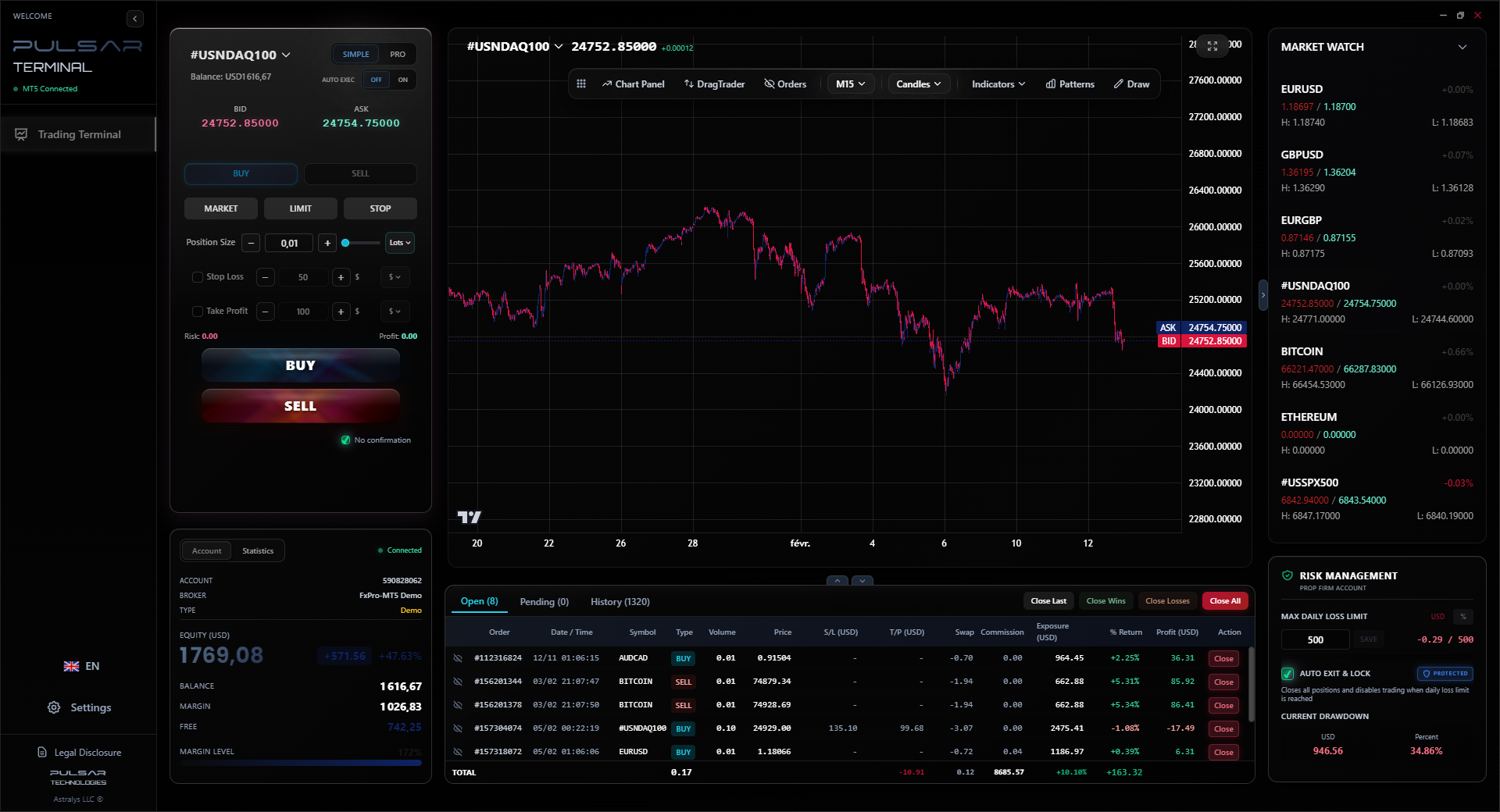
Managing multiple profit targets and a trailing stop on a flag pattern breakout is complex, but Pulsar Terminal automates this directly on your MT5 chart with drag-and-drop ease.
Pulsar Terminal
The all-in-one MT5 companion: drag-and-drop orders, multi-TP/SL, trailing stop, grid trading, Volume Profile, and prop firm protection. Used by 1,000+ traders daily.
Let me be brutally honest about my failures. This is where the real learning happens.
Mistake 1: Entering Before the Breakout. I’d see the flag forming, get excited, and jump in early ‘at a better price.’ Nine times out of ten, price would just oscillate within the flag and stop me out. Patience is the key. Wait for the close outside the channel.
Mistake 2: Ignoring the Overall Trend. A flag is a continuation pattern. It must occur within a clear, established trend. I once tried to trade a ‘bull flag’ in what was actually just a pullback within a larger downtrend. It was a bear trap. The larger trend swallowed the pattern. Always zoom out.
Mistake 3: Setting Profit Targets Too Close. The measured move target is a minimum. In a strong trend, price can go much further. By taking full profit at 100% of the pole, I missed massive extensions. Now, I use a partial closure strategy.
Mistake 4: Not Accounting for News. I had a perfect flag setup on EUR/USD. The breakout happened 5 minutes before a major US jobs report. The news volatility completely ignored the technical pattern and reversed the market. I now always check an economic calendar and avoid trading breakouts within an hour of high-impact news.
These lessons cost me real money. They forced me to build a disciplined checklist I won’t deviate from. The flag pattern is a framework, not a crystal ball. It improves your odds, but without strict rules, you’ll lose.
💡 Winston's Tip
If you can't clearly draw two parallel lines on the consolidation within three seconds, it's not a flag. Your brain recognizes real patterns instantly. Don't negotiate with messy charts.
“The flag pattern is a framework, not a crystal ball. It improves your odds, but without strict rules, you'll lose.”
A flag pattern alone is good. A flag pattern confirmed by other tools is powerful. I use these as confluence filters, not primary signals.
- Moving Averages: In an uptrend, a bull flag will often consolidate near or just above a key rising moving average (like the 20 or 50 EMA). This acts as dynamic support. If my flag is forming below a key declining moving average in a downtrend, I’m more skeptical.
- Support and Resistance: Did the flagpole break a major resistance or support level? If yes, the flag that forms afterward is a consolidation of that breakout, making it much higher probability. The old broken resistance should now act as support for a bull flag.
- Momentum Indicators: I might glance at the RSI indicator or MACD indicator. In a healthy bull flag, the RSI might pull back from overbought to a neutral level (like 50) during the flag, showing the pause. A bear flag might see RSI rise from oversold. I don’t trade based on these, but they help confirm the ‘pause’ narrative.
The core signal is always the price action of the flag itself. These other tools are just members of the jury agreeing with the verdict.
Let’s make this concrete with a recent trade. This was on the 4-hour chart of EUR/USD, using an IC Markets account.
The Setup: EUR/USD had been in a steady uptrend. It then made a powerful 110-pip rally in two candles (the flagpole). Over the next 16 candles (about 2.5 days), it drifted downward in a perfectly parallel channel, retracing about 40% of the pole. Volume declined. It was a textbook bull flag.
The Execution:
- I drew the flag channel. The upper trendline was at 1.0725.
- I placed a Buy Stop order at 1.0730 (just above the line).
- The lowest point of the flag was at 1.0680. I set my Stop Loss at 1.0675 (just below it). My risk per trade was $50 (1% of a $5k segment).
- The flagpole height was 110 pips (from 1.0620 to 1.0730). My first profit target (TP1) was set at 1.0840 (1.0730 + 110 pips).
The Result: Price triggered my order. It broke out cleanly with increased tick volume. It marched straight up and hit my TP1 two days later. I closed 70% of my position there, banking a profit. I moved my stop loss on the remaining 30% to breakeven. The trend continued, and I eventually trailed it out for an extra 40 pips. The initial risk was 55 pips ($50). The first profit on 70% of the position was 110 pips. A solid 1:2 risk-reward trade, executed without emotion because the plan was set in advance.
This is the power of a well-defined flag pattern forex strategy. It turns chaotic price action into a structured plan with clear lines in the sand.
FAQ
Q1Is forex trading with flag patterns legal in Nigeria?
Yes, forex trading is legal for individuals in Nigeria. While the local retail spot forex market isn't directly regulated by Nigeria's SEC, you are allowed to trade with international brokers regulated abroad (like FCA, ASIC). Any profits you make are subject to a 10% Capital Gains Tax by the FIRS.
Q2What is the best timeframe to trade flag patterns?
It depends on your style. For swing trading and higher reliability, use the 4-hour and daily charts. For intraday trading, the 1-hour and 15-minute charts can work, but they require faster execution and tighter risk management due to more noise. I personally find the 4-hour chart offers the best balance.
Q3How much money do I need to start trading flag patterns?
While some brokers like FBS or XM allow deposits as low as $1-$5, I strongly advise starting with at least $200-$500. This allows for proper position sizing and risk management. Starting with too little often leads to over-leveraging, where a single small loss can be devastating. Always use a position size calculator.
Q4Can I trade flag patterns on USD/NGN?
Yes, but with caution. USD/NGN can be highly volatile and subject to Central Bank of Nigeria (CBN) policy shifts. Flag patterns do form, but ensure you understand the fundamental drivers and trade around major news. The spreads can also be wider than on major pairs like EUR/USD.
Q5What's the difference between a flag and a pennant pattern?
Both are continuation patterns with a flagpole. The key difference is the consolidation shape. A flag is a small, slanted channel (parallel lines). A pennant is a small, symmetrical triangle where the trendlines converge. Pennants often represent a tighter, more coiled consolidation.
Q6How often do flag patterns fail?
No pattern works 100% of the time. A well-identified flag on a higher timeframe within a strong trend has a high success rate, perhaps 60-70% in my experience. The key is strict risk management. Your stop loss must always be in place to protect you when the 30-40% of failures happen. A failed breakout that hits your stop is just the cost of doing business.
Q7Should I use other indicators with the flag pattern?
The pattern itself is your primary indicator. However, I use others for confluence. Moving averages can show trend alignment, and volume can confirm the breakout strength. Don't clutter your chart. The cleanest trades often come from pure price action reading of the flag and its breakout.
Prof. Winston's Lesson
Key Takeaways:
- ✓Wait for the close outside the flag channel. Never enter early.
- ✓Always measure the flagpole height for your minimum profit target.
- ✓Place your stop loss on the opposite side of the flag, not inside it.
- ✓Risk no more than 1-2% of your account on any single flag trade.
- ✓High timeframe flags (4H/Daily) are more reliable than lower ones.
How useful was this article?
Click a star to rate
Weekly Trading Insights
Free weekly analysis & strategies. No spam.
About the Author
Olumide Adeyemi
West African Trading Pioneer
One of Nigeria's most active forex trading educators. 8 years of experience trading from Lagos. Specializes in low-capital strategies and prop firm challenges for African traders.
Comments
Risk Disclaimer
Trading financial instruments carries significant risk and may not be suitable for all investors. Past performance does not guarantee future results. This content is for educational purposes only and should not be considered investment advice. Always conduct your own research before trading.
You Might Also Like

Cara Trading Forex Sukses: 7 Prinsip dari Trader Profesional
Cara trading forex sukses dengan 7 prinsip trader pro: manajemen modal, disiplin, journal trading, backtest. Data nyata, bukan janji profit palsu.
Jam Trading Forex Terbaik untuk Trader Indonesia: Panduan Lengkap dengan Tabel Waktu
Panduan jam trading forex untuk trader Indonesia. Tabel 4 sesi dunia, jam emas 20:00-00:00, sesi mana yang harus dihindari. Data akurat + tips dari trader berpengalaman.
Top 5 Sàn Forex Uy Tín Nhất 2026: Review Jujur dari Trader Indonesia
Top 5 sàn forex uy tín 2026 untuk trader Indonesia. Review jujur: spread, deposit, withdraw, dukungan lokal. Exness, XM, IC Markets & lebih.
Get Pulsar Terminal
All these calculators are built into Pulsar Terminal with real-time data from your MT5 account. One-click position sizing, automatic risk management, and instant calculations.
Get Pulsar Terminal