


Let's get this out of the way: if you're a Canadian looking for a forex broker, you're playing on hard mode.

David van der Merwe
Emerging Markets Trader ·  South Africa
☕ 10 min read
What you'll learn:
- 1Welcome to Regulatory Jail: IIROC and Your Limited Options
- 2The TFSA & RRSP Trap: Why Forex Trading is a Tax Nightmare
- 3Realistic Broker Options for Canadian Traders
- 4Platforms, use, and the Reality of Costs
- 5Funding & Withdrawals: Getting Your CAD In and Out
- 6Adapting Your Trading Strategy for the Canadian Context
- 7Your Final Checklist Before You Sign Up

Let's get this out of the way: if you're a Canadian looking for a forex broker, you're playing on hard mode. The global buffet of brokers you see advertised? Most of it is off-limits to you. Canada's regulatory environment is a fortress, designed to protect you but also to severely limit your options. I've watched too many traders waste months trying to sneak into offshore brokers, only to get their accounts frozen during withdrawal. This guide isn't about finding the 'best' broker. It's about finding a legitimate one that won't leave you stranded. I'll walk you through the non-negotiable rules, the realistic platforms you can use, and how to structure your trading around Canada's unique constraints.
Forget everything you've read about international brokers. In Canada, the Investment Industry Regulatory Organization of Canada (IIROC) is the gatekeeper. Any broker offering forex trading to Canadians must be registered with them. This isn't a suggestion, it's the law.
The immediate consequence? Your list of potential brokers shrinks dramatically. Those fancy offshore brokers in Cyprus or the Caribbean? They typically refuse Canadian clients outright to avoid regulatory headaches. If one does accept you, that's your first red flag. You'll have no recourse if things go south.

Warning: Trading with an unregistered offshore broker as a Canadian resident is a great way to lose your entire deposit. IIROC won't lift a finger to help you, and the broker's local regulator won't care.
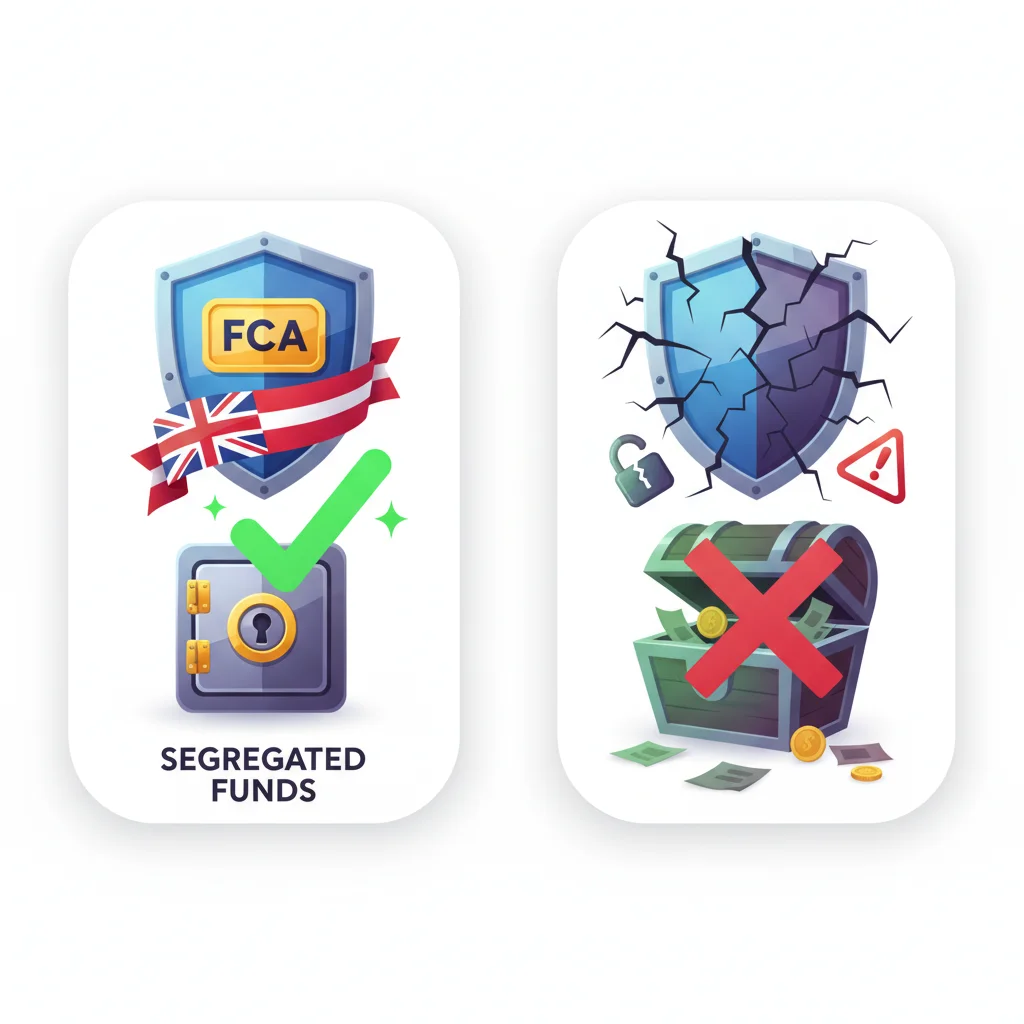
The IIROC framework brings mixed blessings. On one hand, client funds are held in segregated accounts at major Canadian banks. There's also the Canadian Investor Protection Fund (CIPF) covering up to $1 million per account if a member firm goes bust. This is serious protection.
On the other hand, the rules are strict. use is capped - typically a maximum of 50:1 for major currency pairs, and often lower for minors and exotics. This feels restrictive if you're used to the 500:1 offers elsewhere, but it's there to stop you from blowing up your account in three seconds. You need to build your scalping strategy or swing trading plans around this reality.
My first-hand experience? I tried to open an account with a well-known international broker years ago. The sign-up was smooth until I entered my Canadian address. The application instantly halted with a polite, 'We do not accept clients from your jurisdiction.' That was my wake-up call.

💡 Winston's Tip
The use cap is your friend, not your enemy. It's the regulator forcing you to use a seatbelt. The traders who rage against it are the ones who crash the hardest.
Here's where most Canadian beginners faceplant. They think, 'I'll just trade forex in my Tax-Free Savings Account (TFSA) or RRSP. Easy tax-free profits!' This is catastrophically wrong.
The Canada Revenue Agency (CRA) is very clear. Trading in a TFSA is fine if it's passive, long-term investing. Actively trading forex, with frequent buys and sells to profit from short-term price movements, is considered a business activity. The CRA can, and will, tax 100% of your profits and may penalize you. I've seen it happen.
Where Should You Trade Forex?
You trade forex in a margin account. This is a taxable account. Every profitable trade is a capital gain. You need to track every single trade - entry price, exit price, pip value, and profit in CAD. Your broker will provide annual tax slips, but the onus is on you to keep detailed records.
The 50% Rule
The silver lining? Only 50% of your net capital gains are taxable. If you make $10,000 trading forex in a year, you add $5,000 to your income. It's not the end of the world, but you must set aside a portion of your profits for tax time. Not doing this is the fastest way to turn a winning year into a financial crisis come April.

Pro Tip: Use a simple spreadsheet from day one. Log every trade: date, instrument, direction, entry, exit, P&L in CAD. When tax season hits, you'll be grateful. Trying to reconstruct a year of trades from broker statements is a special kind of hell.
“Trading with an unregistered offshore broker as a Canadian is a great way to lose your entire deposit.”
So, who can you actually use? The field is small, but there are legitimate players. Don't expect the ultra-low raw spreads of some international outfits. You're paying for regulation and stability.
The Domestic Choice: Brokers like Questrade (through its Forex.com partnership) and Interactive Brokers Canada are the go-to IIROC-regulated options. They are the 'safest' in terms of compliance. Interactive Brokers, in particular, offers direct market access and a stellar platform (Trader Workstation), but it's complex and geared more towards professional traders.
The International-Regulated Route: Some global brokers have gone through the pain of getting IIROC registration. OANDA is the prime example. They've been serving Canadian traders for years under IIROC. Their platform is solid, and they are a known quantity.
Here’s a quick comparison of what to expect:
| Feature | Domestic IIROC Broker (e.g., IBKR) | IIROC-Regulated Int'l (e.g., OANDA) |
|---|---|---|
| Fund Safety | High (CIPF covered) | High (CIPF covered) |
| use | Up to 50:1 (strict) | Up to 50:1 (strict) |
| Platform | Often proprietary/advanced | Proprietary & sometimes MT4/5 |
| Asset Range | Wider (stocks, futures, forex) | Focused on Forex & CFDs |
| Spreads | Variable, can be competitive | Often slightly wider but stable |
A note on MetaTrader: MT4 and MT5 are less ubiquitous in the strictly Canadian IIROC space. Some brokers offer them, but others use their own platforms. If you're married to MT5, check this specifically before signing up. The advanced order management you might want often requires add-ons, unlike tools built for it like Pulsar Terminal.
I started with a domestic broker but found their execution slow on news events. I switched to a regulated international one and have had no issues with withdrawals, which is the ultimate test. My first withdrawal of $2,500 CAD hit my bank account in two business days.
Your trading costs in Canada come in three forms: spreads, commissions, and the hidden cost of limited use.
Spreads & Commissions: Most IIROC brokers use a commission-plus-spread model or a wider spread with no commission. You need to calculate the all-in cost per pip. For a standard lot (100k units) of EUR/USD, a 1.5 pip spread might cost you $15. Add a $5 commission per side, and your round-trip cost is $25 before you're even in profit. This directly impacts strategies like scalping, where you hunt for small moves.
The use Cap: 50:1 is your ceiling. For a $10,000 account, that's a maximum position size of $500,000 (or 5 standard lots). This forces discipline, but it also limits potential returns on small accounts. You cannot 'over-use' your way out of a small starting balance. Your growth must come from consistent percentage gains, not reckless risk. Always use a position size calculator based on 50:1 max.
Platforms: You'll likely be on the broker's proprietary platform or a version of MetaTrader. The key is reliability and order types. Can you set trailing stops easily? Can you set multiple take-profit levels? If your native platform is clunky, that's where external tools that integrate with MT4/5 become valuable for managing complex trades.

Example: Let's say you trade GBP/CAD (a common pair for Canadians). The spread might be 4 pips. On a mini lot (10k units), each pip is worth roughly $1 CAD. Your immediate cost to enter and exit is about $4. If your profit target is only 10 pips ($10), that cost eats 40% of your profit. You need to factor this in.
💡 Winston's Tip
Your biggest edge as a Canadian is trading the Loonie. You live the economic data. Use that local knowledge on USD/CAD and EUR/CAD before you ever touch the Yen.
“The CRA can, and will, tax 100% of your forex profits in a TFSA. It's not a loophole, it's a trap.”
This is the most underrated advantage of using a regulated Canadian forex broker. Funding and withdrawals are trivial because they work within the domestic banking system.
Funding: You'll typically link your Canadian bank account (RBC, TD, Scotia, etc.) via electronic funds transfer (EFT). Deposits are usually free and appear in your trading account within a day, sometimes instantly. No need for international wire transfers with their $30 fees.
Withdrawals: This is the sweet spot. You request a withdrawal to your linked bank account. It's processed domestically. My experience has been 24-48 hours for the money to land back in my chequing account. No currency conversion nonsense, no waiting for international wires to clear. This reliability is worth the slightly higher trading costs.
Contrast this with an offshore broker: you might send a wire in CAD, they convert it to USD, you trade, you withdraw in USD, you convert back to CAD, and you lose 2-4% on the whole process in bank fees and poor exchange rates. The regulated path is cleaner and cheaper for moving money.
Just remember: every deposit and withdrawal is a transaction your broker records and will report in line with Canadian regulations. Keep your own records too.
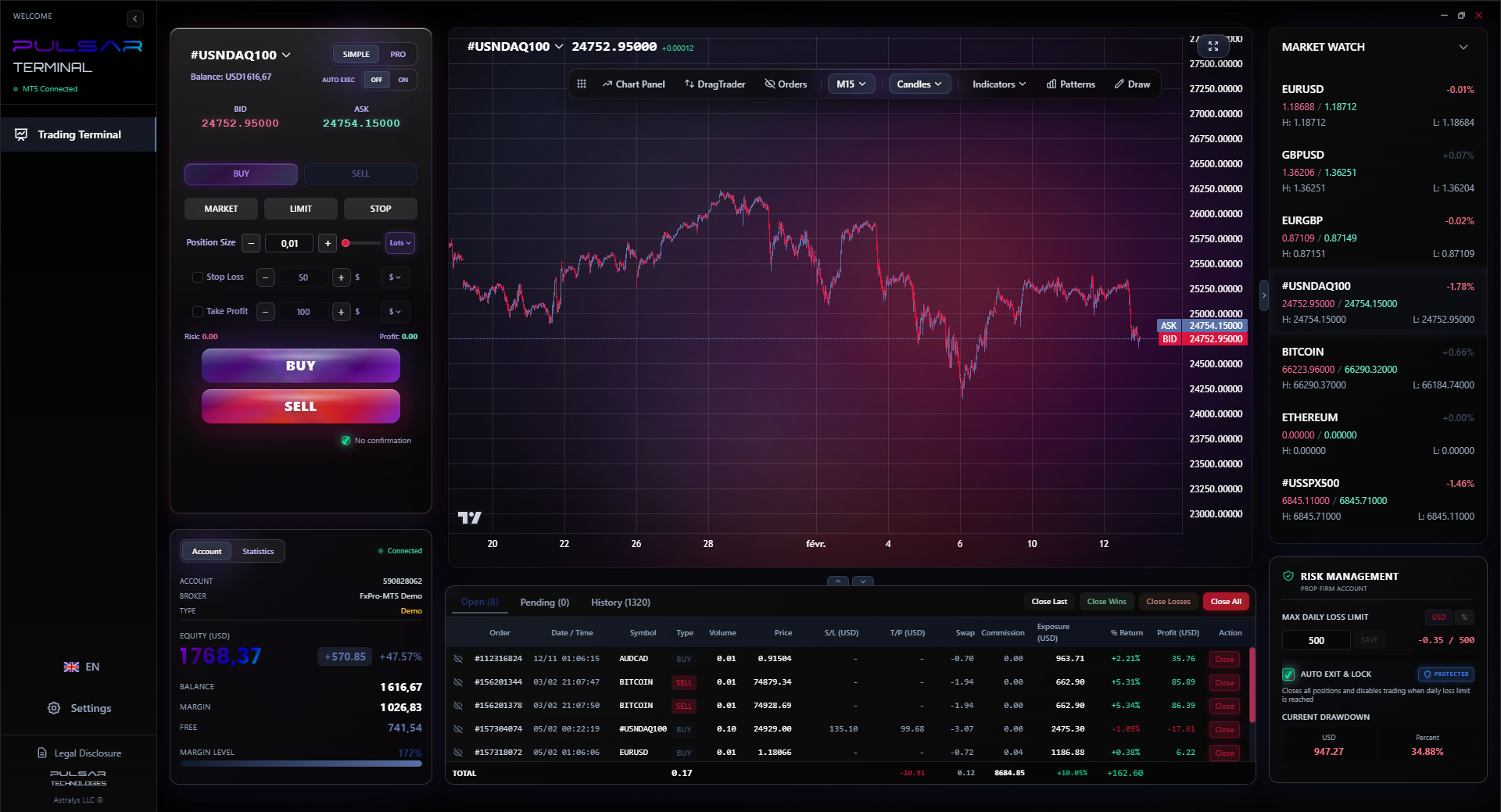
When swing trading CAD pairs on higher timeframes, managing multiple take-profit levels and a trailing stop is key, and Pulsar Terminal lets you set that entire plan with one drag-and-drop order on your MT5 chart.
Pulsar Terminal
The all-in-one MT5 companion: drag-and-drop orders, multi-TP/SL, trailing stop, grid trading, Volume Profile, and prop firm protection. Used by 1,000+ traders daily.
You can't just copy a strategy from a trader in the UK or Australia and expect it to work the same way here. The constraints change the game.
1. use Limits Favor Larger Timeframes: With 50:1 max use, trying to scalp for 5-pip profits on a $1,000 account is a recipe for death by a thousand cuts (from spreads and commissions). Your strategy needs to target larger moves. This naturally pushes you towards higher timeframes - like 4-hour or daily charts - where you can aim for 50-100 pip moves. Swing trading becomes a more viable default approach.
2. Mind the Pairs: You have an edge trading pairs involving the Canadian dollar (CAD). You understand the drivers (oil prices, Bank of Canada announcements) better than someone in Europe. Pairs like USD/CAD, EUR/CAD, and GBP/CAD often have better liquidity and slightly tighter spreads for Canadian brokers. Don't ignore the majors like EUR/USD, but know your home turf.
3. Risk Management is Non-Negotiable: The lower use is a built-in risk management tool, but don't get complacent. You can still blow up an account at 50:1. A 2% risk-per-trade rule is even more critical. Because your potential gains per trade are mechanically lower (due to the use cap), you must be right more often or let your winners run longer. Tools like the RSI indicator or MACD indicator for confirming trends become key.
I learned this the hard way. I tried to force a low-timeframe scalping strategy and got obliterated by costs. When I switched to swinging CAD pairs on the 4H chart, my consistency improved dramatically. My best trade last year was a short on USD/CAD, holding for 280 pips over two weeks.
💡 Winston's Tip
If you can't clearly explain how your broker's fee schedule works before you deposit, you have no business placing a trade. Spreads, commissions, and swaps are bullets. Know your weapon.

“Your goal isn't to find a regulatory loophole, it's to find a partner that lets you trade sustainably for years.”
Before you deposit a single cent, verify these points. This is your due diligence.
- IIROC Registration: Go to the IIROC website. Use their 'Dealer Member Search' tool. Type in the broker's name. If they aren't there, walk away immediately.
- CIPF Coverage: Confirm the broker is a member of the Canadian Investor Protection Fund. This should be clearly stated on their website's legal or 'About Us' page.
- Fee Schedule: Find the PDF. Understand the spread averages, overnight financing (swap) rates, and any inactivity fees.
- Platform Demo: Get a demo account. Test the platform's execution speed, see if it has the charting tools you need, and practice placing and managing orders. Is the trailing stop function easy to use?
- Customer Service Test: Call or live chat with a question. See how long it takes to get a coherent answer from someone who understands trading, not just scripts.
- Withdrawal Policy: Read it. Are there any fees? What's the stated processing time?
If a broker passes all these checks, they're legitimate. From there, it's about which one fits your trading style. Don't chase the ghost of 500:1 use. Work with the system you have. The goal isn't to find a loophole, it's to find a partner that lets you trade sustainably for years, without worrying about your money disappearing.
FAQ
Q1Can I use a popular international broker like Pepperstone or IC Markets in Canada?
Generally, no. Brokers like Pepperstone and IC Markets are not registered with IIROC and typically do not accept Canadian residents. If you somehow open an account by providing non-Canadian details, you are violating their terms of service and Canadian regulations, putting all your funds at extreme risk.
Q2Is forex trading tax-free in a TFSA?
Almost never. The CRA views active forex trading as a business activity. If you trade frequently, any profits earned in a TFSA can be fully taxed, and the account may lose its tax-free status. Always trade forex in a taxable margin account.
Q3What is the maximum use I can get in Canada?
IIROC rules cap use at 50:1 for major currency pairs. For minor pairs or commodities, it can be as low as 20:1 or 30:1. This is a hard rule for all regulated brokers.
Q4How do I know if a broker is IIROC-regulated?
Go to the official IIROC website and use their 'Dealer Member' search function. Any legitimate broker will also prominently display their IIROC registration number on their Canadian website.
Q5Are my funds safe with an IIROC broker?
Yes, significantly safer than with an unregulated broker. Client funds are segregated, and accounts are protected by the Canadian Investor Protection Fund (CIPF) for up to $1 million per account category in the event the firm fails.
Q6Can I trade gold (XAU/USD) with a Canadian broker?
Yes, most IIROC-regulated brokers that offer forex will also offer CFDs on commodities like gold. However, expect lower use (often 20:1) on these products compared to major forex pairs. Check our XAU/USD guide for specifics on trading it.
Q7What happens if I get a margin call?
The same as anywhere, but faster due to lower use. Your broker will issue a margin call to deposit more funds or automatically close losing positions to bring your equity back above the required margin level. The strict use rules make this less likely if you're sizing positions responsibly.
Prof. Winston's Lesson
Key Takeaways:
- ✓Only trade with IIROC-registered brokers. Full stop.
- ✓Use a taxable margin account, never a TFSA/RRSP for active forex.
- ✓Max use is 50:1. Build your strategy around this limit.
- ✓Factor in all-in costs: spread + commission per trade.
- ✓Your home-field advantage is trading CAD pairs.
How useful was this article?
Click a star to rate
Weekly Trading Insights
Free weekly analysis & strategies. No spam.
About the Author
David van der Merwe
Emerging Markets Trader
Johannesburg-based trader with 11 years in emerging market currencies. Specializes in ZAR pairs, FSCA-regulated trading, and South African market analysis.
Comments
Risk Disclaimer
Trading financial instruments carries significant risk and may not be suitable for all investors. Past performance does not guarantee future results. This content is for educational purposes only and should not be considered investment advice. Always conduct your own research before trading.
You Might Also Like

Cara Trading Forex Sukses: 7 Prinsip dari Trader Profesional
Cara trading forex sukses dengan 7 prinsip trader pro: manajemen modal, disiplin, journal trading, backtest. Data nyata, bukan janji profit palsu.
Jam Trading Forex Terbaik untuk Trader Indonesia: Panduan Lengkap dengan Tabel Waktu
Panduan jam trading forex untuk trader Indonesia. Tabel 4 sesi dunia, jam emas 20:00-00:00, sesi mana yang harus dihindari. Data akurat + tips dari trader berpengalaman.
Top 5 Sàn Forex Uy Tín Nhất 2026: Review Jujur dari Trader Indonesia
Top 5 sàn forex uy tín 2026 untuk trader Indonesia. Review jujur: spread, deposit, withdraw, dukungan lokal. Exness, XM, IC Markets & lebih.
Get Pulsar Terminal
All these calculators are built into Pulsar Terminal with real-time data from your MT5 account. One-click position sizing, automatic risk management, and instant calculations.
Get Pulsar Terminal