


If I had a rand for every time someone told me forex trading is just gambling, I'd be retired on a beach in Umhlanga.

David van der Merwe
Emerging Markets Trader ·  South Africa
☕ 11 min read
What you'll learn:
- 1Regulation vs. The Roulette Wheel: How SA Keeps It Real
- 2The Hard Numbers: Why So Many People Lose (And It Looks Like Betting)
- 3The Trader's Mindset vs. The Gambler's Hope
- 4Trading in SA: Your Home Field Advantages (and Quirks)
- 5How to Build Skill, Not Rely on Luck
- 6Tools to Keep You Disciplined (And Off the Casino Floor)
- 7The Final Verdict: It's What You Make It
If I had a rand for every time someone told me forex trading is just gambling, I'd be retired on a beach in Umhlanga. It's the most common, and most dangerous, misconception out there. It lets people off the hook for their losses and stops beginners from learning what actually matters. The truth is, done wrong, it can feel exactly like a casino. But done right, with the rules we have here in SA, it's a disciplined financial skill. Let's set the record straight on why 'forex is a gambling' is a lazy myth, and what you really need to know to trade responsibly.
Here's the first big difference between gambling and trading: one is overseen by a national financial authority, and the other isn't. In South Africa, that authority is the Financial Sector Conduct Authority (FSCA). They don't mess around. A broker needs an FSCA license to operate here legally, and that comes with serious rules. Your funds have to be kept in separate accounts (so the broker can't use your deposit to pay their office rent), and they need enough capital to stay solvent.
Gambling sites? Not so much. There's no FSCA for online casinos. When you hear stories of people not getting their withdrawals from some shady forex 'bucket shop', it's almost always from an unregulated offshore broker the FSCA has warned about. I made that mistake early on, chasing 500:1 use from an unlicensed outfit. I turned R5,000 into R25,000 in a week... and then couldn't withdraw a single cent. The site just vanished. That experience felt like gambling because I was, effectively, in a casino with no oversight.
Another key local rule: you can't directly speculate against the Rand (ZAR) as a retail trader. You need to go through an Authorized Dealer. This might seem like a limitation, but it's a market integrity rule from the South African Reserve Bank (SARB). It structures the activity. Gambling has no such underlying economic purpose.

Warning: Always, and I mean always, check a broker's FSCA license number on the official FSCA public register. If it's not there, walk away. It's your first line of defense against the true gambling operators.
“If you treat it like a casino, the market will happily be the house and take all your chips.”
Let's talk about the elephant in the room. The stats are brutal, and they're the main fuel for the 'forex is a gambling' fire. Globally, between 51% and 89% of retail traders lose money on CFDs (which include forex). In South Africa, the FSCA publishes similar warnings. That's a huge range, but even at the low end, it's more than half.
Why? It's not bad luck. It's usually a combination of three things, and I've been guilty of all of them.
1. Crazy use: Until 2021, you could get use like 100:1 or even 500:1 here. Now, the FSCA caps it at 30:1 for retail clients. That's still powerful. On a R10,000 account, that's R300,000 of market exposure. A 1% move against you wipes out 30% of your capital. Most beginners don't respect that math. They see the big number they can control, not the risk. I once put on a full 100:1 position on GBP/USD during Brexit news. A 50-pip spike against me triggered a margin call and cleaned out 80% of my account in 90 seconds. That wasn't trading; it was a leveraged punt.
2. Ignoring the Costs: Trading isn't free. The spread is your first cost. On USD/ZAR, it can be 5 pips or more. If your profit target is only 10 pips, you're giving half your potential profit to the broker before you even start. Then there are overnight swap fees. Holding a ZAR pair can have hefty charges. If you don't factor these in, you're trading with a built-in disadvantage, like playing blackjack with a 10% house fee.
3. No Plan, Just Hope: This is the gambler's mindset. Entering a trade because it 'feels' like it's going up, moving your stop-loss further away when you're losing (hoping it'll come back), or doubling down on a bad position. A real trader uses a strategy, knows their entry, exit, and stop-loss before clicking buy, and uses a position size calculator to manage risk.

Example: Let's say you trade USD/ZAR with a 5-pip spread. You need the market to move 5 pips just to break even. If your average winning trade is 15 pips, the spread eats 33% of your profit. Now add in a few losing trades. The math gets tough fast, which is why a solid strategy is non-negotiable.

💡 Winston's Tip
The market's job is to find the most people wrong. If you're following the herd on a hot tip with no plan, you're likely already the target.
“Risking more than 2% of your account on a trade isn't confidence; it's a death wish.”
This is where the rubber meets the road. Your psychology determines which side of the line you're on.
A gambler is outcome-focused. They need the next trade to win to feel good, to get back their losses, to prove something. Their mood is tied directly to their P&L. I've been there, staring at a screen for 8 hours, taking revenge trades after a loss, feeling that sick adrenaline rush. It's exhausting and completely unsustainable.
A trader is process-focused. They care about following their plan. A losing trade that was executed according to their rules is a good trade. It provided useful market information. A winning trade that broke all their rules (like entering without a stop) is a bad trade, because it reinforces dangerous behavior.
The Journal is Your Truth Mirror
The single best tool to combat gambling mentality is a trading journal. Not just noting 'bought EUR/USD at 1.0850, sold at 1.0870'. I mean a deep journal. Why did you take the trade? What was the chart setup? What was your emotional state? (Tired? Frustrated? Overconfident?) What was the risk as a percentage of your account? I review my journal every Sunday. The patterns are glaring. My worst weeks always correlate with entries made when I was bored or trying to 'make up for' a previous loss.
Embracing the Grind
Real trading is often boring. It's waiting, analyzing, managing risk, and taking small, consistent gains. The gambler's brain hates this. It craves the big, lottery-style win. But the scalping strategy that nets 10 pips fifty times a month is far more reliable and less stressful than hoping for one 500-pip home run. One builds a business; the other is a desperate bet.

Pro Tip: For one week, paper trade or trade tiny sizes with one rule: you can only enter a trade if you can write down three technical or fundamental reasons for it before you click. This simple act forces analysis over impulse.
“Risking more than 2% of your account on a trade isn't confidence; it's a death wish.”
Trading from South Africa isn't the same as trading from London or New York. We have unique conditions that you can either complain about or learn to use.
The ZAR is a Beast: Pairs like USD/ZAR and EUR/ZAR are wildly volatile. They can move 200 pips in a day on commodity news or political shifts. This volatility is a double-edged sword. It offers great profit potential but can stop you out in seconds if you're not careful. I treat ZAR pairs with more respect and wider stop-losses than majors like EUR/USD. Understanding what moves the Rand - gold/platinum prices, Eskom news, SARB decisions - is part of your job as a local trader.
Brokers That Get Us: Luckily, we have great options. Brokers like XM, Exness, and IC Markets are FSCA-regulated and offer ZAR-based accounts. This means you can deposit and withdraw in Rands without worrying about bank conversion fees killing your profits. They also support local payment methods like EFTs, which is a huge plus.
Platforms are Key: MetaTrader 4 and 5 are the kings here for a reason. They're strong, support automated trading, and have all the tools you need. I live on MT5. But just having the platform isn't enough. You need to know how to use it properly. Learning to draw proper support/resistance lines, or how to set up the MACD indicator and RSI to avoid false signals, takes time.
Taxes: Remember, your net trading profits are taxable income for SARS. A professional gambler's winnings? Not so much. This is another structural difference that underscores this as a financial activity. Keep your statements clean.
💡 Winston's Tip
Your first R10,000 in the market is tuition, not capital. Expect to pay it to learn. The goal is to learn enough so that your second R10,000 grows.
“The FSCA's 30:1 use cap isn't a limitation; it's a life raft most beginners don't know they need.”
So how do you move from the 'gambling' side to the 'skilled trader' side? You build a system. Piece by piece.
1. Start with One Pair. Don't jump between USD/ZAR, Gold, and the Nasdaq. It's too much. Master one market. For most South Africans, that's USD/ZAR or a major like EUR/USD. Learn its personality, its average daily range, when it's most active (it overlaps with London and US sessions).
2. Develop a Simple, Testable Strategy. It could be as simple as: 'Buy when price pulls back to the 50-day moving average on the 4-hour chart and the 1-hour RSI is below 30.' Then back-test it. Look at the last 100 times that happened. Did it work? What was the average win vs. loss? This is data, not a feeling.
3. Risk Management is Your Safety Net. This is the most important skill. Never, ever risk more than 1-2% of your account on a single trade. If you have a R10,000 account, that's R100-R200 max risk per trade. This means your stop-loss distance determines your position size. A tight stop means a bigger lot size, a wide stop means a smaller one. Use a calculator. This rule alone will keep you in the game long enough to learn.
4. Review and Adapt. Your first strategy will probably be bad. Mine was. I lost with it. So I tweaked it, removed a condition, added a filter. I kept a log of every change. Over months, it evolved into something that produced small, consistent gains. That's the work. Nobody gets rich from a 'eureka' moment; they get rich from consistent execution of a slightly profitable edge over hundreds of trades.
Example: Your strategy has a 50% win rate. Your average winner is R300, your average loser is R100 (a 3:1 reward-to-risk ratio). Even though you lose half the time, you're massively profitable over 100 trades: (50 wins * R300) - (50 losses * R100) = R15,000 - R5,000 = R10,000 profit. That's a system, not a gamble.
“The FSCA's 30:1 use cap isn't a limitation; it's a life raft most beginners don't know they need.”
Your mindset is weak on its own. You need tools to enforce discipline, especially when emotions run high.
Automate What You Can: The more you can take your shaky hands out of the equation, the better. Use pending orders instead of market orders. Set your take-profit and stop-loss the second you enter the trade. Better yet, use a platform tool that lets you set multiple take-profit levels and move your stop to breakeven automatically when the first target is hit.
Get the Right Charts: I don't just use the basic MT5 charts anymore. I use an add-on that gives me better Volume Profile and drawing tools. Seeing where the bulk of trading volume has occurred (the 'point of control') on a chart gives me much clearer areas of support and resistance than just guessing. It turns vague 'zones' into precise levels.
Alerts, Not Screen-Staring: Set price alerts for your key levels. Then walk away. Staring at a ticking chart for hours is a surefire way to overtrade. You'll start seeing patterns that aren't there. Let the market come to you.
Community (The Right Kind): Find a group or a mentor who talks about risk, journaling, and psychology - not about their 'lambo' or their latest 1000-pip win. Avoid the hype artists. They're the carnival barkers of the trading world.
💡 Winston's Tip
A strategy that wins 40% of the time but has a 3:1 reward-to-risk ratio is a goldmine. A strategy that wins 70% of the time but risks R3 to make R1 is a path to ruin. Focus on the ratio.
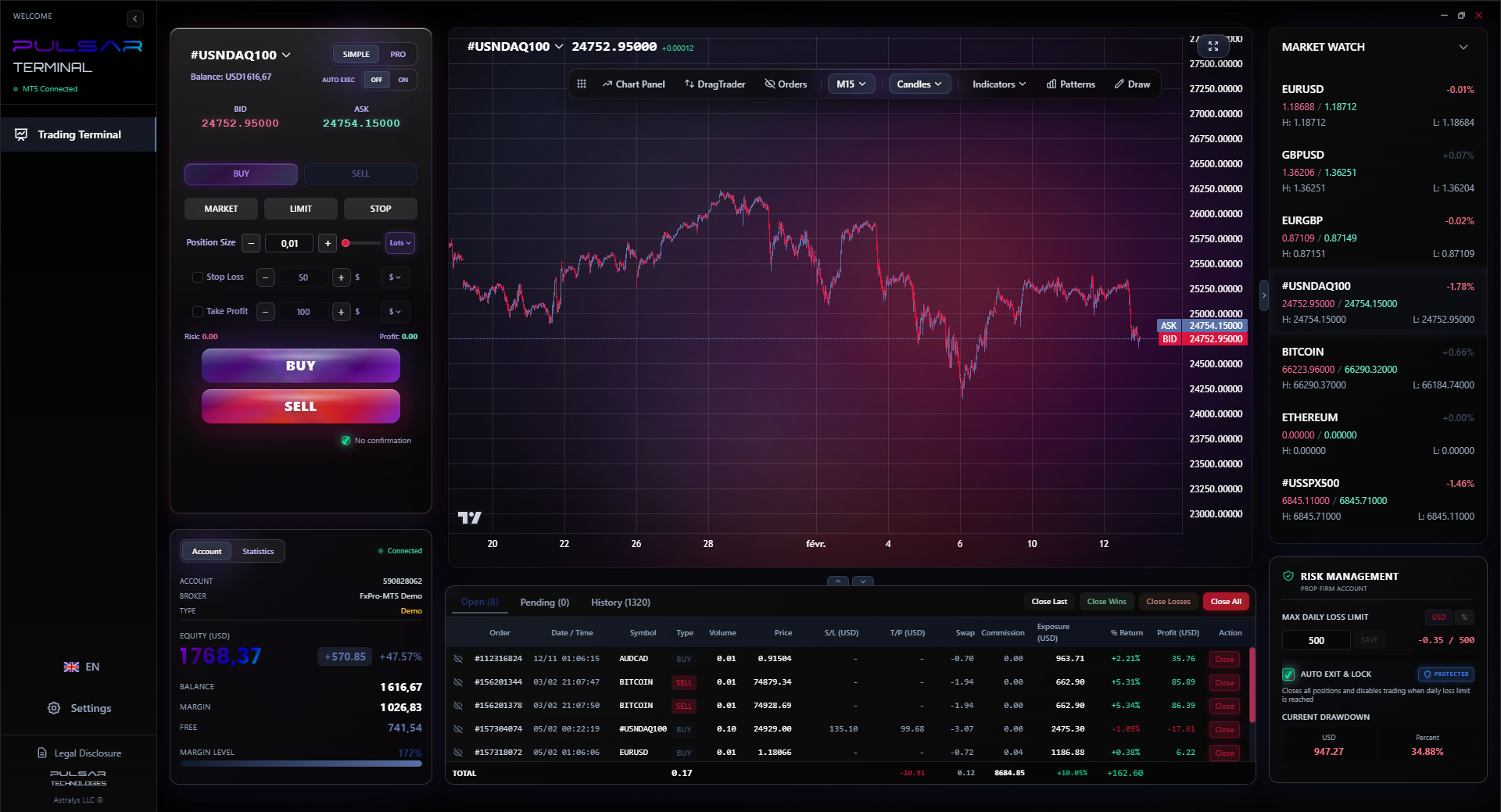
When your trading plan requires multiple take-profit levels and an automatic breakeven stop, manually managing it on MT5 is stressful and error-prone.
Pulsar Terminal
The all-in-one MT5 companion: drag-and-drop orders, multi-TP/SL, trailing stop, grid trading, Volume Profile, and prop firm protection. Used by 1,000+ traders daily.
“A losing trade that followed your plan is a better outcome than a winning trade that broke all your rules.”
So, is forex trading gambling? The FSCA-regulated market in South Africa provides a structured, legal framework for a legitimate financial activity. The tools, the brokers, the rules - they're all there for a skilled pursuit.
But here's the honest truth: it can be gambling if you make it so.
If you deposit your money, ignore risk management, chase losses, trade based on a 'hot tip' from a WhatsApp group, and pray to the market gods, then yes, you are a gambler. You've chosen to be one. The platform you're using is irrelevant.
If you treat it like a craft - study, build a system, manage risk ruthlessly, keep records, and work on your psychology - then you are a trader. The risks are still high, and most still fail, but your failure will be due to a lack of skill you can identify and improve, not just bad luck.
The market doesn't care what you call it. It will simply take your money if you're unprepared. Your job is to prepare. Ditch the 'forex is a gambling' excuse. It's a comforting lie that prevents growth. Embrace the difficult, rewarding truth: it's a skill-based challenge with real stakes, right here in our own volatile, beautiful South African market. Now, go write your first trading plan.
FAQ
Q1Is forex trading illegal or considered gambling in South Africa?
No, it's completely legal and regulated by the Financial Sector Conduct Authority (FSCA). It's classified as a financial derivatives activity, not gambling. However, you must use an FSCA-licensed broker. Trading with unregulated offshore entities is where it becomes risky and unregulated, similar to gambling with no oversight.
Q2What percentage of forex traders actually lose money in South Africa?
While the FSCA doesn't publish an exact local figure, global statistics for retail CFD traders (which includes forex) show loss rates between 51% and 89%. The consensus among experienced local traders is that the figure is comfortably over 70%. This high rate is often due to poor risk management and a lack of education, not mere chance.
Q3What's the maximum use I can get in South Africa?
For retail traders, the FSCA has capped use at 30:1 since 2021. This is a protective measure. Some offshore brokers may offer 100:1 or 500:1, but using them means forfeiting FSCA protection and taking on enormous, often account-ending risk.
Q4Can I trade the South African Rand (ZAR) as a retail trader?
You can trade pairs involving the ZAR (like USD/ZAR or EUR/ZAR) through an FSCA-regulated broker. However, you cannot directly speculate on the ZAR's value outside of these structured derivative products. All foreign exchange must go through an Authorized Dealer as per SARB rules.
Q5What's a realistic amount of money to start forex trading in SA?
While some brokers let you start with R150, that's not practical for learning proper risk management. A more realistic minimum is R1,500 to R5,000. To seriously apply a strategy with sensible position sizing, aim for R5,000 to R20,000. Remember, you're not trying to get rich from this amount; you're paying for an education.
Q6Do I pay tax on my forex trading profits?
Yes. The South African Revenue Service (SARS) views net profits from trading as taxable income. You must declare it in your annual return. Keep detailed records of all your trades, deposits, and withdrawals. This is another key distinction from gambling winnings.
Q7What's the biggest mistake that makes trading feel like gambling?
Not using a stop-loss. It's the number one sin. Moving your stop-loss further away when a trade goes against you is the equivalent of 'doubling down' at the roulette table. It turns a controlled risk into an uncontrolled hope-based gamble. Always know your exit before you enter.
Prof. Winston's Lesson
Key Takeaways:
- ✓Verify FSCA license before depositing any money.
- ✓Never risk more than 2% of your capital per trade.
- ✓Master one currency pair before adding others.
- ✓Journal every trade, especially the losers.
- ✓Taxable profits mean it's a business, not a bet.
How useful was this article?
Click a star to rate
Weekly Trading Insights
Free weekly analysis & strategies. No spam.
About the Author
David van der Merwe
Emerging Markets Trader
Johannesburg-based trader with 11 years in emerging market currencies. Specializes in ZAR pairs, FSCA-regulated trading, and South African market analysis.
Comments
Risk Disclaimer
Trading financial instruments carries significant risk and may not be suitable for all investors. Past performance does not guarantee future results. This content is for educational purposes only and should not be considered investment advice. Always conduct your own research before trading.
You Might Also Like

Cara Trading Forex Sukses: 7 Prinsip dari Trader Profesional
Cara trading forex sukses dengan 7 prinsip trader pro: manajemen modal, disiplin, journal trading, backtest. Data nyata, bukan janji profit palsu.
Jam Trading Forex Terbaik untuk Trader Indonesia: Panduan Lengkap dengan Tabel Waktu
Panduan jam trading forex untuk trader Indonesia. Tabel 4 sesi dunia, jam emas 20:00-00:00, sesi mana yang harus dihindari. Data akurat + tips dari trader berpengalaman.
Top 5 Sàn Forex Uy Tín Nhất 2026: Review Jujur dari Trader Indonesia
Top 5 sàn forex uy tín 2026 untuk trader Indonesia. Review jujur: spread, deposit, withdraw, dukungan lokal. Exness, XM, IC Markets & lebih.
Get Pulsar Terminal
All these calculators are built into Pulsar Terminal with real-time data from your MT5 account. One-click position sizing, automatic risk management, and instant calculations.
Get Pulsar Terminal