


Let's cut through the noise.

Olumide Adeyemi
West African Trading Pioneer ·  Nigeria
☕ 11 min read
What you'll learn:
- 1Investment or Speculation? You're Probably Doing It Wrong
- 2The Nigerian Legal Reality: Taxes, Scams, and Where Your Money Really Is
- 3The Real Cost Breakdown: What Your 'Investment' Actually Eats
- 4Brokers, use, and the Nigerian Trader's Trap
- 5Building a Real Edge: Strategy Over Hope
- 6The Psychological Battlefield: This Is Where You Lose
- 7Practical First Steps for the Nigerian Trader
Let's cut through the noise. The biggest lie sold to Nigerian traders is that forex is a 'get-rich-quick investment.' It's not. Calling it an 'investment' in the traditional sense is a stretch, and that misunderstanding has cost people more than just money. I've seen portfolios wiped out because someone approached the EUR/USD like it was a fixed deposit. This guide isn't about selling a dream. It's about treating your trading capital with the seriousness of a real forex trading investment, which means understanding the legal reality, the actual costs, and the psychological grind that separates the winners from the 90% who lose.
First, let's get our terms straight. An investment typically involves putting money into an asset with the expectation of long-term income or appreciation. You buy a stock for dividends, you buy property for rent. Forex trading? You're speculating on price movements over minutes, hours, or days. The 'income' is purely from capital gains. This isn't a semantic difference, it's a mindset shift that changes everything.
If you treat it like an investment, you'll hold losing positions hoping they 'come back,' you'll over-use your account trying to generate 'yield,' and you'll ignore risk management. I made this exact mistake early on. I bought GBP/USD at 1.3800, watched it drop to 1.3600, and told myself 'it's a long-term investment, it'll recover.' It didn't. I finally cut the loss at 1.3450. That wasn't investing, that was stubbornness with a fancy name. A real forex trading investment approach means protecting your capital first, not praying for a miracle.

Warning: The 10% Capital Gains Tax applies to your gross profits. That means if you make ₦1,000,000 in a year, you owe ₦100,000 to the taxman, regardless of your losses in other trades. This makes consistent profitability non-negotiable.
The market doesn't care about your time horizon. A 200-pip move against you will liquidate your account whether you planned to hold for a day or a decade. Your strategy must be built for speculation: precise entries, defined exits, and strict rules. Tools like a position size calculator aren't optional, they're your survival kit.
“Calling forex a 'get-rich-quick investment' in Nigeria isn't just wrong, it's the marketing line that fuels a ₦500 billion scam industry.”
This is where most guides gloss over the uncomfortable details. Yes, forex trading is legal for you as an individual. No, that doesn't mean it's a free-for-all. The Central Bank of Nigeria (CBN) and the SEC are the main watchdogs, but their focus has historically been on the official banking channels and large-scale operations.
The Offshore Broker Dilemma
Because local, CBN-regulated retail forex brokers aren't really a thing, you're almost certainly using an international broker. Think Exness, IC Markets, or XM. They're regulated in places like Cyprus, Seychelles, or South Africa. This is legal for you, but it introduces a key reality: your funds are held offshore. Your protection is the foreign regulator's client compensation scheme, not Nigerian law. You need to understand your broker's regulatory status inside out.
The ₦500 Billion Elephant in the Room
That figure isn't a typo. In 2024 alone, illegal forex operations (Ponzi schemes, fake investment platforms, signal seller scams) cost Nigerians about ₦500 billion. These scams thrive on the 'forex investment' myth. They promise guaranteed monthly returns, often using religious or community trust. If an 'investment' promises 5% monthly returns with no risk, it's not a trading strategy, it's a crime. Your first line of defense is skepticism.
The Taxman Cometh
Forget offshore accounts hiding your profit. The 10% Capital Gains Tax on gross profits is clear. If you're profitable, you have a tax liability. Period. This directly impacts your net returns. A strategy that yields a 15% annual return before costs and taxes might net you less than 5% after spreads, commissions, and tax. This math must be part of your plan from day one.

💡 Winston's Tip
Your first profitable trade is your most dangerous. It plants the seed of overconfidence. Document the trade carefully, then forget it. Focus on the process that generated it, not the money.
“Your use is a risk dial, not a profit button. Most Nigerian traders have it cranked to 'self-destruct.'”
Let's talk numbers. If you don't know your costs to the pip and the naira, you're just gambling. Here’s what eats into your potential forex trading investment returns.
1. The Spread: This is the broker's cut. On a standard account, EUR/USD spreads can be 0.9 pips or more. On a $10,000 position, that's a $9 cost just to enter the trade. Do 10 trades a day? That's $90 gone before you've even made a cent. ECN/RAW accounts offer spreads from 0.0 pips but charge a commission.
2. Commissions: Often $3-$7 per standard lot (100k units), per side. So a round turn (open and close) costs $6-$14. This is often cheaper than wide spreads for active traders.
3. Swap Rates (Overnight Financing): Hold a position past 5 PM EST? You pay or receive interest. For Nigerian traders often going long on USD/NGN or other pairs, this can be a significant recurring cost that turns a winning trade into a loser over time.
4. The Invisible Tax: Inefficiency. Slippage on entries and exits, platform fees for advanced tools, and the cost of education (courses, mentors) all add up.

Example: Let's say you trade 20 lots total per month.
- Spread Cost (at 0.8 pips avg): 20 lots * $8 per lot = $160
- Commission (if applicable): 20 round turns * $6 = $120
- Monthly Cost: $280 To just break even, your strategy must make over $280 that month. Now add potential swap costs and the 10% tax on gross profits. The hurdle is high.
I learned this the hard way scalping the XAU/USD. My strategy was right about 55% of the time, but my profit per trade was averaging 4 pips. With a 3-pip spread on gold, I was giving up 75% of my potential profit in costs. I was a busy loser. I switched to higher time frame swing trading to reduce the frequency and impact of spreads.
“Your use is a risk dial, not a profit button. Most Nigerian traders have it cranked to 'self-destruct.'”
International brokers love Nigerian clients. Know why? We love use. And use is the fastest way to turn a small account into dust. Offering 1:500 or 1:1000 use isn't a benefit, it's a risk amplifier they're legally allowed to offer because of their offshore regulation.
Here’s a blunt comparison of what you’re really signing up for:
| Broker Aspect | The Allure (What You See) | The Reality (What It Costs) |
|---|---|---|
| High use (1:500) | "Turn $100 into $50,000 in buying power!" | A 0.2% move against you wipes your $100. It turns normal market noise into an account-ending event. |
| Low Minimum Deposit ($5-$10) | "So affordable! Anyone can start!" | An account this small forces you to use insane use to make meaningful gains, guaranteeing poor risk management from the start. |
| Bonus Offers | "Get a 50% deposit bonus!" | Often comes with restrictive withdrawal terms. It's marketing candy, not capital. |
| Local Payment Methods | "Deposit with Naira, no stress!" | Essential service, but doesn't change the underlying risk of the trading itself. |
I used a 1:500 use on a $200 account with a broker similar to Pepperstone's offshore entity. I entered a USD/JPY trade. The price moved 8 pips against me - a tiny fluctuation. My position was so large due to the use that those 8 pips triggered a margin call. Game over in 15 minutes. My 'investment' was gone.

Pro Tip: Your use is a risk dial, not a profit button. Start by calculating your maximum risk per trade (e.g., 1% of account). Then determine your stop-loss distance in pips. Only then can you calculate the position size and the use you'll effectively be using. You'll find you rarely need more than 1:30.
💡 Winston's Tip
If you can't articulate your edge in one sentence, including your win rate and risk/reward ratio, you don't have one. You have a hope. Backtest until you find the numbers.
“A 10% capital gains tax on gross profits makes consistent profitability not just a goal, but a mathematical necessity.”
Hope is not a strategy. A real edge is a statistical advantage gained from a repeatable process. For a Nigerian trader, this edge must be even sharper to overcome costs and taxes.
Your Edge Must Be Quantifiable
Saying "I trade support and resistance" isn't an edge. An edge is: "On the 1-hour chart, when price pulls back to a prior swing high (now support) with a confirmed RSI indicator bullish divergence below 40, my win rate over 100 trades is 62%, with an average reward-to-risk of 1.8:1." See the difference? One is vague, the other is a testable, measurable system.
Discipline as Your Primary Tool
Your environment is full of distractions - NEPA, data issues, noise from social media 'gurus.' Your trading plan must be so mechanical that emotion is removed. This is where technology helps. Using a tool that automates trade management (like setting a trailing stop or taking partial profits) removes a huge psychological burden. For example, if you're in a prop firm challenge, automating your daily loss limit is the difference between passing and blowing an account on one bad trade.
Analysis vs. Execution
You can have a brilliant view on the market and still lose money. Execution is everything. This includes your entry timing, your spread awareness, and your exit plan. A tool that lets you set multiple take-profit levels for partial closures lets you bank profit and let winners run systematically, which is a core component of a profitable edge.
I built my first consistent edge by combining a simple MACD indicator crossover on the 4-hour chart with fundamental filter (only trading in the direction of the weekly central bank trend). I backtested it on 3 years of data for GBP/USD. The win rate was only 48%, but the average winner was 2.5 times larger than the average loser. That's an edge. I then practiced executing it for 3 months on a demo account, focusing solely on following the rules, not the P&L.
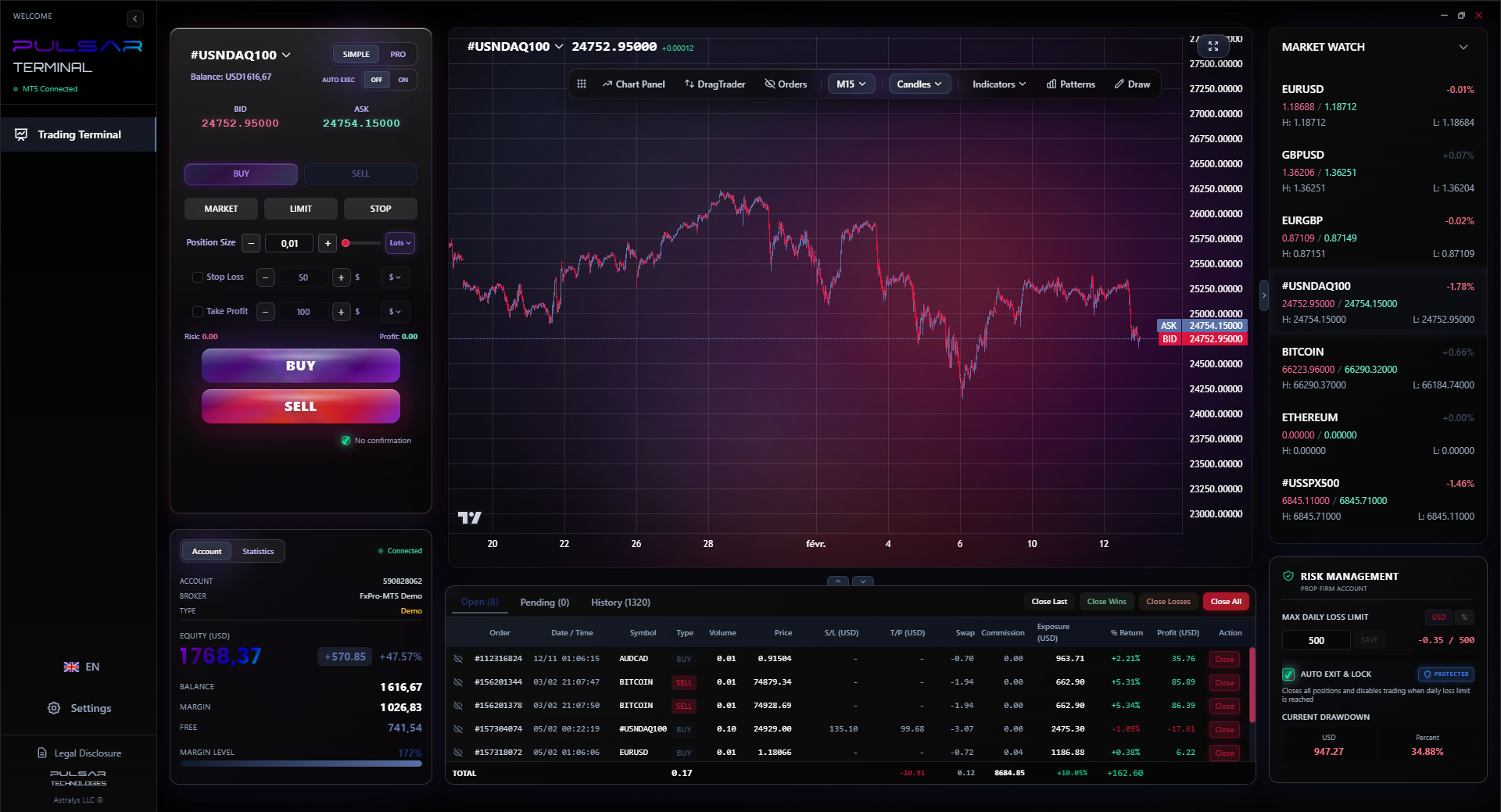
Executing a precise edge requires removing emotion, which is where a tool like Pulsar Terminal excels by letting you set and automate complex trade management rules directly on your MT5 charts.
Pulsar Terminal
The all-in-one MT5 companion: drag-and-drop orders, multi-TP/SL, trailing stop, grid trading, Volume Profile, and prop firm protection. Used by 1,000+ traders daily.
“A 10% capital gains tax on gross profits makes consistent profitability not just a goal, but a mathematical necessity.”
All the knowledge in the world means nothing if you can't handle the psychology. For Nigerian traders, there are unique pressures.
The 'Must-Make-It' Pressure: When you're trading with rent money or savings from a low-income job, every loss feels catastrophic. This pressure leads to revenge trading, overriding stops, and blowing accounts. Your trading capital must be risk capital you can afford to lose completely. If the thought of losing it keeps you up at night, it's too much.
The 'Ogabu' Mentality: The desire for the big, flashy win that solves all problems. This leads to lottery-style trading: tiny accounts with massive, poorly-planned positions. One win feels amazing and validates the approach, but the string of inevitable losses that follow destroys the account. Sustainable growth is boring. It's 2-3% per month, not 200% per week.
Isolation: Trading is lonely. You're often hiding losses from family or dealing with their skepticism. This is why community is important, but it must be the right community - focused on process, not pump-and-dump signal groups.
My biggest psychological fail was after a string of 5 winning trades. I felt invincible. On the 6th trade, I tripled my normal position size on a USD/CAD hunch. No stop loss. 'I'll just watch it,' I thought. A news spike hit, and I was down 8% of my total account in 90 seconds. The physical sensation was nausea. I had broken every rule because of overconfidence. It took me two months to emotionally recover enough to trade my normal plan again.
💡 Winston's Tip
The market's job is to find the price point that causes you the maximum pain. Your stop-loss is your pre-negotiated surrender terms. Never move it further away. Ever.
“Sustainable growth is boring. It's 2-3% per month, not 200% per week. If your plan isn't boring, it's probably broken.”
If you're starting, here's your non-negotiable checklist. Skip a step, and you're just donating your money.
- Education Before Deposit: Spend 3 months learning. Not from Instagram, but from books, reputable online courses, and studying price charts yourself. Understand what a pip really is, how use works, and what a trading plan looks like.
- Choose a Regulated Broker: Pick an international broker with a strong reputation like the ones we review. Start with a demo account. Not for a week, for at least 2-3 months of consistent, daily practice.
- Develop and Backtest ONE Strategy: Pick one market (e.g., EUR/USD) and one time frame (e.g., 4-hour). Develop a clear set of rules for entries, exits, and risk. Then, use your demo account or historical data to manually review how it would have performed over the past year. Write down every hypothetical trade.
- Start Absurdly Small: When you go live, fund your account with the absolute minimum you can. Your goal for the first 6 months is not profit. Your goal is to execute your plan with perfect discipline for 100 trades. If you can do that, you've achieved something 95% of traders never do.
- Keep a Trading Journal: For every trade, note: entry/exit reason, chart screenshot, emotional state, P&L. Review it weekly. Your journal will tell you the truth about yourself that your P&L statement won't.
This path is slow. It's frustrating. It's not glamorous. But it's the only path that leads to treating forex not as a desperate gamble, but as a serious, skill-based endeavor where you have a fighting chance. Your forex trading investment isn't just your money, it's your time, your focus, and your emotional energy. Invest those wisely first.
FAQ
Q1Is forex trading legal and a good investment in Nigeria?
Forex trading is legal for individuals in Nigeria. Calling it a 'good investment' is misleading. It's a high-risk speculation activity, not a capital-appreciation investment like stocks or real estate. It requires specific skills, risk management, and can result in total loss of capital. It's a profession, not a passive income stream.
Q2How much tax do I pay on forex trading profits in Nigeria?
You pay a 10% Capital Gains Tax on your gross trading profits for the year. This is a legal requirement. If you make ₦500,000 in profit from trading (before subtracting losses), you owe ₦50,000 in tax, regardless of whether you use a local or international broker.
Q3What is the minimum amount needed to start forex trading in Nigeria?
Technically, some international brokers allow you to start with as little as $5 (about ₦7,000). However, starting with such a small amount is often a trap that forces you to use dangerous levels of use. A more sensible minimum for serious practice is $100-$200, treated purely as risk capital for learning.
Q4Which international brokers are safe for Nigerian traders?
Look for brokers regulated by reputable authorities like the FSCA (South Africa), CySEC (Cyprus), or ASIC (Australia) that accept Nigerian clients. Examples include Exness, IC Markets, XM, and Pepperstone through their global entities. Always verify the specific regulatory license under which you are opening your account.
Q5Can I use a forex robot or signals for investment?
Be extremely cautious. The vast majority of forex robots and paid signal services are scams, especially those promising guaranteed returns. Even if legitimate, they remove your learning process. If the provider has a magical system, why are they selling it for ₦50,000 instead of using it to trade? You are responsible for your account.
Q6How do I avoid forex trading scams in Nigeria?
Avoid any platform or individual that: 1) Promises guaranteed or weekly profits. 2) Asks you to recruit others for bonuses. 3) Is not transparent about its regulatory status. 4) Uses pressure tactics or religious appeals. 5) Has a Nigerian-only platform with no clear international regulation. Stick to well-known, globally regulated brokers.
Q7Is swing trading or scalping better for Nigerian traders?
Given internet reliability issues and the high cost of frequent trading, swing trading (holding trades for days/weeks) is often more practical than scalping (seconds/minutes). Swing trading reduces the impact of spreads, requires less screen time, and is less affected by momentary power or data outages.
Prof. Winston's Lesson
Key Takeaways:
- ✓Forex is speculation, not investment. Protect capital first.
- ✓10% tax on gross profits kills mediocre strategies.
- ✓use above 1:30 is usually a risk trap.
- ✓Your edge must be measurable: Win rate & Reward/Risk.
- ✓Psychology, not analysis, causes 80% of failures.
How useful was this article?
Click a star to rate
Weekly Trading Insights
Free weekly analysis & strategies. No spam.
About the Author
Olumide Adeyemi
West African Trading Pioneer
One of Nigeria's most active forex trading educators. 8 years of experience trading from Lagos. Specializes in low-capital strategies and prop firm challenges for African traders.
Comments
Risk Disclaimer
Trading financial instruments carries significant risk and may not be suitable for all investors. Past performance does not guarantee future results. This content is for educational purposes only and should not be considered investment advice. Always conduct your own research before trading.
You Might Also Like

Cara Trading Forex Sukses: 7 Prinsip dari Trader Profesional
Cara trading forex sukses dengan 7 prinsip trader pro: manajemen modal, disiplin, journal trading, backtest. Data nyata, bukan janji profit palsu.
Jam Trading Forex Terbaik untuk Trader Indonesia: Panduan Lengkap dengan Tabel Waktu
Panduan jam trading forex untuk trader Indonesia. Tabel 4 sesi dunia, jam emas 20:00-00:00, sesi mana yang harus dihindari. Data akurat + tips dari trader berpengalaman.
Top 5 Sàn Forex Uy Tín Nhất 2026: Review Jujur dari Trader Indonesia
Top 5 sàn forex uy tín 2026 untuk trader Indonesia. Review jujur: spread, deposit, withdraw, dukungan lokal. Exness, XM, IC Markets & lebih.
Get Pulsar Terminal
All these calculators are built into Pulsar Terminal with real-time data from your MT5 account. One-click position sizing, automatic risk management, and instant calculations.
Get Pulsar Terminal