


Most new traders think forex fundamentals are just about watching the news.

David van der Merwe
Emerging Markets Trader ·  South Africa
☕ 9 min read
What you'll learn:
- 1What Forex Fundamentals Actually Are (It's Not What You Think)
- 2The Indicators That Actually Move the Rand (And When to Watch)
- 3The FSCA's 30:1 use Rule & Your Real Trading Costs
- 4A Practical Guide to Trading News Events (Without Blowing Up)
- 5The 3 Biggest Fundamental Mistakes I See (And Made Myself)
- 6Building Your Own Fundamental Analysis Routine
Most new traders think forex fundamentals are just about watching the news. They're wrong. In South Africa, it's a game of connecting global economic whispers to the Rand's heartbeat, all while navigating the FSCA's 30:1 use cap and bank spreads that'll eat your profits for breakfast. I've seen too many 'students' blow accounts because they traded a SARB interest rate decision like it was a sports bet. Let's set the record straight on what fundamentals in forex actually mean for a ZAR-based trader.
Forget the textbook definition. In the real world, forex fundamentals are the measurable economic forces that make one currency stronger or weaker than another over time. It's not news headlines; it's the data behind them.
For a South African trader, this means understanding two layers. First, the global drivers: US interest rates, European inflation, Chinese commodity demand. These move the majors like EUR/USD. Second, and crucially, the local drivers: how those global forces specifically impact the South African Rand (ZAR).
Think of it like this. A US Federal Reserve rate hike is a global fundamental. The fundamental for you is how that hike affects capital flows out of emerging markets like South Africa, pressuring the USD/ZAR pair higher. You're not just trading economics; you're trading relative economic strength.

Warning: A common mistake is reacting to the initial headline scream from a news alert. The real move often happens in the 24-48 hours after, as big banks and institutions digest the fine print of a report. Jumping in on the spike is a great way to get stopped out.
I learned this the hard way trading a US Non-Farm Payrolls report back in 2019. The number beat expectations, USD spiked. I bought USD/ZAR on the pop at R14.85. What I missed was the revision to the previous month's number, which was terrible. Within an hour, the entire move reversed. I was stopped out at R14.72 for a nasty loss. The fundamental wasn't just the new number; it was the new number in context of the old one.

💡 Winston's Tip
The market prices in expectations. Your edge isn't in knowing the data, but in spotting when the reality is meaningfully different from what was already priced in.
Not all data is created equal. Some reports cause ripples, others cause tsunamis. Here’s what moves the needle for ZAR pairs.
Global Heavyweights (For USD/ZAR, EUR/ZAR)
These are your primary drivers. If you trade ZAR crosses, you must watch these.
- US Interest Rates & Federal Reserve Policy: The single biggest driver. When the Fed is hawkish (hinting at rate hikes), the USD tends to strengthen globally, which typically weakens emerging market currencies like the Rand. Watch the FOMC statements and Fed Chair press conferences.
- US Inflation (CPI & PCE): This dictates what the Fed will do. High US inflation = higher chance of Fed rate hikes = stronger USD/ZAR.
- China Economic Data: South Africa's biggest trading partner. Weak Chinese industrial production or GDP data suggests lower demand for our commodities (like platinum and iron ore), which is bad for the ZAR.
Local South African Data
This data often causes sharp, volatile moves in ZAR pairs, but the trend is usually set by global forces.
- South African Reserve Bank (SARB) Interest Rate Decisions: Our local version of the Fed. A surprise hike can temporarily boost the ZAR; a cut can crush it. The tone of the MPC statement is often more important than the decision itself.
- South African CPI (Inflation): Directly influences SARB's decisions. Persistently high local inflation (above the 4.5% target) may force the SARB to keep rates higher for longer, which can offer the ZAR some support.
- Budget & Medium-Term Budget Policy Statement (MTBPS): This is a huge one. The market watches for the government's debt trajectory and plans to fix state-owned enterprises like Eskom. A credible, fiscally conservative budget can strengthen the ZAR. A budget seen as reckless will hammer it.
- Load-Shedding Stages & Eskom Updates: A uniquely South African fundamental. Escalating load-shedding directly impacts economic growth forecasts, which weakens the ZAR. I've seen the Rand sell off on the mere announcement of moving to Stage 6.

Example: Let's say US CPI comes in hot, and the SARB keeps rates on hold the next day. The global fundamental (high US inflation) is pushing USD/ZAR up. The local fundamental (SARB on hold) does nothing to counter it. The path of least resistance is almost certainly higher for the pair. This is how you synthesize data.
“The 30:1 use cap isn't a limitation; it's a forced dose of sanity that stops you from turning a R2,000 account into a suicide mission.”
Let's talk about the environment you're trading in. The FSCA capped use at 30:1 for retail traders. Some moan about this; I think it's the best thing that ever happened to new traders in South Africa.
Before the cap, I saw guys using 500:1, turning a R2,000 account into a R1,000,000 position. One bad trade against them by 20 pips? Wiped out. The 30:1 cap forces a bit of sanity. It means you need more capital to take meaningful positions, which ironically makes you think harder about your trades.
Now, the hidden killer: costs. Your broker's spread is just the entry fee. The real fundamentals of your profitability are the total costs.
- Broker Spreads/Commissions: On a major pair like EUR/USD, you can get under 1 pip. On USD/ZAR, expect 40-80 pips as the norm. That's your starting handicap. Use a position size calculator to see how this eats into your stop-loss distance.
- Bank Forex Fees: This is a scandal. While your broker might charge 50 pips, your bank will charge 1.8% to 2.6% to convert your ZAR to USD to fund your account. On a R10,000 deposit, that's R180-R260 gone before you place a single trade. Always check if your broker offers a ZAR-denominated account to avoid this.
- Swap Rates (Overnight Financing): This is a pure fundamental trade. If you're long a currency with a higher interest rate than the one you're short, you earn swap. If you're wrong, you pay. Holding a long USD/ZAR position (earning US interest, paying SA interest) has often paid positive swap, which adds up over time.
I use Exness and XM for their ZAR accounts and decent spreads on majors, but I always, always calculate the full cost of a trade, including the potential swap if it becomes a swing trading idea.
Here's my blunt method for handling high-impact news. I don't recommend this for beginners.
1. The Preparation (Days Before): I identify the upcoming event (e.g., SARB rate decision). I check the market consensus. Is a 25bps hike priced in? I then decide my fundamental bias. Let's say inflation is high, the Rand is weak, I think they hike 25bps.
2. The Pre-Event (1 Hour Before): I close any existing positions in that currency. Volatility will spike, and stops can get gapped. I set price alerts above and below the current market price, but I do NOT enter a new trade.
3. The Event (The Moment): I do not trade. I watch. My charts are on a 1-minute timeframe. I'm looking for the initial spike, then the rejection. Did price scream higher and instantly fall back below the pre-news level? That's a rejection, a potential sign the news was "bought."
4. The Post-Event (15-60 Minutes After): This is where I might act. The amateur money has rushed in and often gotten it wrong. The institutional flow starts to show its hand. If price broke a key technical level and holds on a retest after the news, that's a higher-probability entry. I'm combining the confirmed fundamental catalyst (the hike happened) with a technical trigger.
Using the MACD indicator on a 5-minute chart here can help spot momentum shifts after the initial chaos dies down. The key is patience. The FOMO (Fear Of Missing Out) on news is an account destroyer.
💡 Winston's Tip
Treat every economic calendar event as a potential trap. If you can't articulate the exact scenario that would prove your trade wrong before the news hits, you have no business being in the market.
“Trading the ZAR means understanding its personality: it's a risk-sensitive, commodity-linked currency that gets sold hard when the world panics.”
1. Trading the Rumor, Then the News: You buy USD/ZAR because everyone expects a hawkish Fed. The Fed is hawkish, USD/ZAR spikes and then collapses. Why? "Buy the rumor, sell the news." The fundamental was already priced in. The actual event is often a chance for the smart money to take profits. You need to gauge what's already expected.
2. Ignoring the Trend for the Data: In a strong USD bull market, a single piece of weak US data might cause a 30-minute dip. New traders short the USD, thinking the trend is broken. The dip gets bought aggressively, and the trend resumes, blowing out the shorts. The longer-term fundamental trend (Fed tightening cycle) outweighs a single data point. Don't use a scalping strategy against the major fundamental tide.
3. Not Knowing Your Currency's Personality: The Rand isn't the Swiss Franc. The ZAR is a risk-sensitive, commodity-linked, emerging market currency. In times of global panic (like March 2020), it gets sold, hard. In times of global greed for yield, it can rally. Trading USD/ZAR with the same "safe-haven" logic you'd use for USD/CHF is a recipe for disaster. Its fundamentals are tied to global risk appetite and local politics.
I once held a long EUR/ZAR position through a local election, convinced a certain outcome would be ZAR-positive. The outcome was messy, coalition talks dragged on, and the ZAR sold off in uncertainty. I was stopped out. I traded my hope, not the fundamental reality of political uncertainty.
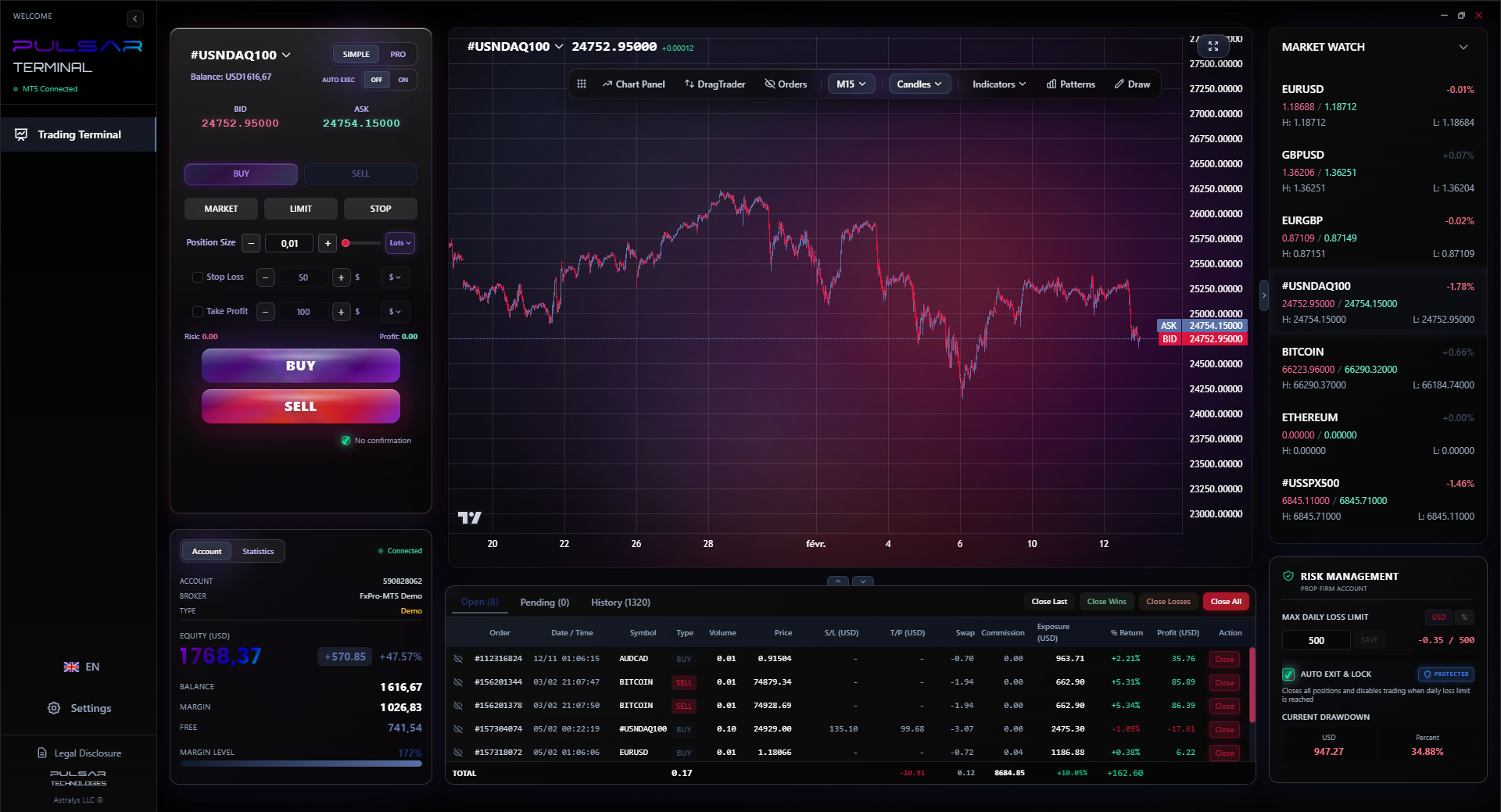
Managing the volatility of fundamental news requires precise order tools, and Pulsar Terminal's drag-and-drop orders and multi-TP/SL features let you set complex trade plans on MT5 before the data drops.
Pulsar Terminal
The all-in-one MT5 companion: drag-and-drop orders, multi-TP/SL, trailing stop, grid trading, Volume Profile, and prop firm protection. Used by 1,000+ traders daily.
You can't watch everything. Build a system.
Weekly (Sunday Night):
- Open an economic calendar. I use the one on TradingView or my broker's platform.
- Highlight the high-impact events for the week for: USA, Eurozone, China, and South Africa.
- Note the consensus forecasts.
Daily (Morning, Before London Open):
- Check overnight price action. Did Asia react to US/SA data from the previous day?
- Scan headlines from Reuters, Bloomberg, Business Day, Moneyweb. I'm not reading every article, just catching the tone.
- Check the USD/ZAR, EUR/ZAR, and my main pair charts (like XAU/USD if I'm trading gold).
Your Cheat Sheet: Keep this simple framework in mind:
| If This Happens... | The Rand (ZAR) Typically... | Example Pair to Watch |
|---|---|---|
| US Interest Rates ↑ | Weakens | USD/ZAR ↑ |
| SA Political Risk ↑ | Weakens | USD/ZAR ↑ |
| Global Risk Appetite ↑ | Strengthens | USD/ZAR ↓ |
| Commodity Prices ↑ | Strengthens | USD/ZAR ↓ |
| SARB Surprise Hike ↑ | Strengthens (short-term) | USD/ZAR ↓ |
Finally, fundamentals give you the direction, the "why." But they are terrible at telling you the exact "when" or "where" to enter. That's where price action and technicals come in. Use fundamentals to decide which side of the market you want to be on. Use technicals to find a precise, low-risk entry point to get on that side. Never let a fundamental opinion stop you from respecting a clear technical margin call level or stop-loss. The market can stay irrational longer than you can stay solvent, even if you're fundamentally right.
FAQ
Q1Is forex trading legal in South Africa?
Yes, completely legal. But you must use a broker that is either licensed by the Financial Sector Conduct Authority (FSCA) or a reputable international regulator. Trading with an FSCA-licensed broker is safer for ZAR deposits and consumer protection.
Q2What is the most important fundamental for the South African Rand?
There's no single one, but the most consistent driver is global risk sentiment. When global investors are fearful, they pull money out of emerging markets like South Africa, weakening the ZAR. Domestically, Eskom's load-shedding and the government's fiscal policy (the budget) are massive fundamental factors.
Q3Why did my broker's spread widen so much during the news?
This is normal and a key risk. During high-volatility events (like SARB decisions or US NFP), liquidity dries up as big banks pull their quotes. Your broker widens the spread definition to protect themselves from the risk of you getting filled at a wildly bad price. Never assume you'll get the normal spread during major news.
Q4Can I use higher use with an international broker?
Some international brokers (like IC Markets or Pepperstone) may offer South African clients higher use (e.g., 500:1) under their offshore licenses. However, you lose the direct protection of the FSCA, your funds may not be segregated in SA, and you're taking on enormous risk. The 30:1 FSCA cap is there for a reason.
Q5How do I start learning fundamentals?
Start small. Pick one currency pair, like USD/ZAR. Each week, focus on understanding one piece of data that affects it. Next week, the US CPI. The week after, the SARB decision. Read the actual reports, not just the headlines. Follow the price reaction for 48 hours after the release. This slow, focused study beats trying to digest everything at once.
Q6Do I need to be an economist to trade forex fundamentals?
Absolutely not. You need to be a detective, not a professor. Your job is to understand what the market cares about right now and whether the actual data confirms or contradicts that story. It's about interpreting reactions, not memorizing economic models.
Prof. Winston's Lesson
Key Takeaways:
- ✓Synthesize global & local data for ZAR pairs.
- ✓FSCA's 30:1 use protects you from yourself.
- ✓Bank forex fees (1.8-2.6%) are a silent profit killer.
- ✓Trade the post-news reaction, not the headline spike.
- ✓The long-term fundamental trend outweighs a single data point.
How useful was this article?
Click a star to rate
Weekly Trading Insights
Free weekly analysis & strategies. No spam.
About the Author
David van der Merwe
Emerging Markets Trader
Johannesburg-based trader with 11 years in emerging market currencies. Specializes in ZAR pairs, FSCA-regulated trading, and South African market analysis.
Comments
Risk Disclaimer
Trading financial instruments carries significant risk and may not be suitable for all investors. Past performance does not guarantee future results. This content is for educational purposes only and should not be considered investment advice. Always conduct your own research before trading.
You Might Also Like

Cara Trading Forex Sukses: 7 Prinsip dari Trader Profesional
Cara trading forex sukses dengan 7 prinsip trader pro: manajemen modal, disiplin, journal trading, backtest. Data nyata, bukan janji profit palsu.
Jam Trading Forex Terbaik untuk Trader Indonesia: Panduan Lengkap dengan Tabel Waktu
Panduan jam trading forex untuk trader Indonesia. Tabel 4 sesi dunia, jam emas 20:00-00:00, sesi mana yang harus dihindari. Data akurat + tips dari trader berpengalaman.
Top 5 Sàn Forex Uy Tín Nhất 2026: Review Jujur dari Trader Indonesia
Top 5 sàn forex uy tín 2026 untuk trader Indonesia. Review jujur: spread, deposit, withdraw, dukungan lokal. Exness, XM, IC Markets & lebih.
Get Pulsar Terminal
All these calculators are built into Pulsar Terminal with real-time data from your MT5 account. One-click position sizing, automatic risk management, and instant calculations.
Get Pulsar Terminal