


I lost $1,200 in a single afternoon in 2015.

Olumide Adeyemi
West African Trading Pioneer ·  Nigeria
☕ 11 min read
What you'll learn:
- 1The Nigerian Reality Check: It's Legal, But It's a Jungle
- 2Forget "Get Rich Quick" – This is a Skilled Profession
- 3Your First ₦100,000: A Sane Capital Plan
- 4Picking Your Battles: Start with ONE Pair
- 5Building a Strategy, Not a Gambling System
- 6Navigating the Broker Minefield
- 7Your First Six Months: The Survival Blueprint
- 8When You're Ready to Scale (And The Pitfalls)
I lost $1,200 in a single afternoon in 2015. It wasn't on some crazy exotic pair, just good old EUR/USD. I'd read a few articles, watched some YouTube videos, and thought I'd cracked the code. I went all in on a 'sure thing' breakout. The market reversed, my broker's stop-loss got slipped by 15 pips, and my account was wiped. That humbling, expensive lesson taught me more than any book ever could: knowing how to become a forex trader isn't about finding a secret signal. It's about building a system you can survive.
Let's clear the air first. Yes, forex trading is legal for you as an individual in Nigeria. No, you don't need a special license from the CBN to trade from your phone. The confusion comes from the CBN's rules for companies offering OTC forex versus you trading online. The regulatory landscape for us retail folks is, frankly, underdeveloped. This creates a weird grey area everyone uses: you're free to sign up with international brokers regulated in places like Cyprus (CySEC), Australia (ASIC), or South Africa (FSCA).
The real hurdle isn't legality, it's logistics. The CBN's strict FX sourcing policies mean you can't use the official, cheaper exchange rate to fund your trading account (they'd rightly call that economic sabotage). So you fund your broker via bank transfer, card, or fintech apps at the prevailing market rate. Your profit? That's taxable income. A 10% capital gains tax applies if you're making serious money. But let's be honest, most people aren't worrying about tax because they never get to the profitable stage. The first step in learning how to become a forex trader is accepting this environment. You're on your own. Your broker's regulator won't come to your house in Lagos if there's a dispute. Your due diligence is your first line of defense.

Warning: I've seen this story too many times. A 'broker' pops up with a Lagos office, offers insane use like 1:1000, and promises to 'help' you bypass CBN rules. They're almost always a scam. Stick with established, internationally regulated names. Check our Exness review and IC Markets review for examples of what real, regulated brokers look like.

💡 Winston's Tip
Your first profitable strategy will likely be boring. If it feels exciting, you're probably gambling.
If your primary motivation is escaping a 9-5, you will lose. The market smells desperation and feeds on it. Between 70-80% of retail traders blow their accounts. In Nigeria, with the added pressures of economic volatility, that number might be higher. Viewing this as a side hustle you'll master in a month is the fastest path to donating your capital to someone else.
Treat It Like a Trade
You wouldn't open a shop without learning inventory, supplier costs, and customer behavior. Trading is the same. Your inventory is capital, your supplier cost is the spread and commission, and your customer is the collective market psychology. Your first 6-12 months should be treated as a paid apprenticeship where the tuition is the money you're willing to lose while learning. I tell every new trader: allocate capital you are 100% comfortable lighting on fire for education. If that's ₦50,000, start there. It's not your 'investment,' it's your tuition fee.
The Two Core Disciplines
There are only two things to master: Analysis and Psychology. Technical analysis (reading charts) gets all the glamour, but market psychology (controlling yourself) is where the real battle is fought. You can have a perfect strategy and still fail because you panic-sell or get greedy. I once held a winning GBP/USD trade for 80 pips, got greedy waiting for 100, and watched it reverse to hit my stop-loss at break-even. The analysis was right. My psychology was weak. Most guides on how to become a forex trader spend 90% on analysis. I'm telling you now, reverse that focus early on.
“If your primary motivation is escaping a 9-5, you will lose. The market smells desperation and feeds on it.”
How much do you need? The most dangerous answer is 'whatever the broker minimum is.' Some brokers let you start with $1 (about ₦1,500). That's a trap. It teaches you nothing about real risk management. Here's a better framework.
Start with what I call 'Survivable Capital.' This is money that, if lost, won't affect your rent, family responsibilities, or mental health. For many Nigerians starting out, a range of ₦50,000 to ₦200,000 is realistic. Why? It's large enough to force you to respect it, but small enough that its loss isn't catastrophic.
Let's do the math with ₦100,000. A fundamental rule is to never risk more than 1-2% of your account on a single trade.

Example:
- Account Balance: ₦100,000
- 1% Risk per Trade = ₦1,000
- If you're trading EUR/USD and your stop-loss is 20 pips away, how much can you trade?
- Pip Value for a Micro Lot (1,000 units) is roughly ₦4 (depending on rate).
- To risk ₦1,000 with a 20-pip stop: ₦1,000 / (20 pips * ₦4) = 12.5 micro lots.
- So, you could trade 1 mini lot (10,000 units) and risk roughly ₦800.
This discipline is non-negotiable. Use a position size calculator religiously. I didn't on that $1,200 loss. I risked about 25% of my account on one 'conviction' trade. Never again. Your capital is your army. Don't send it all over the hill at once.
The forex market has dozens of pairs. The Nigerian temptation is to look at USD/NGN. Don't. The spreads are massive, and the liquidity for retail traders is terrible. You'll get eaten alive by costs.
Start with the majors. They have the tightest spreads and most predictable behavior during specific sessions.
- EUR/USD: The most liquid. Tends to trend well. Spreads as low as 0.6 pips. It's my recommended starting pair. Read our full EUR/USD guide to understand its rhythms.
- GBP/USD: More volatile. Can make bigger moves, but can also whip around during news. Average spread around 0.9 pips.
- USD/JPY: Often driven by interest rate differentials and risk sentiment.
Pick ONE. Just one. Learn its average daily range, what time it's most active (London session for EUR/USD), and how it reacts to major news. I traded only EUR/USD for my first year. I got to know its personality like a neighbor. That focus allowed me to spot when its behavior was changing, which was more valuable than any indicator. Trying to watch five pairs as a beginner is like trying to follow five different football matches at once. You'll miss everything.

Pro Tip: If you're more comfortable with commodities, consider XAU/USD (Gold). It's a great alternative to currencies and often moves on different drivers. We have a dedicated XAU/USD guide that breaks it down.
💡 Winston's Tip
The market can stay irrational longer than you can stay solvent. A good stop-loss isn't a sign of weakness; it's your admission ticket to trade another day.
“Your capital is your army. Don't send it all over the hill at once.”
A strategy is a rule-based plan. It tells you: 1) When to enter, 2) Where to place your stop-loss, 3) Where to take profit, and 4) How much to risk. A gambler has points 1 and maybe 3.
Keep It Stupidly Simple (KISS)
You don't need 10 indicators. Start with price action and one or two tools. My first profitable system used:
- Support & Resistance: Plain old horizontal lines where price had bounced before.
- A Trend Filter: A simple moving average (like the 50-period) to tell me if I should only look for buys or sells.
- The RSI indicator: Not to find entries, but to warn me when the market was overbought or oversold in a trend, so I'd avoid chasing.
I'd wait for price to pull back to support in an uptrend (above the 50 MA), show signs of bouncing (like a bullish pin bar), and then enter. Stop-loss went a few pips below the support. My profit target was the next resistance level. That's it. I backtested this for months on old charts before risking a kobo.
Define Your Style
Your personality dictates your strategy. Are you patient? Then swing trading, holding trades for days, might suit you. Are you adrenaline-fueled and decisive? Then a scalping strategy, grabbing 5-10 pips at a time, could be a fit (though it's the hardest path). I'm a swing trader. I found I was terrible at scalping; I'd second-guess myself constantly.
Your broker is your gateway. A bad one will make winning impossible through re-quotes, massive slippage, and hidden fees. For Nigerian traders, key criteria are:
- International Regulation: CySEC, ASIC, FSCA are good signs. It means they have capital requirements and client fund segregation.
- Deposit/Withdrawal Methods: Must support local bank transfers, cards, and likely fintechs like Flutterwave or Paystack. Fast, free withdrawals are a must.
- Spreads & Commissions: Compare. A 'zero spread' account usually has a commission. Do the math on your typical trade size.
- use: Offers of 1:1000 are a red flag. 1:100 to 1:500 is common, but I beg you, use less. I never use more than 1:30 now. use amplifies losses faster than gains.
Here’s a quick comparison based on 2026 accessibility:
| Feature | What to Look For | Nigerian-Friendly Example |
|---|---|---|
| Regulation | Reputable international license | XM (IFSC, ASIC), Pepperstone (ASIC, FCA) |
| Deposits | Naira bank transfers, no fees | Most top brokers now offer this via payment processors |
| Spreads on EUR/USD | Consistently below 1.0 pip on ECN/Raw accounts | IC Markets, Pepperstone often have sub-0.5 pip averages |
| Platform | MT4/MT5 support | Almost universal, but check mobile app functionality |
Never deposit more than your 'tuition fee' with a new broker. Test their withdrawal process with a small amount first. I learned this after waiting 3 weeks for a payout from a shady outfit back in 2017.
“A strategy is a rule-based plan. A gambler has an entry point and a prayer.”
Here is your actionable, no-BS plan for the first half-year.
Months 1-2: Demo & Education. Open a demo account. Don't trade. Just watch your one chosen pair for 2-4 hours a day. Learn how to place orders, set stops, read basic candlestick patterns. Read one good book (I recommend 'Trading in the Zone' by Mark Douglas for psychology). Paper trade your simple strategy.
Months 3-4: Live Micro Trading. Fund a live account with your Survivable Capital. Switch to micro lots (1,000 unit positions). Your goal is not profit. Your goal is to execute 50-100 trades following your rules EXACTLY. The outcome is irrelevant. Did you place the stop where your plan said? Did you take profit without moving it? This builds discipline. Track every trade in a journal: entry, exit, reason, emotional state.
Months 5-6: Analysis & Refinement. Review your journal. Is your strategy winning more than losing? Is your average winner bigger than your average loser? If not, tweak the strategy in demo, not live. This is where you might integrate a tool like the MACD indicator to help confirm trends, but only if your data says you need it. By now, you should know what a pip and spread cost you in Naira without thinking.
Throughout this, the market will test you. You'll have a winning streak and feel invincible. You'll have a losing streak and want to quit. This is the process. This is how to become a forex trader.
💡 Winston's Tip
Keep a trading journal. Not just entries and exits, but your emotional state. The patterns you'll find in your own behavior are more predictable than any currency pair.
Let's say your six-month review is positive. You're consistently following rules and your equity curve is slowly creeping up. Now the real mental game begins.
Scaling Means More Risk Management, Not Less. The worst thing you can do is double your position size because you're confident. Increase your risk per trade by 0.25% increments, not leaps. If you were risking 1%, go to 1.25% for another 50 trades.
Beware of Prop Firm Hype. Passing a prop firm challenge to trade their capital is a popular goal. It requires insane discipline, as their drawdown rules are brutal. A tool that automates daily loss limits and trailing stops can be the difference between passing and blowing the account. Managing a prop firm challenge manually, while emotionally charged, is a recipe for a margin call.
The Emotional Cycle is Amplified. A ₦20,000 loss feels different from a ₦200,000 loss, even at the same percentage. You will feel it in your gut. This is why the psychological foundation from your first six months is everything. You must have the muscle memory of following your plan, or fear and greed will take over.
The journey of how to become a forex trader never ends. The market changes. You adapt. But the core - discipline, risk management, continuous learning - stays the same. It's a marathon where the finish line keeps moving. But the freedom and self-mastery you gain along the way? That's the real profit.
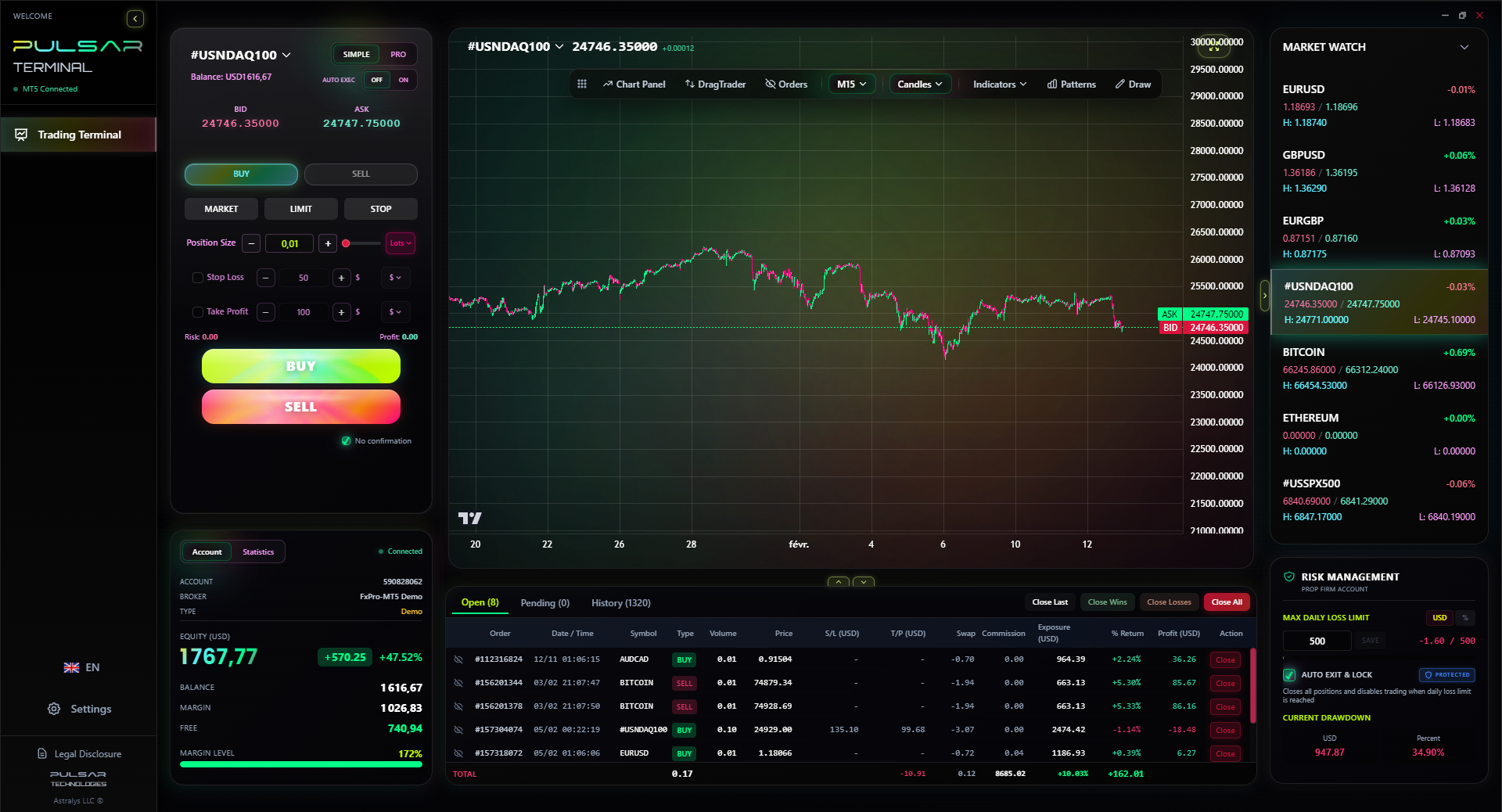
Managing the complex rules of a prop firm challenge or executing a multi-stage exit strategy is where a tool like Pulsar Terminal, which automates trailing stops and daily loss limits directly on MT5, becomes a trader's best friend.
Pulsar Terminal
The all-in-one MT5 companion: drag-and-drop orders, multi-TP/SL, trailing stop, grid trading, Volume Profile, and prop firm protection. Used by 1,000+ traders daily.
FAQ
Q1Is forex trading illegal in Nigeria?
No, it is not illegal for individuals. The Central Bank of Nigeria (CBN) regulates banks and Bureaux de Change, but there are currently no specific laws prohibiting Nigerian residents from trading forex online with internationally regulated brokers. It's a personal investment activity.
Q2How much money do I need to start forex trading in Nigeria?
You can technically start with as little as ₦5,000 with some brokers, but I strongly advise against it. A more realistic 'tuition fee' that allows for proper risk management is between ₦50,000 and ₦200,000. This lets you trade micro lots and practice surviving drawdowns without blowing your account in two trades.
Q3Which is the best broker for Nigerian forex traders?
There's no single 'best' broker. You need one that is internationally regulated (e.g., by CySEC, ASIC), offers reliable Naira deposit/withdrawal methods, and has competitive spreads on major pairs. Brokers like XM, Exness, IC Markets, and Pepperstone are popular choices among experienced Nigerian traders due to their long track records and local payment support.
Q4Do I pay tax on my forex trading profits in Nigeria?
Yes. According to Nigerian law, all income is taxable. Profits from forex trading are subject to Capital Gains Tax, which is currently 10%. You are responsible for declaring this income to the Federal Inland Revenue Service (FIRS).
Q5Why do most forex traders fail?
Most fail due to poor risk management (risking too much per trade), lack of a tested strategy, uncontrollable emotions (fear and greed), and treating trading like gambling instead of a skilled profession. The high use offered to retail traders accelerates these failures.
Q6Can I trade forex with my phone in Nigeria?
Absolutely. Most reputable brokers offer full-featured mobile apps for MT4 or MT5. You can analyze charts, place trades, and manage your account from anywhere with a good internet connection. However, I recommend doing your main analysis on a larger screen if possible.
Q7How long does it take to become a profitable forex trader?
There's no fixed timeline. Treat the first year as a full-time learning period. Some may see consistency after 6 months of dedicated, disciplined practice, while for others it may take 2-3 years. The key is continuous education and strict adherence to a trading plan during the learning phase.
Prof. Winston's Lesson
Key Takeaways:
- ✓Risk a maximum of 1-2% of your capital per trade. Always.
- ✓Master one major currency pair before even looking at another.
- ✓Your first live capital is tuition, not an investment.
- ✓A trading journal is non-negotiable for growth.
- ✓Broker regulation is your first line of defense, not an afterthought.
How useful was this article?
Click a star to rate
Weekly Trading Insights
Free weekly analysis & strategies. No spam.
About the Author
Olumide Adeyemi
West African Trading Pioneer
One of Nigeria's most active forex trading educators. 8 years of experience trading from Lagos. Specializes in low-capital strategies and prop firm challenges for African traders.
Comments
Risk Disclaimer
Trading financial instruments carries significant risk and may not be suitable for all investors. Past performance does not guarantee future results. This content is for educational purposes only and should not be considered investment advice. Always conduct your own research before trading.
You Might Also Like

Cara Trading Forex Sukses: 7 Prinsip dari Trader Profesional
Cara trading forex sukses dengan 7 prinsip trader pro: manajemen modal, disiplin, journal trading, backtest. Data nyata, bukan janji profit palsu.
Jam Trading Forex Terbaik untuk Trader Indonesia: Panduan Lengkap dengan Tabel Waktu
Panduan jam trading forex untuk trader Indonesia. Tabel 4 sesi dunia, jam emas 20:00-00:00, sesi mana yang harus dihindari. Data akurat + tips dari trader berpengalaman.
Top 5 Sàn Forex Uy Tín Nhất 2026: Review Jujur dari Trader Indonesia
Top 5 sàn forex uy tín 2026 untuk trader Indonesia. Review jujur: spread, deposit, withdraw, dukungan lokal. Exness, XM, IC Markets & lebih.
Get Pulsar Terminal
All these calculators are built into Pulsar Terminal with real-time data from your MT5 account. One-click position sizing, automatic risk management, and instant calculations.
Get Pulsar Terminal