


Let's cut through the noise.

Olumide Adeyemi
West African Trading Pioneer ·  Nigeria
☕ 11 min read
What you'll learn:
- 1The Nigerian Reality Check: Profits vs. Promises
- 2The Real Costs of Trading in Naira
- 3Regulation & Broker Risks: Navigating the Grey Zone
- 4use: The Double-Edged Sword That Cuts Most Deeply
- 5What the Profitable Minority Actually Does Differently
- 6A Realistic Profit Timeline for Nigerians
- 7Final Verdict: Should You Start Trading Forex in Nigeria?
Let's cut through the noise. Everywhere you look in Lagos or on social media, you see flashy cars and screenshots of massive profits, all supposedly from forex. The promise is simple: deposit a little money, use some use, and you're on your way to financial freedom. It's a powerful fantasy, and it's why you're asking, 'is forex trading really profitable?' I'm here to give you the mentor's review, not the marketer's pitch. The short answer is yes, it can be, but for most people reading this, it absolutely is not. The path to being in the profitable minority is narrower, harder, and more expensive than you've been told. Let's set the record straight with Nigerian specifics.
First, we need to confront the single most important statistic in this business. Globally, between 69% and 83% of retail traders lose money. Let that sink in. At the worst end, that's 8 out of every 10 people funding an account who walk away with less than they started. In Nigeria, with our unique challenges - internet stability, power issues, emotional pressure to 'make it' quickly - I'd argue the failure rate leans toward that higher number.
The fantasy sold is one of easy money. The reality is a skilled profession. Think of it like surgery. You wouldn't watch a few YouTube videos and then ask, 'Is surgery really profitable?' before cutting someone open. Yet, that's exactly what thousands do with trading. They see a strategy online, deposit ₦50,000, and are shocked when the market, a beast fueled by trillion-dollar banks and algorithms, eats them alive.
My first major loss was a lesson in this. Back in 2015, I was convinced I had cracked the code with a complex indicator setup. I put on a large position size on GBP/USD, ignoring all my own rules. A news event hit, the market spiked against me, and I lost over $1,200 in minutes - about 40% of my account then. I was chasing profit, not practicing a craft. That loss hurt, but it rewired my brain. Profitability isn't about finding a secret; it's about not making stupid mistakes long enough for your edge to work.

Warning: If your primary motivation for trading is to get rich quick or escape a financial squeeze, you are statistically guaranteed to fail. The market exploits desperation perfectly.

💡 Winston's Tip
Your first profit target should be to lose less than you expect. Master the art of the small, controlled loss before you chase the big win.
“Profitability isn't about finding a secret; it's about not making stupid mistakes long enough for your edge to work.”
Before you see a single pip of profit, you're already paying. Most new traders only think about the spread, but the cost structure is deeper, especially for us in Nigeria.
The Obvious Costs: Spreads & Commissions
Spreads are the broker's cut. For a major pair like EUR/USD, you might see 0.8 pips on a standard account. That's $8 gone on a standard lot before you start. On a raw spread account, it could be 0.1 pips plus a $3.50 commission per side. That's $7 in total ($3.50 to open, $3.50 to close). These costs add up fast, particularly if you're a scalping trader making many trades a day.
The Hidden Nigerian Tax: Funding & Withdrawal Fees
This is where it gets local. Funding your account with your Nigerian card often attracts a 1-2% international transaction fee from your bank. Using a domiciliary account is cleaner but not everyone has one. E-wallets like Neteller or Skrill charge their own conversion and transfer fees. When you win and want to withdraw, the process reverses, taking another bite. A 2% fee on deposit and 2% on withdrawal means you need to make a 4% return just to break even on the money movement alone.
The Government's Cut: Capital Gains Tax
Yes, you have to pay tax. The FIRS expects a 10% capital gains tax on your gross profits. Trading with an international broker like Exness or IC Markets doesn't make you invisible. You need to keep careful records. I know traders who've made life-changing money only to be crippled by a tax bill they didn't plan for. Profitability is measured after taxes, not before.

Example: You deposit $1000. Your bank charges a 1.5% fee ($15). You trade well and make a 15% profit ($150). Withdrawal fee is 1% ($11.50). You're left with $1123.50. Pay 10% tax on the $150 profit ($15). Your real net profit is $108.50, or a 10.85% return, not 15%. Costs nearly halved your gain.
“Using maximum use is like driving a Ferrari at 300 km/h on the Third Mainland Bridge during rush hour.”
The legal framework here is... interesting. Forex trading itself is legal. The Central Bank of Nigeria (CBN) regulates local entities, but for online retail trading, the Securities and Exchange Commission (SEC) is the main voice. And they've been loud lately.
The SEC isn't worried about you trading your own money. They're cracking down hard on unlicensed 'fund managers' and Ponzi schemes disguised as forex investment clubs. If someone is asking you to pool money for them to trade, run. It's illegal unless they have a fund manager license, which almost none of these social media gurus do.
This creates a grey zone for you, the individual trader. Most serious Nigerian traders use internationally regulated brokers. Why? Better technology, tighter spreads, and stronger client fund protection. You'll be opening an account with a firm regulated in Cyprus (CySEC), the UK (FCA), Australia (ASIC), or offshore hubs like the Seychelles (FSA).
This is a calculated risk. You get a superior trading platform, but you're outside direct Nigerian regulatory protection. It makes choosing your broker critical. You need one with a long track record, clear regulation, and a reputation for processing withdrawals smoothly for Nigerian clients. I've had good experiences with XM and Pepperstone for reliability, but you must do your own due diligence. A broker's flashy ads offering 1:2000 use are a red flag, not a benefit.
“Using maximum use is like driving a Ferrari at 300 km/h on the Third Mainland Bridge during rush hour.”
Brokers love to advertise insane use - 1:500, 1:1000, even 'unlimited.' To a new trader, this sounds like free power. 'I can control $10,000 with just $10!' This is the single fastest route to a margin call and a blown account.
Let me show you why. Say you deposit ₦100,000 (about $65). With 1:1000 use, your broker might let you open a position worth $65,000. On a standard lot (100,000 units), each pip movement is worth $10. If you buy just one mini lot (10,000 units) worth $10,000, each pip is $1. If the market moves 65 pips against you, your entire ₦100,000 is gone. On a volatile pair, that can happen in under an hour.
High use amplifies every mistake. It turns a small, normal market retracement into an account-ending event. When I mentor new traders, I cap their use at 1:30, no matter what the broker offers. It forces discipline. It makes you think about position size properly. Real, sustainable profitability comes from compounding small, consistent gains, not from hitting a lottery ticket with leveraged bets.
The painful truth? The brokers offer high use because it's good for their business. It increases trading volume and, statistically, speeds up client losses. Don't fall for it. Using maximum use is like driving a Ferrari at 300 km/h on the Third Mainland Bridge during rush hour. It's not a question of if you crash, but when.
💡 Winston's Tip
If you can't explain your trade setup in one simple sentence ('price bounced off the daily support level'), your strategy is too complicated. Complexity is the enemy of execution.
“Your first profit target should be to lose less than you expect.”
So, who are the 17-31% that make it? They aren't psychic. They've just built a boring, strong system and have the discipline to follow it. Here’s their blueprint.
1. They Treat It as a Business, Not a Gamble. This means a startup capital they can afford to lose (I recommend at least $500-$1000 to be meaningful), a business plan with clear goals, and a separate trading account. They track every trade in a journal - entry, exit, reason, emotion. They review it weekly. My journal showed me I lost 80% of my trades entered after 10 PM Lagos time. I was tired and impulsive. I made a rule: no trading after 9 PM. Problem solved.
2. Their Strategy is Simple and Repeatable. They don't chase 20 indicators. They master price action, support/resistance, and maybe one or two key indicators like the RSI or MACD. They know their strategy's win rate and risk/reward ratio. For example, if you win 40% of the time but your average winner is 3 times bigger than your average loser, you're profitable. They find their edge and grind it.
3. Risk Management is Their Religion. This is non-negotiable. They never risk more than 1-2% of their account on a single trade. If you have a $1,000 account, that's a $10-$20 max risk per trade. This means your position size is determined by your stop-loss distance. They use stop-losses on every single trade, no exceptions. This one habit alone would save more than half of failing traders.
4. They Master Their Psychology. They know FOMO (Fear Of Missing Out) will make them chase a move and enter late. They know revenge trading after a loss leads to bigger losses. They have routines to stay calm. The market is a mirror of your mind. If you're greedy, scared, or impatient, the market will find that flaw and exploit it for every naira you have.

Pro Tip: The fastest way to improve isn't finding a new strategy. It's reviewing your last 20 losing trades. Look for patterns. Are you rushing entries? Ignoring the trend? Trading too big? Your losses hold the exact blueprint of your flaws.
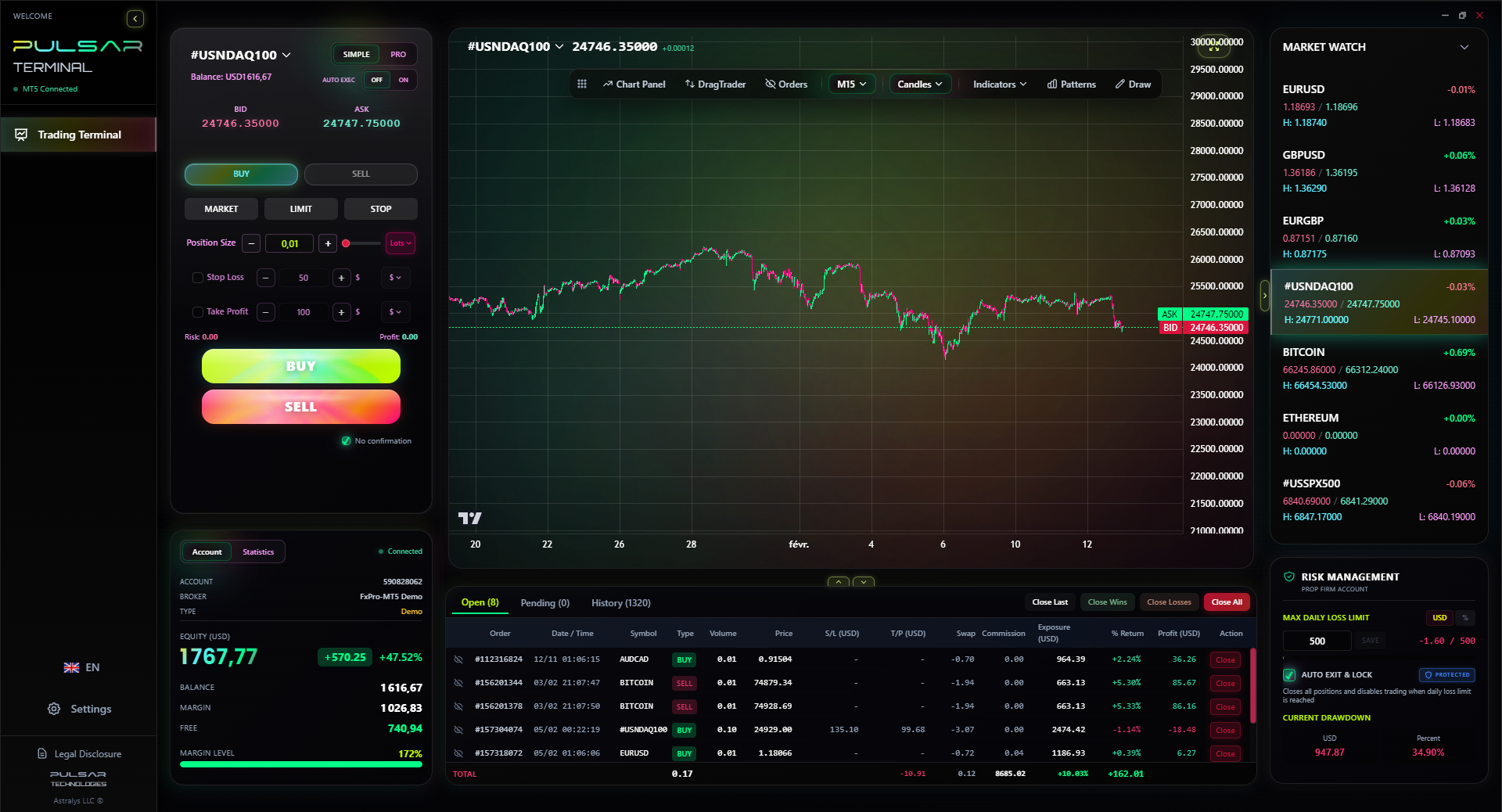
Sticking to a 1-2% risk rule requires precise order calculation, which a tool like Pulsar Terminal automates directly on your MT5 platform.
Pulsar Terminal
The all-in-one MT5 companion: drag-and-drop orders, multi-TP/SL, trailing stop, grid trading, Volume Profile, and prop firm protection. Used by 1,000+ traders daily.
“Your first profit target should be to lose less than you expect.”
Let's crush the 'get rich in 90 days' myth. Here's a more honest pathway, assuming you're dedicated, well-funded, and have a good mentor or course.
Year 1: The Expensive Tuition Year. Your goal isn't profit. Your goal is survival and education. You will likely lose money, or at best break even after costs. This year is for learning your platform, practicing your strategy in a demo, then a small live account, and making every mistake in the book under controlled risk. Expect to spend money on education, data, and maybe coaching. See it as paying university fees.
Year 2: The Break-Even Year. If you've survived and learned, you should now be able to execute your plan consistently. Your trades are based on your rules, not your gut. The goal this year is to cover all your costs - spreads, commissions, fees - and end at zero. This is a massive success. It means your business is viable.
Year 3: The Consistent Profit Year. Now, with a proven system and iron discipline, you can aim for consistent returns. A realistic, professional target is 10-20% annual return on your trading capital. Not 100%. Not 500%. 10-20%. On a $5,000 account, that's $500-$1,000 per year. It sounds small compared to the fantasies, but it's real, sustainable, and can be scaled as your capital grows.
I didn't see consistent monthly profits until my third year. I blew up two small accounts before that. The people you see claiming faster success are either lying, on a lucky streak that will end, or are trading with such huge risk that their next loss will wipe them out.
💡 Winston's Tip
Track your 'P&L per hour.' If you make all your profits between 8 AM - 12 PM Lagos time, but lose it all trading at night, you've just found a free edge: stop trading at night.
“A realistic, professional target is 10-20% annual return on your trading capital. Not 100%. Not 500%.”
So, is forex trading really profitable? The answer is a conditional yes. It is a legitimate way to generate income, but the barriers to entry - in skill, psychology, and capital - are extremely high.
You should NOT start trading if:
- You have less than $500 in dedicated risk capital.
- You need money from trading to pay next month's bills.
- You believe it's a shortcut or an easy side hustle.
- You're not prepared to study for 1-2 years before seeing real results.
- You get emotionally attached to being 'right' on a trade.
You CAN consider it if:
- You have disposable income you can afford to lose completely.
- You are fascinated by markets, economics, and psychology.
- You are intensely disciplined and patient by nature.
- You're willing to invest in education before expecting returns.
- You can follow a boring plan for months without deviating.
For the vast majority of people, a better path is to invest in their career, start a traditional business, or use regulated investment vehicles. Forex trading is a brutal, zero-sum game where the professionals are waiting to take money from the unprepared. If, after all this, you still want to proceed, do it with your eyes wide open. Start with a demo account. Learn one swing trading strategy inside out. Practice for at least six months. Then, and only then, fund a small live account with money you can kiss goodbye. That's the only honest path to potentially joining the profitable minority.
FAQ
Q1What is the minimum amount I need to start forex trading profitably in Nigeria?
While brokers like FXTM or HFM let you start with as little as ₦100 or $5, that's for learning the platform, not profitable trading. For any real chance, you need enough capital to manage risk properly. I recommend a minimum of $500 (about ₦750,000). This allows you to risk 1-2% per trade ($5-$10) and withstand a losing streak without blowing your account. Starting with less forces you to use dangerous use or risk too much per trade.
Q2Do I have to pay tax on my forex trading profits in Nigeria?
Yes. The Federal Inland Revenue Service (FIRS) requires you to pay a 10% Capital Gains Tax on your gross profits from forex trading. This applies even if you trade with an international broker. You are responsible for keeping your own records and declaring the income. Not doing so can lead to penalties and back-tax demands.
Q3Which broker is the best and safest for Nigerian traders?
There's no single 'best' broker, as it depends on your trading style. Look for brokers with strong international regulation (like FCA, CySEC, ASIC), a proven track record of serving Nigerian clients, and reliable deposit/withdrawal methods like domiciliary account transfers or e-wallets. Brokers like XM, Pepperstone, and IC Markets are popular choices. Always check the SEC website to ensure a broker isn't on their warning list.
Q4Can I make a living from forex trading in Nigeria?
It's possible, but it's an incredibly high-risk goal that takes years to achieve. You would need a large, dedicated trading capital (I'd say at least $20,000) and the proven ability to generate consistent returns of 10-20% annually. For 99% of people, it's far safer to treat trading as a supplemental income or a business you build slowly while maintaining a primary job.
Q5Why do most forex traders fail?
They fail for a combination of reasons: poor risk management (risking too much per trade), using excessive use, lack of a tested strategy, emotional trading (greed and fear), and underestimating the costs (spreads, fees, taxes). , they treat it as gambling instead of a professional skill that requires a business plan and immense discipline.
Q6Is it legal to use international forex brokers in Nigeria?
Yes, it is legal for individuals to use their personal funds to trade with international brokers. The SEC's warnings are targeted at unlicensed entities collecting money from the public to trade. As an individual trading your own account, you are generally within the law, provided you report and pay taxes on any profits.
Prof. Winston's Lesson
Key Takeaways:
- ✓83% of retail traders lose money; assume you start in that group.
- ✓Real profit is calculated after ALL costs: spreads, fees, taxes.
- ✓Never risk more than 2% of your account on a single trade.
- ✓Expect 1-2 years of education before consistent profitability.
How useful was this article?
Click a star to rate
Weekly Trading Insights
Free weekly analysis & strategies. No spam.
About the Author
Olumide Adeyemi
West African Trading Pioneer
One of Nigeria's most active forex trading educators. 8 years of experience trading from Lagos. Specializes in low-capital strategies and prop firm challenges for African traders.
Comments
Risk Disclaimer
Trading financial instruments carries significant risk and may not be suitable for all investors. Past performance does not guarantee future results. This content is for educational purposes only and should not be considered investment advice. Always conduct your own research before trading.
You Might Also Like

Cara Trading Forex Sukses: 7 Prinsip dari Trader Profesional
Cara trading forex sukses dengan 7 prinsip trader pro: manajemen modal, disiplin, journal trading, backtest. Data nyata, bukan janji profit palsu.
Jam Trading Forex Terbaik untuk Trader Indonesia: Panduan Lengkap dengan Tabel Waktu
Panduan jam trading forex untuk trader Indonesia. Tabel 4 sesi dunia, jam emas 20:00-00:00, sesi mana yang harus dihindari. Data akurat + tips dari trader berpengalaman.
Top 5 Sàn Forex Uy Tín Nhất 2026: Review Jujur dari Trader Indonesia
Top 5 sàn forex uy tín 2026 untuk trader Indonesia. Review jujur: spread, deposit, withdraw, dukungan lokal. Exness, XM, IC Markets & lebih.
Get Pulsar Terminal
All these calculators are built into Pulsar Terminal with real-time data from your MT5 account. One-click position sizing, automatic risk management, and instant calculations.
Get Pulsar Terminal