


I lost R4,200 in under an hour on a USD/ZAR trade.

David van der Merwe
Emerging Markets Trader ·  South Africa
☕ 10 min read
What you'll learn:
I lost R4,200 in under an hour on a USD/ZAR trade. The chart looked bullish, the news was good, and I jumped in. What I missed was that the price was smack in the middle of a massive distribution zone from the previous week. I was buying into a trap, and the market structure forex framework would have shown me that clear as day. That loss, back in 2019, was the expensive lesson that made me stop chasing candles and start reading the story the market was actually telling. Here’s how I learned to see it.
Forget the fancy definitions. Market structure is simply the footprint of where the big money has been buying and selling. It's the story of supply and demand written in price action. In South Africa, with our volatile ZAR pairs and those wild overnight gaps, if you're not reading this story, you're just gambling.
Think of it like this: the market only does three things. It trends up, it trends down, or it chops sideways (that's a range). Market structure is how you identify which of those three things is happening right now, and more importantly, when it's about to change. It's the framework that tells you if that shiny new high is a genuine breakout or a fakeout designed to trap retail traders like us.
I used to be obsessed with the MACD indicator and RSI, looking for divergences and crossovers. They have their place, but they're secondary. They describe momentum, not location. Market structure tells you where to look for that momentum signal. Trading without understanding structure is like trying to navigate Johannesburg without knowing which suburbs are safe and which aren't. You might get lucky, but it's a dangerous way to live.

Warning: A huge chunk of those 51-89% of retail accounts losing money on CFDs do so because they trade against the prevailing market structure. They buy in a clear downtrend because 'it's cheap' or sell in an uptrend because 'it's too high'. Structure defines the path of least resistance.
This is the alphabet of market structure forex. Everything builds from these four letters.
- Higher High (HH): The most recent peak is higher than the peak before it.
- Higher Low (HL): The most recent pullback low is higher than the pullback low before it.
- Lower High (LH): The most recent peak is lower than the peak before it.
- Lower Low (LL): The most recent pullback low is lower than the low before it.
Uptrend Structure
An uptrend isn't just 'price going up'. A healthy uptrend is defined by a series of HHs and HLs. Each HL is a potential buying zone for the big players. If price makes a HH, pulls back, but then forms a LL instead of a HL, that's your first warning sign the uptrend is cracking. I learned this the hard way on a GBP/ZAR swing trading setup. Price made a beautiful HH, I bought the pullback. Instead of bouncing to make another HH, it sliced through my stop loss and printed a LL. The structure had broken. I was out for a 1.5% loss, but it saved me from a 7% drop that followed.
Downtrend Structure
Flip it. A downtrend is a series of LHs and LLs. Your job is to spot when a LH fails to form. If price makes a LL, rallies, but can't make a LH and instead pushes to a HH, the downtrend's engine has stalled.

Example: Look at USD/ZAR on a daily chart. Draw lines connecting the obvious peaks and troughs from the last three months. Are the highs generally getting higher? Are the lows? That simple exercise tells you the primary structural bias. Ignoring that bias because you got a 5-minute RSI signal is a recipe for a margin call.

💡 Winston's Tip
A trend isn't defined by a moving average. It's defined by price making higher highs and higher lows. If it stops doing that, the trend has stopped. Full stop.
“Trading without understanding structure is like trying to navigate Johannesburg without knowing which suburbs are safe.”
This is where it gets practical for us locals. Support and resistance (S&R) are the walls and floors of the market. But not all S&R is created equal.
Structural Support/Resistance: This is the heavy-duty stuff. It's formed at previous market structure points - where a clear HL or LH was established, or where a trend reversed. These zones have memory because that's where large orders were previously filled. When USD/ZAR approaches a previous major LH from two weeks ago, that's a high-probability resistance zone. It's not a guess; it's a level where sellers have historically stepped in.
Ranged Markets (Consolidation): This is when the market gets stuck. It's printing a series of relatively equal highs and lows. In South Africa, we see this a lot around major economic announcements or during illiquid sessions. The key here is to trade the edges of the range (buy near support, sell near resistance) and wait for a break of structure (BoS) to signal the next directional move. A break above a range's resistance that then forms a HH is a buy signal. A break below support that forms a LL is a sell signal.
I used to get chopped up trying to trade breakouts prematurely. Now, I wait for the market to show me it's committed by changing its structure. For example, if EUR/USD breaks above a range, I don't buy immediately. I wait for it to pull back and form a HL above the old resistance (now support). That pullback-and-hold is the market confirming the breakout is real. This patience alone probably saved me thousands in false breakout losses. A good broker like Pepperstone or IC Markets with tight spreads is crucial here, as you're often entering on a retest where every pip counts.
Trading USD/ZAR, EUR/ZAR, or GBP/ZAR with market structure is a different beast compared to the majors. The volatility is higher, the spreads are wider, and the moves can be explosive.
Lesson from a Win: In early 2025, USD/ZAR was in a clear downtrend on the 4-hour chart (LHs and LLs). It rallied sharply to a previous LH zone around 18.85. The spread was about 45 pips with my broker at the time - a cost you must factor in. Instead of shorting at the zone, I waited. Price tapped 18.87, formed a bearish pin bar, and started to drop. It broke below the recent minor swing low (confirming the LH held), and I entered short on a retest. My stop was just above the LH at 18.95. The trade ran down to 18.25. The wide spread meant my risk was larger, but the structural clarity made the high reward worth it.
Broker Choice Matters: Trading structure on ZAR pairs requires a broker with consistent execution during our market hours. Slippage on these pairs can kill a good setup. I've had better experiences with brokers like Exness and XM for local access, but always check their current ZAR pair spreads and commission structures. That 45-pip spread means you need a move of at least that just to break even, so your position size must reflect that. Always use a position size calculator.

Pro Tip: On volatile pairs, zoom out. The 1-hour and 4-hour charts often give you a cleaner, more reliable read on market structure than the 5 or 15-minute charts, which can be noisy. Define the structure on the higher timeframe, then use the lower timeframe for precise entry on a retest.
💡 Winston's Tip
The most important high or low on your chart is the most recent one. The market's memory is shorter than you think. Stop drawing lines on data from three months ago.
“The sweet spot is at the structure levels, not in the no-man's-land between them.”
Let's get honest. Learning this wasn't smooth.
- Trading the Middle: My R4,200 loss story. The sweet spot is at the structure levels (S&R), not in the no-man's-land between them. If price is halfway between a clear HL and a HH, it's often in equilibrium. Wait for it to commit to a side.
- Ignoring the Higher Timeframe (HTF) Bias: I'd see a beautiful HH and HL forming on the 15-minute EUR/USD guide chart and go long. Meanwhile, the daily chart was painting a massive LH and was in a clear downtrend. The 15-minute uptrend was just a pullback within the larger down move. I was buying into a selling zone. Always check the structure one or two timeframes above yours.
- Chasing Breaks Without Confirmation: A candle wicking above a resistance level is not a break of structure. A daily close above it is better. But the real confirmation is a subsequent HL above the level. I've been faked out more times than I can count by not waiting for that confirmation.
- Overcomplicating It: I used to draw 20 lines on a chart. Now, I mark the last few major HH/HL/LH/LL. That's it. The most recent structure points are the most relevant. Clean charts lead to clear decisions.
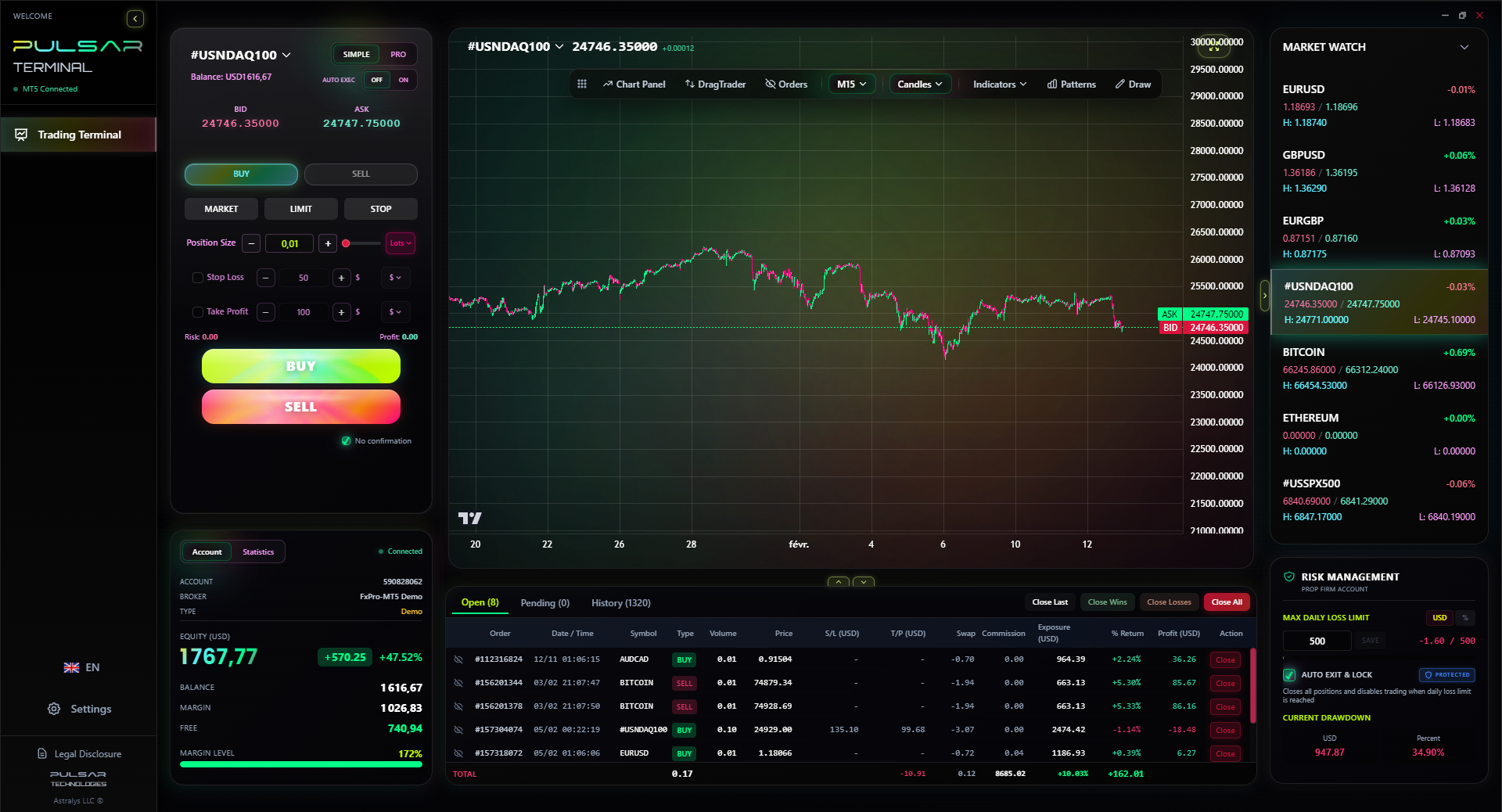
Manually drawing those structure lines and waiting for confirmations is time-consuming, but a tool like Pulsar Terminal can automate pattern recognition and help you visualize key levels directly on your MT5 charts.
Pulsar Terminal
The all-in-one MT5 companion: drag-and-drop orders, multi-TP/SL, trailing stop, grid trading, Volume Profile, and prop firm protection. Used by 1,000+ traders daily.
Here’s exactly what I do each evening before the Sydney session opens.
- Scan the HTF: I open the daily chart on my 3-4 main pairs (including one ZAR pair). I identify the current macro structure. Is it uptrend, downtrend, or range? I mark the most recent key HH/HL or LH/LL.
- Find the Zones: I draw horizontal lines at those recent structure points. These are my potential trade zones for the next 24 hours.
- Drop to the 4H/1H: I look at how price is interacting with those daily zones on the lower timeframe. Is it approaching one? Is it respecting it? I look for a lower-timeframe structure break (like a HH on the 1H) that aligns with the daily bias.
- Plan the Trade: If price is near a daily support in an uptrend, I look for a bullish 1H setup (like a HL forming). I calculate my entry, stop loss (placed beyond the structure break that would invalidate my idea), and take profit. My stop is always structural, not a random number of pips.
- Execute or Wait: If my setup triggers, I take it. If not, I do nothing. Most days, I do nothing. That's okay. This process filters out 70% of the noise.
This routine forces discipline. It moves you from reactive trading ('Ooh, it's going up!') to proactive planning ('If it pulls back to this level and holds, I'll buy').
💡 Winston's Tip
If you can't clearly label the last three swing highs and lows as HH/HL or LH/LL within 10 seconds, you shouldn't be in a trade. The structure is unclear, and you're guessing.
“Most days, I do nothing. That's okay. A good process filters out 70% of the noise.”
Once you're comfortable with basic structure, these concepts can deepen your analysis.
Market Structure Shifts (MSS): This is the golden signal. It's when a trend officially reverses. A downtrend (LH, LL) shifts to an uptrend when price creates a HH and then a HL. That first HL after the HH is often the highest-probability entry for a new trend. The reverse is true for uptrend to downtrend shifts.
Liquidity and Fair Value Gaps: This gets into how markets move. Price often makes fast runs to grab orders sitting above obvious highs (liquidity) before reversing. A Fair Value Gap is a 3-candle pattern that leaves an imbalance; price often returns to 'fill' that gap later. These are advanced but powerful for timing entries within your structural zones.
Volume Profile: Tools like Volume Profile show you where most trading activity happened at specific price levels. Often, the point of control (the price with the most volume) aligns perfectly with a key structural support or resistance level. It's a fantastic confirmation tool.
Don't jump into these yet. Master the HH/HL/LH/LL framework first. It's the foundation. Everything else is just adding rooms to a house that must have solid foundations. Start by just observing the charts for a week without trading. Label the highs and lows. You'll start to see the story, and suddenly, the market won't look so random anymore.
FAQ
Q1Is forex trading legal in South Africa?
Yes, absolutely. It's regulated by the Financial Sector Conduct Authority (FSCA). While you aren't forced to use an FSCA-regulated broker, you really, really should. It's your main protection against scams and ensures some level of local accountability.
Q2What's a good starting deposit for a South African trader?
It varies by broker. Some like XM or JustMarkets let you start with $5-$10, which is great for practicing with tiny risk. More established brokers like IG or Tickmill often require $100-$250. Start with an amount you can afford to lose completely while you're learning. Remember, most retail accounts lose money.
Q3Why is market structure more important than indicators?
Indicators are derived from price; they lag. Market structure is price. It shows you where the actual battles between buyers and sellers took place. An indicator might tell you a market is overbought, but structure tells you where it might reverse - at a previous LH or resistance zone. Structure gives you location, which is everything.
Q4How do I handle the wide spreads on USD/ZAR?
You must account for it in your risk management. If the spread is 50 pips, your trade needs room to breathe. Use higher timeframes (4H, Daily) where the potential profit is hundreds of pips, making the 50-pip cost a smaller percentage. And always, always use a stop loss. A wide spread makes scalping strategy on ZAR pairs very difficult.
Q5What's the biggest mistake beginners make with market structure?
They see an old support line from a month ago and blindly buy when price gets near it. But if the recent market structure has broken down (making LHs and LLs), that old support is far less relevant. Always prioritize the most recent structure. The market has a short memory for old levels if new ones have been established.
Q6Can I use this for trading gold (XAU/USD)?
100%. Market structure is universal. Gold, stocks, indices - they all move based on supply and demand. The principles of HH/HL are exactly the same. In fact, XAU/USD often respects these structural levels very cleanly. It's a great instrument to practice on after forex.
Prof. Winston's Lesson
Key Takeaways:
- ✓Identify HH/HL for uptrends, LH/LL for downtrends.
- ✓Trade at structure levels, not in between.
- ✓Always check the higher timeframe bias first.
- ✓Wait for a break of structure *and* a retest for confirmation.
- ✓Use structural levels for your stop loss placement.
How useful was this article?
Click a star to rate
Weekly Trading Insights
Free weekly analysis & strategies. No spam.
About the Author
David van der Merwe
Emerging Markets Trader
Johannesburg-based trader with 11 years in emerging market currencies. Specializes in ZAR pairs, FSCA-regulated trading, and South African market analysis.
Comments
Risk Disclaimer
Trading financial instruments carries significant risk and may not be suitable for all investors. Past performance does not guarantee future results. This content is for educational purposes only and should not be considered investment advice. Always conduct your own research before trading.
You Might Also Like

Cara Trading Forex Sukses: 7 Prinsip dari Trader Profesional
Cara trading forex sukses dengan 7 prinsip trader pro: manajemen modal, disiplin, journal trading, backtest. Data nyata, bukan janji profit palsu.
Jam Trading Forex Terbaik untuk Trader Indonesia: Panduan Lengkap dengan Tabel Waktu
Panduan jam trading forex untuk trader Indonesia. Tabel 4 sesi dunia, jam emas 20:00-00:00, sesi mana yang harus dihindari. Data akurat + tips dari trader berpengalaman.
Top 5 Sàn Forex Uy Tín Nhất 2026: Review Jujur dari Trader Indonesia
Top 5 sàn forex uy tín 2026 untuk trader Indonesia. Review jujur: spread, deposit, withdraw, dukungan lokal. Exness, XM, IC Markets & lebih.
Get Pulsar Terminal
All these calculators are built into Pulsar Terminal with real-time data from your MT5 account. One-click position sizing, automatic risk management, and instant calculations.
Get Pulsar Terminal