


I watched my NinjaTrader chart as the E-mini S&P 500 futures contract ticked down another point.

James Mitchell
Senior Trading Analyst
☕ 14 min read
What you'll learn:
- 1What Exactly Is a NinjaTrader Prop Firm? (It's Not What You Think)
- 2The Real Cost Breakdown: It's More Than the Evaluation Fee
- 3The Rules That Will Break You (Not the Market)
- 4The 2025 Regulatory Earthquake (And What's Coming)
- 5A Realistic Strategy to Actually Pass the Challenge
- 6Why NinjaTrader? Platform Pros & Cons for Prop Trading
- 7How to Choose a Firm in 2025 (Red Flags & Green Lights)
- 8The Final Verdict: Is It Worth It?
I watched my NinjaTrader chart as the E-mini S&P 500 futures contract ticked down another point. My account was down $487 on the day, just $13 away from my daily loss limit on a $50,000 prop firm evaluation. I broke my own rule, sized up too big on a 'sure thing' reversal, and got steamrolled. One more tick and I'd be locked out for the day, another $250 evaluation fee wasted. This isn't a hypothetical. It's the daily reality for thousands trying to crack the NinjaTrader prop firm code. Most see the advertised 90% profit splits and dream of funded accounts. I see the 90%+ failure rate on challenges and traders blowing up on technicalities they never saw coming.
Let's clear the air first. A NinjaTrader prop firm isn't NinjaTrader itself giving you money. NinjaTrader Group makes the trading software (NinjaTrader) and runs a brokerage (NinjaTrader Brokerage). Prop firms are separate companies like Apex Trader Funding or Topstep that use the NinjaTrader platform as the testing and trading environment for their evaluation programs.
You pay them a fee - anywhere from $100 to $500 - to take a "challenge" or "evaluation." You trade a simulated account with their rules. Pass, and they give you a "funded" simulated account where you keep a large chunk of the profits (usually 80-90%). They're trading their own capital based on your simulated performance. It's a performance-based audition, not a loan.
The key detail most miss? You're almost never trading on the live NinjaTrader Brokerage feeds during the evaluation. You're on a simulated Rithmic or Tradovate data feed. The fills can be perfect, which is great, but it doesn't prepare you for the slight slippage you'll get with real money, even on a platform known for low costs. I learned this the hard way early on. My scalping strategy that nailed entries in the sim would often be off by a tick live, turning small wins into breakeven trades or worse.

Warning: Don't confuse the platform with the funder. Your contract and rules are with the prop firm, not NinjaTrader. If the prop firm changes its rules or goes under, NinjaTrader isn't responsible.

💡 Winston's Tip
The evaluation isn't a test of your maximum profit potential. It's a test of your minimum risk tolerance. Trade like you're trying to lose $1, not make $1,000.
They advertise the evaluation fee. Smart traders budget for the hidden costs that make the challenge even harder.
The Obvious Cost:
- Evaluation Fee: $100 - $500. This is your ticket to play. Consider it gone the second you pay it.
The Hidden, Ongoing Costs:
- Platform Fees: If you pass and get funded, many firms charge a monthly software fee for NinjaTrader, often around $99. This comes out of your profits.
- Commissions & Fees: Even with NinjaTrader's low rates, they add up fast. Let's get specific.
Commissions: The Silent Account Killer
Say you're trading Micro E-mini S&P 500 futures (MES). NinjaTrader Brokerage commissions can be as low as $0.09 per contract, per side. But that's just the commission. Add exchange and NFA fees (about $0.19) and order routing ($0.25). Your real cost per round turn is closer to $0.53 on a micro.
That doesn't sound like much? If you're a scalper taking 10 trades a day, that's $5.30 daily in fees. To hit a typical profit target of, say, $2,500 in a month, you first have to overcome about $116 in trading fees. It forces you to either trade less or make more per trade - both changes that can wreck a strategy that was barely profitable on paper.
I once built a strategy that averaged $12 profit per trade on the MES. Backtest looked great. In sim, it worked. Then I ran the numbers with real fees: $12 profit - $0.53 fees = $11.47 net. One tick of slippage (which is $1.25 on the MES) would wipe out over 10% of my net profit. The strategy wasn't strong; it was fragile. I had to go back and redesign for a larger average profit target, which meant holding longer and taking on more risk.

Example: Trading 5 ES (standard E-mini) contracts per day, 20 days a month. Round-turn cost ~$1.29 commission + ~$0.44 fees = ~$1.73. 5 contracts * $1.73 * 20 days = $173 in monthly fees before you make a single dollar of profit.
“The 90% failure rate isn't a challenge; it's a description of how many lack the patience and discipline.”
This is where 90%+ fail. It's rarely a single bad trade. It's death by a thousand rule violations.
1. The Daily Loss Limit: This is the killer. Your $50,000 evaluation account might have a daily loss limit of $1,000. Hit that, and you're done for the day. Often, the account is also suspended. The trap? It's usually based on your running daily P&L, not per trade. So if you're up $400 in the morning, then give back $500, you're only down $100 on the day, right? Wrong. Your daily loss from your highest point is $500. If your max daily loss is $500, you just triggered a violation. Poof. Account failed.
I violated this exact rule in 2019. Was up $650, got cocky, took a huge position into news. Gave back all $650 and then lost another $200. My net P&L was -$200, but my drawdown from the high was $850. I blew past my $800 daily limit without realizing it until the platform locked me out. Game over.
2. The Maximum Drawdown Rule: This is your total account loss limit. For a $50k account, it's often $2,500. It seems huge, but it includes all closed trades AND the floating loss in your open positions. This is critical. If you have a $2,000 floating loss on a stubborn trade you're hoping will come back, you only have $500 of buffer left in your entire account. One more losing trade of any size can fail you.
3. The Minimum Trading Days: Many require you to trade a certain number of days (e.g., 5-10) during the evaluation. This forces activity, which leads to overtrading on slow days just to hit the count. It's a terrible incentive.
Managing these rules is a tighter constraint than managing your strategy. You need a tool that tracks this in real-time. Manually calculating your distance to the daily loss limit while in a trade is a sure path to disaster. This is where a strong trading journal and real-time risk dashboard are non-negotiable. Frankly, most retail platforms, including base NinjaTrader, don't surface this clearly enough. You need to build it or find a tool that does.

Pro Tip: Your first trade each day should be sized so that a full stop-loss hit cannot breach your daily loss limit. Use a position size calculator religiously, and set it for 50-70% of your daily max, not 100%.
The wild west days are ending. For years, prop firms operated in a gray area. They argued they weren't managing client money, just running sim challenges. Regulators are now closing in, and it changes everything.
The Big Shift (October 2025): NinjaTrader Group itself launched "NinjaTrader Prop" and "Tradovate Prop," dedicated platforms for this space. Why? To bring order and compliance. This is a signal that the big players see regulation coming and are getting their house in order.
The Looming CFTC Rule (Expected 2026): The biggest threat to the current model is the CFTC potentially classifying evaluation-based prop firms as Commodity Trading Advisors (CTAs). This isn't just paperwork. It would mean:
- Mandatory registration with the CFTC and NFA.
- Strict capital requirements for the firms.
- Formal, audited risk disclosures to you, the trader.
- Possible elimination of the one-time evaluation fee model. They might have to charge ongoing management or performance fees like a traditional fund.
What does this mean for you? Smaller, shakier prop firms will vanish. The ones that survive will have higher costs, which they'll pass on to you through higher fees or worse profit splits. The 90% split might become 70%. The $200 evaluation might become $500.
When you choose a firm now, you're not just judging their rules. You're betting on their balance sheet and legal team's ability to navigate the next 18 months. Stick with the large, established names that are already partnering with the official NinjaTrader Prop platform. It's your best hedge against your funded account disappearing because the firm got a regulatory cease-and-desist letter.
This regulatory scrutiny is why understanding a margin call in the futures world is just the start; you need to understand the firm's own risk of being shut down.
💡 Winston's Tip
If you can't explain your edge in one sentence and back it up with 100+ sim trades, you're donating your evaluation fee. Backtest, then forward-test in sim. The challenge is your final exam, not your first practice test.
“You're not trying to make money in the evaluation. You're practicing perfect, low-risk execution.”
Forget get-rich-quick. Passing is a boring, defensive operation. Here's the only blueprint that has consistent merit.
Phase 1: The Grind (Days 1-10) Your only goal is survival. Trade the smallest size allowed - often one micro contract (MES, MNQ). Your aim is to hit the minimum trading day requirement without ever touching 30% of your daily loss limit. I'm serious. If your daily max is $1,000, you should sweat if you're down $300. This phase builds the discipline muscle. You're not trying to make money. You're practicing perfect, low-risk execution. Document every trade. Why did you enter? Was the reason still valid at exit?
Phase 2: The Climb (After Minimum Days Met) Now you can think about the profit target. Increase size by one micro contract. Your edge should be proven by now from Phase 1 data. The profit target is a marathon, not a sprint. Aim for 0.5% to 1% of the account size per day. On a $50k account, that's $250 to $500. It sounds small, but hitting that consistently for two weeks gets you there.
The Instrument Choice: Don't jump into volatile stuff like crude oil or crypto futures because the moves are big. The EUR/USD guide talks about forex pairs having personality; futures do too. The Micro E-mini S&P 500 (MES) or Micro Nasdaq (MNQ) are your best friends. They're liquid, the spread definition is tight (often 1 tick), and the margin is low. They move enough to profit from but aren't prone to the gut-wrenching gaps of smaller markets.
My Personal Failing & Fix: I used to try to pass in the first week. Big size, aggressive targets. I failed four challenges in a row. On the fifth, I imposed a hard rule: one MES contract only until Day 10. I grinded out $40-$80 days. It was painfully boring. But by Day 11, I had zero pressure, a deep understanding of the market's rhythm, and a green account. I then scaled to two contracts and hit the profit target in the next seven trading days. Boring works.
This methodical approach is what tools are built for. Automating your trade plans so you're not making emotional size decisions in the heat of the moment is the difference between passing and blowing up.
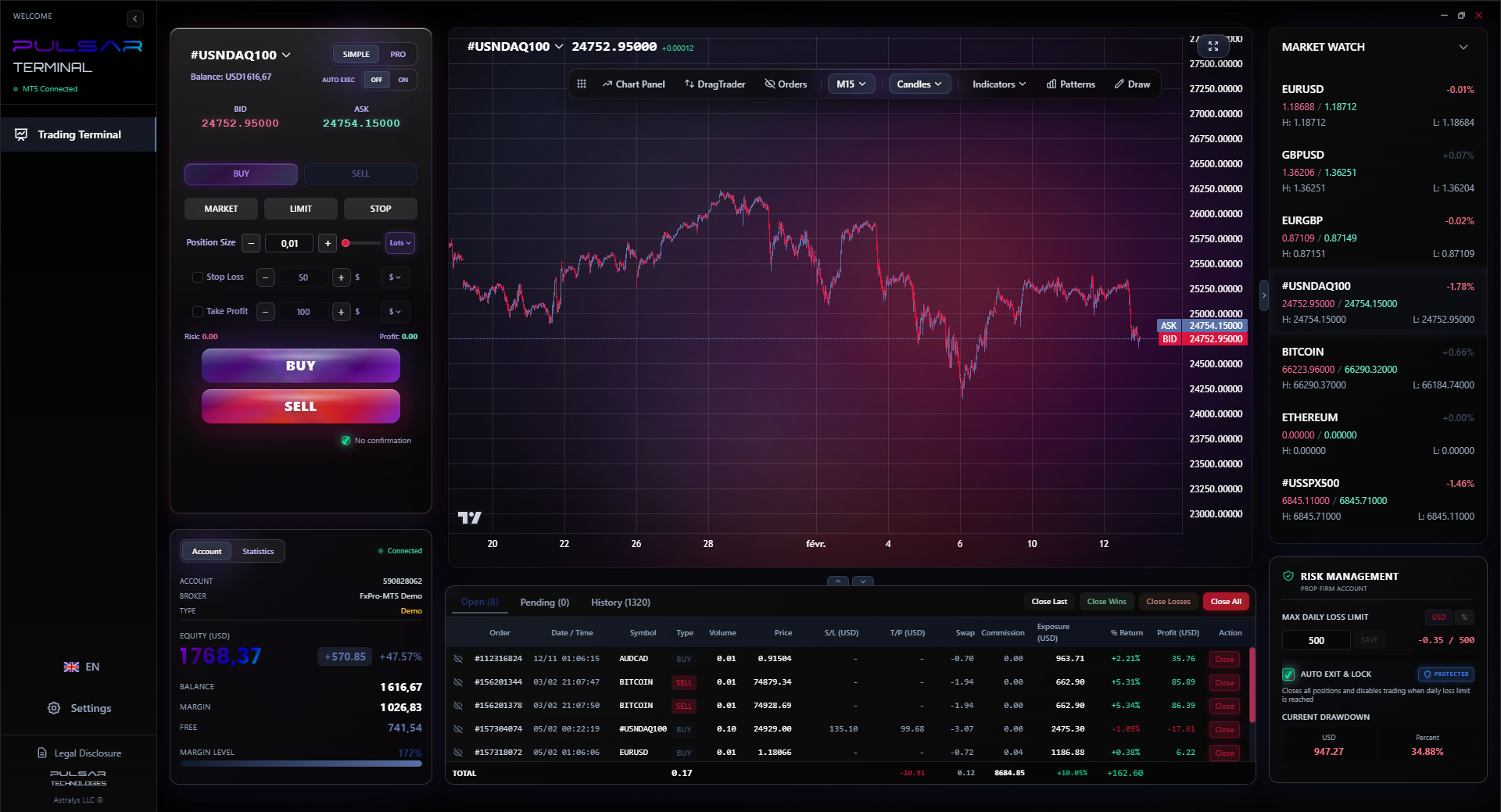
Managing multiple prop firm rules in real-time is a nightmare, which is why tools like Pulsar Terminal build in automatic tracking for daily loss limits and drawdown to keep you from accidental violation.
Pulsar Terminal
The all-in-one MT5 companion: drag-and-drop orders, multi-TP/SL, trailing stop, grid trading, Volume Profile, and prop firm protection. Used by 1,000+ traders daily.
Prop firms use it for a reason. But is it right for you?
| Feature | NinjaTrader for Prop Trading | MetaTrader for Prop Trading |
|---|---|---|
| Core Asset | U.S. Futures (ES, NQ, CL, etc.) | Forex & CFDs (via brokers like IC Markets or Pepperstone) |
| Commission Model | Low per-contract cost (~$0.09-$1.29 per side) | Usually built into the spread |
| Data Feed | Direct CME/Market data (Rithmic, CQG) | Broker-dependent, can be less transparent |
| Charting & DOM | Excellent, native Depth of Market (DOM) is a key tool | Basic DOM, often requires paid add-ons |
| Automation | NinjaScript (C#-based), very powerful | MQL4/MQL5, also powerful |
| Prop Firm Integration | Native. Built-in connection to major funders. | Clunky. Often requires separate login/terminal. |
The Unbeatable Pro: The Depth of Market (DOM) If you're a scalper or price action trader, the NinjaTrader DOM is the killer app. You can see the resting orders, gauge buying/selling pressure, and execute with one click. It provides a context you just don't get from a pure candlestick chart. Learning to read the DOM is a mandatory skill for NinjaTrader prop success.
The Big Con: The Learning Cliff NinjaTrader isn't intuitive. Setting up charts, connecting data, understanding the difference between a Sim account and a Live account - it's complex. You will waste a full day just configuring it. And NinjaScript, while powerful, has a steeper learning curve than MT5's MQL5 for most beginners.
The Verdict: If you want to trade US futures and are serious about scalping or order flow, NinjaTrader is the industry standard for a reason. If you're more focused on swing trading forex or indices based on technical indicators like the MACD indicator, a MetaTrader-based prop firm might feel more familiar. But know that the futures market on NinjaTrader is where the most serious US prop action is.
“In this new regulatory era, stability is the new edge.”
With regulation looming, your due diligence is more important than ever.
Green Lights (Good Signs):
- Uses the Official "NinjaTrader Prop" or "Tradovate Prop" Platform: This means they are a vetted partner with NinjaTrader Group, which is doing compliance checks. Firms like Take Profit Trader and Apex Trader Funding are on this list.
- Transparent, Simple Rules: The rules for the challenge and the funded account are clearly listed, with examples. No weird, hidden clauses.
- Realistic Profit Splits: 80%-90% is standard. Be wary of "100% forever" claims; they often have huge monthly fees instead.
- Clear Payout History: They should openly talk about payout frequency and have trader testimonials (not just screenshots) you can verify.
Red Flags (Run Away):
- No Regulatory Mention or "Not Required" Claims: Any firm not acknowledging the 2025 regulatory environment is asleep at the wheel or lying.
- Overly Complex Rule Sets: If you need a lawyer to interpret their drawdown rules, they're designed for you to fail.
- Pressure to Use Specific "Signal Services" or "Coaches": This is a common upsell scam. The firm makes more money selling you "help" than from you passing.
- Instant Funding with No Evaluation: If it sounds too good to be true, it is. This model is highly suspect and likely to be first on the regulator's chopping block.
My advice? Go with the boring, established player. Yes, Apex and Topstep are huge. That's the point. They have the legal teams and capital to adapt. Your $300 fee is safer with them than with a flashy new firm offering "revolutionary" rules. In this new era, stability is the new edge.
💡 Winston's Tip
Regulatory change is a filter, not a wall. It will remove the weak firms and desperate traders. Your job is to be so strong that you pass through the filter. That means picking strong firms and using strong strategies.
Here's my blunt assessment after 12 years and paying for more evaluations than I'd like to admit.
For whom it's NOT worth it:
- New traders. You will lose your fee. Period. Use a NinjaTrader demo account (it's free) for six months first. Learn what a pip definition means in futures terms (it's a tick).
- Traders without a documented, mechanical strategy. If you can't write down your exact entry, stop, and target rules, you're gambling, not trading.
- Anyone in financial distress. The pressure will destroy your judgment.
For whom it CAN be worth it:
- Consistent, disciplined sim traders who need larger capital to scale a proven strategy. The prop firm model is your cheapest source of significant "capital."
- Traders who understand it's a business expense. The evaluation fee is a cost of customer acquisition for your trading business. Budget for 2-3 attempts.
- Those willing to treat it as a job. This means fixed hours, daily review, and strict risk management above all else.
The landscape is hardening. The easy, unregulated money is drying up. What's left is a tougher, more professional path. If you can navigate the brutal rules, survive the coming regulatory purge, and maintain robotic discipline, a NinjaTrader prop firm can be a legitimate bridge to trading larger size. But look at the 90% failure rate not as a challenge, but as a description. Most people lack the patience, discipline, and humility to do this right. The question is, which side of that statistic are you built for?
FAQ
Q1What is the cheapest NinjaTrader prop firm?
Cheapest isn't best. Evaluation fees range from $100-$500. A firm like Apex Trader Funding often runs sales where challenges drop to $50 or less. But the real cost isn't the fee - it's the commissions, platform fees, and the high likelihood of failing and paying again. Focus on value (clear rules, good platform) over the lowest upfront ticket.
Q2Can I use my own NinjaTrader license with a prop firm?
Usually, no. The prop firm provides you with a specific license key or login for their version of the platform. This is how they control the environment, apply their rules (like daily loss limits), and connect you to their simulated data feed. You'll use NinjaTrader, but it's their instance of it.
Q3Do NinjaTrader prop firms work internationally?
Many accept international traders, but there are major caveats. First, U.S. futures markets trade on U.S. hours. Second, payout methods may be limited (international wire transfers can have high fees). Most importantly, the looming U.S. CFTC regulations may force firms to restrict access to only certain countries. Always check the firm's current terms for your specific country.
Q4What's the difference between Rithmic and Tradovate data on NinjaTrader?
Both are data providers used by prop firms. Rithmic is known for ultra-low latency, preferred by very fast scalpers. Tradovate (now part of NinjaTrader Group) is known for its all-inclusive, simple pricing and clean interface. For most prop traders, the difference is negligible. The firm will choose one for their evaluation accounts. The key is that both are simulated during your challenge, not live broker feeds.
Q5How long does it take to get paid from a funded account?
Typically, you request a payout at the end of a monthly cycle. After approval, it can take 3-10 business days to hit your bank account via ACH (in the US) or longer for international wires. Reputable firms publish their payout schedules. Your first payout is often slower for verification.
Q6Is the NinjaTrader prop firm challenge harder than trading with your own money?
In one crucial way, yes. Your own account has one rule: don't go to zero. A prop challenge has 5-10 arbitrary, non-negotiable rules (daily loss, max drawdown, minimum days) that are often stricter than sensible personal risk management. The psychological pressure of these external constraints makes it objectively harder for most people.
Prof. Winston's Lesson
Key Takeaways:
- ✓Daily loss limits are based on drawdown from your P&L high, not net loss.
- ✓Real trading costs are $0.50+ per micro contract round turn.
- ✓CFTC rules in 2026 may force prop firms to register as CTAs.
- ✓Trade one micro contract until you've met the minimum day requirement.
How useful was this article?
Click a star to rate
Weekly Trading Insights
Free weekly analysis & strategies. No spam.
About the Author
James Mitchell
Senior Trading Analyst
Based in New York with over 9 years of trading experience. Focuses on major USD pairs, prop firm challenges, and the US regulatory landscape.
Comments
Risk Disclaimer
Trading financial instruments carries significant risk and may not be suitable for all investors. Past performance does not guarantee future results. This content is for educational purposes only and should not be considered investment advice. Always conduct your own research before trading.
You Might Also Like

Cara Trading Forex Sukses: 7 Prinsip dari Trader Profesional
Cara trading forex sukses dengan 7 prinsip trader pro: manajemen modal, disiplin, journal trading, backtest. Data nyata, bukan janji profit palsu.
Jam Trading Forex Terbaik untuk Trader Indonesia: Panduan Lengkap dengan Tabel Waktu
Panduan jam trading forex untuk trader Indonesia. Tabel 4 sesi dunia, jam emas 20:00-00:00, sesi mana yang harus dihindari. Data akurat + tips dari trader berpengalaman.
Top 5 Sàn Forex Uy Tín Nhất 2026: Review Jujur dari Trader Indonesia
Top 5 sàn forex uy tín 2026 untuk trader Indonesia. Review jujur: spread, deposit, withdraw, dukungan lokal. Exness, XM, IC Markets & lebih.
Get Pulsar Terminal
All these calculators are built into Pulsar Terminal with real-time data from your MT5 account. One-click position sizing, automatic risk management, and instant calculations.
Get Pulsar Terminal