


It was 2:15 PM Lagos time, and EUR/USD was grinding sideways around 1.0850.

Olumide Adeyemi
West African Trading Pioneer ·  Nigeria
☕ 13 min read
What you'll learn:
- 1What Are Pivot Points, Really?
- 2Setting Up Your Charts: A Nigerian Context
- 3The Core Trading Strategies: Bounce vs. Break
- 4Risk Management: Your Naira Survival Kit
- 5Making Pivots Powerful: Combine with These Tools
- 6Mistakes I Made (So You Don't Have To)
- 7Choosing a Broker for Pivot Trading in Nigeria
- 8Your Daily Trading Routine
It was 2:15 PM Lagos time, and EUR/USD was grinding sideways around 1.0850. The London session had lost its steam, and the chart looked dead. Then, price tapped the daily R1 pivot level for the third time, hesitated for two candles, and collapsed 45 pips straight down to the daily pivot point. I’d been watching, but I didn’t take the trade. I thought the level was ‘too obvious.’ That’s the mistake I see Nigerian traders make every day - they either ignore pivot points completely or treat them like magic lines that guarantee a win. Let’s fix that. Pivot point forex trading isn’t about prediction; it’s about preparing for the most probable price reactions.
Forget the complex definitions. A pivot point is simply the average of the previous day's high, low, and closing price. It's the market's center of gravity for the new trading day. From that single number, we calculate a series of support and resistance levels above and below it. These aren't mystical barriers. They're zones where price action tends to slow down, reverse, or accelerate because a huge number of institutional desks, algo traders, and retail folks like us are all looking at the same numbers.
Here’s the classic floor trader’s formula (the one you’ll find on 90% of platforms):
Pivot Point (PP) = (High + Low + Close) / 3
From there, we get:
- Resistance 1 (R1) = (2 x PP) – Low
- Support 1 (S1) = (2 x PP) – High
- Resistance 2 (R2) = PP + (High – Low)
- Support 2 (S2) = PP – (High – Low)
Some platforms go out to R3 and S3, but R1, PP, and S1 are where 80% of the action happens. The key for us in Nigeria? You need to know your session times. The ‘previous day’ is based on the 24-hour trading day closing at 5 PM EST (which is 10 PM Nigerian time). If your platform lets you, set it to that. Don't use the Lagos close; the forex market doesn't care.

Example: Let's say yesterday's EUR/USD high was 1.0950, low was 1.0900, and close was 1.0920. PP = (1.0950 + 1.0900 + 1.0920) / 3 = 1.0923 R1 = (2 * 1.0923) – 1.0900 = 1.0946 S1 = (2 * 1.0923) – 1.0950 = 1.0896 These levels become your map for today.
I made the error early on of using the default settings on my MT4, which were wrong for forex. My pivots were off by 5-10 pips, and I kept getting stopped out just before a reversal. Check your data source.

💡 Winston's Tip
The pivot point is the day's fair value. Trade the reactions away from it, not the hope that price will sit on it forever.
You don't need to do the math yourself. Every trading platform has a pivot point indicator. In MT4 or MT5, just insert it from the ‘Indicators’ menu > ‘Custom’ > ‘Pivot Points.’ But here’s the critical part most guides skip: you must choose the right time frame and session.
Time Frame is Everything
For day trading, use the Daily pivots. These are calculated from the previous day's 24-hour range. For scalping strategy on the 5 or 15-minute chart, you might also look at Weekly pivots for bigger context. Never use hourly pivots for forex; they're just noise.
Broker Data Matters
Your pivot levels are only as good as your broker's quoted high and low. This is where choosing a broker with tight spreads and reliable feeds, like IC Markets or Pepperstone, pays off. A bad feed can give you a false high or low by a few pips, throwing all your levels off. I once compared pivots between a local introducing broker and my direct Exness ECN account. The difference on GBP/USD was 3 pips. Three pips is the difference between a perfect bounce and getting your head taken off.
Visual Setup on Your Chart
I keep it clean. I plot the Daily Pivots (PP, R1, R2, S1, S2) on my main 1-hour and 15-minute charts. I colour PP yellow, S1/R1 blue, and S2/R2 red. That's it. Don't clutter it with 10 other indicators. The power of pivot point forex trading is in its simplicity. The chart should show you clear zones, not a rainbow.
“Three pips is the difference between a perfect bounce and getting your head taken off.”
There are two main ways to trade pivots, and confusing them is a surefire way to lose money.
1. The Bounce (Reversal) Trade
This is the classic. Price approaches a pivot level (especially R1, S1, or the main PP) and shows rejection. You look for a price action signal - a pin bar, a bullish/bearish engulfing candle, or a double top/bottom right at the level. My Rules for a Bounce Trade:
- The approach matters. If price rockets into R1 like a missile, it's more likely to break through. I want to see it slow down, maybe consolidate just before the level.
- Wait for the confirmation candle to CLOSE. Don't jump in mid-candle because it touched the level.
- Place your stop loss 10-15 pips beyond the pivot level. If price clears that zone, your thesis is wrong. Get out.
- Your profit target is the next pivot level down. Going from R1 to PP is a solid 20-30 pip trade.
2. The Break (Momentum) Trade
Sometimes, price smashes through a pivot level with volume. This isn't a failure; it's a new signal. A clean break of R1 can target R2. A break of S1 targets S2. My Rules for a Break Trade:
- I need to see a strong, closing candle clearly through the level. A wick poke doesn't count.
- I'll often wait for a ‘retest’ of the broken level. That broken resistance becomes new support. Enter on the pullback.
- The stop loss goes on the other side of the retested level.
- This requires quicker reflexes and is better suited for scalping strategy on lower time frames.

Warning: The most common mistake? Trading every single touch. The PP and R1/S1 have the highest hit rate. R3 and S3 are extreme and act more like magnets for profit-taking. Don't force a trade at R2 if the price action is messy. Sometimes the best trade is no trade.
This is where Nigerian traders blow up. High use (I've seen offers of 1:1000) makes pivot trading seem like a goldmine, but without proper risk controls, it's a landmine. Pivot levels are not holy. Price will violate them. Your job is to lose small when it does.
Position Sizing is Non-Negotiable
Never risk more than 1-2% of your account on a single pivot trade. Use a position size calculator every single time. Here’s a real example from last month:
- Account: $1,000 (approx 1.5 million Naira at the time).
- Risk per trade: 1% = $10.
- GBP/USD Trade at S1: Stop Loss 12 pips away.
- Pip value for a 0.01 lot (micro lot) = ~$0.10.
- To risk $10, I could trade: $10 / (12 pips * $0.10) = 8.3 micro lots. I rounded down to 8 lots (0.08 standard lots). That math took 15 seconds and saved me from a 5% loss when the level broke.
Stop Loss Placement
Your stop must be placed where the pivot trade idea is invalidated. For a bounce off R1, if price closes above R1, the bounce failed. Place your stop 5-10 pips above R1. Don't place it based on a random dollar amount. The market doesn't care if you can only afford a 5-pip stop.
The use Trap
Just because your broker (Exness or XM, for example) offers 1:500 use doesn't mean you use it. For a $1,000 account trading 0.1 lots on EUR/USD, you're already using about 1:100 use. That's plenty. Higher use turns a normal 20-pip loss into a margin call waiting to happen.
Remember, tax implications are real. Profits are subject to Capital Gains Tax (10%). Factor that into your net profit goals. A 10% return before tax is really 9% after.
💡 Winston's Tip
If you find yourself constantly getting stopped out 2 pips above R1 or below S1, your broker's data feed is off. Switch to a better one - it's not you, it's them.
“Your stop must be placed where the pivot trade idea is invalidated, not where your wallet can afford.”
Pivot points alone are good. Pivot points with confluence are great. Confluence means two or more independent methods point to the same level. This increases the probability of a reaction.
1. Pivot + Horizontal Support/Resistance
This is the strongest combo. If your daily R1 lines up perfectly with a horizontal resistance level that's been relevant for weeks, that zone becomes a fortress. The market has a collective memory there. I nailed a USD/JPY short last quarter because the daily R1 at 151.80 was also the exact high from three weeks prior. Price tapped it and fell 70 pips.
2. Pivot + 50-period EMA
Many algorithmic traders use the 50-period Exponential Moving Average on the 1-hour or 4-hour chart as a dynamic support/resistance. If the 50 EMA is curling down and price is approaching it at the same time as the daily S1, that's a strong confluence for a bounce.
3. Pivot + Momentum Indicator
I use the RSI indicator (set to 21 periods) for this. If price is hitting R1 and the RSI is above 70 (overbought), that's a potential reversal signal. Conversely, if price breaks above R1 and the RSI is strong but not overbought, it confirms the momentum break. Don't use too many. Pick one or two confirmations. I used to have MACD indicator, Stochastic, and RSI all on my chart. It was a mess of conflicting signals.

Pro Tip: For swing trading perspectives, always check where the weekly pivot point is. If you're taking a daily bounce trade and the weekly pivot is 50 pips away in the same direction, that gives you a much larger profit target runway.
Let's get blunt. Here's where I've lost money with pivots, and I see Nigerian traders in our community groups doing the same thing every week.
Mistake 1: Trading Pivots in a News Vacuum. I once had a beautiful setup short at the daily R1 on GBP/USD. The level held, a pin bar formed. I entered. Then the US CPI data dropped, a huge beat. The pair ripped through R1, R2, and R3 like they weren't even there. I lost 2.5% of my account in 90 seconds. Lesson: Know the economic calendar. If major news (US NFP, CPI, Central Bank decisions) is due within an hour of your potential trade, step away. Pivots are for technical environments, not fundamental explosions.
Mistake 2: Ignoring the Overall Trend. In a strong uptrend, price will respect support pivots (S1, PP) more often and blow through resistance pivots (R1). In a downtrend, the opposite is true. Don't stubbornly short every touch of R1 in a raging bull market. I did that for two weeks in early 2023 on XAU/USD guide (gold) and got shredded. Align your trades with the higher time frame trend.
Mistake 3: Chasing the Level. You see price racing towards S1. You're so sure it will bounce you enter market order 5 pips above it. Price touches S1, drops another 8 pips, hits your stop, and then rockets up 40 pips. You got the direction right but were early and poorly positioned. Lesson: Be patient. Let price come to the level and show you its hand. Use limit orders at the level or wait for the confirming close.
Mistake 4: Not Accounting for Spread. If your broker's spread definition on EUR/USD is 1.5 pips during the Asian session (some local brokers are that wide), and your stop is 5 pips away, you're already down 30% on your risk before the trade moves. Use brokers with consistent, tight spreads for this style, or widen your stop accordingly.
“Discipline is what separates the consistent trader from the gambler.”
Your broker is your gateway. A bad one will sabotage your pivot point forex trading before you even place an order. Here’s what to look for, with local realities in mind.
Regulation & Safety
Your money's safety comes first. While Nigerian regulators like SEC are involved, most serious retail traders use internationally regulated brokers. Look for ASIC (Australia), FCA (UK), CySEC (Cyprus), or FSCA (South Africa) regulation. Brokers like IC Markets (ASIC) or Pepperstone (FCA/ASIC) are solid choices. This doesn't guarantee against losses, but it ensures client fund segregation and fair practice.
Trading Conditions
- Spreads: You need tight, stable spreads, especially around your pivot levels. ECN/RAW accounts from Exness, IC Markets, or Pepperstone offer spreads from 0.0 pips on majors (plus a small commission). This is ideal. Avoid brokers with spreads that routinely widen to 3+ pips on EUR/USD.
- Execution: You need fast, slippage-free execution. When price hits R1 and reverses, you need your limit order filled at R1, not at R1 + 2 pips. Test with a demo account.
- Deposits/Withdrawals: This is crucial for Nigeria. Can you fund with your domiciliary account, debit card, or e-wallets like Skrill? How long do withdrawals take? XM and Exness are known for good local payment processing. Minimum deposits can be as low as $5-$10, so you can start small.
Platform & Tools
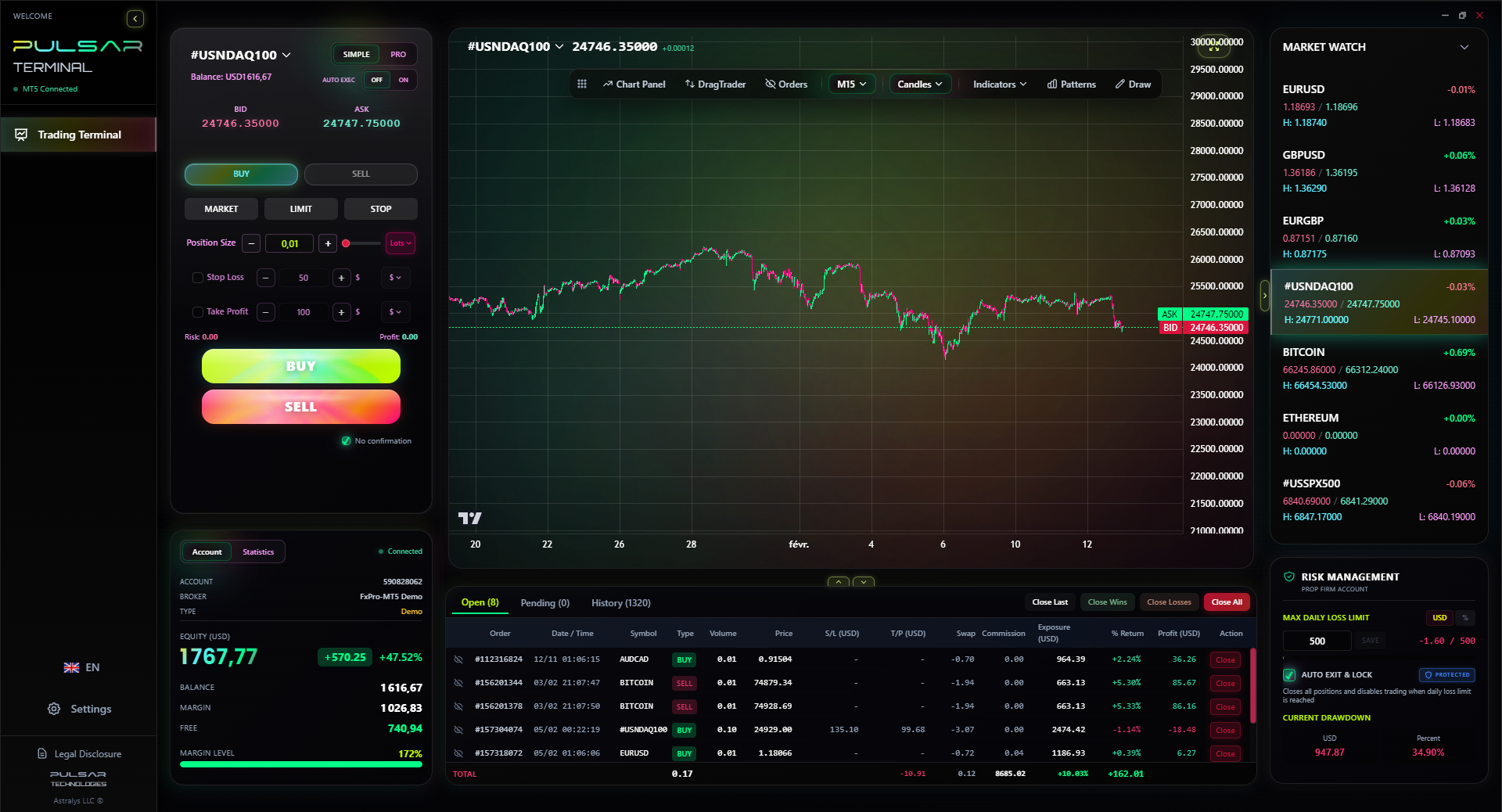
MT4/MT5 is standard and has built-in pivot indicators. But ask: does the broker offer advanced charting? Can you easily set multiple take-profit levels for scaling out of a trade? This is where a tool like Pulsar Terminal, which works with MT5, becomes valuable for managing complex trades around these key levels.
💡 Winston's Tip
The best pivot trade is the one you don't take because the news calendar is red. Patience isn't just a virtue; it's a profit center.
Managing multiple take-profit levels around pivot points is key, and Pulsar Terminal lets you drag-and-drop them directly onto your MT5 chart for precise trade management.
Pulsar Terminal
The all-in-one MT5 companion: drag-and-drop orders, multi-TP/SL, trailing stop, grid trading, Volume Profile, and prop firm protection. Used by 1,000+ traders daily.
This is the process. Do this every day before the London open (7 AM Nigerian time).
Step 1: Calculate & Plot. Check the previous day's high, low, and close (5 PM EST / 10 PM Nigeria). Let your platform plot the daily pivots. Note the key ones: PP, R1, S1.
Step 2: Identify Confluence. Look at the 1-hour chart. Do any of today's pivots align with:
- A clear horizontal level?
- A key moving average (like the 50 or 200 EMA)?
- A round number (e.g., 1.1000 on EUR/USD)? Mark these high-probability zones on your chart.
Step 3: Check the Trend. Look at the 4-hour chart. Is it clearly up, down, or ranging? This tells you whether to favor bounce trades (in a range) or break trades (in a trend).
Step 4: Plan Your Trades. For each confluence zone, decide in advance:
- What is your trigger? (e.g., a bearish engulfing candle at R1)
- Where is your entry? (e.g., at the close of that candle)
- Where is your stop loss? (e.g., 10 pips above R1)
- Where is your take profit? (e.g., at the PP level)
- What is your position size? (Use your position size calculator).
Step 5: Execute & Manage. Place your orders. If price reaches your zone and your trigger happens, take the trade. If it doesn't, do nothing. Once in the trade, you can consider moving your stop to breakeven once price moves in your favor by 1.5x your risk. For a 10-pip risk, move to breakeven at +15 pips. This turns a risky trade into a free roll.
Stick to this routine. Discipline is what separates the consistent trader from the gambler. Pivot point forex trading gives you the structure; your discipline provides the profits.
FAQ
Q1What is the best time frame to use for pivot points in forex?
For most active traders, the Daily pivot points (calculated from the previous trading day's 24-hour range) are the most effective. Use them on the 1-hour and 15-minute charts for entry timing. Weekly pivots are great for swing trading context. Avoid intraday pivots like hourly or 4-hour; they create clutter and aren't widely followed by the broader market.
Q2Can I trade pivot points on currency pairs like USD/NGN?
Technically yes, but I wouldn't recommend it. USD/NGN is heavily influenced by Central Bank of Nigeria (CBN) policies, illiquidity in the retail market, and wide spreads. Pivot points work best in highly liquid, freely-traded markets like the major pairs (EUR/USD, GBP/USD) where technical levels are respected by global participants. Stick to the majors for pivot point forex trading.
Q3How do I know if a pivot level will hold or break?
You don't know for sure, and anyone who says they do is lying. You assess probability. Look for confluence (other technical levels aligning) and market context (trend, upcoming news). A level approached with slow, consolidating price action is more likely to cause a bounce. A level approached with a strong, high-volume momentum candle is more likely to break. Your job is to have a plan for both scenarios and manage your risk accordingly.
Q4Are pivot points lagging indicators?
No, and this is a key point. Pivot points are forward-looking. They are calculated from yesterday's data to project today's potential support and resistance. They don't lag behind price like a moving average. They are static levels on the chart for the entire trading day, waiting for price to come to them.
Q5What's a realistic profit target using pivot points?
Aim for the next pivot level. If you enter a long trade at the daily S1, your first target is the PP. If momentum is strong, you can trail your stop and aim for R1. A move from S1 to PP or R1 to PP is often 20-40 pips on a major pair, which is a solid, realistic target for a day trade. Don't get greedy and aim for R3 from PP in a single move; scale out of your position.
Q6Do professional traders in Nigeria use pivot points?
The serious ones do, absolutely. While I can't speak for every desk, the concept is foundational in many institutional trading models because it's simple, objective, and widely monitored. It's less about having a secret formula and more about understanding where the crowd is looking. Many prop firm traders and funded account holders use pivot levels as core components of their strategy to identify high-probability, low-risk entries.
Prof. Winston's Lesson
Key Takeaways:
- ✓Daily pivots from the 24-hour close are your primary map.
- ✓Always seek confluence with one other technical factor.
- ✓Never risk more than 1-2% per trade, regardless of use.
- ✓Avoid trading pivots 1 hour before/after major news events.
- ✓The PP, R1, and S1 are your workhorses; focus there.
How useful was this article?
Click a star to rate
Weekly Trading Insights
Free weekly analysis & strategies. No spam.
About the Author
Olumide Adeyemi
West African Trading Pioneer
One of Nigeria's most active forex trading educators. 8 years of experience trading from Lagos. Specializes in low-capital strategies and prop firm challenges for African traders.
Comments
Risk Disclaimer
Trading financial instruments carries significant risk and may not be suitable for all investors. Past performance does not guarantee future results. This content is for educational purposes only and should not be considered investment advice. Always conduct your own research before trading.
You Might Also Like

Cara Trading Forex Sukses: 7 Prinsip dari Trader Profesional
Cara trading forex sukses dengan 7 prinsip trader pro: manajemen modal, disiplin, journal trading, backtest. Data nyata, bukan janji profit palsu.
Jam Trading Forex Terbaik untuk Trader Indonesia: Panduan Lengkap dengan Tabel Waktu
Panduan jam trading forex untuk trader Indonesia. Tabel 4 sesi dunia, jam emas 20:00-00:00, sesi mana yang harus dihindari. Data akurat + tips dari trader berpengalaman.
Top 5 Sàn Forex Uy Tín Nhất 2026: Review Jujur dari Trader Indonesia
Top 5 sàn forex uy tín 2026 untuk trader Indonesia. Review jujur: spread, deposit, withdraw, dukungan lokal. Exness, XM, IC Markets & lebih.
Get Pulsar Terminal
All these calculators are built into Pulsar Terminal with real-time data from your MT5 account. One-click position sizing, automatic risk management, and instant calculations.
Get Pulsar Terminal