


Let's cut the crap.

James Mitchell
Senior Trading Analyst
☕ 11 min read
What you'll learn:
- 1The Regulatory Minefield: Why Your EA Might Be Illegal Tomorrow
- 2The Real Costs (It's Not Just the Evaluation Fee)
- 3What Makes an EA Actually Work (And Why 99% Fail)
- 4Brokers, Spreads, and the Slippage Problem
- 5Your Step-by-Step Setup and Execution Plan
- 6The Future: AI, Consolidation, and the 7% Payout Club
Let's cut the crap. The idea of buying a 'prop firm EA,' hitting start, and watching money roll in is a fantasy sold to desperate traders. The reality? It's a minefield of hidden fees, regulatory gray areas, and strategies that fail the moment market conditions shift. I've seen more traders lose money buying these 'magic bots' than they ever would have trading manually. But here's the controversial part: when used correctly - as a disciplined tool, not a savior - a well-built EA can be your ticket through a prop firm's gauntlet. This guide isn't about selling you a dream. It's about showing you the hard numbers, the real regulations, and the specific setups that have a fighting chance in the US market.
Most US traders have no idea they're operating in a regulatory gray area that's about to get a whole lot less gray. Prop firms have cleverly skirted SEC and CFTC oversight by calling their challenges 'simulated evaluations.' You're not trading real client money (initially), so they argue they're not a fund manager. That loophole is closing fast.
The CFTC is actively looking at reclassifying these evaluation-based firms as Commodity Trading Advisors (CTAs). If that happens by 2026 as expected, everything changes: mandatory registration, serious capital requirements, and formal risk disclosures. Your favorite prop firm might just vanish overnight. I've already seen this shakeout begin. In early 2024, MetaQuotes (the company behind MT4/MT5) cracked down, forcing an estimated 80-100 prop firms to close up shop. That's 13-14% of the global market gone in a blink.
What This Means For Your EA
If you're using an EA, it must be built for US compliance from the ground up. That means:
- Hard Stop-Losses on Every Trade: No exceptions. A trailing stop that never gets set as a hard stop will get you disqualified.
- NFA/FIFO Compliance: If the prop firm's broker is US-regulated, your EA must close the oldest position first on the same instrument. Most cheap EAs from overseas ignore this rule completely.
- No 'Toxic' Strategies: Latency arbitrage, martingale, grid trading that exploits slippage - these are quick ways to get your account terminated and your evaluation fee forfeited. A good prop firm's risk team spots these in seconds.

Warning: Buying an EA marketed as 'prop firm safe' from a non-US developer is asking for trouble. Most haven't coded for FIFO or understand the specific drawdown rules (like trailing vs. static) that US-focused firms use. I learned this the hard way in 2023, losing a $299 evaluation on Apex Trader Funding because my fancy European EA opened multiple EUR/USD positions without a FIFO close logic. Poof. Account gone.

💡 Winston's Tip
An EA is a disciplined employee, not a genius. Program its job description first: 'Do not lose more than X% today.' The entry signals are secondary.
“The idea of buying a 'prop firm EA,' hitting start, and watching money roll in is a fantasy sold to desperate traders.”
Everyone looks at the evaluation fee. That's just the cover charge to get into the casino. The real money gets siphoned off in ways they don't advertise upfront. Let's break down the actual cost of running a prop firm EA, because if your strategy can't overcome these, you're already losing.
| Cost Type | Typical Range | What It Really Means |
|---|---|---|
| Evaluation Fee | $100 - $400+ | Your ticket to play. For a $100K account, expect ~$300. |
| Activation Fee | $0 - $800 | Some firms charge this after you pass, before you get 'funded.' A nasty surprise. |
| Platform/Data Fees | $0 - $230+/month | The killer. 'Professional' CME data for futures can be $130/month per exchange. |
| Reset Fee | $60 - $80 | Fail your challenge? Pay this to try again. It's how many firms really make money. |
| EA Cost | $149 - $739 | One-time is standard. Anything with a monthly subscription is a red flag. |
| Profit Split | 80/20 to 90/10 | You get the larger share. Some offer 100% on first payout. |
Here's a real example from my books. I passed a $300,000 challenge with a firm in 2024. My costs looked like this:
- Evaluation Fee: $495
- Activation Fee: $0 (I chose this firm specifically for that)
- Monthly Platform & Data (for futures): $187
- EA Purchase: $329 (a mean-reversion bot for the NASDAQ)
Total sunk cost before my first trade in the funded account: $1,011. My first profit target wasn't just to make money, it was to dig out of a thousand-dollar hole. This is why your position size calculator is your best friend. You need to know exactly what each trade risks relative to your total capital, including these sunk costs.

Example: Let's say you buy a $50,000 evaluation for $199. You pass, pay a $150 activation, and then face $100/month in fees. You need to make $449 in profits just to break even on the costs, not even counting the EA price. At an 80/20 split, that means your EA needs to generate $561.25 in gross profit before you see a dime. On a $50k account, that's a 1.12% return just to get back to zero.
“Your first profit target isn't just to make money, it's to dig out of a thousand-dollar hole in sunk costs.”
I've tested over two dozen 'prop firm' EAs. Most are garbage - over-optimized on past data, with no understanding of live market dynamics or the specific rules of the game. The ones that have a chance share a few brutal, non-negotiable traits.
First, they prioritize capital preservation over explosive gains. A prop firm's #1 rule is 'don't blow the account.' Your EA must have a maximum daily loss limit (often 4-5%) hard-coded. It should stop trading for the day if hit. I modified a popular scalping strategy EA to include this, and it saved me three times in one month from a single bad news event wiping out a week's work.
Second, they are simple. The more complex the logic, the more likely it is to fail when volatility shifts. The best-performing EA I've ever used for a prop firm challenge was a disciplined RSI indicator divergence trader with a tight stop-loss. It won small, lost small, and consistently grinded out the 8-10% profit target needed to pass.
Third, they have a news filter. This is non-negotiable. An EA blindly trading through an FOMC announcement is a suicide bot. The filter doesn't need to be fancy; just a simple time-based shutdown around high-impact news events.
Finally, they are transparent. You should be able to see and adjust every parameter: lot size, stop loss, take profit, maximum daily trades. If it's a 'black box' where you just click 'start,' run away. You need to understand its logic to trust it when it has a losing week (and it will).

Pro Tip: The most common reason EAs fail prop challenges isn't strategy - it's violating a rule. They trade too many lots, ignore minimum trading day requirements, or breach a trailing drawdown. Before you run an EA live on a challenge, backtest it with the firm's specific rules as the primary metric. Did it ever breach the daily drawdown? Did it trade on 80% of the required days? This is more important than your profit factor.
💡 Winston's Tip
The 'prop firm EA' market is 90% marketing. If the sales page shows a Lamborghini, the developer is selling a dream, not a tool. Look for boring, detailed strategy explanations instead.
“Only about 7% of all traders who buy a challenge ever receive a payout. Your EA is competing against these brutal odds.”
Your prop firm EA doesn't trade with the prop firm. It trades with the broker the firm has a partnership with. This is a critical distinction. The trading conditions (spreads, commissions, slippage, execution speed) will make or break your algorithm.
Most US-friendly prop firms use brokers like OANDA (for FTMO US), or other large liquidity providers. You need to know the real costs:
- Spreads: Can blow out during news. Your EA's stop-loss might get filled at a terrible price.
- Commissions: Often $4-$5 per lot round turn. If your EA is a high-frequency scalper making 20 trades a day, commissions will eat you alive.
- Slippage: This is the silent killer for EAs. A backtest assumes perfect execution. Reality is messy. An EA that places market orders will suffer.
I once built a beautiful EUR/USD mean reversion EA. In backtesting on a demo account with tight spreads, it had a 2.8 profit factor. I ran it on a live evaluation with a major prop firm. The first time it entered a trade during Asian session liquidity, the spread was 3 pips instead of the usual 0.8. My tight stop was instantly triggered. It did this three times in one night, hitting my daily loss limit. The strategy was sound; the market conditions it was executed in were not.
This is why you must choose a prop firm known for good, stable conditions. Firms partnered with brokers like IC Markets or Pepperstone often have tighter, more consistent spreads crucial for EA performance. Do your research. Don't just look at the account size; look at the broker behind it.
“Only about 7% of all traders who buy a challenge ever receive a payout. Your EA is competing against these brutal odds.”
Okay, you've bought a decent EA and picked a firm. Now what? Most people fail right here, in the setup. Follow this checklist religiously.
- Start on Demo: Run the EA on a demo account with the prop firm's broker for at least two weeks. Not your broker's demo. The conditions must be identical. Monitor every trade. Does it obey all the rules?
- Adjust for Rules: Code in the firm's specific limits. Maximum daily loss percentage. Maximum overall drawdown (is it trailing from equity high or balance?). Minimum trading days. This is manual work. No EA comes pre-loaded for every firm.
- Start Small: Buy the smallest, cheapest evaluation the firm offers. Use this as a live test for $100, not a $500 gamble. Your goal here is to confirm the EA works within their system, not to get funded.
- Monitor Relentlessly: Do not 'set and forget.' Check the account at least twice a day. Is the EA running? Did it stop trading after a loss? Has any rule been breached?
- Withdraw Early and Often: Once funded, take your first payout as soon as you're eligible. Get your initial investment back out of the system. Now you're playing with the house's money. This changes your entire psychology.
Let me be vulnerable here. I broke my own rule #3 in 2022. I was so confident in a gold trading EA I'd tweaked, I went straight for a $200,000 challenge. I passed. Got funded. Then, a week into the funded account, the EA encountered a period of low volatility it wasn't programmed for. It kept entering tiny, pointless trades that got stopped out by commissions and minor spreads. It churned until it hit the trailing drawdown limit. I lost the funded account and my $650 evaluation fee. I should have paid $99 to test it on a small account first. A $10,000 lesson.
💡 Winston's Tip
Your first funded account payout should go straight to your bank account. Until you've physically recovered your initial investment, you are still gambling.
“'Set and forget' is a myth that will cost you money. Daily checks are mandatory.”
The prop firm industry is a gold rush, and the sheriff is finally coming to town. The wild west days are ending. Here's what's coming down the pipe that will affect your EA journey.
Massive Consolidation: Analysts predict 3 major players will control 80% of the market by 2026. The hundreds of small firms will get squeezed out by regulation or acquisition. This means less choice, but potentially more stability for traders who make it through.
AI vs. Your EA: It's not just you using algorithms. The prop firms are too. They now use AI-driven risk systems that monitor your trading in real-time, flagging statistical anomalies. If your EA suddenly changes its behavior (win rate, trade time, lot size), it can be automatically flagged for review. Your simple RSI EA is competing against systems analyzing 65% of the global market.
The Harsh Statistics: Let's talk about the real success rate, because it's ugly. Industry data shows only about 7% of all traders who buy a challenge ever receive a payout. Not 7% pass, 7% get paid. The average payout is about 4% of the account size. So that dream of a $10,000 payout from a $100k account? The average is more like $4,000, and only 7 in 100 challengers ever see it. Your EA isn't just competing against the market; it's competing against these brutal odds.
This is why automation is shifting from pure trade execution to rule and risk management. The winning edge isn't a better entry signal; it's an automated system that guarantees you never, ever breach the firm's drawdown rules. This is where tools that manage trades and enforce protections become more valuable than the strategy itself.
Managing the complex rules and risk limits of a prop firm challenge is where most EAs fail, which is why a tool that automates trade and risk management directly on your MT5 platform is a game-changer.
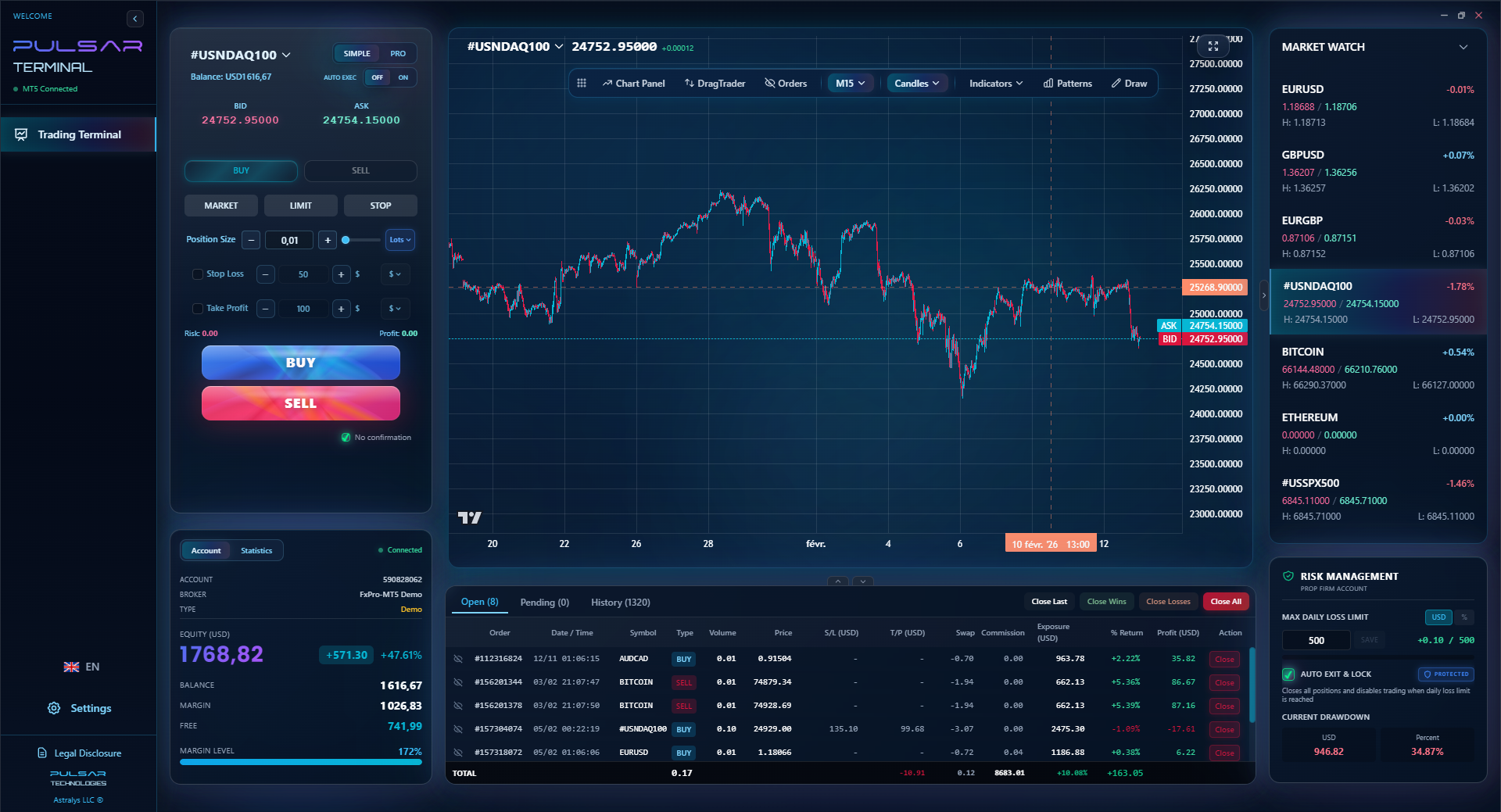
Pulsar Terminal
The all-in-one MT5 companion: drag-and-drop orders, multi-TP/SL, trailing stop, grid trading, Volume Profile, and prop firm protection. Used by 1,000+ traders daily.
FAQ
Q1Is it legal to use an EA with a prop firm in the US?
Right now, it exists in a gray area. Most prop firms allow EAs, but you must comply with their specific rules (no martingale, grid trading, etc.) and any NFA/FIFO rules if their broker is US-regulated. The legality of the prop firm model itself is under regulatory review, which could change everything.
Q2What's the single biggest mistake traders make with a prop firm EA?
They backtest on perfect data and then run it live without adjusting for real-world costs (spreads, commissions, slippage) and the firm's specific, non-negotiable rules (like daily loss limits). They treat the EA as a finished product, not a tool that needs calibration for a very specific environment.
Q3How much should I spend on a prop firm EA?
Anywhere from $200 to $500 for a reputable, one-time license. Be deeply suspicious of EAs costing over $1,000 or those with high monthly subscriptions. The price rarely correlates with performance in a live prop challenge setting.
Q4Can I use a free or cracked EA?
Absolutely not. This is financial suicide. Cracked EAs often have malicious code, can stop working unexpectedly, or have hidden logic flaws. You are trusting this software with your evaluation fee and potential capital. Never run software on your trading platform that you didn't obtain from a verified source.
Q5Which prop firms are best for EA trading?
Look for firms that are transparent about their allowed strategies and have stable broker partnerships with good execution. US traders often use FTMO (via OANDA), Apex Trader Funding, or FundedNext. Always check their FAQ for explicit EA rules before buying a challenge.
Q6Do I need to monitor an EA if it's fully automated?
Yes, constantly. 'Set and forget' is a myth that will cost you money. You need to ensure it's running, hasn't hit a rule violation, and hasn't been disabled by a platform update or news event. Daily checks are mandatory.
Q7What's more important, the EA or the prop firm's rules?
The rules, 100%. The most profitable EA in the world is worthless if it violates the firm's trailing drawdown or minimum trading day policy. Your first job is to configure your EA to survive within the rule set. Profitability comes second.
Prof. Winston's Lesson
Key Takeaways:
- ✓Sunk costs average $1,000+ before your first funded trade.
- ✓Only 7% of challengers ever receive a payout.
- ✓Hard-code daily loss limits above all else.
- ✓Test on the smallest challenge account first.
- ✓Regulatory changes in 2026 could upend the industry.
How useful was this article?
Click a star to rate
Weekly Trading Insights
Free weekly analysis & strategies. No spam.
About the Author
James Mitchell
Senior Trading Analyst
Based in New York with over 9 years of trading experience. Focuses on major USD pairs, prop firm challenges, and the US regulatory landscape.
Comments
Risk Disclaimer
Trading financial instruments carries significant risk and may not be suitable for all investors. Past performance does not guarantee future results. This content is for educational purposes only and should not be considered investment advice. Always conduct your own research before trading.
You Might Also Like

Cara Trading Forex Sukses: 7 Prinsip dari Trader Profesional
Cara trading forex sukses dengan 7 prinsip trader pro: manajemen modal, disiplin, journal trading, backtest. Data nyata, bukan janji profit palsu.
Jam Trading Forex Terbaik untuk Trader Indonesia: Panduan Lengkap dengan Tabel Waktu
Panduan jam trading forex untuk trader Indonesia. Tabel 4 sesi dunia, jam emas 20:00-00:00, sesi mana yang harus dihindari. Data akurat + tips dari trader berpengalaman.
Top 5 Sàn Forex Uy Tín Nhất 2026: Review Jujur dari Trader Indonesia
Top 5 sàn forex uy tín 2026 untuk trader Indonesia. Review jujur: spread, deposit, withdraw, dukungan lokal. Exness, XM, IC Markets & lebih.
Get Pulsar Terminal
All these calculators are built into Pulsar Terminal with real-time data from your MT5 account. One-click position sizing, automatic risk management, and instant calculations.
Get Pulsar Terminal