


Let's be brutally honest: 90% of the 'prop firm gurus' you see on YouTube and TikTok are selling you a fantasy, not a funded account.

James Mitchell
Senior Trading Analyst ·  Canada
☕ 10 min read
What you'll learn:
- 1What Exactly Are We Talking About Here?
- 2The Canadian Regulatory Gray Zone (It's Not What You Think)
- 3How to Decode the Influencer Pitch (And Spot the Red Flags)
- 4The Real Numbers: Costs, Chances, and Your Bankroll
- 5A Canadian Trader's Action Plan: How to Protect Yourself
- 6What's Coming: The Looming Enforcement Crackdown
- 7The Bottom Line: Build Skill, Don't Just Buy Challenges
Let's be brutally honest: 90% of the 'prop firm gurus' you see on YouTube and TikTok are selling you a fantasy, not a funded account. In Canada, this whole influencer-driven prop trading scene operates in a regulatory gray area that's more dangerous than a naked short during a flash crash. I've watched traders blow their savings on challenge fees because they trusted a charismatic guy with a Lambo thumbnail. This article isn't about bashing influencers; it's about teaching you how to dissect their promotions, understand the real Canadian rules (or lack thereof), and protect your capital in a market that's currently the wild west.
Prop firm influencer management isn't some official job title. It's the environment where financial influencers - 'finfluencers' - promote proprietary trading firms and their evaluation challenges. They get paid, usually through affiliate commissions, for every sucker... I mean, trader, they sign up. The firm gets your evaluation fee (anywhere from $15 to over $1,200), and the influencer gets their cut, sometimes up to 30%. It's a business transaction dressed up as mentorship.
The problem in Canada is the accountability vacuum. The prop firm itself often isn't directly regulated by CIRO because it's trading its own capital. The influencer likely isn't a registered advising representative. So who's responsible if the promotion is misleading? As of late 2025, regulators are starting to point fingers at both, but you're still the one left holding the bag if it goes south. I learned this the hard way early on, trusting a popular forex influencer's 'guaranteed pass' strategy for a $599 challenge. The strategy was overly aggressive, ignored basic risk management, and I hit the daily loss limit in two trades. That was an expensive lesson in trusting personality over process.

Warning: If an influencer's main 'proof' of success is their luxury car or watch, run. Real trading profits are boring. They show consistent equity curves and risk-adjusted returns, not material goods that could be leased.

💡 Winston's Tip
If an influencer's video title is in all caps with more emojis than words, your first thought shouldn't be FOMO. It should be 'what are they trying to distract me from seeing in the fine print?'
Here’s the core misunderstanding: prop firms are legal in Canada, but that doesn't mean the way they're promoted is above board. The firm might be fine, but the influencer shilling for them could be breaking securities law every single day. The Canadian Securities Administrators (CSA) and CIRO made this crystal clear in their December 2025 Staff Notice 31-369.
The Rules Finfluencers Keep Breaking
First, registration. If you're consistently giving trading advice or promoting specific financial opportunities as a business, you probably need to be registered. Most of these TikTok and YouTube gurus aren't. They're operating illegally from the jump. Second, disclosure. This is the big one. If an influencer is getting a commission from a prop firm for your sign-up, they must disclose that. Clearly. Conspicuously. Not buried in a 10,000-word description or mumbled at 2x speed. I've seen disclosures hidden in emoji-filled captions - that's not compliance, that's camouflage. Third, no misleading statements. Saying 'this is a risk-free path to riches' or 'use my special link for a secret advantage' is a fast track to enforcement. Yet, this language is everywhere.
Where the Prop Firms Themselves Stand
Most prop firms avoid direct broker regulation because they're not holding client funds for trading - they're holding their own capital. Your challenge fee? That's a murkier area. Regulators are now pushing to have those fees treated as client money until the service (the evaluation) is complete. They also want profits held in segregated accounts. This is a huge deal that will shake out weaker firms. For now, when you pay a $89 fee to FTMO or a $1,299 fee for a larger challenge, that money has very little regulatory protection. You're relying on the firm's goodwill. Understanding this distinction is critical before you hand over a single cent. Always check if a firm is broker-backed by a regulated entity like those reviewed in our Exness review or IC Markets review, as that adds a thin layer of infrastructure oversight.
“90% of the 'prop firm gurus' you see are selling you a fantasy, not a funded account.”
You need to become a skeptic. Watch their content with the same analytical eye you'd use on a price chart.
Red Flag #1: The 'One Simple Strategy' Myth. Any influencer claiming their single indicator or 'secret' SMC strategy will guarantee you pass is lying. Passing a challenge requires discipline, rock-solid risk management, and adapting to live markets. There is no magic bullet. I fell for this years ago with a 'MACD indicator](/en/indicators/macd) divergence scalp' system that was backtested to death on old data. It fell apart in real volatility.
Red Flag #2: Focus on Payouts, Not Process. If 90% of their videos are about 'MY $50,000 PROP FIRM PAYOUT!!!' and only 10% are about managing a margin call or dealing with a losing streak, their priorities are clear. They're selling a dream, not a skill.
Red Flag #3: Affiliate Link Obsession. The call-to-action is always, always their special link. They'll often say 'this firm is the best, but this other one I'm linked with is also good.' They're not guiding you to the best firm for your style; they're guiding you to the firm that pays them the highest commission.

Pro Tip: Do the opposite of what they do. If they're hyping a firm, go research the one they never mention. Read the terms and conditions yourself - especially the rules on drawdown, consistency, and profit targets. Use a position size calculator to figure out your real risk per trade under their rules, because their examples probably use reckless sizing.
Let's strip away the hype and look at the cold, hard math. This is where influencer content usually gets vague.
The Fee Structure Trap:
| Fee Level | Example Amount | What It Really Means |
|---|---|---|
| 'Low-Cost' Entry | $15 - $49 | Often attached to tiny accounts ($5k-$10k). The profit split is lower (50-70%), and the spread costs can eat you alive. It's designed to feel low-risk, but the odds are still against you. |
| Standard Challenge | ~$89 for $10k | The industry standard. Remember, this is a non-refundable fee. You are paying for the chance to be evaluated. |
| Premium Challenge | Up to $1,299 | For larger virtual capital ($100k+). The psychological pressure is immense. Blowing $1,299 on a failed challenge hurts way more than $89. |
The Success Rate Illusion: Influencers show their wins, but they rarely talk about the 70-90% failure rate industry-wide. For every trader who gets funded, several more have paid the fee and gotten nothing. Your goal isn't to be the influencer's success story; it's to be in the sustainable 10-30%.
Profit Split Reality: 'Up to 100% profit share!' is a marketing headline. The fine print usually requires hitting massive scaling targets first. A realistic starting split is 80/20 in your favor. Do the math on what that actually means. To make $1,000, you need to generate $1,250 in gross profit for the firm. After taxes, that's not a Lambo; it's a decent side income if you can do it consistently. This is where a solid swing trading or scalping strategy plan, built by you, matters more than any affiliate link.
💡 Winston's Tip
Treat every prop firm challenge fee as a 100% loss in your mental accounting. If you can't afford to light that money on fire, you can't afford the challenge. This mindset removes desperation from your trading.
“Your evaluation fee is your risk capital. Never use money you can't afford to lose 100%.”
Knowledge is your only edge here. Follow this checklist before you click 'buy' on any challenge.
- Verify the Firm's Backend: Is it broker-backed? A firm using a reputable, CIRO-regulated broker's infrastructure (even if based offshore) is a slightly safer bet. It means there's some level of financial and operational scrutiny. Check our Pepperstone review or XM review to understand what a regulated broker looks like.
- Ignore the Hype, Read the FAQ: Go directly to the prop firm's website. Read their FAQ, their terms of service, and their payout policy. How do they handle withdrawals? CAD to USD conversions? How long do payouts take? If it's vague, that's a red flag.
- Manage Your Challenge Fee Like a Trade: Your evaluation fee is your risk capital. Never use money you can't afford to lose 100%. It is not an investment; it's the cost of admission to a test. Size it accordingly in your personal finance budget.
- Test the Strategy DEMO First: If an influencer has a strategy, test it yourself in a demo account on the actual prop firm platform for a month. Don't take their word for it. See how it handles news events on EUR/USD or volatility on XAU/USD.
- Prepare for Tighter Rules: With regulators eyeing use limits and fund segregation in 2025/2026, choose firms that already seem conservative. A firm offering 1:2000 use is a regulatory target. A firm offering 1:100 is more likely to survive the coming crackdown.
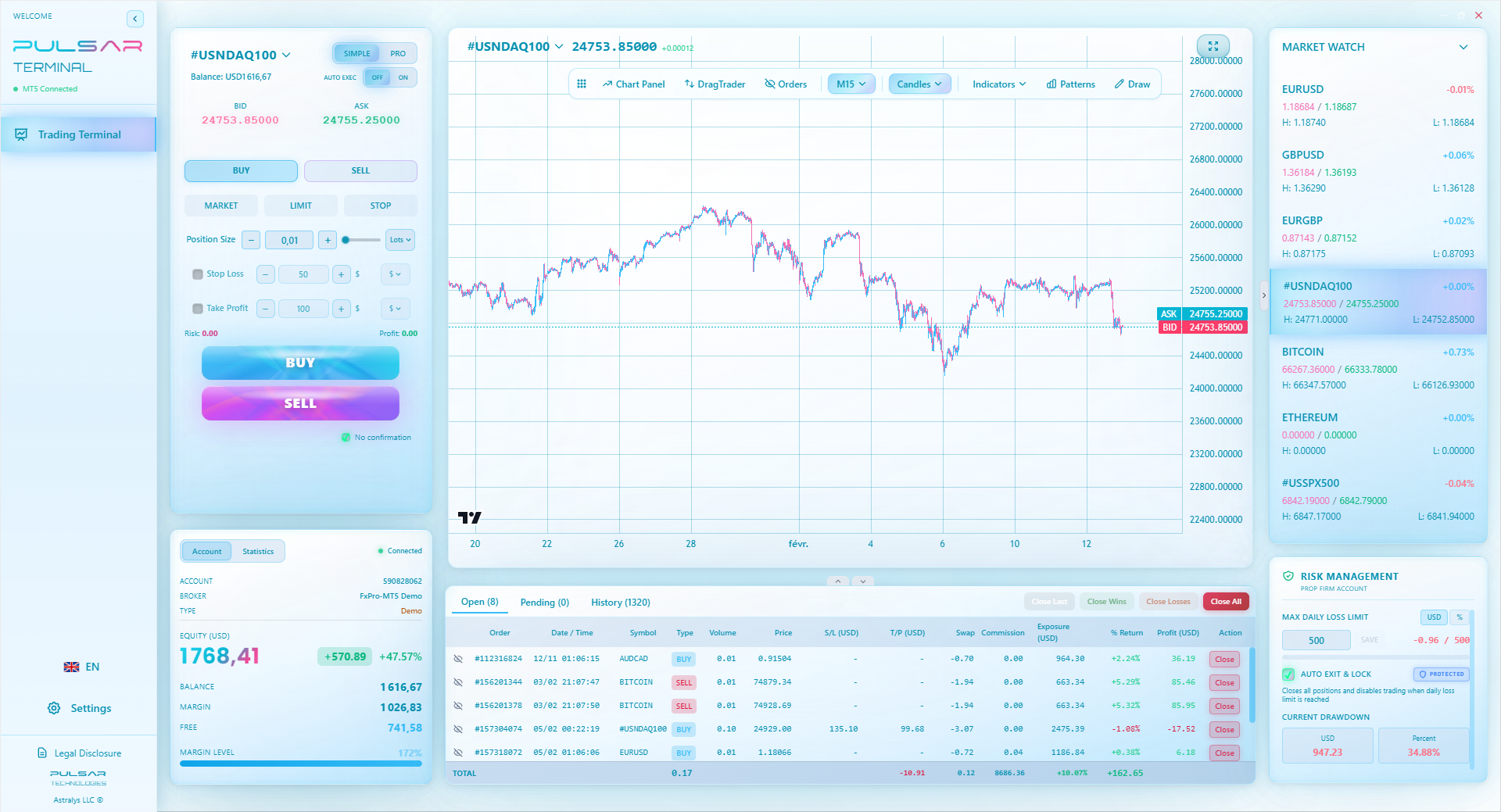
Managing the strict rules of a prop firm challenge requires flawless trade execution and risk management, which is where a tool like Pulsar Terminal's one-click order and stop-loss features on MT5 becomes a trader's best friend.
Pulsar Terminal
The all-in-one MT5 companion: drag-and-drop orders, multi-TP/SL, trailing stop, grid trading, Volume Profile, and prop firm protection. Used by 1,000+ traders daily.
The September 2025 enforcement action in Alberta wasn't a one-off. It was a warning shot. Regulators are tired of the gray area. The 2025-2026 horizon looks like this:
- Influencer Purge: Expect more fines and cease-and-desist orders against high-profile finfluencers who aren't registered and don't disclose. The 'wild west' era of promotion is ending.
- Prop Firm Scrutiny: The push for segregated accounts and treating evaluation fees as client funds will become law. Firms that can't or won't comply will exit the Canadian market. This is good for you - it weeds out the shady operators.
- use Reduction: The 1:1000+ use you see advertised is on borrowed time. Canada will likely align with other jurisdictions and cap use for retail-style offerings, perhaps at 1:50 or 1:30. This changes the game entirely. High-use, high-frequency scalping strategy approaches will become much harder to execute profitably.
What does this mean for you? The firms and influencers that survive will be the more legitimate ones. The barrier to entry will rise. This is healthy for the industry, but it will cause a lot of chaos during the transition. Your job is to not be collateral damage. Stick with firms and educators who emphasize risk management and realism over get-rich-quick fantasies. The ones who teach you about a pip and a position size calculator are worth more than the ones who just show you their latest payout screenshot.
“The challenge is a test of emotional control and risk management, not just technical analysis.”
Here's the uncomfortable truth I learned over a decade: consistently passing prop firm evaluations has very little to do with which influencer you follow and everything to do with your own discipline. The challenge is a test of emotional control and risk management, not just technical analysis.
I have a student in Toronto who failed three different challenges from three different 'top-rated' firms promoted by influencers. He was frustrated and ready to quit. We ignored all the hype, went back to basics, and he paper-traded a simple supply-demand strategy on the 4-hour chart for three months. He focused on risk per trade, journaling every decision. His fourth challenge attempt, on a firm he researched himself with no affiliate influence, he passed. He's now consistently pulling $800-$1,200 a month from a $25k account. No Lambo. No hype. Just steady progress.
That's the real path. Use influencer content for entertainment or to discover new firms, but never as your primary education or due diligence. Your trading plan, your risk rules, and your ability to stick to them are the only things that will get you funded and keep you funded. Everything else, especially in the current Canadian climate of prop firm influencer management, is just noise designed to part you from your money.
FAQ
Q1Is it illegal for influencers to promote prop firms in Canada?
It's not illegal to promote them, but how they do it often breaks securities law. If they're not registered with provincial authorities and/or fail to clearly disclose they're paid for referrals, they are likely operating illegally. The CSA/CIRO guidance from December 2025 made this explicitly clear.
Q2What's the single biggest red flag from a prop firm influencer?
The lack of a clear, upfront, and unambiguous disclosure like 'I am paid a commission if you use my link.' If you have to hunt for it, it's a problem. Also, any promise of guaranteed results or downplaying the high failure rate is a major warning sign.
Q3As a Canadian, how do I get paid from a prop firm?
Most pay in USD via bank wire/ACH or cryptocurrency. You'll need a USD account at your Canadian bank (like RBC, TD) to receive wire transfers smoothly and avoid extra conversion fees. Crypto payouts (USDT, Bitcoin) are common for faster, lower-cost transfers.
Q4Are prop firm challenge fees tax deductible in Canada?
This is a complex area requiring an accountant. Potentially, if you are running a serious, documented trading business, the fees could be considered a business expense. However, if you're just trying a challenge or two casually, almost certainly not. Never rely on influencer tax advice.
Q5Will new regulations make prop trading disappear in Canada?
No, but they will clean it up. Expect weaker firms with poor practices to fold, use to be reduced, and more protections around your fees and profits. The survivor firms will be more stable and legitimate, which is better for serious traders in the long run.
Q6Should I use an influencer's 'special discount link'?
Only if you've independently decided the firm is right for you after your own research. The discount is real, but it's bait. Never choose a firm solely because an influencer's link makes it 10% cheaper. The terms and rules are far more important than a small fee discount.
Prof. Winston's Lesson
Key Takeaways:
- ✓Influencer affiliate links are business, not mentorship.
- ✓Challenge fees have almost zero regulatory protection.
- ✓70-90% failure rate is the hidden industry standard.
- ✓Always read the firm's Terms, not the influencer's hype.
- ✓Real success is boring consistency, not viral payouts.
How useful was this article?
Click a star to rate
Weekly Trading Insights
Free weekly analysis & strategies. No spam.
About the Author
James Mitchell
Senior Trading Analyst
Based in New York with over 9 years of trading experience. Focuses on major USD pairs, prop firm challenges, and the US regulatory landscape.
Comments
Risk Disclaimer
Trading financial instruments carries significant risk and may not be suitable for all investors. Past performance does not guarantee future results. This content is for educational purposes only and should not be considered investment advice. Always conduct your own research before trading.
You Might Also Like

Cara Trading Forex Sukses: 7 Prinsip dari Trader Profesional
Cara trading forex sukses dengan 7 prinsip trader pro: manajemen modal, disiplin, journal trading, backtest. Data nyata, bukan janji profit palsu.
Jam Trading Forex Terbaik untuk Trader Indonesia: Panduan Lengkap dengan Tabel Waktu
Panduan jam trading forex untuk trader Indonesia. Tabel 4 sesi dunia, jam emas 20:00-00:00, sesi mana yang harus dihindari. Data akurat + tips dari trader berpengalaman.
Top 5 Sàn Forex Uy Tín Nhất 2026: Review Jujur dari Trader Indonesia
Top 5 sàn forex uy tín 2026 untuk trader Indonesia. Review jujur: spread, deposit, withdraw, dukungan lokal. Exness, XM, IC Markets & lebih.
Get Pulsar Terminal
All these calculators are built into Pulsar Terminal with real-time data from your MT5 account. One-click position sizing, automatic risk management, and instant calculations.
Get Pulsar Terminal