


I lost R4,200 in a single afternoon back in 2015 trying to 'trade' currencies through my FNB app.

David van der Merwe
Emerging Markets Trader ·  South Africa
☕ 11 min read
What you'll learn:
- 1FNB Forex Services: What You're Actually Buying
- 2Real Retail Forex in South Africa: Brokers & Rules
- 3The Cost Showdown: FNB vs. A Real Broker
- 4Getting Started: Deposits, ZAR, and Payment Methods
- 5Strategy & The Tax Man: Making It Work in SA
- 6Common Pitfalls & How to Avoid Them
- 7Final Verdict: When to Use What
I lost R4,200 in a single afternoon back in 2015 trying to 'trade' currencies through my FNB app. I thought I was being clever, buying USD/ZAR through the bank's platform because it felt safe. The spread was so wide I needed the pair to move 80 pips just to break even. It didn't. That lesson cost me, but it taught me the brutal difference between a bank's forex service and actual retail forex trading. Here's what every South African needs to know before they click 'buy' or 'sell'.
Let's cut through the marketing. When you use FNB's forex services, you're not trading in the retail forex sense. You're conducting a foreign exchange transaction with your bank. It's a service, not a trading platform. They've won awards (Best Foreign Exchange Provider eight years running) for moving money internationally, not for giving you a competitive edge on EUR/USD.
Their Global Accounts are useful tools. No opening fees, no monthly charges. Need to hold British Pounds for an upcoming trip? Perfect. Sending tuition fees to the UK? The 0.55% commission on transfers over R10k is fairly standard for banks. But here's the kicker for would-be traders: the exchange rate margin.
FNB, like all banks, adds a margin to the interbank rate. This isn't a spread you see quoted in pips; it's a percentage markup, usually between 1% and 4%. On a R100,000 transaction, that's R1,000 to R4,000 gone before the market even moves. In the broker world, we call that a terrible entry.

Warning: Using a bank's forex service for short-term speculation is like using a cargo ship for a speedboat race. It's built for a different purpose. The costs are structured for occasional, large transfers, not frequent, small trades.
I learned this the hard way. My R4,200 loss wasn't from a bad market call; it was from the built-in cost of doing business through that channel. For actual trading, you need a different vehicle.

💡 Winston's Tip
A bank's 'rate' includes their lunch money. A broker's spread is just the toll for using the highway. Know which road you're on.
This is where the game is played. Retail forex trading here is legal and regulated by the Financial Sector Conduct Authority (FSCA). The market is growing fast, projected to hit nearly USD 6.9 billion by 2033. But it's a different universe from your FNB app.
The FSCA Rulebook
The regulator isn't messing around. Since 2021, use for retail clients is capped at 30:1. That's your maximum. If a broker offers you more as a standard retail client, they're not FSCA-licensed, and you're not protected. Professional status exists, but the criteria are strict (significant portfolio size, experience). The 30:1 rule is actually a good thing. It prevents the kind of wipeouts I saw in the early days with 500:1 use.
All legitimate brokers must have an FSP license and keep your money in segregated accounts. This means if the broker goes bust, your funds are separate and should be returned. This is non-negotiable.
The Broker Landscape
You have two choices: local FSCA-regulated brokers or international brokers that accept South African clients. Going with an FSCA broker gives you local recourse. Going international might give you access to specific platforms or assets. Many top international brokers like IC Markets and Pepperstone are popular here because of their tight spreads and good reputations.

Example: Cost Comparison
| Transaction | FNB Service | FSCA Broker (e.g., IC Markets) |
|---|---|---|
| R100,000 USD Purchase | ~1-4% margin (~R1,000-R4,000) + possible commission | Spread from 0.0 pips + ~$7 commission per lot (R130-ish on R100k) |
| Purpose | International Payment, Holding Currency | Speculative Trading, Hedging |
| Holding Cost | Account fees may apply | Overnight swap fees (can be positive or negative) |
The difference in cost structure is staggering. One is built for transfers, the other for trading.
“Using a bank's forex service for short-term speculation is like using a cargo ship for a speedboat race.”
Let's get specific with numbers, because this is where your profit goes to die.
FNB's Fee Structure (For Transactions):
- Under R10,000: Fixed fee of R100-R200 to send, R75-R175 to receive.
- Over R10,000: 0.55% commission (min R275, max R550 to send; min R175, max R450 to receive).
- The Hidden Killer: The exchange rate margin of 1-4%. This is how they really make their money on these services. You don't see it as a line item, but it's there in the rate you're quoted.
A Typical FSCA Broker's Cost Structure (For Trading EUR/USD):
- Spread: From 0.0 pips on raw accounts. Even on standard accounts, 0.8-1.0 pips is common.
- Commission: On raw accounts, ~$7 per 100k lot (round turn). That's about R130.
- No Percentage Margin: The cost doesn't scale as a percentage of your trade size in the same way.
Here's a real trade example. In 2022, I wanted exposure to a weakening ZAR. Option A: Buy USD/ZAR via FNB. Option B: Buy USD/ZAR CFD via my broker.
I went with Option B. Entry at 17.8500 with a 1-lot position (USD 100,000). My cost? The spread was 50 pips (wide, but it's an exotic pair), so R500 on the entry. I held for two weeks as it climbed to 18.3000 - a 4,500 pip move. Profit: R45,000. Minus costs: R44,500.
Had I used FNB's service to buy $100,000 of USD, the 1.5% margin (conservative estimate) would have cost me R26,775 upfront. My paper profit on the exchange rate move would be similar, but my net profit would be almost R20,000 lower because of that initial haircut. For swing trading ideas, this cost difference is make-or-break.

Pro Tip: If you're moving money to fund a trading account, use your bank's service (it's what it's for). If you're speculating on price movements, use a trading account with a broker. Never confuse the two tools.
💡 Winston's Tip
The FSCA's 30:1 use cap isn't a cage, it's a seatbelt. The old 400:1 days were like driving a Ferrari on ice. Exciting, but you only crash once.
So you've opened an account with a broker. Now you need to get your Rands in there. This is where FNB and other local banks are actually useful.
Funding Your Broker Account:
- Local EFT: This is the most common method. You do a bank transfer from your FNB (or any SA bank) account to the broker's local South African trust account. It usually clears within a few hours to a day. No forex conversion happens here - you're sending Rands to a Rand account.
- Credit/Debit Card: Visa/Mastercard deposits are instant but sometimes have lower limits. Your bank might flag it as an international transaction, so call them first to avoid a block.
- Digital Wallets: Some brokers accept Skrill, Neteller, or PayPal. Fees apply.
The SARB Limit: Remember, the South African Reserve Bank has an annual discretionary allowance of R11 million for individuals, but a more relevant limit is the R1 million single discretionary allowance for offshore investment. For most retail traders starting out, this isn't a hurdle. But if you're moving serious capital, be aware of the rules. You're not breaking them by trading with an international broker, but you must declare the funds if asked.
Minimum Deposits: This is a huge advantage brokers have over the perception of high entry costs. XM lets you start with $5. HFM has a zero-minimum micro account. FP Markets is $50. You can test strategies with real money without risking your rent. I started my first proper account with R1,500 (about $100 at the time). Use a position size calculator religiously with small accounts - it's the only way to survive.
The key is to see your local bank and your broker as parts of a system. One is for managing your ZAR life. The other is for executing your trading strategy on global markets.
“My R4,200 loss wasn't from a bad market call; it was from the built-in cost of doing business through that channel.”
Trading through a broker gives you the tools to implement real strategies. You can scalp for a few pips, swing trade trends, or hedge your actual USD exposure from imports. You can't do any of that effectively through a bank app.
But with great power comes great responsibility... to SARS.
Taxation on Trading Profits: In South Africa, profits from forex trading are considered income from a business or speculative activity. They are not capital gains. This means your net profit (after deducting all allowable expenses) is added to your other income and taxed at your marginal rate.
What You Can Deduct:
- Broker commissions and spreads (these are your direct 'cost of sales').
- Data subscription fees (like Reuters or TradingView pro).
- Portion of home office expenses if you trade professionally.
- Internet and computer costs related to trading.
- Education costs (books, courses) are typically not deductible, but check with an accountant.
Keep Impeccable Records: This is non-negotiable. Every trade, every deposit, every withdrawal. Use your broker's statements. I learned this after a nasty audit in 2018 where I had to reconstruct six months of trades from screenshots. It took a week. Now I download monthly statements religiously.
Your bank statements from FNB showing deposits to and withdrawals from your broker are crucial evidence for your tax return. They prove the flow of funds. The FSCA's use cap of 30:1 also indirectly helps your risk management, which is the most important part of any strategy. You can't blow up an account in seconds at 30:1 like you could at 200:1.
Managing multiple trades and their tax implications is where journaling tools become critical.
💡 Winston's Tip
Your first R10,000 in the market should be spent on learning, not just trading. That includes the cost of losses. Consider it tuition, not gambling money.
I've made most of these. Let me save you the money.
Pitfall 1: Chasing Low Spreads on Exotics. You see USD/ZAR with a 50-pip spread and think it's a rip-off. So you search for a broker offering 10 pips. That broker is probably not FSCA-regulated, has dodgy execution, and will margin call you at the worst time. The spread is wide because the pair is illiquid. Pay the spread or don't trade it. I lost R2,000 on a 'cheap' USD/TRY spread before the broker mysteriously froze my account.
Pitfall 2: Ignoring the Swap (Overnight Financing). Holding a USD/ZAR position overnight? You'll either pay or earn a swap rate. This can be significant over time. I once held a short ZAR position for three months for a R15,000 profit, but the negative swap cost me R3,800 of it. Always check the swap rates in your platform before holding a trade for multiple days.
Pitfall 3: Using the Wrong Platform for the Goal. This is the core of the retail forex FNB confusion. Need to convert Rands to Dollars to pay for something? Use FNB. Need to speculate that the Dollar will strengthen against the Euro over the next week? Use a broker. Each tool has a purpose. Using your broker to pay for your Amazon subscription is as silly as using FNB to scalp the EUR/USD.
Pitfall 4: Not Understanding the Quote. On a broker platform, you see a bid/ask for USD/ZAR of 18.5000/18.5050. That's a 5-pip spread. On your FNB app, you see a rate to 'Buy USD' of 18.7500. That's not a spread; that's the interbank rate plus their margin. You can't compare the two numbers directly. The broker's quote is for trading. The bank's quote is for currency conversion.
Pro Tip: Before you place any trade, know your exit. Set your stop-loss and take-profit orders immediately. Emotional exits are where the biggest losses live. A tool that lets you set a trailing stop or multiple take-profit levels can automate your discipline.
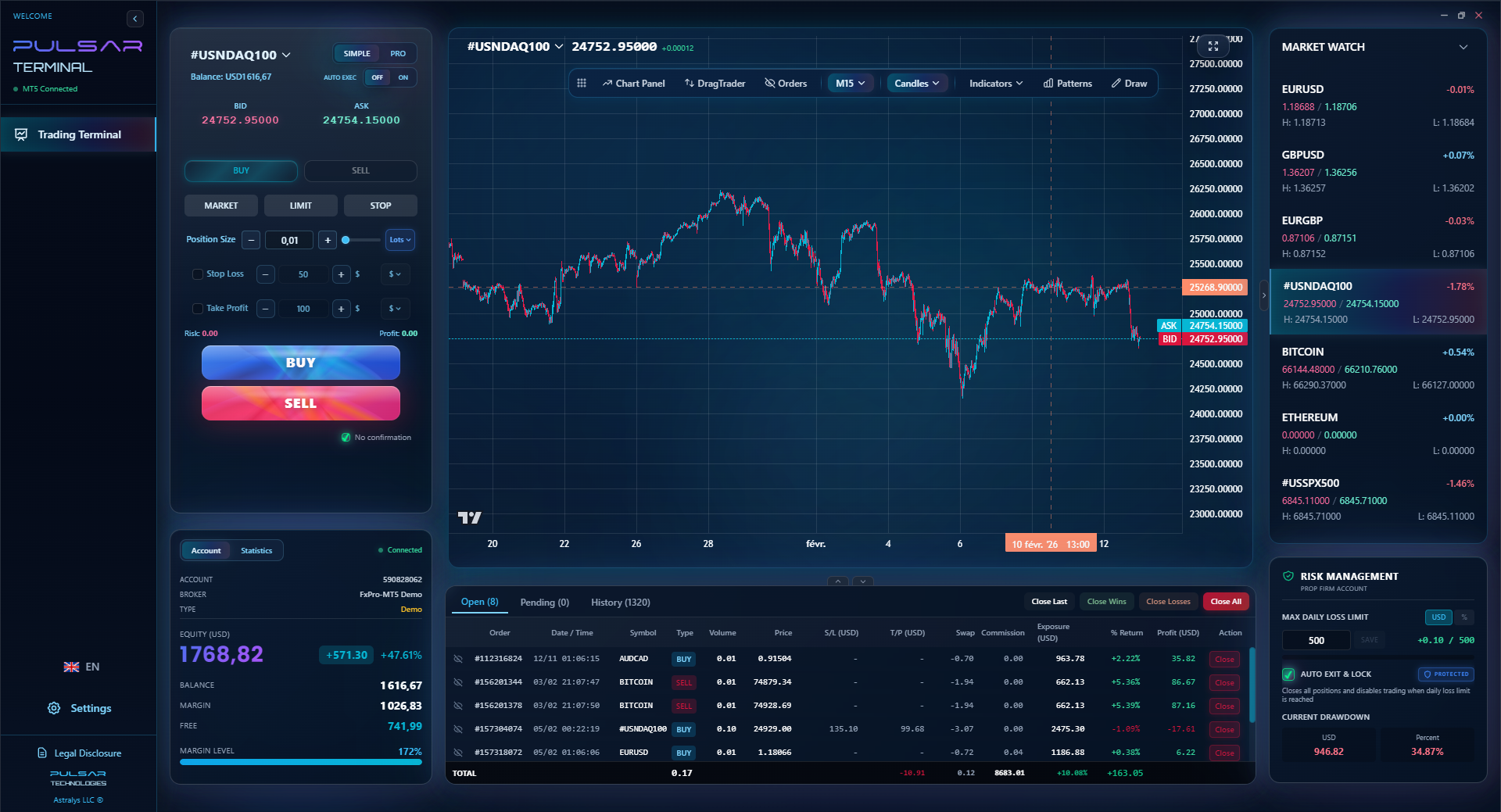
Managing complex trades and their tax paperwork is a headache; Pulsar Terminal automates your trade journal and advanced orders directly in MT5, so you can focus on the strategy, not the admin.
Pulsar Terminal
The all-in-one MT5 companion: drag-and-drop orders, multi-TP/SL, trailing stop, grid trading, Volume Profile, and prop firm protection. Used by 1,000+ traders daily.
“The FSCA's use cap of 30:1 also indirectly helps your risk management, which is the most important part of any strategy.”
After 12 years and plenty of mistakes, here's my simple breakdown.
Use Your FNB (or any bank) Forex Service When:
- You need to send money overseas for tuition, family, or business.
- You're traveling and want to load a foreign currency card.
- You have a genuine need to hold a foreign currency for a future expense.
- You're converting trading profits from your broker back to ZAR to spend in SA.
Use a Regulated Retail Forex Broker When:
- You are speculating on the price movements of currency pairs (including USD/ZAR).
- You want to use use (up to 30:1).
- You need advanced order types, charts, and technical indicators like the RSI or MACD.
- You are implementing a specific trading strategy with defined risk per trade.
- You want to trade other instruments like gold (XAU/USD), indices, or commodities from the same account.
The South African market is strong and well-regulated. You have excellent local and international broker options like Exness, IC Markets, and XM. You have the protection of the FSCA. You have a strong currency in the Rand that offers interesting trading opportunities.
Don't let the convenience of your banking app trick you into thinking it's a trading platform. They are fundamentally different services for fundamentally different goals. Understand the costs, tools, and purposes of each, and you'll keep more of your hard-earned Rands in your pocket - where they belong.
FAQ
Q1Is it illegal to use international forex brokers as a South African?
No, it's perfectly legal. South Africans can use both FSCA-regulated local brokers and international brokers that accept SA clients. The key is to ensure the international broker is reputable and regulated by a recognized authority like ASIC (Australia) or CySEC (Cyprus). Using an FSCA broker simply gives you easier local recourse if something goes wrong.
Q2What is the single biggest cost difference between FNB and a broker?
The exchange rate margin. FNB adds 1-4% to the interbank rate for conversions. On a R100,000 transaction, that's R1,000-R4,000 lost immediately. A broker charges a spread (e.g., 1 pip on EUR/USD = ~R1.50 per R100k) and sometimes a small commission. For trading, the broker's cost structure is orders of magnitude cheaper.
Q3Can I trade USD/ZAR with a broker?
Absolutely. Most major brokers offer USD/ZAR as a CFD (Contract for Difference). Be aware the spreads are much wider than on majors like EUR/USD (often 30-80 pips), reflecting lower liquidity. It's a popular pair for South African traders wanting to speculate on or hedge against ZAR movement.
Q4How do I fund my international broker account from my FNB account?
You typically do a local ZAR EFT to the broker's South African trust account (held with a local bank like Standard Bank or Absa). The broker then converts it at the interbank rate and credits your trading account in USD, EUR, etc. It's a straightforward process, and brokers provide detailed instructions.
Q5Does the FSCA's 30:1 use limit apply to international brokers?
It applies to brokers regulated by the FSCA. If you open an account with an international broker under their overseas license (e.g., ASIC), their local use rules apply, which may be different. However, many international brokers apply the 30:1 limit to South African residents as a policy, regardless of the license you're under.
Q6Are profits from trading with an international broker taxable in South Africa?
Yes. South Africa taxes worldwide income. Your net trading profit, whether made through a local or international broker, is considered taxable income and must be declared to SARS. Keep all your trading statements and records of fund transfers as proof.
Q7Is FNB's trading platform on their app good for beginners?
It's not a trading platform in the retail forex sense. It's a currency conversion and transfer service. For learning to trade with charts, indicators, and proper order management, you need a dedicated platform like MetaTrader 4/5 or cTrader, provided by a broker. Starting on a bank app will teach you bad habits due to the high costs and lack of tools.
Prof. Winston's Lesson
Key Takeaways:
- ✓FNB's 1-4% margin kills short-term trades.
- ✓FSCA caps use at 30:1 for safety.
- ✓Broker spreads cost fractions of bank margins.
- ✓Use EFT to fund brokers, not card forex.
- ✓Trading profits are income, not capital gains.
How useful was this article?
Click a star to rate
Weekly Trading Insights
Free weekly analysis & strategies. No spam.
About the Author
David van der Merwe
Emerging Markets Trader
Johannesburg-based trader with 11 years in emerging market currencies. Specializes in ZAR pairs, FSCA-regulated trading, and South African market analysis.
Comments
Risk Disclaimer
Trading financial instruments carries significant risk and may not be suitable for all investors. Past performance does not guarantee future results. This content is for educational purposes only and should not be considered investment advice. Always conduct your own research before trading.
You Might Also Like

Cara Trading Forex Sukses: 7 Prinsip dari Trader Profesional
Cara trading forex sukses dengan 7 prinsip trader pro: manajemen modal, disiplin, journal trading, backtest. Data nyata, bukan janji profit palsu.
Jam Trading Forex Terbaik untuk Trader Indonesia: Panduan Lengkap dengan Tabel Waktu
Panduan jam trading forex untuk trader Indonesia. Tabel 4 sesi dunia, jam emas 20:00-00:00, sesi mana yang harus dihindari. Data akurat + tips dari trader berpengalaman.
Top 5 Sàn Forex Uy Tín Nhất 2026: Review Jujur dari Trader Indonesia
Top 5 sàn forex uy tín 2026 untuk trader Indonesia. Review jujur: spread, deposit, withdraw, dukungan lokal. Exness, XM, IC Markets & lebih.
Get Pulsar Terminal
All these calculators are built into Pulsar Terminal with real-time data from your MT5 account. One-click position sizing, automatic risk management, and instant calculations.
Get Pulsar Terminal